Pharma Strategy Blog

Commentary on Pharma & Biotech Oncology / Hematology New Product Development

Posts from the ‘Ovarian Cancer’ category

Today’s Science Friday post looks at the identification of a potential new biomarker and possible strategies for expanding use of PARP inhibitors in patients most likely to respond to them as a way to validate the the approach prospectively.  This has important implications for future clinical trial designs with this class of drugs.

Photo Credit: Ben Sutherland via flickr

Photo Credit: Ben Sutherland via flickr

Regular readers will be very familiar at my rants against broad catch-all studies and phase III trials with targeted agents that do not have a biomarker or even a logical well defined subset of patients because it’s akin to blindfolding an archer, turning him around 360 degrees and then asking him to hit a bullseye 50 or 100 yards hence.

How can you hit a target you can’t see?

PARP inhibitors have had a bit of a chequered history after the initial excitement was later followed by a series of rather disappointing clinical trial results, which occurred for a multitude of reasons.  Several of the approaches sadly fell into the category of ‘Five things not to do in R&D’ as delineated in my recent tongue-firmly-in-cheek post on the topic.  I’ll leave interested and curious readers to ponder at length exactly which of the no-nos they managed to break!

That said, we do know a few things of relevance:

  1. PARP1/2 inhibitors have produced sustained anti-tumor responses in patients with germ-line BRCA gene mutations
  2. Biomarkers other than BRCA1 and BRCA2 are clearly needed to predict responses to PARP inhibitors
  3. Catch-all trials without segmenting for BRCA mutations and biomarkers are highly unlikely to be successful (recall the spectacular phase III failure in triple negative breast cancer with iniparib, for example)
  4. Next generation PARP inhibitors have focused on more clearly defined subset populations with greater success (and potency).

Chris Lord and Alan Ashworth’s lab have recently published some nice work (open access, see Refs below) that is worthy of discussion. Bajrami et al., (2013) decided to dive a little deeper and look at what genes and mutations might affect the responses to PARP inhibition:

“In hypothesizing that additional genetic determinants might direct use of these drugs, we conducted a genome-wide synthetic lethal screen for candidate olaparib sensitivity genes.  In support of this hypothesis, the set of identified genes included known determinants of olaparib sensitivity, such as BRCA1, RAD51 and Fanconi’s anemia susceptibility genes.”

The main reason behind this approach quickly becomes apparent – there is a huge need for it:

“One of the major issues in the clinical development of PARP1/2 inhibitors is the identification of biomarkers other than BRCA1 and BRCA2 gene mutations that predict a favourable response to therapy.”

While patients with germline BRCA mutations have a greater tendency to respond, they don’t account for all the responses that have been seen in the clinic.  What else is involved?

What did they find?

“Integration of the list of candidate sensitivity genes with data from tumor DNA sequencing studies identified CDK12 deficiency as a clinically relevant biomarker of PARP1/2 inhibitor sensitivity.”

In other words, when CDK12 was low, PARP sensitivity was high, making it a potential predictive biomarker for response to therapy with a PARP inhibitor.

What does this mean?

“The appearance of CDK12 in our olaparib sensitization gene list, alongside the CDK12 mutational data, suggested the possibility that loss of CDK12 function could sensitize tumor cells to PARP1/2 inhibitors and that loss of CDK12 function in HGSOVCa could be a predictive biomarker for response to this developmental class of agents.”

In other words, it would be useful to evaluate loss of CDK12 as a biomarker of response for PARP inhibitors in prospective clinical trials in breast and ovarian cancers, with and without germ-line BRCA mutations.

CDK12 is only one of nine genes known to be mutated in high grade serous ovarian cancer (HGS-OVCa), for example, so should patients be identified upfront who have loss of CDK12, then it may be enough to ensure response to a PARP inhibitor, irrespective of BRCA status.  Clearly this work is still very early, but it creates a smart and well argued rationale that can be tested in clinical trials.

Should the approach be validated, then it could well expand the utility of PARP inhibitors in the clinic based on a predictive biomarker.  I would be interested to see what happens not only with olaparib, but also the new generation of PARP inhibitors from Abbott (veliparib), Biomarin (BMN 673) and Clovis (rucaparib), to name a few who are conducting trials in breast or ovarian cancers.

If this works, it will be a thing of beauty.

References:

ResearchBlogging.orgBajrami I, Frankum JR, Konde A, Miller RE, Rehman FL, Brough R, Campbell J, Sims D, Rafiq R, Hooper S, Chen L, Kozarewa I, Assiotis I, Fenwick K, Natrajan R, Lord CJ, & Ashworth A (2014). Genome-wide Profiling of Genetic Synthetic Lethality Identifies CDK12 as a Novel Determinant of PARP1/2 Inhibitor Sensitivity. Cancer research, 74 (1), 287–97 PMID: 24240700

Photo Credit: Ben Sutherland
This is the second post of a two-part mini series on RNases with Dr Laura Strong of Quintessence Biosciences.  If you haven’t yet read it, check out yesterday’s post, which focused on Ribonucleases (RNase) – what are they and why are they relevant to cancer?

Yesterday, we learned that RNases kill cancer cells by a novel mechanism – destruction of RNA – and may be synergistic with some chemotherapy agents.

In the second part of the mini-series, Laura is going to discuss Quintessence’s progress with moving QBI–139, their lead RNase compound, from precinical research to the clinic. This post focuses on how a small biotech company decided upon the relevant clinical targets they wanted to focus on and reported the initial findings at the American Association for Cancer Research (AACR) meeting last month.


What is the clinical plan for a broadly active agent without a marker?

We took QBI–139 into a first-in-human Phase I trial with the primary objective of understanding the safety profile of the drug in patients with solid tumors. While dose escalating continues, the trial should be complete this year.

In the meantime, we have been refining our strategy for the next stage of clinical development.  One of our challenges is the selection of tumor type because the drug showed broad efficacy in the xenograft models. After considering a variety of factors (including markets, competition, regulatory impacts and clinical trial designs), we narrowed our disease focus to non-small cell lung (NSCLC) and ovarian cancers. Despite having single agent activity, we anticipate advancing QBI–139 as part of a combination regimen with a standard of care drug. We have been gathering in vitro and in vivo data to support these approaches and we shared some of our in vitro results at the AACR 2012 annual meeting.

To select the drugs we would combine with QBI–139, the first, second and third line therapies in non-small cell lung and ovarian cancers were evaluated. The diseases are an interesting dichotomy because ovarian cancer is still largely treated as a single disease while non-small cell lung cancer (NSCLC) is transitioning to a collection of diseases divided largely by genetic mutations with some differences based on histology.

First line therapies in ovarian cancer are based on combinations of platinum drugs and taxanes. In contrast, second and third line therapies for ovarian cancer involve a variety of drugs (e.g. topotecan, gemcitabine, vinorelbine), which resulted in selection of cisplatin and docetaxel to explore in combination with QBI–139.

NSCLC patients with changes in EGFR, KRAS and ALK will be treated with targeted agents as first line therapy. The remainder, which is actually the majority, of NSCLC patients, will receive a first line therapy that often includes cisplatin as part of a combination regimen. {Editor’s Note: common NSCLC therapies typically include a platinum (eg cisplatin or carboplatin) and a taxane (eg paclitaxel or docetaxel), or other chemotherapy doublets (eg gemcitabine or pemetrexed with a platinum.)}

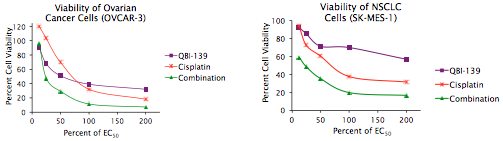
A cell viability assay was run to determine the concentration of each single agent that caused a half maximal effect (EC50). The combination studies were then run starting with each drug at the concentration of maximal effect.

Two graphs are provided as examples of the results. The ovarian cancer cell line OVCAR–3 (left) and the NSCLC cell line SK-MES–1 (right) were treated with QBI–139, cisplatin or a combination of the two drugs. The QBI–139 + cisplatin had an additive effect on the OVCAR–3 (ovarian cancer) cells and a synergistic effect on the SK-MES–1 (NSCLC) cells.

QBI-139 Quintessence Cell Viability

QBI-139 Cell Viability courtesy of Laura Strong, Quintessence

The combination index (CI) is then determined using the median effect analysis (This approach is sometimes referred to as the Chou Talalay combination index.). The CI values represent: additive effect (CI = 1), synergy (CI < 1) and antagonism (CI > 1).

What combinations have been evaluated so far?

The QBI–139 combinations showed synergy or additive effects against the ovarian cancer lines tested:

QBI–139 + Cisplatin:

  • SKOV–3 cells: CI=0.33
  • OVCAR–3 cells: CI=1

QBI–139 + Docetaxel:

  • SKOV–3 cells: CI=0.037
  • IGROV–1 cells: CI=0.05

The QBI–139 + cisplatin combination was synergistic against the non-small cell lung cancer lines tested:

  • A549 cells: CI=0.714
  • SK-MES–1 cells: CI=0.4

So what comes next for RNase therapies?

The discovery that naturally occurring RNases could be exploited for potent anti-cancer drugs has provided an alternative approach to RNA as a therapeutic target.  Our efforts have advanced a drug with broad activity in xenograft models into the clinic.  As we complete the Phase I trial, we are working to best position the drug for the next step on the path to delivering a new tool to help cancer patients.


1 Comment

During my years in Pharmaland, I often sat in waiting rooms waiting to see the Principal Investigator (PI) for one of the studies we were doing.  I would generally see them at the end of the clinic, preferring to arrive early and chat with some of the patients to learn of their experiences, the trials and tribulations of cancer therapy.  This keeps your feet on the ground – drug development is not an academic exercise, there are real people involved after all.

Some of those patients were really sick, with quite advanced disease, maybe with a year or less to live by conventional estimates and yet they were entering a clinical trial, or seeking to get into one with great hope.  Over time, one would meet some of those patients repeatedly, to be greeted with good cheer and the latest round in their stories. These shared moments are precious, you learn little snippets of their journey back to health and what it’s really like to go through various regimens. I cannot tell you how thrilling it was to meet some of the sickest patients several years later and learn that the greatest thing you ever hear in an oncologists surgery – that they were in remission.

To this day that still gives me goosebumps.

One of the things that often came up in those brief chats though, was the lab results, with various counts being up or down.  Some of these matter, some don’t.  The one that always puzzled me was raised platelets because on asking the doctors, few ever really seemed concerned about the levels, unless they were too low (thrombocytopenia) to undergo their next round of treatment.  The scientist in me, however, always wondered about raised platelets – what do they do and do they have an impact on outcome?

This week, a paper has been published in the New England Journal of Medicine by Anil Sood’s group at MD Anderson Cancer Center that begins to address this very issue of raised platelets or thrombocytosis in cancer therapy.

The crux of the research was nicely summed in the MD Anderson press release:

“Highly elevated platelet levels fuel tumor growth and reduce the survival of ovarian cancer patients.”

Now that may sound a little dramatic but I was curious to know why does this happen, so this morning I talked to Dr Sood to find out more about his groups research:

PSB: This exciting research was about the impact of elevated platelets, can you tell us why this happens and what the consequences are?

Dr Sood: We looked at the clinical implications and found that patients who have higher platelet counts tend to live for a shorter time period and beyond that we asked how is it that these platelet counts are going up?  We did a number of studies, including human material as well as laboratory experiments, and figured out that tumors can produce certain growth factors such interleukin-6 (IL-6) that stimulate the liver to produce this factor called thrombopoietin, which stimulates platelets counts.  That’s the paracrine or complex circuit that promotes high levels of platelets in cancer patients.

PSB: What was the basic underlying mechanism behind this?

Dr Sood: The mechanism here was that the tumor derived IL-6 stimulates thrombopoietin production.  Thrombopoietin will stimulate megakaryopoeisis through the bone marrow, which will then stimulate platelet production.  We did some experiments to also figure out that if you could block this from occurring, could you reduce or could you block platelet levels from going up.  We did a number of experiments using both siRNA as well as an antibody that blocks interleukin-6.  If you block either of those you can abrogate the platelet counts from going up.

We also worked with collaborators in UK where they had used this same antibody that we used for animal experiments, in a clinical trial and they found that platelets come down when patients are treated with an IL-6 blocking antibody.  That gave us further evidence that this mechanism seems to be operative where it is important for platelets.

PSB: Are there IL-6 antibody therapies available for community oncologists to treat their patients.

Dr Sood: Not yet.  It is something, especially in the context of ovarian cancer, that is undergoing clinical development, so they need to be carefully developed.

The other question is an antibody such as that adequate in itself, or does it need to be combined with a cytotoxic or with a chemotherapy drug?  In some of our preclinical experiments that we included here, there was the suggestion that combining it with chemotherapy was even more effective than just using the antibody alone.

PSB: When oncologists see patients with high platelet levels do they currently treat them in any way?

Dr Sood: Not really any differently.  It is something that we have simply known for a long time.  In this context, given especially that these patients tend to have aggressive behavior (of the tumour), there is a lot of potential clinical implications, but again this is relatively new, so I think we need to do additional work to really figure out what are the best approaches to treat these patients.

Is it better to combine an IL-6 antibody, specially in those patients who have high platelets, along with chemotherapy?  Can drugs like even aspirin or things like that that interfere with platelet function, could those have implications?  There are data that would suggest that patients who are on a daily aspirin tend to live longer in the context of cancer patients. These type of things need to be developed further.

PSB: Could the high platelets cause inflammation?

If you can’t see the soundbite audio clip, click here.

PSB: Where is your research going next?

Dr Sood: In many directions!  This has opened a lot of questions for us. We found that platelets are not restricted to the blood system, but that they can in the tumor microenvironment also traffic.  We want to understand how is that survival can be effected?  I don’t think that the survival is effected just because these patients are getting more blood clots, or something like that.  I think that the platelets can provide growth factors for cancers, which we are trying to understand.

Obviously, you don’t want to reduce or completely eliminate platelets because they are an essential part of our body, but if we can block this kind of abnormal thrombocytosis from occurring then that might have implications for therapy as well.  The other thing we are asking is that since platelets are elevated in a fraction of cancer patients, can these be also useful as a biomarker, so we are trying to do studies to look at that aspect. There are many directions this research opens up.

Summary:

Although thrombocytosis has obviously been known for a long time, it’s really only now that we are starting to have a clearer idea of the potential negative impact of raised platelet levels in cancer patients.  The survival curves between normal platelets and thrombocytosis in ovarian cancer were dramatically significantly different in the paper (P<0.001).

Obviously these results would need to be confirmed in randomised trials before making a more definitive conclusion from a patient perspective.  That said, the results from Stone et al., (2012) do suggest that while raised platelets can influence survival in ovarian cancer, there may be some therapeutic options down the road to address this, possibly with an  IL-6 antibody added to chemotherapy.

The anti-IL-6 antibody used in this elegant research (and the early study at Barts) was siltuximab (J&J), although a quick search of the clinical trial database revealed no US studies in ovarian cancer.  In the paper data from UK patients were included (see also Coward et al., (2011) in the referencs below, as the MD Anderson press release noted:

“In a clinical trial conducted at the Barts Cancer Institute, Queen Mary, University of London, the team also found that treatment of 18 ovarian cancer patients in a phase I/II clinical trial with siltuximab, an antibody to IL-6, sharply reduced platelet counts over a three-week period.”

It will be interesting to see if approach is subsequently tried in a larger scale trial with ovarian patients who have thrombocytosis to confirm the positive impact.  Certainly, the clinical rationale is there.  For those of you interested in the role of IL-6 in ovarian cancer further, a recent paper by Coward et al., (2011) from the group who did the phase I/II trial of siltuximab in ovarian cancer is well worth a read (see references below).

References:

ResearchBlogging.orgStone, R., Nick, A., McNeish, I., Balkwill, F., Han, H., Bottsford-Miller, J., Rupaimoole, R., Armaiz-Pena, G., Pecot, C., Coward, J., Deavers, M., Vasquez, H., Urbauer, D., Landen, C., Hu, W., Gershenson, H., Matsuo, K., Shahzad, M., King, E., Tekedereli, I., Ozpolat, B., Ahn, E., Bond, V., Wang, R., Drew, A., Gushiken, F., Collins, K., DeGeest, K., Lutgendorf, S., Chiu, W., Lopez-Berestein, G., Afshar-Kharghan, V., & Sood, A. (2012). Paraneoplastic Thrombocytosis in Ovarian Cancer New England Journal of Medicine, 366 (7), 610-618 DOI: 10.1056/NEJMoa1110352

Coward, J., Kulbe, H., Chakravarty, P., Leader, D., Vassileva, V., Leinster, D., Thompson, R., Schioppa, T., Nemeth, J., Vermeulen, J., Singh, N., Avril, N., Cummings, J., Rexhepaj, E., Jirstrom, K., Gallagher, W., Brennan, D., McNeish, I., & Balkwill, F. (2011). Interleukin-6 as a Therapeutic Target in Human Ovarian Cancer Clinical Cancer Research, 17 (18), 6083-6096 DOI: 10.1158/1078-0432.CCR-11-0945

“Women with high-grade ovarian cancer live longer and respond better to platinum-based chemotherapy when their tumors have BRCA2 genetic mutations.”

MD Anderson Cancer Center press release

That statement got my attention last night while browsing the cancer news on Twitter! Many thanks to the Provost, Ray DuBois, for sharing it.

Recently, much of the focus has been on finding biomarkers associated with prognosis or response to tyrosine kinase inhibitors and other targeted agents, including PARP in breast and ovarian cancers. It is therefore fascinating that a marker of better prognosis should emerge with chemotherapy.

Given the recent controversy over the whole BRCA1/2 issue and whether there is any clinical significance, with Yang et al., (2011) noting that:

“It has been hypothesized that BRCA-deficient patients will likely have higher survival rates because of an improved response to platinum-based chemotherapy.”

Tan et al., (2008) did indeed observe that epithelial ovarian patients had better response rates than controls if BRCA-ness was present:

“BRCA-positive patients had higher overall (95.5% v 59.1%) and complete response rates (81.8% v 43.2%) to first line treatment, higher responses to second and third line platinum-based chemotherapy (second line, 91.7% v 40.9%; third line, 100% v 14.3%).”

These values were all highly significant.  The researchers therefore set out to see whether this would result in improved outcomes and:

“Determine the relationships between BRCA1/2 deficiency (ie, mutation and promoter hypermethylation) and overall survival (OS), progression-free survival (PFS), chemotherapy response, and whole-exome mutation rate in ovarian cancer.”

Taking a look at the Kaplan-Meier overall survival curves in Yang et al’s (2011) JAMA article (link below), the women who had either the BRCA1 or BRCA2 mutation clearly did better than those who were BRCA wild-type (WT) ie no mutation was present. This is a very important finding and it certainly does help to explain why mixing a heterogeneous population in a clinical trial is never a good idea. Imagine if the BRCA mutation status of the women is unknown – you could end up with unbalanced groups that can affect your outcomes based on the therapies randomised. By this, I mean a control group with chemotherapy alone could theoretically do better than one with a targeted therapy included if the groups were unbalanced for BRCA status.

Now, the current data are limited to high-grade serous ovarian cancer cases, but it would obviously be most interesting to see if a similar (or different) pattern might emerge in BRCA2 breast cancer. Obviously I’m thinking of the recent failed iniparib phase III trial here, as I never understood why BRCA status wasn’t tested and taken into account when balancing the baseline characteristics. We don’t know whether the results reported in ovarian cancer would also be seen in breast cancer, but it would be a critical question to address.

Significance of the results

Ultimately, these kind of findings can help us define and refine specific subsets of women with ovarian cancer who might respond better to certain types of therapies than others. This kind of information is crucial in helping to improve clinical trial design.

What I would really love to see is more logical combinations of targeted therapies or chemotherapy given to patients who have the best chance of responding rather than randomly expose people willy nilly to systemic agents where there is no idea or clue about how they might work. Patients deserve much better than this!

Tak Mak (U Toronto) summed this up beautifully at the recent ECCO meeting, with a most apt quote we could all do well to learn from:

“Doctors pour drugs of which they know little,
to cure diseases of which they know less,
into patients of which they know nothing.”

Moliere, 1622-1673

It is research such as Yang et al., (2011) that may actually help avoid this sorry state and begin to improve the outcomes associated with cancer therapy in the 21st century.

References:

ResearchBlogging.orgYang, D., Khan, S., Sun, Y., Hess, K., Shmulevich, I., Sood, A., & Zhang, W. (2011). Association of BRCA1 and BRCA2 Mutations With Survival, Chemotherapy Sensitivity, and Gene Mutator Phenotype in Patients With Ovarian Cancer JAMA: The Journal of the American Medical Association, 306 (14), 1557-1565 DOI: 10.1001/jama.2011.1456

Tan DS, Rothermundt C, Thomas K, Bancroft E, Eeles R, Shanley S, Ardern-Jones A, Norman A, Kaye SB, & Gore ME (2008). “BRCAness” syndrome in ovarian cancer: a case-control study describing the clinical features and outcome of patients with epithelial ovarian cancer associated with BRCA1 and BRCA2 mutations. Journal of clinical oncology : official journal of the American Society of Clinical Oncology, 26 (34), 5530-6 PMID: 18955455

4 Comments

After a wild day yesterday once we realised Continental had mysteriously and unaccountably changed our flights to Stockholm from Weds to Weds to Thurs to Tues, it seems that Cinderella will be going to the ball after all.

European Multidisciplinary Cancer Conference (EMCC) here we come, whew!

There are a couple of sessions I’m particularly looking forward to this year:

    1. Presidential Symposium on Sat 25th with talks from some of the leading lights in translational research:
      • Tak Mak (U Toronto) on metabolism and cancer
      • Jose Baselga (MGH) on the challenges of personalised medicine
      • Gordon Mills (MDACC) on the future of personalised medicine


    1. Various abstract highlights include:
      • Update on phase II ERIVANCE data for the Hedgehog inhibitor, vismodegib, in basal cell carcinoma (see phase I data from AACR)
      • Biomarkers, including VEGF-A in the bevacizumab trials and an update on KRAS
      • Phase II T-DM1 (trastuzumab emtansine) data in breast cancer
      • Reversing drug resistance in breast cancer (Mon 27th)
      • Updated data from the phase I and III (BRIM3) studies of vemurafenib (Zelboraf) in BRAF V600E-mutation positive metastatic melanoma (will be interesting to see how this compares to the ASCO data
      • Update on therapies in prostate cancer, including new phase III Alpharadin data (see Biotech Strategy Blog)


  1. Scientific symposia on PARP inhibitors and PI3K inhibitors (both on Tues 28th). I’m gutted these two important sessions clash, as they are both key events I’d love to attend 🙁

All in all, it promises to be a fun and interesting meeting. For those interested, here’s the link to the full details of the EMCC programme.

Social media comes to ECCO


The official Twitter hashtag of the meeting is #emcc2011, a bit long I know, and I would much rather have the shorter, more descriptive and well known #ECCO or #ESMO, but it is a three organisation event afterall, with ECCO, ESMO and ESTRO all involved. You can also follow the EMCC conference organisers on Twitter (@EuropeanCancer).

This inevitably creates branding issues given it seems everyone in the industry has been seemingly asking me over the last two weeks if I’m going to ECCO or ESMO in equal measures! None outside of Twitter have mentioned EMCC at all. Ah well.

9 Comments

The other day an interesting paper came to my attention entitled:

“Intraoperative tumor-specific fluorescence imaging in ovarian cancer by folate receptor-α targeting: first in-human results”

Thanks to my translational research friend Angela Alexander for highlighting it!

The idea behind this concept is that fluorescence technology can be used to help guide ovarian cancer surgery more effectively, since the tumours tend to be small and hard to see for surgeons performing the excision:

“Tumor-specific intraoperative fluorescence imaging may improve staging and debulking efforts in cytoreductive surgery and thereby improve prognosis.”

Folate receptor-α as a tool for imaging originally came from an understanding of the biology of the disease:

“The overexpression of folate receptor-α (FR-α) in 90–95% of epithelial ovarian cancers prompted the investigation of intraoperative tumor-specific fluorescence imaging in ovarian cancer surgery using an FR-α–targeted fluorescent agent.”

This marker (FR-α) be easily detected either on tumour cells in ascites fluid or on tumor tissue obtained during staging laparoscopy or primary surgery.

What did the results show?

“In this limited series, we showed that the use of intraoperative tumor-specific fluorescence imaging of the systemically administered FR-α–targeted agent folate-FITC offers specific and sensitive real-time identification of tumor tissue during surgery in patients with ovarian cancer and the presence of FR-α–positive tumors.”

It was also encouraging to see further validity is also provided by negative results:

“One patient presented with a malignant tumor that did not express FR-α, and consequently, no fluorescence was detected.”

What do these results mean?

I think van Dam et al., (2011) encapsulated the significance of the imaging test nicely:

“The use of targeted fluorescent agents could provide a paradigm shift in surgical imaging as it allows an engineered approach to improving tumor staging and the technique of cytoreductive surgery and thereby improving the outcome in ovarian cancer.”

There are potential applications too associated with clinical research too, since Morphotek/Eisai are investigating farletuzumab, a humanized IgG1 antibody that targets folate receptor alpha in ovarian and other cancers. Using this imaging technique could be used to determine the drugs effectiveness in reducing the tumour in patients in a non-invasive fashion.

Of course, the initial trials are being undertaken in the metastatic setting, but if successful, I could see a role for the agent developing in neoadjuvant disease to shrink the tumour margins prior to surgery. Having an appropriate marker test, coupled with a valid imaging technique could well lead to improvements in survival down the line.

Overall, folate receptor-α could well be an interesting new development to watch out for over the next couple of years as data from the imagining and drug trials mature.

References:

ResearchBlogging.orgvan Dam, G., Themelis, G., Crane, L., Harlaar, N., Pleijhuis, R., Kelder, W., Sarantopoulos, A., de Jong, J., Arts, H., van der Zee, A., Bart, J., Low, P., & Ntziachristos, V. (2011). Intraoperative tumor-specific fluorescence imaging in ovarian cancer by folate receptor-α targeting: first in-human results Nature Medicine DOI: 10.1038/nm.2472

Well, after just getting back from the American Society of Clinical Oncology (ASCO) meeting in Chicago, I’m heading off to Europe for the European Hematology Association (EHA) meeting – no rest for the wicked!

ASCO was a rather flat meeting this year – the stars were undoubtedly the imatinib 36 vs 12 month data in adjuvant GIST (clearly superior) and Roche/Plexxikon/Daiichi Sankyo’s vemurafenib in BRAF V600E metastatic melanoma. The ipilimumab data was strangely disappointing in the upfront setting – only 2 months improvement in survival when added to DTIC.

On the Sarcoma front, the catch-all nature of the study came back to haunt Merck with an improvement in PFS but no overall survival benefit for ridaforolimus as maintenance therapy after 1-3 cycles of chemotherapy. That filing will likely result in a highly charged ODAC meeting debating the merits of some awkward results.

Ovarian cancer data was a mixed bag – olaparib continues to look promising in this setting, although the Avastin OCEANS data caught a few people by surprise – yet another PFS endpoint met but no overall benefit in survival and the expected incidence in bowel perforations. I think this will likely be reserved for high risk women, if used.

There was a lot of interesting/promising data in phase II, which are too numerous to mention right now – check back as I will be adding some notes on some of the emerging compounds that I liked.

Meanwhile, I’m aggregating the tweets from the hematology meeting using the #EHA11 hashtag – you can track them in the widget below if interested in following along remotely. Most of the tweets from me will likely be on leukemias, lymphomas and multiple myeloma.

2 Comments

This weekend I’m heading off to Chicago for the annual meeting of the American Society of Clinical Oncology (ASCO).  I’ll be writing some in depth pieces and daily highlights from the conference, but in the meantime, many of you will be wondering what might be interesting amongst the 5,000 or so abstracts.

Here’s a quick snapshot of some data I’m looking forward to catching up on – there’s no clapperboard or guy with a teleprompter behind the camera, just a few ideas and some things to watch out for:

http://youtu.be/TNwQvV4aYl8

.

1 Comment

Last week the American Society of Clinical Oncology (ASCO) held a press briefing to highlight some of the studies at the forthcoming annual meeting in Chicago next month.

ASCO Annual Meeting 2011 Patients, Progress, PathwaysASCO president, Dr George Sledge of Indiana, announced that the meeting theme for this year is “Patients, Pathways, Progress” to reflect the growing focus on molecular targets to identify and treat patients more effectively.
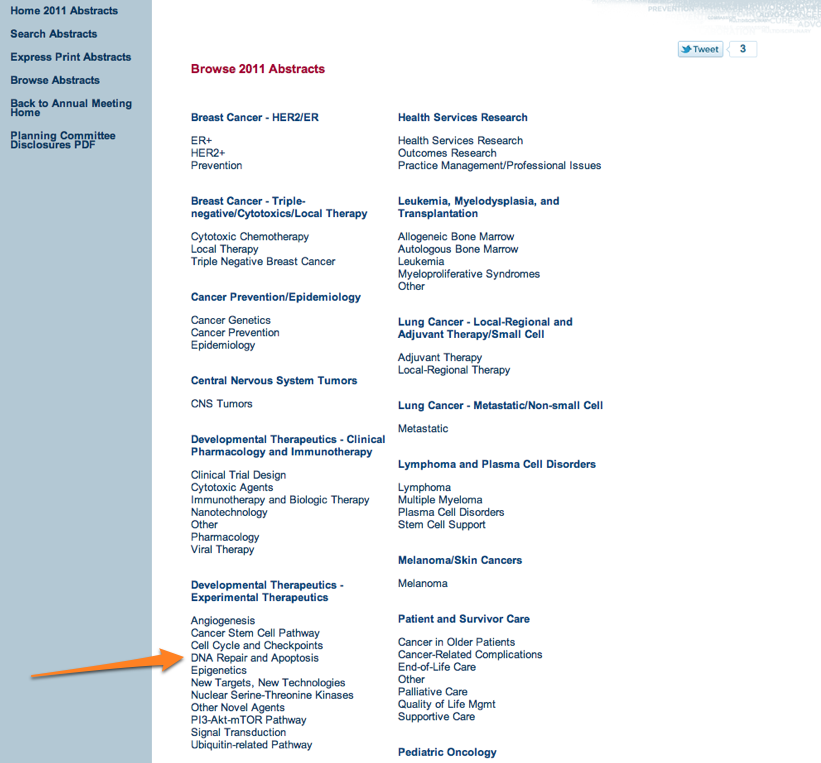
Traditionally, ASCO has organised their meeting around tumour types such as breast, lung, prostate and colon cancers, for example, but this year I was delighted to see that the Developmental Therapeutics section is getting more attention with a greater focus on the molecular targets that are now emerging:

ASCO 2011 Annual Meeting Pathways

Of the abstracts covered in the briefing, two in particular really stood out for me.  One was on Exelixis’ cabozantinib (XL184) in bone metastases, which my colleague wrote about on Biotech Strategy Blog and the other was the data for AstraZeneca’s PARP inhibitor, olaparib, in serous ovarian cancer.

Many of you will know that I’ve been covering PARP inhibitors on this blog since 2006 – although they have had somewhat of a chequered history to date.  After the recent failure of Sanofi’s iniparib in triple negative breast cancer and AstraZeneca deciding to put a phase III breast cancer trial on hold while they reformulate the drug from capsules to a tablet to make it easier for people to take, many weren’t sure what was happening with the PARP class of compounds.

Would they be consigned to the drug dustbin or would they come back from the dead?

Dr Jonathan Ledermann (University College London) presented an overview of the phase II results in serous ovarian cancer.  These were women both with, and without, the BRCA gene.  It has previously been shown by Audeh et al., (2010) that ~30% of inherited BRCA mutated tumours respond to PARP inhibitors, particularly those that have ‘platinum-sensitive’ disease.

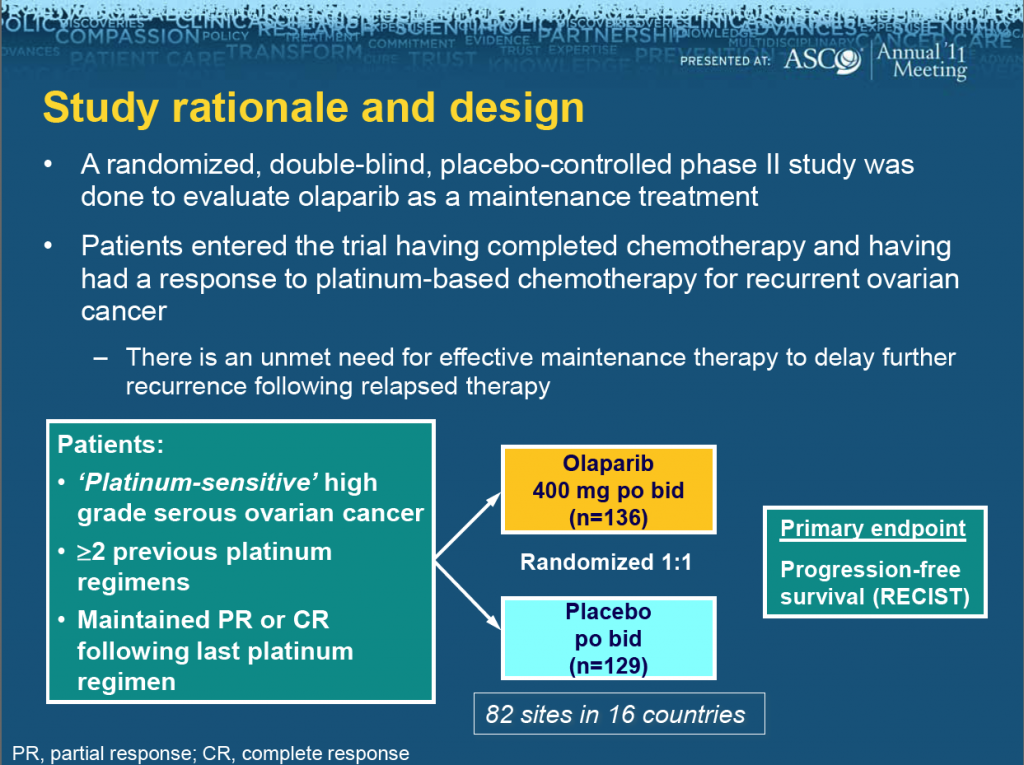
Here is the phase II study design in serous ovarian cancer:

Olaparib serous ovarian cancer phase II trial design

What was in interesting in this study was that, overall, Dr Ledermann noted that they found that women in the olaparib arm lived for 8.4 months before progression, compared to 4.8 months on placebo.  This 3.6 month improvement in PFS was statistically significant.

We will know more about the details of this study on Saturday 4th June at ASCO, but for now, two things stand out:

  • This is the first study to demonstrate a statistically significant benefit of maintenance treatment for ‘platinum-sensitive’ relapsed serous ovarian cancer
  • 50% of olaparib and 16% of placebo patients were still on treatment at the time of the analysis

These results seem pretty compelling and important to me.

If you’re around at ASCO on Saturday, the ovarian cancer session is on from 3-6pm in room E354a – check it out!

For those interested, there are also some new data being presented on Abbott’s PARP inhibitor, ABT-888 (veliparib) combined with temozolomide in refractory colorectal cancer.  This is also on Saturday afternoon from 4.30-6pm in the Clinical Science Symposium in Hall D1.

No doubt many of us will be running around up and down the escalators on the very first day, some Segways with hooters might help!  Still, I dream/long for the future when ASCO follows AACR’s lead and organises sessions around molecular targets and pathways instead of tumour types… maybe that won’t be too far into the future after all 🙂

References:

ResearchBlogging.orgAudeh, M., Carmichael, J., Penson, R., Friedlander, M., Powell, B., Bell-McGuinn, K., Scott, C., Weitzel, J., Oaknin, A., Loman, N., Lu, K., Schmutzler, R., Matulonis, U., Wickens, M., & Tutt, A. (2010). Oral poly(ADP-ribose) polymerase inhibitor olaparib in patients with BRCA1 or BRCA2 mutations and recurrent ovarian cancer: a proof-of-concept trial The Lancet, 376 (9737), 245-251 DOI: 10.1016/S0140-6736(10)60893-8

5 Comments

Today I’m delighted to announce that we have a guest post from Adam Bristol, Ph.D, who works for Aquilo Capital Management in San Francisco.  Adam helps to manage a life sciences investment fund, where they invest in new drug discovery and drug development companies.  He also told me that his scientific training was in neuroscience, but “I’ve become absolutely fascinated with oncology and virology since I left the lab.” This is wonderful to hear and his enthusiasm really comes across in his report below.

At the recent American Society of Hematology meeting I was a tad grumpy at not being able to attend one of the science sessions and a lively discussion followed in the comments.  Adam wrote that he was attending the session and kindly offered to share his notes with the PSB community, which I’m delighted to post forthwith…

Readers of the PharmaStrategy Blog will be familiar with a scientific session entitled, “DNA-Repair Pathways: Cancer Syndromes to Novel Therapies” held on Monday afternoon at the recent ASH meeting.  With an expanding list of PARP inhibitors advancing in the clinic for multiple tumor types, and a growing literature on the biology of DNA repair mechanisms, this session promised to be a terrific overview of an emerging treatment paradigm.  However, as noted in an earlier post here, the conference program stated that attendance was limited to “medical professionals” only, thereby excluding a significant portion of ASH attendees.  While I’m not a medical professional, I was permitted to attend the session, perhaps because I registered before the restriction was imposed.  Below is the published abstract for the session and my take-aways from a very engaging presentation and discussion, which was chaired by Drs. Alan D’Andrea (Dan-Farber Cancer Institute) and Michael Kastan (St. Jude Children’s Research Hospital).  As with all scribbled notes on oral presentations, mine required some decoding as I began my write-up.  Corrections and elaborations from readers are more than welcome!

Here is a quick synopsis of the session from ASH:

“Conventional anticancer therapy (chemotherapy and radiation) kills tumor cells by causing DNA damage. Tumors differ in their response to these agents, at least in part, through their variable levels of DNA-repair activity. Human tumor cells have six independent DNA-repair pathways, including base-excision repair (BER), nucleotide-excision repair (NER), homologous recombination (HR), mismatch repair (MMR), non-homologous endjoining (NHEJ), and translesion DNA synthesis (TLS). Here, we will discuss the six major DNA-repair pathways found in human tumors, the relevant inherited cancer syndromes, the available biomarkers for assessing these pathways, and the emerging class of drugs referred to as DNA-repair inhibitors. These inhibitors, including those that target PARP or the ATM protein kinase, block DNA-repair pathways and can enhance the sensitivity of tumor cells to conventional therapy. Dr. Alan D’Andrea will discuss the Fanconi anemia/BRCA pathway and its synthetic lethal relationship with other DNA-repair mechanisms. Pharmacologic modulation of this pathway has led to novel therapies for cancer and for bone marrow failure. Dr. Michael Kastan will review another critical DNA-damage-response pathway, the ATM-p53 pathway. This pathway presents opportunities for development of novel anticancer agents, including potential approaches for both radiosensitization and radiation- or chemo-protection. As with the Fanconi anemia/BRCA pathway, the concept of synthetic lethality may also apply to this signaling pathway. Thus, targeting these pathways could lead to preferential killing of tumor cells based on the genetic or microenvironmental abnormalities in the tumors.”

Dr. D’Andrea’s presentation led off the session. He first noted that cancer cells are often defective in a DNA repair pathway and that this deficiency alters sensitivity to DNA-damaging chemotherapeutic agents. This leads to the possibility that knowing the status of DNA repair pathways could aid in predicting tumor sensitivity to chemotherapy. He cited a few examples, such as loss of BRCA1 and sensitivie to PARP inhibitors, low levels of DNA excision repair protein ERCC-1 predictive of cisplatin sensitivity, and levels of DNA repair protein O6-methylguanine-DNA methyltransferase (MGMT) associated with temozolomide sensitivity/resistance.

D’Andrea then summarized a significant amount of work that he and his colleagues have conducted on Fanconi Anemia (FA), a rare disease resulting from defects in thirteen DNA repair proteins, specifically the DNA repair response to cross-linking agents. Consequently, FA patients are hypersensitive to mitomycin C (MMC) and other cross-linking agents.  Three of the thirteen FA genes, including BRCA2, are known to be susceptibility genes for breast cancer and ovarian cancer.  D’Andrea proposed that loss of ubiquitination of the D2 Fanconi protein (FANCD2) can be useful biomarker of tumor susceptibility to DNA damaging agents because this ubiquitination step is the results of a DNA-damage-induced assembling of eight FA proteins into a multi-protein complex that acts as a E3 ubiquitin ligase that mediates the repair process.  In other words, because knocking out any of the protein in this process causes FA, tumors with low or no ubiquitination of FANCD2 should be sensitive to MMC or cisplatin.  He cited data showing that 20% of ovarian cancer biopsies showed deficits in the FA pathway (likely due to silencing by epigenetic events, such as methylation).

Ovarian cancer was not the only tumor type with a deficient FA pathway:

  • 18% of breast cancers
  • 15% of NSCLC
  • 15% squamous cell head and neck cancers
  • 35% cervical cancers

Sporadic AML, including those with the complex karyotypes of secondary AML, also commonly harbor FA deficiencies.  Dr. D’Andrea noted that de-methylatation, and thus restoration of FA pathway DNA repair, can also occur, and that this could be mechanism of tumor resistance.  Thus, serial tracking of FANCD2 ubiquitination can be used to track resistance.

He next raised the question of whether the FA pathway is druggable to effectively sensitize tumors to chemo agents.  That is, can we inhibit the mono-ubiquitination of FANCD2?  D’Andrea briefly reviewed the results of a chemical screen that found three kinase inhibitors but, importantly, also bortezomib (Velcade), inhibited FANCD2 ubiquitination.  Subsequent in vitro data showed that bortezomib sensitized ovarian cancer cell lines to cisplatin, both when bortezomib was administered as a pre-treatment or when administered concurrently with cisplatin.  Based on these and other data, they are currently running a Phase 1b trial of bortezomib in combination with cisplatin.

Lastly, Dr. D’Andrea discussed the concept of synthetic lethality and PARP inhibitors. Inhibitors of PARP, which stands for poly (ADP-ribose) polymerase, work because, in breast cancer tumors, cells become reliant on a specific DNA repair pathway, specifically base-excision repair.  He called them “essentially homologous-repair deficient tumors”, meaning that breast cancer tumor have lost that DNA repair pathway.  The problem, he said, is that resistance to PARP inhibitors has already been observed and that secondary tumors can be error-free in their repair.  At present, the rules for tumor specificity/sensitivity to PARP inhibitors is not well understood.  The question of resistance to PARP inhibitors resurfaced in the Q&A, at which time Dr. D’Andrea explained that the mechanism is not completely known but that it may be due to somatic reversion, i.e., mutant allele reverting to WT-like allele, thus reinstating the HR repair pathway.

Dr. Kastan gave the second talk of the session, beginning his remarks with a particularly sobering reminder: DNA is damaged in many ways, for example:

  • on purpose, such as when we are intentionally exposed to X-rays
  • on accident, such as when we are subjected to excessive sun exposure
  • unavoidably, such as the damage due to production of reactive oxygen species, a natural byproduct of cellular metabolism and ageing.

He cited the incredible estimate that our cells deal with ~10,000 instances of DNA damage per cell per day!  Exploration of DNA repair pathways is therefore relevant to the areas of metabolism, apoptosis and autophagy, noting specifically that interest in autophagy is really exploding at present.  Autophagy is a process of cellular self-destruction in which organelles and macromolecules are targeted and degraded by the lysosome.  In general, apoptosis and autophagy are important brakes on tumorigenesis and deficiencies in these processes, such as by alteration in tumor suppressor genes, are common proliferative strategies.

He noted that Arf/p53 tumor suppressor pathway is responsive to DNA damage (among other signals), in part through activation by Ataxia-Telangiectasia-mutated (ATM) protein kinase.  For example, ionizing irradiation activates ATM as does chemotherapy. Similarly, mutations in ATM (as in ataxia-telangiectasia, the kinase’s namesake) and a related kinase, ATM- and Rad3-related (ATR) kinase, have been shown to render mice and humans hypersensitive to ionizing radiation.  Thus, in theory, an ATM inhibitor could be a chemosensitizer.  It turns out that caffeine is an ATM/ATR inhibitor, but with poor potency.

Dr. Kastan and his colleagues have collaborated with Pfizer scientists to identify novel small molecule ATM inhibitors.   They’ve published on first generation compounds, and are now onto next generation molecules, specifically to explore the SAR, increase bioavailability, and perform siRNA screens for other related targets.  Achieving ATM/ATR selectivity would be challenging, however, as the enzymes are closely related.

On the other hand, activation of ATM kinase and subsequent induction of Arf/p53 could serve as a tumor prevention strategy.  Chloroquine, a anti-malarial drug originally discovered in the 1930’s, activates the ATM kinase and induces Arf/p53 without damaging DNA.  In a mouse model of ATM-deficient, Myc-driven tumors (a model of Burkitt lymphoma), Kastan showed (in Maclean et al., JCI, 2008) that weekly, low dose choloquine could prevent spontaneous de novo lymphomas.  He also cited clinical epidemiological data in which incidence of lymphoma in Tanzania was reduced by 75% during a trial of chlorquine as a treatment for malaria (the investigators were testing the hypothesis that malaria was a causative factor in development of Burkitt lymphoma, thus the collection of the incidence data).  Strikingly, the incidence rate returned to the pre-trial baseline within two years of the study’s completion.

Dr. Kastan also noted that a paper in Science in 1999 described pifithrin-alpha has capable of inhibiting p53 activation and preventing chemotherapy-induced apoptosis (a potential strategy to prevent an unwanted side effect in normal tissues), but the exact mechanism is still unclear.   He also discussed the use of phosphorylated ATM is a potential biomarker of ROS status.

In my opinion, both speakers presented compelling case studies of bench-to-bedside translational science; in each case, an understanding of the cell signaling pathways, their alteration and involvement in tumorigenesis and progression yielded therapeutic targets and novel treatment strategies.  I hope we see additional advances as this field progresses.

References:

ResearchBlogging.org Komarov PG, Komarova EA, Kondratov RV, Christov-Tselkov K, Coon JS, Chernov MV, & Gudkov AV (1999). A chemical inhibitor of p53 that protects mice from the side effects of cancer therapy. Science (New York, N.Y.), 285 (5434), 1733-7 PMID: 10481009

Maclean, K., Dorsey, F., Cleveland, J., & Kastan, M. (2008). Targeting lysosomal degradation induces p53-dependent cell death and prevents cancer in mouse models of lymphomagenesis Journal of Clinical Investigation, 118 (1), 79-88 DOI: 10.1172/JCI33700

error: Content is protected !!