Pharma Strategy Blog

Commentary on Pharma & Biotech Oncology / Hematology New Product Development

Posts tagged ‘c-MET’

Amazingly, it’s been a year since I started doing conference highlight videos, with the first one rolling out at EAU meeting in Vienna last March. They’ve proven to be much more popular than expected! The good news is that the video recording, production and presentation skills have improved along the way.

Unlike last year, the 2012 EAU Congress wasn’t lit up with excitement about new data (abiraterone and MDV3100 dominated last year).  Instead, there were more reflective discussions about how to consider sequencing and combinations in a more crowded castrate resistant prostate cancer market going forward as well as some mention of new up and coming targets outside the androgen receptor (AR) such as ERG and Src.

Here’s the short (under 5 mins) video update:

If you can’t see the video, click here.

Meanwhile, the next conference update will be from the annual American Association for Cancer Research (AACR) meeting from March 31st-April 4th.

A couple of recent controversies in the field of angiogenesis have fascinated scientists and clinicians alike, namely:

  • Does VEGF inhibition lead to more aggressive tumours?
  • What drives metastases and invasion?
  • What is the role of tumour hypoxia in this process?

Data was originally presented in glioblastoma by Rubenstein et al., (2000), showing that anti-VEGF antibody treatment prolonged survival, but resulted in increased vascularity caused quite a stir.  Several other groups subsequently demonstrated in preclinical models that VEGF signaling shrinks tumours, but also results in increased invasion and metastases (see Casanovas et al., (2005), Ebos et al., (2009), Paez-Ribes et al., (2009), for examples).

The mechanism for this process, however, remained elusive. A number of factors have been thought to be contributing, including:

  • Vessel pruning
  • Hypoxia
  • Increased expression of c-MET and/or HGF

The corollary of course, is that once we better understand the underlying biology, we can devise strategies to test new agents in clinical trials. The end result would hopefully be improved outcomes for patients undergoing cancer therapy.

Sennino et al., (2012) performed an elegant series of experiments that were published today in Cancer Discovery and sought to understand the roles of VEGF and c-MET signalling in invasion and metastases by using a variety of VEGF and MET inhibitors in transgenic mouse models of pancreatic neuroendocrine tumours. The paper makes for very interesting reading, which I highly recommend.

Here are some of the highlights:

  1. Tumours treated with VEGF inhibitors such as an antibody (#AF-493-NA, R&D Systems) or sunitinib tended to shrink, but were more invasive as defined by irregular tumour border and presence of acinar cells.
  2. Post treatment with VEGF inhibitors, proliferating cells were reduced in the tumour centre compared to control but there were more apoptotic cells compared to the control. This is consistent with what we would expect from anti-angiogenic therapy.
  3. Interestingly, when looking at mesenchymal markers (eg Snail1, N-cadherin, vimentin) there were stronger bands in Western blots after VEGF therapy. EMT activity is usually a sign of invasion and early metastases in the microenvironment.
  4. Tumours treated with anti-VEGF agents had fewer blood vessels than control, again consistent with expectations for anti-VEGF therapy. However, the reduced vascularity was also accompanied by more hypoxia and greater levels of HIF-1a.
  5. c-MET staining was greatest in tumour cells, but not tumour vessels, after VEGF therapy compared with the controls. The latter is reduced as vessel pruning takes place.
  6. Inhibition of c-MET with PF-04217903 and either sunitinib or the anti-VEGF antibody led to reduction in invasion and tumours with smoother contours, but not greater vascular pruning.

Other experiments were performed with both PF-04217903 and crizotinib (MET inhibitors), as well as cabozantinib, a dual inhibitor of MET and VEGF. When both targets were inhibited together, using either cabozantinib or PF-04217903 plus sunitinib, there was a consistent reduction in invasion and metastases. This also increased with tumour hypoxia and c-MET expression.

What does this data mean?

This is the first paper I’ve come across that convincingly suggests that targeting both VEGF and c-MET simultaneously reduces not only tumour size, but also invasion and metastases, thereby overcoming one of the limitations of treatment with VEGF inhibitors alone.

The work also advances our understanding of the anti-angiogenesic process which involves:

“A complex mechanism involving vascular pruning, intratumoral hypoxia, HIF-1a accumulation, and activation of c-MET in tumor cells.”

As a result, the data also suggest the value in combining VEGF and MET inhibitors with a therapy such as cabozantinib (XL184:

“Inhibition of both signaling pathways by XL184 also reduced tumor growth, invasion, and metastases, and prolonged survival.”

Overall, this was a very nicely put together piece of research and expands our understanding of angiogenesis. It also offers insight into how we can improve clinical strategies with combined VEGF and MET inhibition, which I think we will see more off rather than targeting either pathway alone.

Some of these agents are already approved (e.g. bevacizumab, sunitinib, crizotinib), while several others (MetMAB, tivantinib and cabozantinib) are in phase III clinical trials for various tumour types.  It will be interesting to see how dual inhibition develops in the clinic and whether the animal studies can be confirmed in humans.  I do hope so.

References:

ResearchBlogging.orgSennino, B., Ishiguro-Oonuma, T., Wei, Y., Naylor, R., Williamson, C., Bhagwandin, V., Tabruyn, S., You, W., Chapman, H., Christensen, J., Aftab, D., & McDonald, D. (2012). Suppression of Tumor Invasion and Metastasis by Concurrent Inhibition of c-Met and VEGF Signaling in Pancreatic Neuroendocrine Tumors Cancer Discovery DOI: 10.1158/2159-8290.CD-11-0240

Rubenstein JL, Kim J, Ozawa T, Zhang M, Westphal M, Deen DF, & Shuman MA (2000). Anti-VEGF antibody treatment of glioblastoma prolongs survival but results in increased vascular cooption. Neoplasia (New York, N.Y.), 2 (4), 306-14 PMID: 11005565

Casanovas O, Hicklin DJ, Bergers G, & Hanahan D (2005). Drug resistance by evasion of antiangiogenic targeting of VEGF signaling in late-stage pancreatic islet tumors. Cancer cell, 8 (4), 299-309 PMID: 16226705

Ebos JM, Lee CR, Cruz-Munoz W, Bjarnason GA, Christensen JG, & Kerbel RS (2009). Accelerated metastasis after short-term treatment with a potent inhibitor of tumor angiogenesis. Cancer cell, 15 (3), 232-9 PMID: 19249681

Pàez-Ribes M, Allen E, Hudock J, Takeda T, Okuyama H, Viñals F, Inoue M, Bergers G, Hanahan D, & Casanovas O (2009). Antiangiogenic therapy elicits malignant progression of tumors to increased local invasion and distant metastasis. Cancer cell, 15 (3), 220-31 PMID: 19249680

2 Comments

Continuing our mini series on molecular targets and lung cancer this week, today I’m going to focus on MET amplications for this post.

MET confers resistance to EGFR inhibitorsA few years ago, Jeffrey Engelman’s group at Mass General (see Reference section below) reported that MET amplication leads to resistance with EGFR inhibitors such as gefitinib (Iressa) by activating ERBB3 signalling:
“MET amplification was detected in 4 of 18 (22%) lung cancer specimens that had developed resistance to gefitinib or erlotinib. We find that amplification of MET causes gefitinib resistance by driving ERBB3 (HER3)–dependent activation of PI3K, a pathway thought to be specific to EGFR/ERBB family receptors.”

Others have shown similar results in non-small cell lung cancer (NSCLC) with erlotinib.

Subsequent to this, a number of MET inhibitors have entered the clinic looking at the impact of combining a MET inhibitor with erlotinib in adenocarcinomas that are EGFR mutation positive.

Two of the leading compounds in phase II/III development are described below:

  1. ARQ-197 (ArQule/Daiichi Sankyo) a small molecule inhibitor of c-MET
  2. METMab (Roche/Genentech) a monoclonal antibody to c-MET

ArQule currently has two phase III trials both in the refractory setting looking at non-squamous NSCLC in combination with erlotinib versus erlotinib alone – one is currently enrolling while the other will soon be open to recruitment.

Of course, there are other MET inhibitors in earlier development (eg crizotinib is a weak inhibitor of c-MET, but is being evaluated in ALK translocated NSCLC).

What was interesting at ESMO last September was the phase II data that was presented on both agents in the same session.  The ARQ-197 data grouped all the patients together as one group and showed a trend in favour of the combination arm vs erlotinib plus placebo (7.3 vs 3.6 months) in terms of time to new metastases.

Since then, the ArQule phase III trials have been set up and appear to be looking at:

“The status of the following biomarkers will be collected in this study: EGFR and KRAS mutation status prior to randomization, and MET status post randomization.”

I think that is a good approach, because the METMab data at that conference clearly showed that MET High and MET Low patients had very different outcomes, based on the limited phase II data I saw at ESMO.

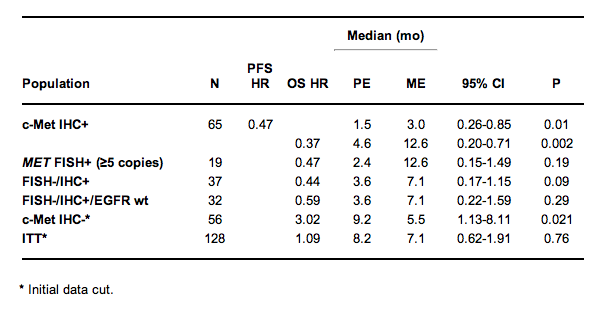
Meanwhile, the final METMab phase II data was presented from the OAM4458g study at ASCO this month, with no major change from the interim data presented last Fall ie MET High patients appear to have superior responses with the combination than erlotinib monotherapy.  The results clearly illustrate the importance of accurate biomarker analysis in these types of studies because while some patients did well on the combination, others did not, some did worse and the unselected group overall showed no difference.

Which begs the all important question – which patients did well on METMab plus erlotinib?

Those who had high MET expression, confirming the theory that resistance can be attenuated, at least for a while, with a dual combination approach of MET plus EGFR inhibitors but only in a very select subgroup of patients.

To illustrate this we can see that the addition of METMAb to erlotinib almost doubled the median time that those who were MET High (positive) were free of disease from 1.5 months to 2.9 months (HR 0.53; P=0.04) as you can see in the table from the ASCO abstract.  The combination also tripled median OS from 3.8 months to 12.6 months (HR 0.37; P=0.002):

Erlotinib +/- METMab in NSCLC at ASCO 2011

I would imagine that a phase III trial in NSCLC will evolve very soon and it will be most interesting to see how the design and patient selection criteria for the trial will evolve, based on the known findings to date.  These factors may determine whether a successful difference can be seen with the combination based on biomarkers to define a more homogenous group.

Interestingly, a phase II study is currently enrolling with METMab in triple negative breast cancer.  This is a complex three arms design looking at the impact of:

  • MetMAb + bevacizumab + paclitaxel
  • MetMAb + placebo + paclitaxel
  • Placebo + bevacizumab + paclitaxel

In theory, this should tell us whether eith METMab or bevacizumab have any advantage over paclitaxel chemotherapy.

What does the data with MET inhibitors mean?

The trials with both ARQ-197 and METMab teach us some important lessons in NSCLC:

  1. Catch-all studies of homogenous groups are a recipe for the dreaded words, “there was no significant difference in survival between the two groups”
  2. The importance of biomarkers in teasing out those most likely to respond
  3. The importance of careful patient selection in achieving those aims

When we think about this year’s ASCO conference theme of “Patients. Pathways. Progress,” we should be mindful of the fact that in order to match the therapy to the patient’s mutations, we need to continue to devise studies that seek to do exactly that – sometimes good drugs fail, not because they didn’t work, but because the relevant biomarker wasn’t found to illustrate which patients did respond.  When that happens, it’s a failure of R&D, not the drug itself.

Going back to the quote above from the Engelman et al., (2007) paper, I do wonder if MET plus erlotinib is the ideal combination in the relapsed/refractory setting with adenocarcinomas, even allowing for MET-High status?  Would a pan-EGFR inhibitor that also inhibits HER3 be a better partner with MET inhibitors than erlotinib in these patients?  Who knows, but hopefully someone will test that hypothesis out in a phase II trial at some point.

References:

ResearchBlogging.orgEngelman, J., Zejnullahu, K., Mitsudomi, T., Song, Y., Hyland, C., Park, J., Lindeman, N., Gale, C., Zhao, X., Christensen, J., Kosaka, T., Holmes, A., Rogers, A., Cappuzzo, F., Mok, T., Lee, C., Johnson, B., Cantley, L., & Janne, P. (2007). MET Amplification Leads to Gefitinib Resistance in Lung Cancer by Activating ERBB3 Signaling Science, 316 (5827), 1039-1043 DOI: 10.1126/science.1141478

2 Comments

Here's an interesting paper that was just published in Cancer Research that describes some factors driving acquired resistance to MET inhibition with small molecules.

MET inhibitors have gained a lot of attention recently (see Comoglio et al's review in the references for a good overview) and we have covered this topic a few times on this blog both in terms of the biology and also on promising inhibitors such as ArQule/DaiichiSankyo's ARQ-197, which is the leading compound in this field.

Acquired resistance is a common and limiting problem for chronic therapy with many tyrosine kinase inhibitors (TKI), not just MET inhibitors. After initial excitement at seeing some responses though, they appear to stop working. The big question is why, and what underlying mechanisms may be at play?

Of course, while the issue may be a universal one, the resistance mechanisms are not and will differ with each class of TKI and potentially even tumour types or combinations.

Background

The MET gene is disregulated in a number of different tumour types and those cells exhibiting MET amplification may offer a suitable target for drug inhibition.  Doing so results in impairment of cell growth and apoptosis.

You can read more about the biology of the c-MET pathway here.

Acquired Resistance to MET

In this important research, the authors decided to see if they could define some of the underlying mechanisms of MET resistance:

"To predict mechanisms of acquired resistance, we generated resistant cells by treating MET-addicted cells with increasing concentrations of the MET small-molecule inhibitors PHA-665752 or JNJ38877605."

The results?

They found that cells progressively amplified KRAS, which resulted in increased expression and activation of wild-type (wt) KRAS and in activation of the mitogenactivated protein kinase (MAPK) pathway:

"We show that amplification of wt MET and KRAS is found in cells of diverse histotypes, resistant to different inhibitors.

Moreover, unexpectedly, we observed that resistance to treatment was reversible and that the alterations leading to resistance were lost after drug withdrawal."

This is a very important finding because it may well be helpful for designing future clinical studies, either in combination or in sequence, to reduce the potential for resistance emerging with MET inhibitors, thereby improving the potential for better long term outcomes with treatment.

"Our results suggest that MET and KRAS amplification is a general mechanism of resistance to specific MET inhibitors given that similar results were observed with two small inhibitors and in different cell lines of different histotypes."

Impact

My favourite part of this story was not just the identification of potential mechanisms of MET resistance, but some hints of how the learnings from the data could be applied:

"Because specific anti-RAS drugs are not available, we tested the ability of compounds acting downstream RAS (such as U0126, PD325901, and sorafenib) to impair cell viability. We observed that cells resistant to MET inhibitors that underwent KRAS amplification are indeed sensitive to these drugs."

Clearly, our ability to not only predict potential mechanisms of resistance, but also devise strategies for overcoming or preventing it, is crucial for improved clinical development with these agents as well as providing a clear rationale for other inhibitors still in research.

Where there's a viable target, there's a way forward.


References

ResearchBlogging.org Cepero, V., Sierra, J., Corso, S., Ghiso, E., Casorzo, L., Perera, T., Comoglio, P., & Giordano, S. (2010). MET and KRAS Gene Amplification Mediates Acquired Resistance to MET Tyrosine Kinase Inhibitors Cancer Research DOI: 10.1158/0008-5472.CAN-10-0436

Comoglio, P., Giordano, S., & Trusolino, L. (2008). Drug development of MET inhibitors: targeting oncogene addiction and expedience Nature Reviews Drug Discovery, 7 (6), 504-516 DOI: 10.1038/nrd2530

"ArQule, Inc. (Nasdaq: ARQL) and Daiichi Sankyo Co., Ltd. (TSE 4568) today announced that they will move forward with a Phase 3 clinical trial of ARQ 197, a small molecule inhibitor of the c-Met receptor tyrosine kinase, in patients with non-small cell lung cancer (NSCLC).

In connection with this decision, the sponsor company, Daiichi Sankyo, will file a Special Protocol Assessment (SPA) with the U.S. Food and Drug Administration (FDA) for a trial comparing ARQ 197 plus erlotinib against erlotinib plus placebo."

Source: ArQule


This is promising news from ArQule and their partner Daiichi Sankyo, which one of my Twitter buddies kindly alerted me to this morning (Thank You, you know who you are!).

Many of you may remember the blog post earlier this year discussing the phase II results. The data was a little odd in that they saw a fairly large improvement in PFS from 9.7 to 16.1 weeks when used in combination with erlotinib (Tarceva), which is clinically significant but without the P-value hitting significance.

Dr West from Swedish did a very nice overview of the data on his lung cancer site, GRACE, which is well worth reading for those interested.  I particularly loved this quote from his post:

"This work is also looking only at patients who haven’t received an EGFR inhibitor before. It may be that ARQ 197 and/or another c-MET inhibitor could restore activity and clinical benefit for patients who previously responded to an EGFR inhibitor and then progressed from acquired resistance. That concept remains to be demonstrated, but the concept is certainly appealing."

I'm also keen to see what the data from a larger sample size would show and whether there are any useful molecular markers involved.  There are a myriad of other interesting questions:

  • Must all the people entering the study have MET/EGFR or KRAS amplification?
  • Did any of the patients in the phase II trial have/develop the ALK or T790M mutation?
  • Was the EGFR mutation present as WT or mutated?
  • Were there any particular features of the people who responded versus those who did not?

The list could go on and on, but likely the study would be underpowered in phase II to tell us any of that important information.  If it does, I can't wait for more extensive analysis!

There are numerous other c-MET inhibitors in pipeline development (at least 11 or 12 that I know of), but ArQule's appears to be the most advanced to date.


1 Comment

Over the past few years it has been interesting to watch AACR organise and group it's sessions by pathways, so you end up with a higgledy piggledy collection of different inhibitors, therapeutics, chemotherapies etc as well as a mix of different tumour types.  This works well for the scientist, less so for the clinician who may specialise in only a few cancer types.  

Meanwhile, at ASCO, everything is organised by cancer track, so if you want to search for data on say, MEK, AKT or c-MET inhibitors for example, then the data is now all over the place and trying to get round and find it all is much more difficult.  The chances of missing something, or worse, having clashes in interesting sessions is much higher.  I'm already looking a potential schedule with too many clashes and periods of nothing.  That's not a very efficient way to organise the data, yet this was not something I experienced at AACR to the same extent.

image from farm4.static.flickr.comPersonally, I find myself much preferring the AACR approach because it's ultimately logical and allows you to see patterns and trends more strategically, providing you approach it sensibly. You do need to think in 3D though, much like that 3 level chess board beloved by Spock in the original Star Trek. This way allows you to see potential connections and future approaches more easily rather than being hemmed in by tumour siloes.

In the long run, I confidently predict that the future trend of personalised medicine is going to be more based on a pathways approach allied with mutational analysis based on constitutive activation, rather than simply thinking in terms of cancer type by line of therapy.  Once you start understanding which subsets exist and which inhibitors can be combined together, it is not hard to see a new world evolving out there that may lead to better outcomes and improved quality of life.

Who knows, we might even be able to get rid of toxic chemotherapies altogether and prescribe a cocktail of more targeted agents based on the patients characteristics.

Now that would be a fine thing indeed.  Thoughts?

Photo Credit: GiftsforyouBiz

c-MET inhibitors are a class of drug I've been interested in and following for a little while.  All are in early development and most of the big oncology players have one lurking in their pipeline. The concept of blocking c-MET is appealing because of number of studies have shown that activated c-MET mutations may be associated with poorer prognosis and induce resistance, ie an escape route for cancer cells. 

Looking at the pathways we can see MET has a strategic position in the signalling as an upstream receptor, which makes it a good potential target, much in the way EGFR, VEGF have shown proof of concept to date:

image from www.n-of-one.com
Source: n-of-one

It was therefore interesting to see a press release this morning proclaiming:

"Biotechnology company ArQule Inc said its experimental lung cancer drug showed positive results in a mid-stage trial, sending its shares up 57 percent in pre-market trade.
The drug, ARQ 197, when used with another lung cancer drug, erlotinib, showed a 66 percent improvement in median progression-free survival (PFS) – the time without cancer growth or death – in patients with advanced, refractory non-small cell lung cancer, ArQule said."

66% improvement would normally get me very enthusiastic, but after the recent glut of promising phase II data leading to flops in phase III, I'm feeling a little more cautious and circumspect.  Especially when, on further examination it appears that:

"The median PFS was 16.1 weeks in the ARQ 197 plus erlotinib arm, compared with 9.7 weeks in the erlotinib plus placebo arm, the company said in a statement.
The company, however, said the difference in PFS between the two arms did not achieve statistical significance by applying a log-rank test."

In other words, there is no significant difference between the two groups!
Hmmm, why make a lot of noise about it then?  Perhaps that's a little harsh, but achieving significance is the sine quo non of clinical trials and that's a very black and white number.  Breathless hypey press releases do make me cringe though.

I suppose we can say that these are promising, but very early, data and more time will tell whether the approach will have any meaningful impact on survival and outcomes.  Perhaps some biomarker analysis will help determine which people with non-small cell lung cancer were most likely to respond to the combination, potentially improving the efficacy and significance.

17 Comments
error: Content is protected !!