Pharma Strategy Blog

Commentary on Pharma & Biotech Oncology / Hematology New Product Development

Posts tagged ‘chronic lymphocytic leukemia’

At the recent ASCO 2013 meeting in Chicago, I had the great pleasure to interview Susan M. O’Brien, MD who is the Ashbel Smith Professor in the Department of Leukemia at the University of Texas, MD Anderson Cancer Center in Houston, and someone who is making a difference to the lives of CLL patients.

ASCO 2013 Dr Susan O'BrienI first met Dr O’Brien over ten years ago when I was at Novartis Oncology in new products working on bringing to market what was then known as STI571, and subsequently became Gleevec.

In the same way that tyrosine kinase inhibitors forever changed CML, the treatment of Chronic Lymphocytic Leukemia (CLL) is set to undergo a major transformation over the next few years.

I hope you will enjoy this video interview in which Dr O’Brien discusses some of the CLL data presented at ASCO ’13 and shares her perspective on several of the new targeted agents in development. It’s an exciting time in CLL!

After several months of free/open access, this video is now viewable on Biotech Strategy Blog Premium Content.

Late last week saw an incredible amount of noise in the media over the startling news that three patients with chronic lymphocytic leukemia (CLL) had responded well to an experimental gene therapy that aimed to boost T cells to fight a particular type of leukemia, some of it, unfortunately, bordering on near hysterical hype, such as MSNBC’s article entitled:

“New leukemia treatment exceeds ‘wildest expectations'”

Ugh.  There were others in similar vein, mostly derived from the AP and Reuters press releases.  Quite frankly, with a headline like that I was expecting something more substantial and robust than three patients.

The most measured story I saw came from NPR Shots, who took a more rational and thoughtful approach to the publications in New England Journal of Medicine and Science and Translational Medicine.

Gary Schwitzer also did a nice review of some of the commentary that emanated from the health media outlets as well as a well thought out longer piece.

It was clear though, that some of my medical and science friends were rather disappointed by the rather breathless nature of the general media reporting.  There is something really icky about raising peoples hopes based on very minimal data.  Part of this is due to journalists and editors with attention grabbing headlines, presumably because that’s what drives traffic, but also a noticeable lack of rigour or critical thinking in reviewing the situation in depth.

Let’s take a look at the disease in more detail first.

CLL is well known to be a disease of the elderly, with a median age around 63-65 years. It’s an indolent immune-sensitive cancer and treatment is largely based on a series of immunotherapies, either alone or in combination, such as fludarabine, rituximab, bendamustine, pentostatin and alemtuzumab, for example.  Not one of the media reports I read looked at how refractory these patients (only a small sample of n=3) really were or what their prognosis was.  It is well known that patients can live normal lives between treatments until relapse, when another treatment is initiated.  This process can go on for several years but eventually, they run out of options as these patients did.

What do we know about the patients?

Looking at the actual data reported from the two journals, we find some interesting nuggets about their prior immunotherapy treatment and karyotypes:

  1. The NEJM article is a single case report on one patient who had previously received FR (twice, for 2 and 4 cycles), BR (1 cycle), B (3 cycles) and alemtuzumab. He was found to have a 17p del with TP53 involvement, which has a known poor prognosis.
  2. All three patients had received both bendamustine and alemtuzumab (in different lines of treatment).
  3. Not all of the patients appear to have received prior fludarabine, which is surprising given that it is largely considered to be the standard of care, either as fludarabine-cytoxan-ritiximab (FCR) or fludarabine-rituximab (FR).  (Note: The patient who achieved a PR rather than CR did not apear to receive prior fludarabine).
  4. Two of the patients had a 17p deletion (with p53 involvement), the other had a normal karyotype.  The latter generally has a better prognosis.
  5. No indication of what might be expected without treatment in terms of the time elapsed after the last therapy is feasible without a comparative trial, so evaluating the effects of the gene therapy versus a control group will be needed going forward.
  6. None of the patients appear to have received a prior bone marrow transplant, which while potentially curative in about half of patients, is not without its complications such as a 20% chance of mortality from the procedure itself.
  7. All of the patients experienced some degree of tumour lysis with fevers, chills, nausea and fever, which occurs when many cancer cells die at once.

The tumour lysis reported in the patients is the most encouraging signal that the gene therapy was working effectively.

What did the researchers do?

Porter et al., (2011) described the idea behind the gene therapy in the NEJM article:

“In most cancers, tumor-specific antigens for targeting are not well defined, but in B-cell neoplasms, CD19 is an attractive target. Expression of CD19 is restricted to normal and malignant B cells and B-cell precursors”

This knowledge provided an opportunity to create a targeted gene therapy and test it in a pilot proof of concept study in a small sample size (n=3).  Patients cells were removed and then a personalised gene therapy was created:

“We designed a self-inactivating lentiviral vector (GeMCRIS 0607-793), which was subjected to preclinical safety testing, as reported previously.”

In plain English, the lentivirus vector encodes an antibody-like protein known as a chimeric antigen receptor (CAR), which is expressed on the surface of T cells and was designed to bind to the CD19 protein used as the target.

The U. Penn press release described the rationale behind the targeted therapy further:

“Once the T cells start expressing the CAR, they focus all of their killing activity on cells that express CD19, which includes CLL tumor cells and normal B cells.

All of the other cells in the patient that do not express CD19 are ignored by the modified T cells, which limits side effects typically experienced during standard therapies.” 

What results were seen?

Two patients (one normal karyotype, one with a 17p TP53 del) were seen to have a complete response (CR) of 10 and 11 months each.

A third patient with a 17p TP53 del was adjudged to have a partial response (PR) of 7 months.

These results were fairly encouraging and offer a good proof of concept that the gene therapy is viable in CLL patients.  They also justify pursuing the gene therapy approach in larger scale clinical trials.

What do these data really mean?

Very little, other than an initial proof of concept, based on such a small sample size, but it does give some encouragement to move forward with a broader program to validate the findings.  At present, there is no doubt that people who have CLL with 17p and TP53 deletions tend to experience shorter remissions after standard therapies, so a new option that can be evaluated in clinical trials is an encouraging and welcome sign of some progress in this area.

Overall, while encouraging, these results are best described as ‘promising, but very early indeed’ – a lot more data will need to collected from randomised controlled trials before we see whether we really have a viable new therapy for people with CLL.  To suggest anything else is hype over hope at this stage and that does a great disservice to people with the disease.

Far too many agents fail between initial proof of concept to actually filing for Health Authority approval based on phase II or III data to raise hopes unnecessarily.  In fact, given more therapies fail in R&D than make it market, we would best remember that before we call anything the new ‘breakthrough’ or ‘killer therapy.’

I’m looking forward to seeing the gene therapy program develop further in larger randomised clinical trials, hopefully without excessive hype.

In an editorial in the NEJM, Urba and Longo (2011) urged some caution:

“Only with the more widespread clinical use of chimeric antigen–receptor T cells will we learn whether the results reported by Porter et al. reflect an authentic advance toward a clinically applicable and effective therapy or yet another promising lead that runs into a barrier that cannot be easily overcome.”

I couldn’t agree more with those sentiments.

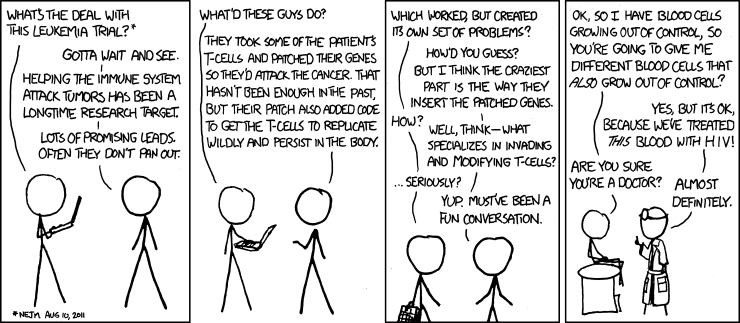
Still, on a much lighter note, XKCD came to the rescue with this awesome cartoon to brighten up a dull grey morning:

Source: XKCD

References:

ResearchBlogging.orgPorter, D., Levine, B., Kalos, M., Bagg, A., & June, C. (2011). Chimeric Antigen Receptor–Modified T Cells in Chronic Lymphoid Leukemia New England Journal of Medicine DOI: 10.1056/NEJMoa1103849

Kalos, M., Levine, B., Porter, D., Katz, S., Grupp, S., Bagg, A., & June, C. (2011). T Cells with Chimeric Antigen Receptors Have Potent Antitumor Effects and Can Establish Memory in Patients with Advanced Leukemia Science Translational Medicine, 3 (95), 95-95 DOI: 10.1126/scitranslmed.3002842

Urba, W., & Longo, D. (2011). Redirecting T Cells New England Journal of Medicine DOI: 10.1056/NEJMe1106965

12 Comments

Over the last five years I’ve been involved in quite a bit of market research relating to chronic lymphocytic leukemia (CLL) and have been struck how the core therapies are still largely chemotherapy based. CLL is an indolent disease of the bone marrow, where it produces too many lymphocytes (white blood cells), whereas chronic myeloid leukemia (CML) is an excess production of myeloid cells:

CLL is characterised by an excess of lymphocytes

Source: cancer.gov

Interestingly, while we know a fair bit about the biology of CML in terms of the driver mutation, ie Philadelphia chromosome that occurs as a result of the translocation from the 9 and 22 chromosomes thereby producing a new gene, BCR-ABL, we don’t half as much about the underlying biology pertaining to CLL.

Compare the simple elegance of CML biology to CLL, as Fabbri et al., (2011) noted:

“The pathogenesis of chronic lymphocytic leukemia (CLL), the most common leukemia in adults, is still largely unknown. The full spectrum of genetic lesions that are present in the CLL genome, and therefore the number and identity of dysregulated cellular pathways, have not been identified.”

This means that in CML, we have a valid target (BCR-ABL) and several highly effective tyrosine kinase inhibitors (TKIs) are now approved to treat the disease, turning CML from a certain death sentence into a cancer now be managed as a chronic condition.

By contrast, in CLL (which tends to have an older population than CML), we largely stuck with various immunotherapies and chemotherapies such as:

  • fludarabine (F)
  • cyclophosphamide (C)
  • bendamustine/Treanda (B)
  • chlorambucil/Leukeran (L)
  • doxorubicin/Adriamycin (A)

These are often used in combination with each other, or with the monoclonal antibody, rituximab (R) eg FCR, FC, FR, BR etc.

Other monoclonal antibodies in use include alemtuzumab (Campath) and ofatumumab (Arzerra), although these are often reserved for the refractory setting because FCR or FC or FR are usually preferred upfront, with BR often preferred as second line therapy. Alternative therapies that are beginning to emerge in clinical practice in the refractory setting (based on clinical trials) are bortezomib (Velcade) and lenalidomide (Revlimid), although both are currently approved for multiple myeloma and not CLL.

The challenge though, is the same old chestnut that exists for many tumour types – a heterogeneous disease without clear molecular targets means that patients cycle through various chemotherapies or immunotherapies, which prolong outcomes at the cost of relatively poor quality of life due to the extensive side effects of chronic treatment that ends up with weary, beaten up and worn out people.

With that somewhat depressing landscape in mind, my interest was piqued by Fabbrio et al’s (2011) paper on CLL and mutations that has just been published this week.

What’s new in CLL?

Basically, the group undertook an analysis to look at the mutations found in the genes of CLL patients at different stages of the disease. They found several mutations not previously linked with CLL, but most patients had relatively few genetic mutations compared to some other types of cancer.

However, they did find something very interesting:

“Mutational activation of NOTCH1, observed in 8.3% of CLL at diagnosis, was detected at significantly higher frequency during disease progression toward Richter transformation (31.0%), as well as in chemorefractory CLL (20.8%).”

That was one of those “ooh” moments that made me read on and see what else they have to say and what the implications are.  Is NOTCH1 a good molecular target that might change things for people with CLL for better?

They went to say:

“Consistent with the association of NOTCH1 mutations with clinically aggressive forms of the disease, NOTCH1 activation at CLL diagnosis emerged as an independent predictor of poor survival.”

A dysregulated pathway can be a useful target to start with, but there are no guarantees, since it may turn out to be a passenger rather than a driver mutation.  The only way to find out is to see what happens in clinical trials with CLL patients and to determine what combinations might be useful.

Clinical trials with NOTCH inhibitors

There are currently 54 trials ongoing with NOTCH inhibitors, either alone or in various combinations. Roche have the lead compound in this area, with a broad and deep program already established across multiple potential indications. The table below shows the key players, their NOTCH/gamma secretase inhibitors and the tumour types being evaluated:

Notch

This is still in very early clinical research with mostly phase I (solid tumours or advanced cancers) and only a few phase II trials started, so the race is wide open.  Breast cancer and leukemia appear for two of the compounds, although I should point out that the latter tend to be in Acute Lymphoblastic Leukemia (ALL) rather than CLL.  This may change with time.

This should be an interesting field to follow and I look forward to writing more about the class as the data matures…

{Update: The Howard Hughes Medical Institute send me a link via Twitter, showing that NOTCH may also have a role to play in a rarer form of leukemia, Chronic Myelomonocytic Leukemia (CMML).  They also have a very cool (and free) app for ipods and ipads, which allows you to read their quarterly magazine online.  It’s beautifully produced and I very much much enjoy reading it – if only it came out monthly :)}


References:

ResearchBlogging.orgFabbri, G., Rasi, S., Rossi, D., Trifonov, V., Khiabanian, H., Ma, J., Grunn, A., Fangazio, M., Capello, D., Monti, S., Cresta, S., Gargiulo, E., Forconi, F., Guarini, A., Arcaini, L., Paulli, M., Laurenti, L., Larocca, L., Marasca, R., Gattei, V., Oscier, D., Bertoni, F., Mullighan, C., Foa, R., Pasqualucci, L., Rabadan, R., Dalla-Favera, R., & Gaidano, G. (2011). Analysis of the chronic lymphocytic leukemia coding genome: role of NOTCH1 mutational activation Journal of Experimental Medicine DOI: 10.1084/jem.20110921

As many readers here on PSB know, I've not been a big fan of genome-wide molecular profiling, preferring an oncogene addiction approach to drug development and targeted cancer therapies. However, every once in a while something comes along that stops you in your tracks and makes you think differently.

This morning I was reading the latest copy of the New England Journal of Medicine over coffee and was fascinated by a review article by Drs Lenz and Staudt at the NCI on the molecular genetics of diffuse large-B-cell lymphomas (DLBCL), which account for 30-40% of newly diagnosed lymphomas.

As the review article points out, it is well know that different subsets of diffuse large-b-cell lymphomas are associated with different overall survival rates after initial anthracycline based therapy.  For example, it is more favourable in people with PMBL and the GCB subytype but less favourable in those with the ABC subtype.  R-CHOP therapy has improved survival in people with ABC, but the cure rates are still lower than those with the GCB subtype.  Gene expression signatures can help identify the subtypes and predict survival rates:

image from content.nejm.orgSource: NEJM

Current therapeutic treatment with chemotherapy has made headway in improved survival, but in order to make further headway, new approaches are very much needed.  Targeted therapies have now begun to expand clinical trial options. 

The article talks about numerous pathways, but I particularly liked this one, which details the Nuclear Factor kB (NFkB) signalling pathways in normal and malignant lymphocytes:

image from content.nejm.org
Source: NEJM

Essentially, signalling is initiated when a SRC family kinase ( SFK) phosphorylates tyrosines in the immunoreceptor tyrosine-based activation motifs (ITAMs) on B-cell subunits.  SYK is then recruited to the ITAMs through the SH2 domains and becomes active.  Many of you will remember SYK inhibition from previous posts on Rigel's fostamatinib, a SYK inhibitor.  I think Celgene also mentioned a SYK inhibitor in early development at their recent R&D Day, although the Rigel-AZ is further ahead but more erratic in it's results, at least in immune disorders.  A more recent paper in Blood looked promising in NHL and CLL, though.  Companies are clearly starting to look at specific inhibitors in the downstream pathway for lymphomas and chronic lymphocytic leukemia.

What's interesting about the cartoon above is that you can also see that phosphatidylinositol-3-kinase (PI3-kinase) is activated in parallel, activating the mTOR pathway.  These two targets are getting a lot of attention from Pharma in the clinic, especially in leukemias and lymphomas, and we may well see more of their latest development at AACR next week and ASCO in June.  Exelixis and their partner, sanofi-aventis (a client), for example, have already announced 12 abstracts at ASCO, including 6 on their PI3K and mTOR inhibitors, but they are focusing on lung cancer, a much more difficult carcinoma, rather than NHL, where there is a strong rationale.

It's good see new treatment modalities being tested in leukemias and lymphomas and not just solid tumours, where most companies inevitably focus due to the larger population sizes.  That said, the challenge in lymphoma is going to be identifying rational combinations that kill lymphoma cells synergistically.  As we learn more about the underlying biology of the disease, targets and biomarkers, so more effective and less toxic solutions may evolve.

ResearchBlogging.org
Lenz, G., & Staudt, L. (2010). Aggressive Lymphomas New England Journal of Medicine, 362 (15), 1417-1429 DOI: 10.1056/NEJMra0807082 

Friedberg, J., Sharman, J., Sweetenham, J., Johnston, P., Vose, J., LaCasce, A., Schaefer-Cutillo, J., De Vos, S., Sinha, R., Leonard, J., Cripe, L., Gregory, S., Sterba, M., Lowe, A., Levy, R., & Shipp, M. (2009). Inhibition of Syk with fostamatinib disodium has significant clinical activity in non-Hodgkin lymphoma and chronic lymphocytic leukemia Blood, 115 (13), 2578-2585 DOI: 10.1182/blood-2009-08-236471

Last night and this morning brought some topical news on the leukemia front.

Just before 5pm EST yesterday, the FDA announced they had approved Roche/Genentech's rituximab (Rituxan) in chronic lymphocytic leukemia (CLL).  Rituxan is already approved for non-Hodgkins Lymphoma (NHL) and rapidly the standard of care when combined with CHOP chemotherapy in this disease.  CLL is the most common adult leukemia and tends to affect older patients.

According to the Roche press release this morning, the FDA approval was for:

"Rituximab plus fludarabine and cyclophosphamide (FC) chemotherapy for people with either previously untreated (first-line) or previously treated (relapsed or refractory) CD20-positive chronic lymphocytic leukemia (CLL)."

The CLL data was presented last year at ASH, showing that FCR led to improved survival compared to FC alone.  FDA's press release highlighted the results:

"The safety and effectiveness of Rituxan was evaluated in two studies that measured progression-free survival, defined as the time a patient in the study lived without the cancer progressing.

In one study of 817 patients who had not received any prior chemotherapy, progression-free survival was eight months longer for those receiving Rituxan plus chemotherapy than for those who received chemotherapy alone.  In another study of 522 persons whose cancer had progressed following other chemotherapy drugs, progression-free survival was five months longer for those who received Rituxan plus chemotherapy.

The FDA analyzed the data on patients 70 years of age and older who had received Rituxan and found no evidence that adding the drug to chemotherapy benefitted elderly patients compared to receiving chemotherapy alone.  However, there was also no evidence that Rituxan was harmful to elderly patients."

This approval affects several companies in the CLL space. 

Late last year, GSK received approval for their CD20 antibody, ofatumumab (Arzerra) in CLL in the refractory setting but are likely to be impacted by rituximab's approval in both first and second line CLL.  My guess would be that physicians will be very comfortable and experienced using the Roche/Genentech monoclonal antibody and therefore using it in CLL as well as NHL will not be a difficult stretch. 

Bendamustine (Treanda), from Cephalon, is an old drug that has been making a comeback in NHL and after the success of the bendamustine-rituximab (BR) combination in NHL that was presented at ASH, it may well become the new standard of care there instead of R-CHOP.  Trials are ongoing with BR in CLL and if positive, I can see that becoming a solid option in CLL in the not too distant future.  For now, FCR looks like being the most efficacious first-line option in CLL, replacing FC.  It may not be long before BR offers similar or better efficacy than FCR with fewer side effects.  We will have to wait and see.

The other news that was interesting in my inbox is that Novartis (a client), announced that nilotinib (Tasigna) received FDA priority review for newly diagnosed patients with early-stage chronic myeloid leukemia (CML):

"FDA priority review status is granted to therapies that offer major advances in treatment or provide a treatment where no adequate therapy exists.  This status accelerates the standard review time from 10 to six months.  Tasigna demonstrated that significantly fewer patients progressed to more advanced stages of the disease than the standard of care Glivec® (imatinib)* at 12 months.  Tasigna also showed a statistically significant improvement over Glivec in every other measure of efficacy in the trial, including major molecular response (MMR) and complete cytogenetic response (CCyR) at 12 months."

Novartis and BMS were in a race to file for the front-line indication for their second generation tyrosine kinase inhibitors (TKIs) with comparative trials versus the standard of care, imatinib (Gleevec/Glivec).  Novartis presented the initial Tasigna results at ASH in December in a late breaking abstract that pointed to earlier and deeper responses with nilotinib compared with imatinib.

BMS didn't presented any data from their randomised registration trial at the meeting, but recently announced at the JP Morgan Healthcare conference last month, that they expected data to be available at ASCO.  I'm not sure whether they submitted a regular abstract or a late breaker, but it will be interesting to see what the data looks like and the big question now is when will they be filing Sprycel with the FDA for the front-line indication?

It going to be an interesting few months ahead in leukemia, that's for sure!

Reblog this post [with Zemanta]
2 Comments

At the American Society of Clinical Oncology (ASCO) meeting earlier this year, we learned that rituximab added to standard fludarabine plus cyclophosphamide improved overall survival in patients with chronic lymphocytic leukemia (CLL), even in elderly patients of 70 years old.

Six months later, one of the highlights of the American Society of Hematology
(ASH) meeting held in a rather cold, wet and windy New Orleans, was updated data presented by
the same German CLL Study Group (GCLLSG) confirming the combination of
fludarabine, cyclophosphamide and rituximab (FCR) as the current front-line
standard of care in chronic lymphocytic leukemia (CLL).

Increased overall survival for CLL patients receiving the combination of fludarabine, cyclophosphamide and rituximab (FCR)

Michael Hallek of the University of Cologne reviewed updated results from the GCLLSG CLL8 study, in which FCR was compared against the combination of fludarabine and cyclophosphamide (FC).   At ASH in 2008, data was presented showing FCR to be superior to FC in terms of response rate and progression free survival (PFS).  This year at ASH, Hallek presented updated data showing that patients in the FCR study arm still had a statistically significant higher overall survival (OS) compared to those receiving FC.

The published abstract shows the OS rate at 37.7 mo was 84.1% in the FCR arm versus 79.0 % in the FC arm (p=0.01).  At the conference, Hallek presented data showing an 87.2% OS in the FCR arm versus 82.5% in the FC arm (P=0.012) at three years for those who achieve a complete response.  There is a clear survival benefit from treatment with FCR as compared to FC, particularly in those patients who have Binet A or B stage disease.

GLLSG phase II trial combining bendamustine with rituximab (BR) in first-line therapy of advanced CLL

The data for this combination suggested that it appears to be safe and effective.  Response rates for BR were similar to those obtained with FCR. However, there were significantly less neutropenias with BR than would be expected with FCR.  This has led the GCLLSG to initiate a protocol (CLL10) comparing FCR against BR in front-line CLL.  The results from this study will show whether the new standard of care in front-line CLL should become bendamustine in combination with rituximab in the future.

In the poster sessions, a number of interesting ones jumped out at me that may be worth looking at in the clinic for the future. 

Lenalidomide (Revlimid) has shown early promise in CLL in the CLL5 AGMT study.  This was a phase I/II study that looked at combining fludarabine with rituximab with escalating doses of lenalidomide.  Although only a small number of evaluable patients (n=6) were available, all 6 patients responded and 3 achieved a complete response.  40% of the patients were dose limited due to skin and vascular toxicities so the protocol was amended to include thrombo-prophylaxis and delayed start of prophylaxis against pneumocystis.  It is too early to tell whether this regimen will reach the prime time but the risk-benefit trade-off may turn out to an issue.

An interesting compound that I have been following for a little while is Trubion's TRU-016, which is a small modular immunopharmaceutical protein (SMIP) being tested in relapsed and rferactory CLL.  It targetes CD37, expressed predominantly on B-cells.  In a phase I study, interim results were presented from CLL patients (n=33), demonstrating a manageable safety profile despite grade 3/4 myelosuppression.  The DLT and MTD had not yet been reached.  Reductions in peripheral lymphocytosis were observed, together with some objective responses in the higher dose cohorts.  hopefully, further data will be available on this novel agent at ASCO in the summer.

Overall, with new monoclonal antibodies in development and the recent approval of ofatumumuab in refractory CLL, it is likely there will be interesting new data and further changes to the standard of care over the next two or three years.  Biomarkers are also slowly emerging in CLL research, and while it is early days yet, it is good to see some attention finally being given some importance in this disease both from a predictive and a prognostic standpoint. 

We can expect some compelling new data in the treatment of CLL, hopefully by ASCO in June 2010. 

Watch this space!

Reblog this post [with Zemanta]
error: Content is protected !!