Pharma Strategy Blog

Commentary on Pharma & Biotech Oncology / Hematology New Product Development

Posts tagged ‘ER+’

This week I have been in Orlando for the American Association for Cancer Research (AACR) Special Conference on prostate cancer chaired by Drs Arul Chinnaiyan (U. of Michigan) and Charles Sawyers (MSKCC).  It was a superb meeting, probably one of the best I’ve attended since the PI3K meeting that AACR hosted in February last year.  I wrote nearly half a Moleskine of notes that vaguely resemble chicken scratch – there were so many good talks that stimulated new ideas and explained a few scientific things I also didn’t know too well.  Learning is a continuous lifetime experience, after all.

During the meeting, I had a nice correspondence with one of our regular blog readers, the thoughtful Biomaven.  Peter mentioned some data on the androgen receptor (AR) as a potential target in breast cancer following Medivation’s recent conference call.  It’s an interesting topic and one well worth discussing.  Here’s a map of the AR pathway for reference:
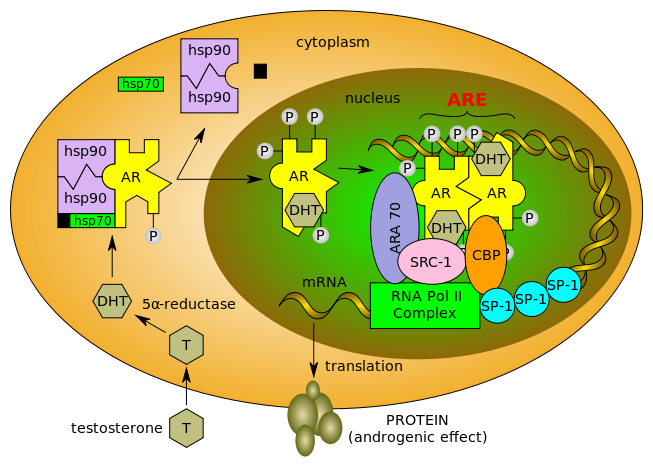
Source: wikipedia

The AR is not something one naturally and immediately thinks of in women, since testosterone is usually considered a manly thing.  That said, it is present in women in both normal breast epithelial cells and ~70% to 90% of invasive breast cancers.

Until recently, the link, however between AR status and breast cancer survival is uncertain and perhaps a little controversial, but Hu et al., (2011) looked at the association between the AR status and breast cancer survival in the Nurses’ Health Study (NHS) – see references at the end for the link to the article.

What was the study about?

According to the authors:

“The NHS is a prospective cohort study established in 1976 when 121,700 female registered nurses from across the United States, aged 30 to 55 years, completed a mailed questionnaire on factors that influence women’s health.

Follow-up questionnaires have since been sent out every 2 years to the NHS participants to update exposure information and ascertain nonfatal incident diseases. Follow- up rate from 1976 to December 2007 is 98.9% in our study.”

Not to be confused with an population/epidemiology study from the NHS (National Health Service) in the UK!  The main goal of this study was to:

“… determine the association of AR status with survival outcomes adjusting for covariates.”

What did the research find?

Out of all the breast cancers followed (n=1467), 78.7% were AR+. Additionally, amongst the ER+ patients (n=1,164), 88% were AR+:

“AR positivity was associated with a significant reduction in breast cancer mortality (HR, 0.68; 95% CI, 0.47–0.99) and overall mortality (HR, 0.70; 95% CI, 0.53–0.91) after adjustment for covariates.”

The situation was very different in women who were ER- (n=303) though:

“42.9% were AR-. There was a nonsignificant association between AR status and breast cancer death (HR, 1.59; 95% CI, 0.94–2.68).”

In other words, AR+ confers a better prognosis in ER+ breast cancer.

Now, the relevance of all this research is potentially important when considering possible mechanisms of resistance to aromatase inhibitor (AI) therapy in ER+ breast cancer.  Recall that one mechanism of resistance to AI treatment is mTOR, which is why the BOLERO2 trial with an AI (exemestane) plus an mTOR (everolimus) in the relapsed setting did so well in ER+ women.  Not all of the women in the trial responded to the treatment though, suggesting that other factors may play a role in acquired or adaptive resistance.

What is the importance of AR to therapies for breast cancer?

Normally, knowing whether a particular situation has a better or worse outcome isn’t particularly helpful for patients, since it doesn’t predict which therapy might be more appropriate. However, there is some other AR and breast cancer research from Cochrane et al., (2011) which was presented to the Endocrine Society Peter referred to that tells us a bit more of the AR story:

“We postulate that ER+ breast cancers that fail to respond or become resistant to current endocrine therapies (tamoxifen or AI) may do so because they have switched from growth controlled by estradiol (E2) and ER to growth controlled by liganded AR.

We therefore sought to determine if blocking AR activity could serve as a therapeutic intervention for such tumors.”

What did they do?

Cochrane et al, (2011) stated that:

“We used breast cancer cells that express ER and AR such as MCF7 cells and a cell line that we recently isolated that contains more AR than ER.

Our data indicate that although DHT does slightly inhibit E2-mediated proliferation, DHT alone is proliferative in cells such as MCF7 with both ER and AR, and is even more proliferative than E2 when AR is more abundant than ER.”

What did the results show?

The results were a) interesting and b) a little surprising:

“We found that while both the anti-androgen bicalutamide and the triple acting, non-steroidal, AR antagonist MDV3100 block DHT and R1881-mediated proliferation of breast cancer cells, we made the novel observation that MDV3100, but not bicalutamide, inhibits E2-mediated proliferation of breast cancer cells.”

These results led the authors to conclude that:

“Anti-androgens, such as MDV3100, may be particularly useful to treat patients whose tumors fail to respond to traditional endocrine therapy despite being ER+, or who have ER-/AR+ tumors.”

Not surprisingly, Medivation announced on their recent conference call this month that they will be seeking to explore this phenomenon in clinical trials.  I think this is a logical and exciting development that is well worth a shot on goal.  We know that not all the women in the BOLERO2 trial responded to exemestane and everolimus, so other mechanisms must be at play here.  This is certainly worth exploring.

The question with the study design of me for me though, is patient selection.  How do we determine which women whose initial AI therapy leads to relapse should go onto an mTORor an AR antagonist?  I’m guessing that maybe biopsies will be part of the answer.

In conclusion…

On the positive side, it would be pretty cool if we could uncover two mechanisms of resistance to AI therapy in ER+ breast cancer and have some viable therapies to offer women once relapse or acquired resistance sets in.  It would start to offer a) hope and b) potentially prolong outcomes further as we determine ways to shut down the various escape routes and signaling pathways.  If the concept works, given that up to 30% of women with ER+ breast cancer may have AR+ signaling, then it would also be good news for Medivation and Astellas with MDV3100’s potential upside.

References:

ResearchBlogging.orgHu, R., Dawood, S., Holmes, M., Collins, L., Schnitt, S., Cole, K., Marotti, J., Hankinson, S., Colditz, G., & Tamimi, R. (2011). Androgen Receptor Expression and Breast Cancer Survival in Postmenopausal Women Clinical Cancer Research, 17 (7), 1867-1874 DOI: 10.1158/1078-0432.CCR-10-2021

4 Comments

Heterogeneity remains one of the biggest barriers to progress in clinical research. Triple negative breast cancer is an excellent example of this conundrum as I’ve said many times here on this blog – it’s defined not what it is but what it’s not.  By that, I mean it’s a broad catch-all for all those women with breast cancer who are essentially ER/PR- HER2- but beyond that are likely other subsets yet to be identified or characterised.

That said, once we have a better sense of what those smaller groups are (from basic and translational research) then progress with targeted therapeutics is much more likely. Why? Because by reducing the inherent variability we increase the chances of success with a given target. If you don’t have a valid and well defined target to aim at then the risks of a negative result in large scale clinical trials are much much higher.

We may also see a new subgroup breast cancers emerge defined solely by their ER/PR- status irrespective of the HER gene.  This in itself would be an interesting idea as it lends itself well to the current grouping of patients.

Nature Genetics

This morning’s coffee browsing in Nature Genetics brought up something that piqued my interest greatly – Haiman and colleagues sent in a Letter reporting on a common risk variant for ER- breast cancer associated with chromosome 5P5, i.e. the TERT-CLPTM1L locus.

The essence of their research was given ER- breast cancer tends to be higher in women of African than European ancestry and confers a poorer prognosis, what common risk alleles could be identified? They collated information from genome-wide association study (GWAS) data in women of African (n=1,004 ER-, n=2,745 controls) and European (n=1,718 ER-, n=3,670 controls) ancestry. Here’s what they found:

“The (5P5) variant was also significantly associated with triple-negative (ER-negative, progesterone receptor (PR)-negative and human epidermal growth factor-2 (HER2)-negative) breast cancer, particularly in younger women (defined as less than 50 years of age).”

In addition, they also observed that:

“In combining the results across all studies (6,009 ER-negative cases and 20,708 controls with genotype data), rs10069690 was significantly associated with an increased risk of ER-negative breast cancer.”

What particularly struck me, however, was a little nugget buried deep in the discussion:

“We found no significant association with rs1006960 among ER- and PR-positive cases when stratified by HER2 status.”

In other words, it is the estrogen receptor status that is the defining characteristic. This suggests that not all triple negative women will behave in the same way, so identifying the factors that are important may change our thinking in how to approach patients in the future.

What do these findings mean?

This study is important because it identifies, for the first time, an aberration ie a common variant at the TERT-CLPTM1L locus that is associated with ER- breast cancer that also tended to occur in younger women. As we begin to dig deeper into the molecular biology of ‘triple negative breast cancer’, I use parentheses loosely here as that definition may one day change with more research, we are likely to:

  • Define new subsets of patients who may respond differently
  • Identify possible new targets for clinical trials of rationally targeted agents
  • Smaller trials will be needed for well-defined subsets that have a greater chance of a good response, this in turn makes an accelerated development potentially possible as we saw recently with crizotinib for ALK-positive lung cancer.

I look forward to following the burgeoning research in this area and suspect that we will see many more groups begin to isolate and identify important aberrations that drive the disease and offer new targets for therapeutic intervention.

References:

ResearchBlogging.orgHaiman, C., Chen, G., Vachon, C., Canzian, F., Dunning, A., Millikan, R., Wang, X., Ademuyiwa, F., Ahmed, S., Ambrosone, C., Baglietto, L., Balleine, R., Bandera, E., Beckmann, M., Berg, C., Bernstein, L., Blomqvist, C., Blot, W., Brauch, H., Buring, J., Carey, L., Carpenter, J., Chang-Claude, J., Chanock, S., Chasman, D., Clarke, C., Cox, A., Cross, S., Deming, S., Diasio, R., Dimopoulos, A., Driver, W., Dünnebier, T., Durcan, L., Eccles, D., Edlund, C., Ekici, A., Fasching, P., Feigelson, H., Flesch-Janys, D., Fostira, F., Försti, A., Fountzilas, G., Gerty, S., Giles, G., Godwin, A., Goodfellow, P., Graham, N., Greco, D., Hamann, U., Hankinson, S., Hartmann, A., Hein, R., Heinz, J., Holbrook, A., Hoover, R., Hu, J., Hunter, D., Ingles, S., Irwanto, A., Ivanovich, J., John, E., Johnson, N., Jukkola-Vuorinen, A., Kaaks, R., Ko, Y., Kolonel, L., Konstantopoulou, I., Kosma, V., Kulkarni, S., Lambrechts, D., Lee, A., Marchand, L., Lesnick, T., Liu, J., Lindstrom, S., Mannermaa, A., Margolin, S., Martin, N., Miron, P., Montgomery, G., Nevanlinna, H., Nickels, S., Nyante, S., Olswold, C., Palmer, J., Pathak, H., Pectasides, D., Perou, C., Peto, J., Pharoah, P., Pooler, L., Press, M., Pylkäs, K., Rebbeck, T., Rodriguez-Gil, J., Rosenberg, L., Ross, E., Rüdiger, T., Silva, I., Sawyer, E., Schmidt, M., Schulz-Wendtland, R., Schumacher, F., Severi, G., Sheng, X., Signorello, L., Sinn, H., Stevens, K., Southey, M., Tapper, W., Tomlinson, I., Hogervorst, F., Wauters, E., Weaver, J., Wildiers, H., Winqvist, R., Berg, D., Wan, P., Xia, L., Yannoukakos, D., Zheng, W., Ziegler, R., Siddiq, A., Slager, S., Stram, D., Easton, D., Kraft, P., Henderson, B., & Couch, F. (2011). A common variant at the TERT-CLPTM1L locus is associated with estrogen receptor–negative breast cancer Nature Genetics DOI: 10.1038/ng.985

Last week while I was away at the ASCO GenitoUrinary (GU) symposium in Florida, two interesting findings in cancer science hit the journals, one in breast cancer and the other in glioblastoma, a form of brain cancer.  I thought it would be a good idea to take a quick look at those new publications (see reference links below) over the next couple of days.

Today, we begin with the ZNF703 oncogene in Luminal B breast cancer.

This research is important because it’s the first oncogene to be found in the last 5 years and could be active in up to 1 in 12 breast cancers.   The last active oncogene to be discovered in breast cancer was HER2 and we all know how that worked out!

I always remember Harold Varmus’s pithy keynote lecture at AACR a few ago, where he described how oncogenes work in a very simple to understand way, namely:

“Oncogenes are normal genes that control growth in every living cell, but which, under certain conditions can turn renegade and cancerous.”

The latest research, jointly led by Cancer Research UK Cambridge Research Institute and the British Columbia Cancer Agency in Vancouver, Canada, reports how they looked at gene activity in breast tumour samples (n=1172), as well as looking at breast cancer cells grown in the laboratory.

It’s a elegant study that by a painstaking process of detective work, they were able to sort through the enormous mass of data and eliminate genes, until there was only the ZNF703 gene left within a region on chromosome 8, that was overactive in all the samples tested. Wow.

What is particularly interesting, is that that region of DNA was suspected of harbouring mutant genes twenty years ago, but it is only with modern data gathering and processing tools (ie high-resolution copy number profiling) that the oncogene could be actually be isolated.

Here’s what the scientists concluded:

“Overexpression of ZNF703 in normal human breast epithelial cells enhanced the frequency of in vitro colony-forming cells from luminal progenitors.  Taken together, these data strongly point to ZNF703 as a novel oncogene in Luminal B breast cancer.”

Luminal B histology is common in estrogen receptor-positive (ER+) breast cancers.

Keep an eye on this oncogene, because in the next few years we may well see new targeted drugs emerge from Pharma and Biotech pipelines to target the aberrant activity and by inhibiting the oncogene, switch off the signalling activity driving the cancer.  If that happens, this could well be an important and exciting finding:

“Clinical correlation: ZNF703 amplification is associated with a distinct subtype (Luminal B breast cancer) and with worse clinical outcome in ER+ cancers.  ZNF703 amplification is associated with higher grade and more aggressive tumours, explaining the worse clinical prognosis.”

It’s much easier to design a drug or therapeutic once you have a valid target to aim for and with more specific targeting, comes improved patient outcomes.

Reference:

ResearchBlogging.orgHolland, D., Burleigh, A., Git, A., Goldgraben, M., Perez-Mancera, P., Chin, S., Hurtado, A., Bruna, A., Ali, H., Greenwood, W., Dunning, M., Samarajiwa, S., Menon, S., Rueda, O., Lynch, A., McKinney, S., Ellis, I., Eaves, C., Carroll, J., Curtis, C., Aparicio, S., & Caldas, C. (2011).  ZNF703 is a common Luminal B breast cancer oncogene that differentially regulates luminal and basal progenitors in human mammary epithelium EMBO Molecular Medicine DOI: 10.1002/emmm.201100122

3 Comments
error: Content is protected !!