Pharma Strategy Blog

Commentary on Pharma & Biotech Oncology / Hematology New Product Development

Posts tagged ‘IGF1R’

Metastatic melanoma is quite a hot topic right now with a rich pipeline of products in development after a decade of little or no progress.  Of course, it is a bit like three London buses coming along at once after an hour long wait in the winter weather, but better late than never.

Many of you will remember the recent data from ipilimumab (BMS), an immunotherapy that showed increased survival, albeit with some severe adverse events, from the phase III trial in newly diagnosed metastatic melanoma presented at ASCO in the plenary session earlier this year, followed by a publication in the NEJM.  The FDA filing was subsequently submitted on the basis of the positive data.

Yesterday, BMS announced that the FDA have moved the PDUFA date back 3 months from Dec 25th to March 26th, 2011.  A precise reason for the delay wasn’t given , but the company did say:

“In response to an FDA request, Bristol-Myers Squibb submitted further analysis of data pertaining to the current application for pre-treated advanced melanoma and the agency considers this to be a major amendment to the drug’s BLA.”

I’m not going to speculate on the reasons for the extra review time or what the new data was, but it is an interesting and unexpected development.

Meanwhile, there’s also been a lot of buzz around targeted BRAF inhibition in melanoma lately, specifically around the initial stunning results seen with PLX4032 (Plexxikon & Roche).  So far, it seems that responses of around 6-12 months, with a median of around 8 months are possible with an kinase inhibitor that specifically targets the V600E mutation associated with BRAF, although there two problems:

  1. The responses are not durable as resistance (eg associated with MEK or AKT amplification) sets in.
  2. Inhibiting CRAF as well as BRAF appears to lead to an unwanted excess proliferation of squamous cells, which is reversible on withdrawal of treatment.

In the first case, a couple of recent papers have looked at mechanisms of resistance around BRAF inhibition that give us some clues of where to go next.
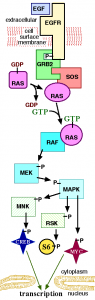
Gopal et al., (2010) decided to see what happened with AZD6244 or selumetinib (Array and AstraZeneca), a MEK and MAP/ERK inhibitor, and whether it would have any impact in mitigating BRAF resistance, given the potential close interaction within the RAS-RAF-MAPK pathway and downstream events that could be impacted through cross-talk and feedback loops:

“We analyzed a panel of Braf mutant human cutaneous melanoma cell lines for their sensitivity to growth and survival inhibition by AZD6244. We compared these effects with the baseline activation status of signaling pathways in the cells, and with AZD6244 treatment–induced changes in signaling networks.

These studies have identified the phosphoinositide 3-kinase (PI3K)-AKT pathway as a critical regulator of the efficacy of AZD6244 in Braf-mutant melanomas, including in cells without baseline activation of the pathway.”

In order to determine possible mechanisms of resistance in the cell lines, they compared the effects of AZD6244 treatment on their signaling pathways with effects in sensitive cell lines and found:

“Although all four of these Braf-mutant cell lines showed similar degree and duration of MAPK inhibition and several other proteins, the resistant cell lines increased their P-AKT levels following exposure to AZD6244, which was not observed in the sensitive cell lines.”

They went on to note:

“The functional significance of AKT activation is supported by the fact that inhibition of AKT activity, either by AKT knockdown or concurrent treatment with the mTORC1/2 inhibitor AZD8055, resulted in synergistic cell killing in the resistant cell lines.”

AstraZeneca and Merck have an ongoing partnership with their MEK (AZD6244) and AKT (MK-2206) kinase inhibitors, so combining them in a clinical trial to try and reduce resistance via feedback loops here would be an interesting approach worth trying.  Such a combination trial is currently recruiting in advanced solid tumours, not melanoma per se.  It is, however, a classic catch-all phase I study to see what kinds of cancers might respond and determine the MTD, but I would be very interested to see the data from patients with metastatic melanoma if they are enrolled.

Now, it has been shown in breast cancer cell lines showed that MEK inhibition resulted in cross-activation of the EGFR tyrosine growth factor receptor, but EGFR has not been shown to be relevant in melanoma, so Gopal et al., considered what other receptors might be responsible for mediating the effects.   In the discussion, an interesting snippet caught my eye:

“AZD6244 treatment induced a slight increase of IGF-I secretion by the cells, and knockdown of IGF-I also blocked P-AKT induction by AZD6244.  Supporting a specific role for the pathway in cell survival, recombinant IGF-I treatment blocked AZD6244-induced cell death, but not growth arrest, in the sensitive WM35.”

This might also suggest another useful combination approach to consider in clinical trials.

Previously, it has been shown that targeting BRAF can not only inhibit the important driver in melanoma, the V600E mutation, but it can also stimulate cellular signaling through the MEK-ERK pathway by activating the related family member C-RAF. This may explain the squamous cell proliferation seen in some patients with PLX4032. The more ideal BRAF inhibitor would therefore specifically target BRAF V600E, without activating CRAF at the same time.

Related to the subject of malignant melanoma, Kamata et al., (2010) just published a paper that looked at the relationship between BRAF and CRAF in the disease.  Previously it has been shown that D594A BRAF lacks kinase activity, but can induce the related gene product CRAF in addition to the mitogen-activated protein/extracellular signal-regulated kinase (ERK) kinase (MEK)/ERK pathway.  What they found was really interesting.  In a nutshell:

“We show that the aneuploid phenotype is dependent on Craf. Treatment with the MEK inhibitor U0126 did not attenuate the emergence of aneuploidy but prevented the growth of aneuploid cells.  These results provide a previously unidentified link between Craf and chromosomal stability, with important implications for our understanding of the development of cancers with driver mutations that hyperactivate Craf.”

Aneuploidy is an abnormal number of chromosomes and can lead to genetic instability, a key cancer hallmark. It’s an important concept here because Kamata et al., have offered a different reason for the CRAF proliferation observed with some BRAF inhibitors:

“Impaired activity BRAF mutants are frequently coincident with oncogenic RAS mutations in human cancers (26) and in these, albeit rare, cancers, we may expect the hyper-activated CRAF induced by the combination of both oncogenes to enhance the aneuploidy response compared with mutation of either oncogene alone.  Such a situation is likely to be highly detrimental to the individual and, indeed, this mechanism may well account for the highly aggressive melanomas we observed following the combined expression of D594A Braf and G12D Kras in melanocytes.”

All in all, this is a very complex yet fascinating area of research and for those of you interested in this field, I would highly recommend reading the latest papers.

Photo Credit: Wikipedia

References:

ResearchBlogging.org Boni, A., Cogdill, A., Dang, P., Udayakumar, D., Njauw, C., Sloss, C., Ferrone, C., Flaherty, K., Lawrence, D., Fisher, D., Tsao, H., & Wargo, J. (2010). Selective BRAFV600E Inhibition Enhances T-Cell Recognition of Melanoma without Affecting Lymphocyte Function Cancer Research, 70 (13), 5213-5219 DOI: 10.1158/0008-5472.CAN-10-0118


Garnett MJ, Rana S, Paterson H, Barford D, & Marais R (2005). Wild-type and mutant B-RAF activate C-RAF through distinct mechanisms involving heterodimerization. Molecular cell, 20 (6), 963-9 PMID: 16364920

Gopal, Y., Deng, W., Woodman, S., Komurov, K., Ram, P., Smith, P., & Davies, M. (2010). Basal and Treatment-Induced Activation of AKT Mediates Resistance to Cell Death by AZD6244 (ARRY-142886) in Braf-Mutant Human Cutaneous Melanoma Cells Cancer Research, 70 (21), 8736-8747 DOI: 10.1158/0008-5472.CAN-10-0902

Kamata, T., Hussain, J., Giblett, S., Hayward, R., Marais, R., & Pritchard, C. (2010). BRAF Inactivation Drives Aneuploidy by Deregulating CRAF Cancer Research, 70 (21), 8475-8486 DOI: 10.1158/0008-5472.CAN-10-0603

4 Comments

At the AACR meeting on Molecular Diagnostics and Cancer Therapeutics meeting in Denver, there was quite a bit of interesting scientific data coming out on cancer biology and biomarkers, so here is a quick synopsis of what appealed to me:

1. IGF-1R is over expressed in a subset of triple negative breast cancers (TNBC)

This presentation, from Witkiewicz et al., was interesting because they showed that IGF-1R might be a useful prognostic biomarker in TNBC. Usually, TNBC, which occurs in 15-20% of all breast cancers and is associated with a poorer prognosis, so finding a subgroup that might actually do better could be useful. Gene amplification was seen in 23% of the cases investigated. Caution must be exercised here, however, just because something is over expressed or amplified, does not mean that it is mutated, and therefore a potential druggable target with a therapeutic as we saw with the negative phase III results with figitumumab, an IGF-1R inhibitor in lung cancer.

What I would like to know though, is how many women with TNBC also have the BRCA1 or 2 mutation and have amplified IGF-1R? We know that targeting a cancer with one drug at one or two mutations in solid tumours has modest effects. But what if we target several things with a combination therapy, for a specific subset, then that might possibly yield different results altogether.

2. Molecular biomarker analysis using circulating tumour cells (CTCs)

Siminder Atwal, a Genentech scientist, presented her work on CTCs, with the idea of determining whether they could be used as a predictive biomarker by correlating CTCs with HER2 status in archival tumour samples. CTC's in theory should match tumour biopsies since they are cells that have shed from the primary tumour.  The Genentech scientists found that they were indeed correlated, with a high concordance (95%) using the CellSearch system. Of course, EpCAM expression can vary in some tumour types, complicating analysis and interpretation, but it looks like they saw some early hints that molecular biomarker status in CTCs are indeed reflecive of the biomarker status in patient tumours.

Predictive biomarkers allow us test whether a patient is likely to benefit from a given treatment, so the obvious and leading question is whether this work could be extended to look at eg CTC's in colorectal, lung or breast cancers to determine whether a patient is more likely to respond to bevacizumab (Avastin) or not. It would probably be easier in breast (lots of biopsy samples) and colorectal (lots of surgery providing samples).

At the moment, there is no way of telling who is most likely to respond to Avastin, so a predictive biomarker test would be really useful for clinicians before deciding on treatment, rather than having to expose thousands of patients to the systemic side effects. Given that the FDA have to make a decision by the year end on the full approval of Avastin in breast cancer, it is a shame that they likely won't have this sort of data to help guide a decision.  

3. BRCA1 mutations in prostate cancer

Gerhardt Attard gave an enlightening talk entitled, "Circulating tumor cells: Potential uses, pitfalls and challenges in their use as pharmacodynamic markers" but what struck me was not so much the fascinating information about CTCs as his mention that a subset of prostate cancer patients have the BRCA1 mutation. They tested the impact of olaparib, a small molecule PARP inhibitor from AstraZeneca, and found that all three responded.

A study open for men with prostate cancer and either BRCA1 or 2 mutations is currently recruiting patients. Given the interest with PARP inhibitors in breast and ovarian cancers, I'll be following this development with great interest.

Yesterday, I covered some of the key pathways and kinases associated with cell energy metabolism, LKB1 and AMPK.  These, together with Insulin-like Growth Factor-I (IGF-I) and the insulin receptor (IR), appear to play important roles in the broader regulation of energy and homeostasis.  Experimental evidence suggests that an overexpression of IGF-I is implicated in pancreatic tumours, for example. Increased IGF-II and decreased IGF binding protein (IGFBP)-3 serum concentrations have also been linked to a number of other cancers (see journal link below).

If we look at the IGF-IR pathway, we can see more clearly how they all interlink and how mTOR, LKB1 and AMPK may all be a critical part of the process:

IGF1RSource: Tao et al., (2007)

Research conducted over the past two decades has shown the importance of the type 1 insulin-like growth factor receptor (IGF-1R) in tumorigenesis, metastasis, and resistance to existing forms of cancer therapy. We also now know that feedback and cross-talk between IGF1R and IR can exist, driving hyperglycemia and free insulin production, as shown in a previous post regarding IGF-1R inhibition with figitumumab.  

Clearly, there are drugs commercially available that reduce hyperglycemia in diabetes, so the next logical step would be to see what happens if they were to be used in cancer patients or people with a very high risk for developing cancer.

Background:

The journal Cancer Prevention Research has just published an interesting series of research papers around metformin, a generically available oral biguanide for the treatment of Type II diabetes, in cancer prevention.  An excellent overview to the topic was covered in a comprehensive review of metformin for oncology applications by Michael Pollak, which is well worth reading.

In short, metformin was originally derived from a plant extract from the French lilac and activates AMPK in the liver.  This means that it plays an important role in insulin signaling, whole body energy balance, and the metabolism of glucose.  In diabetes, metformin therefore improves hyperglycemia primarily through its suppression of hepatic glucose production, ie gluconeogenesis. 

If we accept the research that shows high levels of free IGFI (from the higher IGF-I/IGFBP-3 molar ratio) are important in cancer growth, then it makes logical sense to see what effects taking metformin might have on cancer prevention and risk reduction in animal models and humans.

Effect of metformin on lung cancer

Memmot et al., published a paper entitled, "Metformin Prevents Tobacco Carcinogen– Induced Lung Tumorigenesis" in Cancer Prevention and Research. The idea was that activation of the mammalian target of rapamycin (mTOR) pathway is an important and early event in tobacco carcinogen–induced lung tumorigenesis, thus therapies that target mTOR might be effective in the prevention or treatment of lung cancer.  Since metformin activates AMPK, which in turn inhibits mTOR, they decided to investigate the possibilities in a mouse model.  The mice were given a known cancer causing carcinogen, nitrosame ketone (NNK) and a group were treated with metformin and compared to controls (no treatment).

What they found was startling:

"Oral administration of 1 or 5 mg/mL metformin decreased lung tumor burden in mice by 38% and 53%, respectively."

What happened to the control mice who did not receive metformin? 100% of them developed tumorigenesis.  To put these findings into perspective:

"The steady-state levels of metformin in mice given 5 mg/mL are similar to those in diabetic patients using metformin, suggesting the possibility that clinical prevention of lung cancer could be achieved with standard oral dosing."

Unsurprisingly even greater results were observed with direct intravenous metformin:

"intraperitoneal administration of metformin was more effective than oral administration and decreased tumor burden by 72%."

Overall, the researchers found that inhibition of the mTOR pathway in tumours was associated with decreases in levels of circulating IGF-I and insulin, which may well explain the dramatic results they saw with metformin.

Effect of metformin on colorectal cancer

Animal models are all very well, but what about human data? Japanese researchers have now reported the first study of metformin in people without diabetes, albeit on a small scale. Hosono et al., published an article, "Metformin Suppresses Colorectal Aberrant Crypt Foci in a Short-term Clinical Trial" after their earlier work in rodents. Rectal aberrant crypt foci (ACF) are an endoscopic surrogate marker of colorectal cancer, essentially an early precursor to malignant disease.

This work looked at prospectively randomized people without diabetes (n=26) with ACF to either treatment with metformin (250 mg/d, n=12) or no treatment (control, n=14).  The initial results are promising:

"At 1 month, the metformin group had a significant decrease in the mean number of ACF per patient (8.78 ± 6.45 before treatment versus 5.11 ± 4.99 at 1 month, P = 0.007), whereas the mean ACF number did not change significantly in the control group (7.23 ± 6.65 versus 7.56 ± 6.75, P = 0.609)."

In other words, this is the first reported trial showing that metformin can inhibit colorectal carcinogenesis in man. It also provides preliminary evidence that metformin suppresses colonic epithelial proliferation and rectal ACF formation and may be a potentially useful agent for early cancer chemoprevention.

Conclusions

In an accompanying editorial, Engelman and Cantley provided some useful commentary on the underlying pathways and highlighted the promise of metformin for cancer prevention and therapy in the lung and other sites.

Of course, no pharma company is going to sponsor large scale epidemiology trials as metformin is now available generically, but given the prominence given to chemoprevention by Harold Varmus in his NCI acceptance speech earlier this year, perhaps we will see some progress from both the NCI and the NIH in this field. It's really a public health issue that needs a broader perspective than individual companies can offer alone.

We all intuitively know that preventing or catching cancer as early as possible will likely yield better long term outcomes for patients than treating end-stage metastatic disease with highly expensive therapies.


Additional References:

ResearchBlogging.org Douglas JB, Silverman DT, Pollak MN, Tao Y, Soliman AS, & Stolzenberg-Solomon RZ (2010). Serum IGF-I, IGF-II, IGFBP-3, and IGF-I/IGFBP-3 Molar Ratio and Risk of Pancreatic Cancer in the Prostate, Lung, Colorectal, and Ovarian Cancer Screening Trial. Cancer epidemiology, biomarkers & prevention : a publication of the American Association for Cancer Research, cosponsored by the American Society of Preventive Oncology PMID: 20699371

Tao Y, Pinzi V, Bourhis J, & Deutsch E (2007). Mechanisms of disease: signaling of the insulin-like growth factor 1 receptor pathway–therapeutic perspectives in cancer. Nature clinical practice. Oncology, 4 (10), 591-602 PMID: 17898809

Chitnis MM, Yuen JS, Protheroe AS, Pollak M, & Macaulay VM (2008). The type 1 insulin-like growth factor receptor pathway. Clinical cancer research : an official journal of the American Association for Cancer Research, 14 (20), 6364-70 PMID: 18927274

Douglas JB, Silverman DT, Pollak MN, Tao Y, Soliman AS, & Stolzenberg-Solomon RZ (2010). Serum IGF-I, IGF-II, IGFBP-3, and IGF-I/IGFBP-3 Molar Ratio and Risk of Pancreatic Cancer in the Prostate, Lung, Colorectal, and Ovarian Cancer Screening Trial. Cancer epidemiology, biomarkers & prevention : a publication of the American Association for Cancer Research, cosponsored by the American Society of Preventive Oncology PMID: 20699371

1 Comment
error: Content is protected !!