Pharma Strategy Blog

Commentary on Pharma & Biotech Oncology / Hematology New Product Development

Posts tagged ‘MEK’

“RAF inhibitors (vemurafenib and dabrafenib) have profound clinical activity in patients with BRAF-mutant melanoma, but their therapeutic effects are limited by the emergence of drug resistance.”

Solit and Rosen (2014)

For today’s post on Science Fridays, I wanted to take a look at an overview paper, published in Cancer Discovery, from two researchers in the metastatic melanoma field who have been looking at multiple mechanisms of resistance.  It’s an important topic because while we have seen incremental improvements in outcomes for this disease, the 5-year survival rate is still rather poor with only 10–20% of metastatic patients still alive by then.  This is not to disparage the efforts of scientists, clinicians or companies working in this space, far from it, but there is is clearly a need for new therapies, strategies and combinations, given the high unmet medical need that exists.

We still have a long way to go in moving the survival needle dramatically.

It wasn’t until I searched for related blog posts to link to this one that I realised how much we have already covered on this topic! Regular readers will recall discussions here on PSB on various combinations such as:

  1. RAF + MEK inhibitors (downstream resistance)
  2. RAF + PI3K-AKT-mTOR inhibitors (cross resistance)
  3. RAF + CTLA–4 checkpoint inhibitors (anti-tumour immunity)

to name a few examples.

We have seen that adding a MEK inhibitor to dabrafenib e.g. trametinib can overcome resistance temporarily and add a few extra months before the resistance sets in again. Similarly for PI3K inhibitors tested to date. Adding ipilimumab, an anti-CTLA–4 checkpoint inhibitor held much promise, but the combination was abandoned with the emergence of unexpected liver toxicity.

Results thus far suggest that something else is acting as an escape route, thereby enabling the tumour to continue driving oncogenic addiction to BRAF.

The $64K questions are what is happening and what can we do about it?

We also need to remember that clinical research advances piecemeal based on evidence from preclinical reseach, so we see the logical evolution of BRAF monotherapy -> combos with downstream (MEK) or upstream (NRAS) targets in same pathway -> combos with diagonal (PI3K) pathways etc.

What Solit and Rosen have done is put a nice summary together of the state of play in this disease and the paper (see References below) is well worth reading.

Their main assertion is interesting, namely:

“The common feature of each of these mechanisms of resistance is that they result in activation of ERK signaling that is insensitive to the RAF inhibitor. Thus, RAF inhibitor resistance is often associated with maintenance of activation of the oncogene-driven pathway.”

Two recent papers are cited in support of this theory from Shi et al., (2014) and Allen et al., (2014) – see References below for additional background reading. Both studies used patient samples to look at clonal evolution and the genetic landscape in advanced melanoma. It’s actually quite amazing what unbiased exome sequencing can uncover at the molecular level, not least are the development of new mutations and other functional alterations.

The Shi et al., (2014) study was briefly summarised by Solit and Rosen:

“Multiple biopsies were obtained at different times or from disparate locations from several patients, and more than a single lesion in the ERK pathway was identifi ed in multiple patients typically within
different tumor biopsies.”

They went to note:

“A detailed phylogenetic analysis of multiple progressive lesions from a subset of these patients suggested branching evolution of tumors in which the development of genetic diversity was not linearly associated with time.”

Previously, a case report found distinct mechanisms of BRAF inhibitor resistance were present in two different progressing lesions from a single patient, so the work of Shi et al., (2014) is consistent with this finding. It blows my mind that different lesions in the same patient might behave completely differently though – imagine trying to devise an appropriate and effective clinical strategy in these cases?!

Allen et al’s (2014) work also involved whole exome sequencing (WES) from patient samples:

“WES was performed on paired pretreatment and progression samples collected from 45 patients, of whom 14 developed resistance soon after initiation of therapy (within 12 weeks). They also detected several resistance mechanisms that had been previously identified to confer RAF inhibitor resistance, including mutations in NRAS , MAP2K1, and NF1 and BRAF amplification.”

A third important study in this area from Wagle et al., (2014) adds to the weight of evidence with new mutations developing. Solit and Rosen continued the story:

“Consistent with the preclinical studies highlighted above demonstrating that MEK1 and MEK2
mutations can confer RAF and MEK inhibitor resistance, a MEK2 Q60P mutation was identifi ed in 1 of 5 patients studied. Of greater surprise to the investigators, one patient had a BRAF splice variant lacking exons 2–10 and a second patient had BRAF amplification.”

By now, you can see the sheer variety of changes and adaptations taking place in different studies around the world in some of the top melanoma labs. What do they have in common though?

“One hypothesis to explain this result is that increased abundance of the oncogenic driver (in this case BRAF) in response to prolonged drug treatment results in increased flux through the ERK pathway and restoration of ERK activity above the threshold required for inhibition of cell proliferation.”

The next challenge is to figure how we can approach better therapeutic index and shutting down of the pathways?

“The results suggest that the early adaptive response of BRAF -mutant cells to ERK pathway inhibition may promote the selection of resistant clones that harbor additional genomic events that
confer higher levels of RAF inhibitor resistance. The data also support combinatorial approaches that attenuate the adaptive response, including the addition of a PI3K or AKT inhibitor to the RAF and MEK (or ERK) inhibitor combination.”

The problem with this approach though, is that the neither the BRAF nor PI3K inhibitors have been able to reach or go beyond the single agent dosing schedules:

“As previous attempts to combine MAPK and PI3K pathway inhibitors have been limited by overlapping toxicities, upfront testing of intermittent treatment schedules should be considered.”

This is the also approach that Das Thakur suggested in her work presented at AACR last year, and subsequently published in Nature, to delay the development of resistance to vemurafenib.

I do think this one area where we may well see new trials evolve in advanced melanoma, so we will have to wait for new data before we can see if the strategy is successful at delaying the emergence of resistant clones. It is good to see the evolution of solid preclinical and translational evidence from patient biopsies helping to inform future clinical trial strategies.

In the meantime, the next major milestone I’m waiting for is on Roche/Genentech’s MEK inhibitor, cobimetinib (GDC–0973), which is due to report combination data with vemurafenib (continuous dosing) later this year. It will be interesting to see if this inhibits MEK more completely than trametinib and whether the combination has a better initial outcome than dabrafenib plus trametinib, which added about two to three months of extra survival over dabrafenib alone.

References:

ResearchBlogging.orgSolit DB, & Rosen N (2014). Towards a Unified Model of RAF Inhibitor Resistance. Cancer discovery, 4 (1), 27–30 PMID: 24402945

Shi H, Hugo W, Kong X, Hong A, Koya RC, Moriceau G, Chodon T, Guo R, Johnson DB, Dahlman KB, Kelley MC, Kefford RF, Chmielowski B, Glaspy JA, Sosman JA, van Baren N, Long GV, Ribas A, & Lo RS (2014). Acquired Resistance and Clonal Evolution in Melanoma during BRAF Inhibitor Therapy. Cancer discovery, 4 (1), 80–93 PMID: 24265155

Van Allen EM, Wagle N, Sucker A, Treacy DJ, Johannessen CM, Goetz EM, Place CS, Taylor-Weiner A, Whittaker S, Kryukov GV, Hodis E, Rosenberg M, McKenna A, Cibulskis K, Farlow D, Zimmer L, Hillen U, Gutzmer R, Goldinger SM, Ugurel S, Gogas HJ, Egberts F, Berking C, Trefzer U, Loquai C, Weide B, Hassel JC, Gabriel SB, Carter SL, Getz G, Garraway LA, Schadendorf D, & Dermatologic Cooperative Oncology Group of Germany (DeCOG) (2014). The Genetic Landscape of Clinical Resistance to RAF Inhibition in Metastatic Melanoma. Cancer discovery, 4 (1), 94–109 PMID: 24265153

Wagle N, Van Allen EM, Treacy DJ, Frederick DT, Cooper ZA, Taylor-Weiner A, Rosenberg M, Goetz EM, Sullivan RJ, Farlow DN, Friedrich DC, Anderka K, Perrin D, Johannessen CM, McKenna A, Cibulskis K, Kryukov G, Hodis E, Lawrence DP, Fisher S, Getz G, Gabriel SB, Carter SL, Flaherty KT, Wargo JA, & Garraway LA (2014). MAP Kinase Pathway Alterations in BRAF-Mutant Melanoma Patients with Acquired Resistance to Combined RAF/MEK Inhibition. Cancer discovery, 4 (1), 61–8 PMID: 24265154

Das Thakur M, Salangsang F, Landman AS, Sellers WR, Pryer NK, Levesque MP, Dummer R, McMahon M, & Stuart DD (2013). Modelling vemurafenib resistance in melanoma reveals a strategy to forestall drug resistance. Nature, 494 (7436), 251–5 PMID: 23302800
At AACR last year, one of the most revealing presentations was on metastatic melanoma, specifically, some elegant research by Meghna Das Thakur (NIBR) demonstrating that intermittent pulsing of vemurafenib (a BRAF V600E inhibitor) led to less resistance than inhibiting the target 24/7.

Many of us wondered whether such a pulsing approach would be useful for other tyrosine kinase inhibitors (TKIs).

Fast forward to this week.

CD current Jan 2014Neal Rosen’s lab at MSKCC has an interesting new paper out looking at the effects of pulse dosing with PI3K and ERK inhibition, since targeting both has long been suspected to be key in overcoming cross-resistance.

Recall that despite promising preclinical research, most of the early patient trials looking at targeting the PI3K-Akt-mTOR and RAS-RAF-MEK-ERK pathways in combination were, however, disappointing to say the least, both in terms of the side effect profile, and also with respect to clinical efficacy.

These results also applied to combinations with chemotherapy, which were added to either agent to try and induce cell death via apoptosis.

We know that the PI3K pathway is dysregulated in many cancers, so why have the combinations tried to date produced less than optimal results?

Well, Will et al., (2014) showed that:

  1. RAS-ERK pathway is a key downstream effector pathway of oncogenic PI3K
  2. ERK inhibition is required for apoptosis (cell death) to occur with a PI3K inhibitor
  3. It is important to coordinate downregulation of AKT and ERK since both are necessary for induction of apoptosis and antitumor activity
  4. Such an effect can be achieved with intermittent dosing, which will also likely decrease toxicity and allow administration of therapeutic doses

Ah so the same concept that Das explored in metastatic melanoma could also have potential with PI3K and MEK inhibition!

I find this approach fascinating because in the past, when I queried whether we needed to hit two targets maximally and continuously, rather than look at intermittent or minimally effective dosing (MED), industry people were up in arms and sent me more heated emails on this topic than anything else we’ve ever blogged about!

Meanwhile, Rosen himself hinted at this solution in a talk at the AACR Molecular Targets meeting in Boston last year and said a publication was underway to explain their findings. Generally, I don’t report on unpublished findings out of respect to the scientists and thus didn’t mention it in our extensive AACR Targets Coverage, but am delighted this is now a topic for more public discussion.

Part of the conundrum was articulated by Will et al., (2014) in their author manauscript (see below for the link under the Cancer Discovery Online First Section this month):

“Since mTOR and AKT inhibitors reactivate PI3K signaling, we asked whether PI3K inhibitors have more significant antitumor activity, perhaps by inhibiting other PI3K targets in addition to AKT/mTOR.

Selective PI3K and AKT inhibitors were compared in tumors with activation of PI3K pathway signaling in order to assess differences in the biochemical and biologic consequences of their inhibition. Both inhibitors effectively inhibited downstream targets of AKT, relieved feedback inhibition of growth factor receptors, and inhibited cell growth. However, in HER2-dependent breast cancers, PI3K inhibitors, but not AKT inhibitors, caused the rapid induction of a significant degree of apoptosis.

We find that, whereas AKT inhibitors inhibit AKT/mTOR and activate ERK signaling, PI3K inhibitors inhibit both. They cause durable inhibition of AKT signaling but also transient inhibition of RAS activation and ERK signaling, both of which are required for induction of apoptosis. Moreover, induction of apoptosis by an AKT inhibitor is significantly enhanced when combined with a MEK inhibitor.

Our results show that PI3K is upstream of wild type RAS as well as AKT/mTOR, and this causes the therapeutic consequences of PI3K inhibition to be significantly greater than those of AKT inhibition.”

A number of different inhibitors of PI3K, AKT, mTOR and MEK were explored in this research, so the results are not limited to one or two.

One important question that the group sought to address the inhibition issue:

“PI3K inhibitors cause rapid inhibition of ERK in breast cancer cells with HER2 amplification, but P-ERK levels rebound fairly quickly. Even so, this transient inhibition is required for significant induction of apoptosis by these drugs. We asked whether more complete and sustained inhibition of ERK might enhance induction of cell death by the PI3K inhibitor.”

They found that:

“These results suggest that, in some cells, inhibition of other non-AKT targets of PI3K contribute to induction of apoptosis, or that stronger MEK inhibition is required to fully activate apoptosis. Combined inhibition of MEK and PI3K caused more apoptosis than any of the other treatments in all three models.”

This lead to further work and the finding that:

“Pulsatile PI3K inhibition caused initial tumor regression and significantly suppressed tumor growth. The effectiveness of intermittent administration of the PI3K inhibitor and its superior antitumor activity compared to AKT inhibition were confirmed in another HER2 amplified, PI3K mutant breast cancer model, MDA-MB–361.”

The reason for this?

“We hypothesized that the effectiveness of PI3K inhibition was due in part to its combined inhibition of ERK and AKT.”

The Will et al., (2014) article is available online and open access (see here for direct link) – I highly recommend those interested in this field checking it out and reading the nuggets for yourself, it’s well written and easy to follow.

What does all this mean?

It would be hard for me to improve on Will et al., (2014) conclusion that:

“Recently, treatment with more selective PI3K inhibitors has led to greater therapeutic efficacy in lymphomas and in breast cancer with PI3K mutation or HER2 amplification. The ability of any PI3K inhibitor to inhibit signaling adequately is limited by physiologic toxicity. Moreover, attempts to combine MEK inhibitors with `dual specificity’ PI3K or AKT inhibitors have been complicated by severe toxicity at modest doses of these drugs.

The idea that the pathway must be inhibited continuously dominates the clinical development of these drugs.

Our finding that transient inhibition of PI3K is effective in in vivo models suggests that periodic rather than continuous target inhibition is an alternative strategy that would allow adequate pathway inhibition without causing inordinate toxicity or chronic feedback reactivation of receptors.

Thus, combining PI3K inhibitors, MEK inhibitors and, perhaps, inhibitors of key reactivated RTKs, and administering them at high dose on intermittent schedules may be a more effective therapeutic strategy for these tumors.”

Overall, don’t be surprised to suddenly see new clinical trials emerge evaluating intermittent dosing with PI3K and MEK inhibitors. The only questions in my mind is who will be the first to go this route and who will be able demonstrate superior efficacy and tolerability in patients?

The scientific rationale is very solid for intermittent dosing with BRAF V600E inhibitors and now with the combination with a PI3K plus a MEK inhibitor; it will be really interesting to see if such an approach will translate successfully in the clinic.  I hope it does because improving outcomes is ultimately what we are all here for.

Reference:

ResearchBlogging.orgMarie Will, Alice Can Ran Qin, Weiyi Toy, Zhan Yao, Vanessa Rodrik-Outmezguine, Claudia Schneider, Xiaodong Huang, Prashant Monian, Xuejun Jiang, Elisa de Stanchina, Jose Baselga, Ningshu Liu, Sarat Chandarlapaty, & Neal Rosen (2014). Rapid induction of apoptosis by PI3K inhibitors is dependent upon their transient inhibition of
RAS-ERK signaling Cancer Discovery : 10.1158/2159–8290.CD–13–0611

One of the interesting themes for that emerged for me at AACR this year was the amount of effort that is being expended on strategies to overcome drug resistance. This was particularly noticeable in metastatic melanoma and non-small cell lung cancer (NSCLC).  More on lung cancer in another post, as today I want to focus on melanoma.

In the advanced melanoma, vemurafenib is given to patients with the BRAFV600E mutation, which occurs in approximately 50% of patients. This oncogene drives activity of the tumour, but inhibition with vemurafenib (Zelboraf) has shown some remarkable effects, as the stunning before and after photos from Levi Garraway’s group demonstrate.

The challenge, however, is that adaptive or acquired resistance can occur in response to treatment and patients sadly find their melanoma returning after approximately 6-9 months on continuous daily therapy.

At last year’s ASCO, we saw that adding a MEK inhibitor such as trametinib to a BRAF inhibitor such as dabrafenib added around an extra 3 months over single agent BRAF therapy before the resistance set in and the disease returned, sometimes with a deadly vengeance.

I’ve written here on this blog about numerous mechanisms of resistance in advanced melanoma from MEK to COT and others (see related posts below for background reading).

The big question at this AACR was how is the field progressing with new research?

Sometimes, we have to go back to the lab to study animal models of resistance before returning to the clinic with new ideas.

Screen Shot 2013-04-15 at 2.54.50 PMThat’s what a young Novartis Postdoctoral fellow from NIBR, Meghna Das Thakur, did. She asked critical questions and attempted to answer them in a series of elegant experiments with mice as well as retrospectively test the concept in patient data. The cool thing is that while many of the oral sessions were taken up by the Major League researchers is that it’s also nice to see up and coming young scientists present some nicely done research.

What Dr Thakur did was really interesting…

Her hypothesis was simple – that resistant tumours are ‘less fit’ than sensitive cells and have a selective disadvantage over sensitive cells in the absence of drug.

If this were true then we would expect to see dependence on drug for growth of resistant tumours in xenografts, much as we do in humans, with vemurafenib. The data clearly showed that vemurafenib resistant tumours were dependent on drug for growth. They also observed that:

1) p-ERK levels increased following withdrawal of vemurafenib in resistant tumours
2) There was a great deal of heterogeneity in the mechanisms of resistance

The key question then becomes how can we use this information to prevent resistance?

One way to explore this is to look at selective pressure, since vemurafenib is usually given continuously…

  • Treating continuously means that selective pressure enriches resistant cells
  • However, withdrawing the drug means that resistant cells suffer a fitness deficit

Essentially, the researchers noted that, “alternating the selective pressure prevents the emergence of a resistant population.”

In comparing continuous vs intermittent dosing, two things could be concluded from the model:

1) Resistant tumours emerge more rapidly under continuous dosing with vemurafenib
2) Intermittent dosing in multiple tumor xenograft models forestalled resistance

What can we learn from retrospective patient data?

What they did next was to look at computed tomography (CT) scans analysed for evidence of vemurafenib-dependence in patients treated with vemurafenib in the BRIM-3 and vemurafenib safety study, which were identified from the clinical trials database at the Royal Marsden Hospital. In particular, they focused on patients who stopped treatment because of progressive disease (PD).

Of 42 patients identified, 19 of these had CT scans performed after cessation of vemurafenib available for review, while 23 patients did not have a CT available for review and in 16 patients this was because of rapid PD.

For each of those 19 patients with a post-vemurafenib CT, the total tumour volume on three consecutive CT scans was recorded:

  • The CT performed prior to stopping vemurafenib
  • The CT performed when progressive disease was diagnosed and vemurafenib stopped
  • The CT performed after vemurafenib was stopped and prior to the initiation of further therapy

They found that 14 of the 19 patients experienced decreased tumour growth rate following cessation of vemurafenib, supporting the hypothesis that resistant tumours emerge more rapidly under continuous dosing with vemurafenib.

In this model, it is clear that intermittent dosing prolongs survival, but what is the underlying mechanism, and what does this mean for future treatment of patients and also clinical trial designs?

From this initial work it was clear that the MOA is not yet fully understood and further bench work will be needed to elucidate the mechanisms involved.  We don’t yet know, as the researchers point out, whether:

“Does resistance come from a clonal population or is it an adaptation or re-wiring of a selected few cells?”

What was clearer though, is that new clinical research will be needed to evaluate the potential for intermittent vs continuous dosing in patients, particularly in combination:

  • Will there be greater selective pressure from BRAF + MEK inhibitor combinations vs BRAF alone?
  • Identify combination partners that could be used during BRAF inhibitor holiday.

Overall…

I thought this was a very nice piece of well thought out research, perhaps one of my favourites from the AACR meeting this year.  Critically, we saw that the preclinical mouse xenograft model predicted a clinically-relevant resistance mechanism. Removal of drug from resistant cells leads to MAPK pathway hyper-activation and resistant cells experience a fitness deficit. Cycling the mice on and off therapy led to better outcomes than if they were dosed continuously, thereby giving us a new strategy to consider in melanoma patients.

The main impact of this preclinical study is that future clinical research in advanced melanoma should investigate the value of intermittent dosing strategies to improve patient outcomes.

The work turns the old concept of continuous dosing 365/24 on its head – suppressing the BRAFV600E oncogene continuously in melanoma may not necessarily be the best strategy in terms of superior outcomes.

This this does NOT mean that ALL tumours will behave in a similar fashion and intermittent dosing should be tested first in clinical trials where there is sufficient scientific evidence to warrant it.  If I were a patient, considering drug holidays without any evidence of effectiveness would NOT be a good idea.

I’m really looking forward to seeing the results of future combination trials with intermittent dosing to see if outcomes are indeed improved beyond would we currently see with continuous dosing either alone or in combination.


4 Comments

Today is the 1000th blog post here on PSB, a milestone I never imagined actually reaching while writing the inaugural and rather boring post way back in 2006. At that time, 10 posts seemed a lot, never mind 100 or 1000! Anyway here we are, thus the facing the new dilemma of what to write about to celebrate the event.

The nice thing about having a following on Twitter is a ready supply of suggestions and papers from readers. Today’s suggestion comes from Angela Alexander (@thecancergeek), a Post Doc in breast cancer research at MD Anderson who asked if I had seen the exciting new phase II data on MEK inhibition in lung cancer from Pasi Janne’s lab. I’ve long been an admirer of his work, so it is fitting the data has just been published in Lancet Oncology this week (reference below).

Background on KRAS in lung cancer:

KRAS is a particularly tricky gene target because some tumours are seriously addicted to this oncogene, making it tough to completely shutdown from a pathway perspective. Part of the reason is that few drugs possess sufficient therapeutic index and thus resistance can occur fairly early. Recently, though, a number of companies have been exploring targeting downstream of KRAS to see if that approach could attentuate the driver activity in some way. One of these targets is MEK, which many of you will be familiar with in metastatic melanoma, where MEK inhibitors have been shown to be an effective strategy in combination with BRAF inhibitors to produce improved outcomes.

KRAS has been found to be abnormal, or mutated, in approx. 20-25 percent of patients with non-small cell lung cancer (NSCLC), making it the most frequent of the mutations seen in this disease.  We also know that KRAS mutations predict a poor response to EGFR inhibitors and are a negative prognostic indicator.  Finding therapeuetic strategies to overcome KRAS are therefore a high priority in clinical research.

What is the latest study about?

Janne et al., (2012) performed a simple but elegant phase II study looking at the impact of adding a MEK inhibitor, selumetinib (AZD6244/ARRY-142886) from AstraZeneca and Array to standard chemotherapy, docetaxel (Taxotere) to determine whether targeting KRAS indirectly would impact overall survival (OS) and allow patients to live longer. Selumetinib targets both MEK1 and MEK2 and previous phase I trials suggested a promising safety and efficacy profile to warrant further investigation.

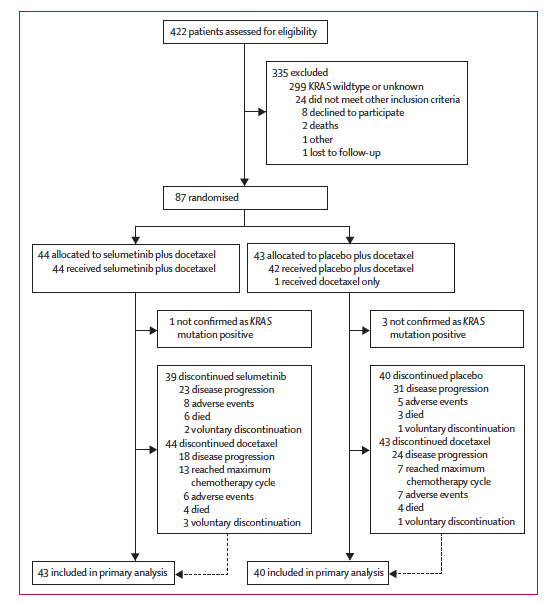
To get an idea of the complex logistics involved in the study, 422 patients were screened from 67 sites in 12 countries, of whom 87 whom previously received initial chemotherapy and had both NSCLC AND the KRAS mutation were selected to participate in the trial, indicating an incidence of 20.1% for KRAS-positivity in this sample:

Source: Jänne et al., (2012)

Half the sample (n=44) were randomised to receive standard docetaxel chemotherapy (75 mg/m2 q3w) plus selumetinib capsules (75 mg BD) and the other half (n=43) received docetaxel plus placebo. Both groups were treated until progression or toxicities were unacceptable. Subsequent therapies were allowed, but not crossover.

The primary endpoint for this study was OS and secondary endpoints included PFS, objective response and others such as safety.

What did they find?

Now, first up I would expect the docetaxel alone group to have an overall survival in the second-line setting of around 5-6 months. In this trial the MOS for the placebo group was 5.2 months, which is in line with expectations. However, the selumetinib arm had a near doubling in MOS to 9.4 months, which I think is quite impressive in a very difficult to treat subgroup. PFS also saw a doubling from 2.1 months in the docetaxel alone group to 5.3 months in the docetaxel plus selumetinib group.

Toxicities appeared to be in line with previous trials – selumetinib tends to increase grade 3/4 events when combined with docetaxel i.e. neutropenia (67%) compared to the docetaxel alone group (55%), febrile neutropenia (18% vs. 0%) and asthenia (9% vs. 0%).

What can we conclude from this study?

I thought these results were very promising, although of course, the caveat is that it’s early days yet and a larger phase III multi-center trial is needed as a confirmatory study – not all phase II trials will yield positive data once they complete phase III so we cannot project that far yet. The main added toxicity, myelosuppresion, is to be expected given that it is likely additive to the existing effect seen with docetaxel alone.

This is, however, the first time I can recall seeing very solid evidence that adding a MEK inhibitor to standard chemotherapy in second-line NSCLC significantly improved overall survival in patients with KRAS mutations.

Overall, these results are encouraging and definitely warrant a phase III confirmatory trial with docetaxel and selumetinib in the second-line setting for NSCLC patients with the KRAS mutation.

References:

ResearchBlogging.orgJänne, P., Shaw, A., Pereira, J., Jeannin, G., Vansteenkiste, J., Barrios, C., Franke, F., Grinsted, L., Zazulina, V., Smith, P., Smith, I., & Crinò, L. (2012). Selumetinib plus docetaxel for KRAS-mutant advanced non-small-cell lung cancer: a randomised, multicentre, placebo-controlled, phase 2 study The Lancet Oncology DOI: 10.1016/S1470-2045(12)70489-8

Photo Credit: Sally Church Pharma Strategy BlogFollowing on from my preview of the 2012 American Society of Clinical Oncology (ASCO) meeting, I am now working through updates on some of the hot topics.

I’m delighted to announce The Chemical & Engineering News blog ‘The Haystack’, have published my second guest post on advances in metastatic melanoma.

This is a devastating disease that has seen very few advances over the last decade since the approval of dacarbazine (DTIC) until last year when the FDA approved two new therapies in vemurafenib (Zelboraf) for patients with the BRAFV600E mutation and ipilumumab (Yervoy), an immunotherapy that targets CTLA4.

Since then, we’ve realised that the inevitable happens – patients tumours become resistant to single agent TKI therapy because adaptive resistance pathways are activated and cross-talk with the MAPK kinase pathway often occurs.  The question of how we can improve on the encouraging results seen so far was explored in new trials in Chicago?

For those of you interested, you read my summary on The Haystack about the new developments in metastatic melanoma from ASCO, which includes dabrafenib, trametinib, anti-PD-1 and others.

For those who missed it, I also wrote a guest post about the ASCO 2012 data on overcoming resistance in non-small cell lung cancer.

May I take this opportunity to wish all my American readers a very enjoyable July 4th Independence Day weekend!


1 Comment

Sometimes following the progress of cancer drugs can be very depressing given the failure rate, but every now and then something comes along that really brightens the landscape considerably. This week was one of those times.

Eighteen months ago, I posted a note from the 2010 ESMO meeting regarding GSK’s GSK208436 (now known as dabrafenib) in an early phase I/II trial in brain metastases associated with melanoma that was presented by Dr Georgina Long on behalf of an Australian group.

Do check out that original post – it’s well worth reading for some background context in the light of the new data.

At that time, the data and brain scans were quite simply stunning, but the big unanswered question was how durable would the responses be?  After all, many of you will know that people with metastatic melanoma generally have a poor prognosis, with a median overall survival of approximately 9–11 months (see Balch et al., 2009).

Originally, the finding that the drug crossed the blood brain barrier was a surprise, as this MD Anderson press release notes:

“The drug’s activity against brain metastases was initially a serendipitous finding at one study site.  In one patient, a research PET scan performed just before starting dabrafenib revealed a brain metastasis, but this result was not available until after treatment began.

The institution’s ethics board approved the patient to continue treatment because a follow-up PET scan two weeks later showed decreased metabolic activity in the brain metastasis and subsequent MRIs showed a reduction in its size.”

This week we learned more about the progress of dabrafenib in brain metastases associated with melanoma from a new publication in The Lancet by the same group, in conjunction with researchers from MD Anderson’s Department of Investigational Cancer Therapeutics group (see Falchook et al., 2012). This time, the phase I/II data was reported in incurable patients with brain metastases (n=184, 156 of whom also had metastatic melanoma).

The goals of this study were to determine the safety and tolerability, as well as establish a recommended phase II dose in patients.

The most common side effects were in line which those previously reported for BRAFV600 mutant inhibitors:

“The most common treatment-related adverse events of grade 2 or worse were cutaneous squamous-cell carcinoma (20 patients, 11%), fatigue (14, 8%), and pyrexia (11, 6%).”

For those of you interested in the recommended phase II dose, the group found that 150mg twice daily was the optimal dose for dabrafenib.

At the initial ESMO presentation in 2010, 9 out of 10 of the patients saw reductions in the overall size of their tumours, so I was most interested to see the latest progress with efficacy in a larger cohort of patients. In this study, the shrinkage continued apace:

“Brain metastases in most patients given dabrafenib reduced in size, with four patients’ metastases completely resolving.”

Emphasis mine.  Overall, the phase II portion of the trial demonstrated that the responses continue to look rather encouraging:

“At the recommended phase 2 dose in 36 patients with Val600 BRAF-mutant melanoma, responses were reported in 25 (69%) and confirmed responses in 18 (50%). 21 (78%) of 27 patients with Val600Glu BRAF-mutant melanoma responded and 15 (56%) had a confirmed response.

In Val600 BRAF-mutant melanoma, responses were durable, with 17 patients (47%) on treatment for more than 6 months.”

I highly encourage reading of the paper for the waterfall plots alone – they are pretty impressive!  Overall, nine out of ten patients with brain metastases saw their tumour shrink, as noted in MD Anderson’s press release.

What about the survival curves? So far, the authors have reported the following in the current study:

  • Non-brain metastases (n=36): median PFS 5·5 months
  • Brain metastases (n=10): median PFS 4·2 months

The authors speculated the reason for the variability in responses may be due to severity of the disease:

“Differences in progression-free survival in patients with varying lactate dehydrogenase concentrations or ECOG performance status suggest that burden of disease could affect response durability.”

Overall survival data was not provided, presumably because they were not yet met, but these early data are very encouraging signs given that few drugs cross the blood brain barrier, leading the authors to conclude:

“Dabrafenib is the first drug of its class to show activity in treatment of melanoma brain metastases. Clinical trials of melanoma usually exclude patients with brain metastases because of preclinical predictions about drug distribution into the CNS.

We hope that the introduction of drugs that are effective in Val600 BRAF-mutant melanoma metastasised to the brain will result in new trial designs that allow such patients to be included.”

Inevitably, with combination data for BRAF + MEK being presented at this year’s ASCO meeting as highlighted in my preview video, I don’t think it will be long before we see a new trial looking at dabrafenib plus trametinib in this patient population to see whether dual inhibition can overcome the inevitable acquired resistance that develops.

References:

ResearchBlogging.orgFalchook, G., Long, G., Kurzrock, R., Kim, K., Arkenau, T., Brown, M., Hamid, O., Infante, J., Millward, M., Pavlick, A., O’Day, S., Blackman, S., Curtis, C., Lebowitz, P., Ma, B., Ouellet, D., & Kefford, R. (2012). Dabrafenib in patients with melanoma, untreated brain metastases, and other solid tumours: a phase 1 dose-escalation trial The Lancet, 379 (9829), 1893–1901 DOI: 10.1016/S0140–6736(12)60398–5

Balch CM, Gershenwald JE, Soong SJ, Thompson JF, Atkins MB, Byrd DR, Buzaid AC, Cochran AJ, Coit DG, Ding S, Eggermont AM, Flaherty KT, Gimotty PA, Kirkwood JM, McMasters KM, Mihm MC Jr, Morton DL, Ross MI, Sober AJ, & Sondak VK (2009). Final version of 2009 AJCC melanoma staging and classification. Journal of clinical oncology : official journal of the American Society of Clinical Oncology, 27 (36), 6199–206 PMID: 19917835

3 Comments

A couple of interesting developments have emerged over the last week with AKT and MEK inhibitors, specifically Merck’s MK-2206 and AstraZeneca/Array’s AZD6244, that are well worth discussing.

  1. At the ECCO/EMCC meeting in Stockholm last Tuesday, Johann De Bono discussed the combination data for MK-2206 and AZD6244 in KRAS driven colorectal cancer.
  2. Later the same week, Array Biopharma announced the initial results from a randomized phase II placebo-controlled study that compared the efficacy of selumetinib (AZD6244/ARRY-886) in combination with docetaxel compared to docetaxel alone in the second-line treatment of patients (n=87) with KRAS-mutant, locally advanced or metastatic non-small cell lung cancer (NSCLC).

Now, to be clear, I like the concept of AKT and MEK inhibitors, especially in select combinations, but the key thing here is the right combinations in the right context.

Let’s take a look at the lung cancer KRAS data first. One of the challenges I have with this approach, is that we’ve know for a while that BRAF and KRAS driven cancers behave rather differently according to Wee et al., (2009):

“Previous studies have found that whereas BRAF mutant cancers are highly sensitive to MEK inhibition, RAS mutant cancers exhibit a more variable response.”

Variable response is not an encouraging phrase when planning clinical trials!

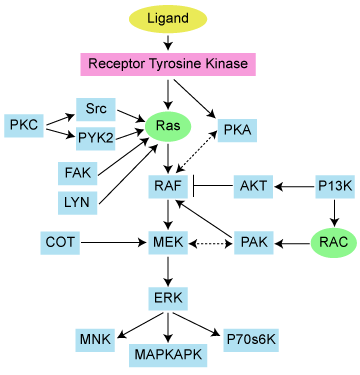
Let’s take a look at the pathway itself:

We can immediately see that MEK is downstream of RAS, meaning that even if we target MEK, unfortunately RAS and KRAS is still largely untouched upstream. This is important to remember when considering the actual results later.

The other key factor to consider is what are the adaptive resistance pathways that might evolve as a result of treatment with a MEK inhibitor? In an ideal world, logical combinations would be tested that target both the primary driving mutation or aberration, as well as the adaptive resistance, to try and shut down the pathway more completely than targeting either alone. Another key question that needs to be addressed is what is driving the KRAS aberrant activity in the first place?

We’ve discussed MEK numerous times here on PSB, but the Wee et al., (2009) MEK paper stands out in particular. They identified a critical resistance pathway to MEK inhibition, namely PI3K. Although we discussed this originally in the context of BRAF driven tumours such as melanoma, it is well worth discussing again here in regards to KRAS driven tumours given a MEK inhibitor is being tested.

They observed that:

“Activating mutations in PIK3CA reduce the sensitivity to MEK inhibition, whereas PTEN mutations seem to cause complete resistance.”

It isn’t clear from the Array press release whether any of the patients with NSCLC exhibited PIK3CA mutations or loss of PTEN, but they definiely do occur in this disease. It will be interesting to see of more meta data is available at the forthcoming AACR Molecular Targets meeting next month.

I’m not a big fan of chemotherapy plus a single targeted agent, because as you can see from the evidence above, the pathway is not being shut down by one targeted agent and resistance is not being addressed at all. The chances of such a combination working (by that I mean increasing overall survival), I think would be fairly low.

According to the press release, the study did not see a significant improvement in overall survival (OS) but did show an encouraging response in the form of progression free survival (PFS):

“The key secondary endpoints of progression-free survival, objective response rate, and alive and progression-free at 6 months were all demonstrated with statistical significance, showing improvement in favor of selumetinib in combination with docetaxel versus docetaxel alone.”

Indeed, at the recent AACR and ASCO meetings, there was also some encouraging early signs from Genentech’s PI3K inhibitor, GDC-0941, as a single targeted agent with chemotherapy in NSCLC (a very small early trial), albeit not KRAS specific, but defined more broadly by squamous and non-squamous histology. Thus, all is not lost with the MEK agent yet – if we combined MEK and PI3K inhibitors in NSCLC patients previously treated with chemotherapy, we might have a better chance of succeeding and shutting down the pathway, based on evidence offered from Wee et al’s preclinical research:

“At the molecular level, the dual inhibition of both pathways seems to be required for complete inhibition of the downstream mammalian target of rapamycin effector pathway and results in the induction of cell death.”

As a result, they went onto to suggest a logical treatment approach:

“Our study provides molecular insights that help explain the heterogeneous response of KRAS mutant cancers to MEK pathway inhibition and presents a strong rationale for the clinical testing of combination MEK and PI3K targeted therapies.”

Of course, clinical trials like this always progress incrementally, such that we test a MEK or a PI3K inhibitor alone to determine safety and efficacy activity, then perhaps in combination, which requires another phase I dose finding study to determine the ideal dosages and whether they are too toxic or not combined.

So while either single agent targeted therapy with chemotherapy in and of itself is not a win, there are signs that combining the two may be more appropriate. I would still want to know what is driving the KRAS activity though, given MEK and PI3K are downstream of it. It is entirely possible that a third agent would be needed to shut down the pathway more completely in that patient subset.

At ECCO, De Bono (Royal Marsden) discussed the combination of AstraZeneca’s MEK inhibitor (AZD6244) and Merck’s AKT inhibitor (MK-2206) in RAS mutant colorectal (CRC) and lung (NSCLC) cancers. The results here were not a big win in the former, with 8/15 patients showing no antitumour activity to date.

There are several things we can conclude from the initial data:

  • If we have the right combination for the right target in the right patient subset, then the therapeutic index of the agents is lacking and we need better drugs
  • Are the targets (AKT and MEK) critical?
  • Is something else driving the KRAS activity (see below)*?
  • Are we shutting down the adaptive resistance pathways (escape routes?)
  • Which patient subsets are most likely to respond and how do we best characterise them (ie need more biomarker data)?

And so on… there are always more questions than answers sometimes.

    * Note: This situation could well be similar to BRAF in malignant melanoma, where it is the V600E mutation that is driving the BRAF activity, thus specifically targeting ithe mutation rather than the kinase will have a greater clinical effect than targeting BRAF broadly. In this case, if we really believe KRAS is critical to the lung or colorectal tumour’s survival, then we need to figure out what is driving it before progress is made. Frank McCormick’s elegantly simple wac-a-mole concept for pathway inhibition is very apt here!

No doubt we will see more detailed data and an update soon, perhaps even at the forthcoming AACR Molecular Targets meeting next month.

References:

ResearchBlogging.orgWee, S., Jagani, Z., Xiang, K., Loo, A., Dorsch, M., Yao, Y., Sellers, W., Lengauer, C., & Stegmeier, F. (2009). PI3K Pathway Activation Mediates Resistance to MEK Inhibitors in KRAS Mutant Cancers Cancer Research, 69 (10), 4286-4293 DOI: 10.1158/0008-5472.CAN-08-4765

4 Comments

A new paper has just been published on the mechanisms associated with BRAF resistance by Corcoran et al., (2011).  One of the things I liked about this paper, other than it’s clarity and simplicity, is that you can find it in OncoTarget, an open access cancer journal (see references below), with a prestigious editorial board including Carlo Croce, Bert Vogelstein, Pier Palo Pandolfi, Wafik El Deiry, and Brian Druker to mention a few of the researchers.

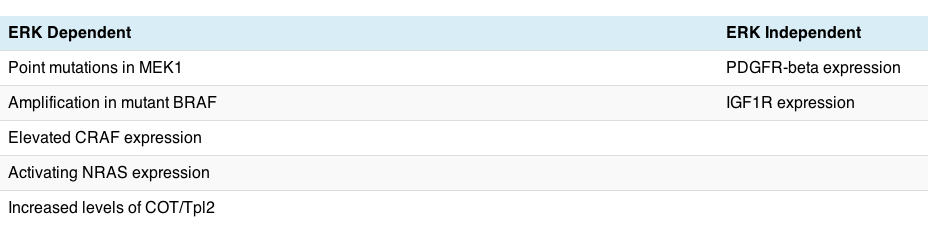
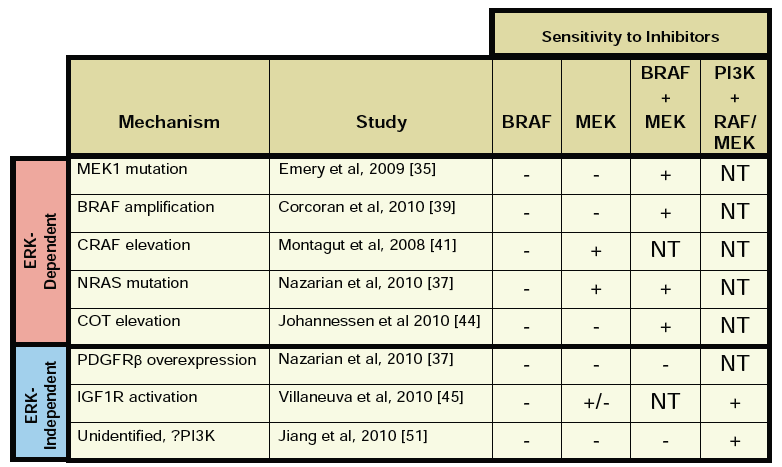
The article essentially describes ERK and non-ERK dependent methods by which resistance occurs to BRAF inhibitors such as PLX4032 (vemurafenib).  These are summarised in the table below:

Mechanisms of resistance associated with BRAF

As a result of these findings on the underlying biology to date, the authors suggest that different treatment strategies can be considered:

Potential treatment strategies for overcoming BRAF resistance

As our knowledge of the science of metastatic melanoma improves, so do our opportunities for therapeutic intervention and improvement in outcomes.

Metastatic melanoma is likely to be a hot topic at the forthcoming ASCO annual meeting next month with updated data from the vemurafenib and ipilimumab clinical trials.  I will add a more detailed post once the new data has been presented.

In the meantime, this paper is well worth reading – check it out!

References:

ResearchBlogging.orgCorcoran RB, Settleman J, & Engelman JA (2011). Potential Therapeutic Strategies to Overcome Acquired Resistance to BRAF or MEK Inhibitors in BRAF Mutant Cancers. Oncotarget PMID: 21505228


The other day, we discussed resistance in melanoma and how COT can reactivate BRAF signalling through MAPK reactivation.  Previously, we reviewed how MEK inhibitors may potentially be useful when combined with BRAF inhibitors in overcoming resistance due to cross-talk.  There are also other methods of preserving this oncogenic activity, which are highly relevant to current clinical development.

At the recent American Association for Cancer Research (AACR) meeting, Levi Garraway (Dana Farber) presented at the plenary session on “Navigating the interface of tumor biology and therapeutic development through integrative genomics.” He first discussed the history and context of targeted therapy, then focused on the progress in metastatic melanoma, highlighting some dramatic responses to the BRAF inhibitor PLX4032 (vemurafenib) using before and after pictures of his patients.

The talk was very well done indeed and I was so engrossed in following the story, I forgot to make notes – that’s how good it was!  The good news is that AACR captured the excellent slides and audio in a free webcast.  If you have 20 minutes, please do take some time to check this one out – it was one of my highlights of the meeting.

Dr Garraway also drew the audience’s attention to a poster from Wagle et al., (2011) based on new research from his lab looking at a new mechanism of resistance in melanoma, namely mutations in MEK.  Unfortunately, I missed the poster that morning, but the group kindly referred me to their publication in Journal of Clinical Oncology last month (see references below), which offers more detail for discussion here.

Essentially, they used a genomics approach to see if they could advance our understanding of mechanisms of de novo and acquired resistance to RAF inhibition, which are poorly understood.  To put things in context, the same patient that Dr Garraway refers to in the webcast above was also the subject of the genomics profiling in the paper:

“We performed massively parallel sequencing of 138 cancer genes in a tumor specimen from a melanoma patient who developed resistance to PLX4032 after a dramatic initial response.”

Initially, the patient responded to therapy:

“A profound clinical response ensued, including nearcomplete regression of all subcutaneous tumor nodules at 15 weeks on drug.”

The pictures of the patients torso in the webcast were dramatic.  There were several involuntary sharp intakes of breaths from the audience around me in the session.

Unfortunately, it wasn’t all good news:

“After 16 weeks on PLX4032, the patient experienced widespread disease relapse, which by 23 weeks involved most previous sites of visceral and subcutaneous disease.”

The pictures in the webcast also showed the physical impact of this sad news.  The key question then, is why did the patient relapse?

The genomic profiling undertaken by the group addressed this question and uncovered something unexpected:

“The resulting profile identified a novel mutation in the downstream kinase MEK1 that was absent in the corresponding pre-treatment tumor.

This MEK1 mutation was shown to increase kinase activity and confer robust resistance to both RAF and MEK inhibition in vitro.”

What are the implications of this research?

This was a very nice piece of work that sought to uncover the reason for a responding patient becoming resistant to treatment with PLX4032.  The researchers found a downstream MEK1 mutation was responsible for inducing resistance.

The implications of the finding, however, are slightly scary.

Why?  Because as the authors concluded in their paper, the MEK1 mutation found in this patients is cross-resistant to allosteric MEK inhibitors (eg AZD6244), even though the patient has never been exposed to a MEK inhibitor.  It also implies a mechanism by which melanoma may become resistant to combination RAF and MEK inhibitors (eg PLX4032 + AZD6244) with just a single mutation.

In other words, we still have a ways to go figuring out all the potential combinations and methods of resistance that could take place in this disease.  The good news is that research into mechanisms of resistance is running parallel with clinical development in metastatic melanoma and will hopefully continue to do so.

References:

ResearchBlogging.orgWagle, N., Emery, C., Berger, M., Davis, M., Sawyer, A., Pochanard, P., Kehoe, S., Johannessen, C., MacConaill, L., Hahn, W., Meyerson, M., & Garraway, L. (2011). Dissecting Therapeutic Resistance to RAF Inhibition in Melanoma by Tumor Genomic Profiling Journal of Clinical Oncology DOI: 10.1200/JCO.2010.33.2312

Yesterday was a travel day for many of us at AACR and the weather doesn’t always cooperate in ensuring timely arrivals.  Never fear, there are ways to catch up on what was missed…. wondering what was hot on Day 1?  Check out the short video clip below:

AACR have posted their webcast and podcasts links for those following remotely that are worth checking out – many are free as well, making them great value.

2 Comments
error: Content is protected !!