Pharma Strategy Blog

Commentary on Pharma & Biotech Oncology / Hematology New Product Development

Posts tagged ‘ovarian cancer’

“Women with high-grade ovarian cancer live longer and respond better to platinum-based chemotherapy when their tumors have BRCA2 genetic mutations.”

MD Anderson Cancer Center press release

That statement got my attention last night while browsing the cancer news on Twitter! Many thanks to the Provost, Ray DuBois, for sharing it.

Recently, much of the focus has been on finding biomarkers associated with prognosis or response to tyrosine kinase inhibitors and other targeted agents, including PARP in breast and ovarian cancers. It is therefore fascinating that a marker of better prognosis should emerge with chemotherapy.

Given the recent controversy over the whole BRCA1/2 issue and whether there is any clinical significance, with Yang et al., (2011) noting that:

“It has been hypothesized that BRCA-deficient patients will likely have higher survival rates because of an improved response to platinum-based chemotherapy.”

Tan et al., (2008) did indeed observe that epithelial ovarian patients had better response rates than controls if BRCA-ness was present:

“BRCA-positive patients had higher overall (95.5% v 59.1%) and complete response rates (81.8% v 43.2%) to first line treatment, higher responses to second and third line platinum-based chemotherapy (second line, 91.7% v 40.9%; third line, 100% v 14.3%).”

These values were all highly significant.  The researchers therefore set out to see whether this would result in improved outcomes and:

“Determine the relationships between BRCA1/2 deficiency (ie, mutation and promoter hypermethylation) and overall survival (OS), progression-free survival (PFS), chemotherapy response, and whole-exome mutation rate in ovarian cancer.”

Taking a look at the Kaplan-Meier overall survival curves in Yang et al’s (2011) JAMA article (link below), the women who had either the BRCA1 or BRCA2 mutation clearly did better than those who were BRCA wild-type (WT) ie no mutation was present. This is a very important finding and it certainly does help to explain why mixing a heterogeneous population in a clinical trial is never a good idea. Imagine if the BRCA mutation status of the women is unknown – you could end up with unbalanced groups that can affect your outcomes based on the therapies randomised. By this, I mean a control group with chemotherapy alone could theoretically do better than one with a targeted therapy included if the groups were unbalanced for BRCA status.

Now, the current data are limited to high-grade serous ovarian cancer cases, but it would obviously be most interesting to see if a similar (or different) pattern might emerge in BRCA2 breast cancer. Obviously I’m thinking of the recent failed iniparib phase III trial here, as I never understood why BRCA status wasn’t tested and taken into account when balancing the baseline characteristics. We don’t know whether the results reported in ovarian cancer would also be seen in breast cancer, but it would be a critical question to address.

Significance of the results

Ultimately, these kind of findings can help us define and refine specific subsets of women with ovarian cancer who might respond better to certain types of therapies than others. This kind of information is crucial in helping to improve clinical trial design.

What I would really love to see is more logical combinations of targeted therapies or chemotherapy given to patients who have the best chance of responding rather than randomly expose people willy nilly to systemic agents where there is no idea or clue about how they might work. Patients deserve much better than this!

Tak Mak (U Toronto) summed this up beautifully at the recent ECCO meeting, with a most apt quote we could all do well to learn from:

“Doctors pour drugs of which they know little,
to cure diseases of which they know less,
into patients of which they know nothing.”

Moliere, 1622-1673

It is research such as Yang et al., (2011) that may actually help avoid this sorry state and begin to improve the outcomes associated with cancer therapy in the 21st century.

References:

ResearchBlogging.orgYang, D., Khan, S., Sun, Y., Hess, K., Shmulevich, I., Sood, A., & Zhang, W. (2011). Association of BRCA1 and BRCA2 Mutations With Survival, Chemotherapy Sensitivity, and Gene Mutator Phenotype in Patients With Ovarian Cancer JAMA: The Journal of the American Medical Association, 306 (14), 1557-1565 DOI: 10.1001/jama.2011.1456

Tan DS, Rothermundt C, Thomas K, Bancroft E, Eeles R, Shanley S, Ardern-Jones A, Norman A, Kaye SB, & Gore ME (2008). “BRCAness” syndrome in ovarian cancer: a case-control study describing the clinical features and outcome of patients with epithelial ovarian cancer associated with BRCA1 and BRCA2 mutations. Journal of clinical oncology : official journal of the American Society of Clinical Oncology, 26 (34), 5530-6 PMID: 18955455

4 Comments

The other day an interesting paper came to my attention entitled:

“Intraoperative tumor-specific fluorescence imaging in ovarian cancer by folate receptor-α targeting: first in-human results”

Thanks to my translational research friend Angela Alexander for highlighting it!

The idea behind this concept is that fluorescence technology can be used to help guide ovarian cancer surgery more effectively, since the tumours tend to be small and hard to see for surgeons performing the excision:

“Tumor-specific intraoperative fluorescence imaging may improve staging and debulking efforts in cytoreductive surgery and thereby improve prognosis.”

Folate receptor-α as a tool for imaging originally came from an understanding of the biology of the disease:

“The overexpression of folate receptor-α (FR-α) in 90–95% of epithelial ovarian cancers prompted the investigation of intraoperative tumor-specific fluorescence imaging in ovarian cancer surgery using an FR-α–targeted fluorescent agent.”

This marker (FR-α) be easily detected either on tumour cells in ascites fluid or on tumor tissue obtained during staging laparoscopy or primary surgery.

What did the results show?

“In this limited series, we showed that the use of intraoperative tumor-specific fluorescence imaging of the systemically administered FR-α–targeted agent folate-FITC offers specific and sensitive real-time identification of tumor tissue during surgery in patients with ovarian cancer and the presence of FR-α–positive tumors.”

It was also encouraging to see further validity is also provided by negative results:

“One patient presented with a malignant tumor that did not express FR-α, and consequently, no fluorescence was detected.”

What do these results mean?

I think van Dam et al., (2011) encapsulated the significance of the imaging test nicely:

“The use of targeted fluorescent agents could provide a paradigm shift in surgical imaging as it allows an engineered approach to improving tumor staging and the technique of cytoreductive surgery and thereby improving the outcome in ovarian cancer.”

There are potential applications too associated with clinical research too, since Morphotek/Eisai are investigating farletuzumab, a humanized IgG1 antibody that targets folate receptor alpha in ovarian and other cancers. Using this imaging technique could be used to determine the drugs effectiveness in reducing the tumour in patients in a non-invasive fashion.

Of course, the initial trials are being undertaken in the metastatic setting, but if successful, I could see a role for the agent developing in neoadjuvant disease to shrink the tumour margins prior to surgery. Having an appropriate marker test, coupled with a valid imaging technique could well lead to improvements in survival down the line.

Overall, folate receptor-α could well be an interesting new development to watch out for over the next couple of years as data from the imagining and drug trials mature.

References:

ResearchBlogging.orgvan Dam, G., Themelis, G., Crane, L., Harlaar, N., Pleijhuis, R., Kelder, W., Sarantopoulos, A., de Jong, J., Arts, H., van der Zee, A., Bart, J., Low, P., & Ntziachristos, V. (2011). Intraoperative tumor-specific fluorescence imaging in ovarian cancer by folate receptor-α targeting: first in-human results Nature Medicine DOI: 10.1038/nm.2472

Well, after just getting back from the American Society of Clinical Oncology (ASCO) meeting in Chicago, I’m heading off to Europe for the European Hematology Association (EHA) meeting – no rest for the wicked!

ASCO was a rather flat meeting this year – the stars were undoubtedly the imatinib 36 vs 12 month data in adjuvant GIST (clearly superior) and Roche/Plexxikon/Daiichi Sankyo’s vemurafenib in BRAF V600E metastatic melanoma. The ipilimumab data was strangely disappointing in the upfront setting – only 2 months improvement in survival when added to DTIC.

On the Sarcoma front, the catch-all nature of the study came back to haunt Merck with an improvement in PFS but no overall survival benefit for ridaforolimus as maintenance therapy after 1-3 cycles of chemotherapy. That filing will likely result in a highly charged ODAC meeting debating the merits of some awkward results.

Ovarian cancer data was a mixed bag – olaparib continues to look promising in this setting, although the Avastin OCEANS data caught a few people by surprise – yet another PFS endpoint met but no overall benefit in survival and the expected incidence in bowel perforations. I think this will likely be reserved for high risk women, if used.

There was a lot of interesting/promising data in phase II, which are too numerous to mention right now – check back as I will be adding some notes on some of the emerging compounds that I liked.

Meanwhile, I’m aggregating the tweets from the hematology meeting using the #EHA11 hashtag – you can track them in the widget below if interested in following along remotely. Most of the tweets from me will likely be on leukemias, lymphomas and multiple myeloma.

2 Comments

This weekend I’m heading off to Chicago for the annual meeting of the American Society of Clinical Oncology (ASCO).  I’ll be writing some in depth pieces and daily highlights from the conference, but in the meantime, many of you will be wondering what might be interesting amongst the 5,000 or so abstracts.

Here’s a quick snapshot of some data I’m looking forward to catching up on – there’s no clapperboard or guy with a teleprompter behind the camera, just a few ideas and some things to watch out for:

http://youtu.be/TNwQvV4aYl8

.

1 Comment

Last week the American Society of Clinical Oncology (ASCO) held a press briefing to highlight some of the studies at the forthcoming annual meeting in Chicago next month.

ASCO Annual Meeting 2011 Patients, Progress, PathwaysASCO president, Dr George Sledge of Indiana, announced that the meeting theme for this year is “Patients, Pathways, Progress” to reflect the growing focus on molecular targets to identify and treat patients more effectively.
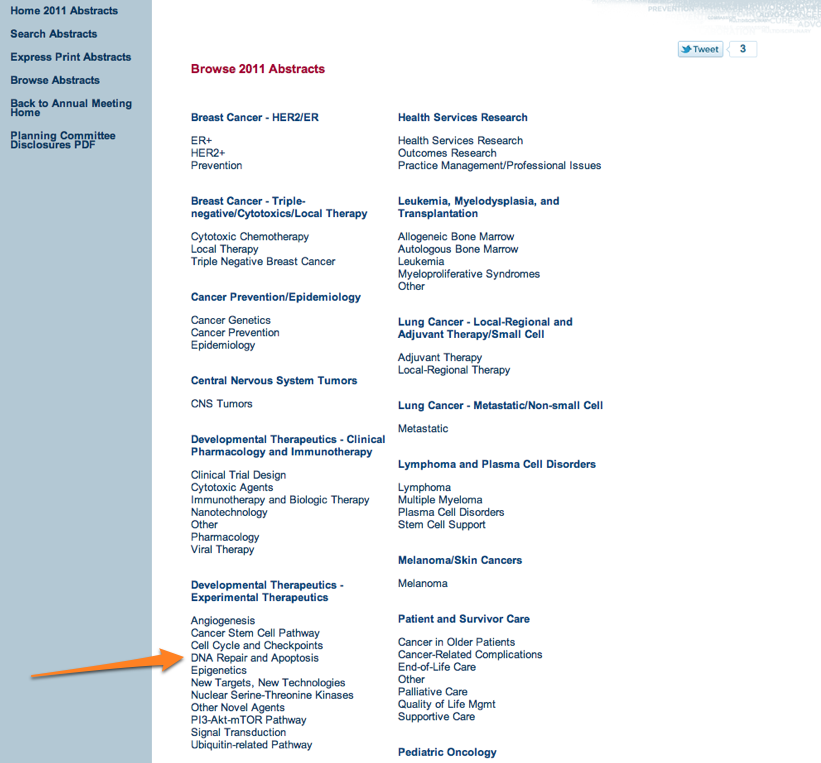
Traditionally, ASCO has organised their meeting around tumour types such as breast, lung, prostate and colon cancers, for example, but this year I was delighted to see that the Developmental Therapeutics section is getting more attention with a greater focus on the molecular targets that are now emerging:

ASCO 2011 Annual Meeting Pathways

Of the abstracts covered in the briefing, two in particular really stood out for me.  One was on Exelixis’ cabozantinib (XL184) in bone metastases, which my colleague wrote about on Biotech Strategy Blog and the other was the data for AstraZeneca’s PARP inhibitor, olaparib, in serous ovarian cancer.

Many of you will know that I’ve been covering PARP inhibitors on this blog since 2006 – although they have had somewhat of a chequered history to date.  After the recent failure of Sanofi’s iniparib in triple negative breast cancer and AstraZeneca deciding to put a phase III breast cancer trial on hold while they reformulate the drug from capsules to a tablet to make it easier for people to take, many weren’t sure what was happening with the PARP class of compounds.

Would they be consigned to the drug dustbin or would they come back from the dead?

Dr Jonathan Ledermann (University College London) presented an overview of the phase II results in serous ovarian cancer.  These were women both with, and without, the BRCA gene.  It has previously been shown by Audeh et al., (2010) that ~30% of inherited BRCA mutated tumours respond to PARP inhibitors, particularly those that have ‘platinum-sensitive’ disease.

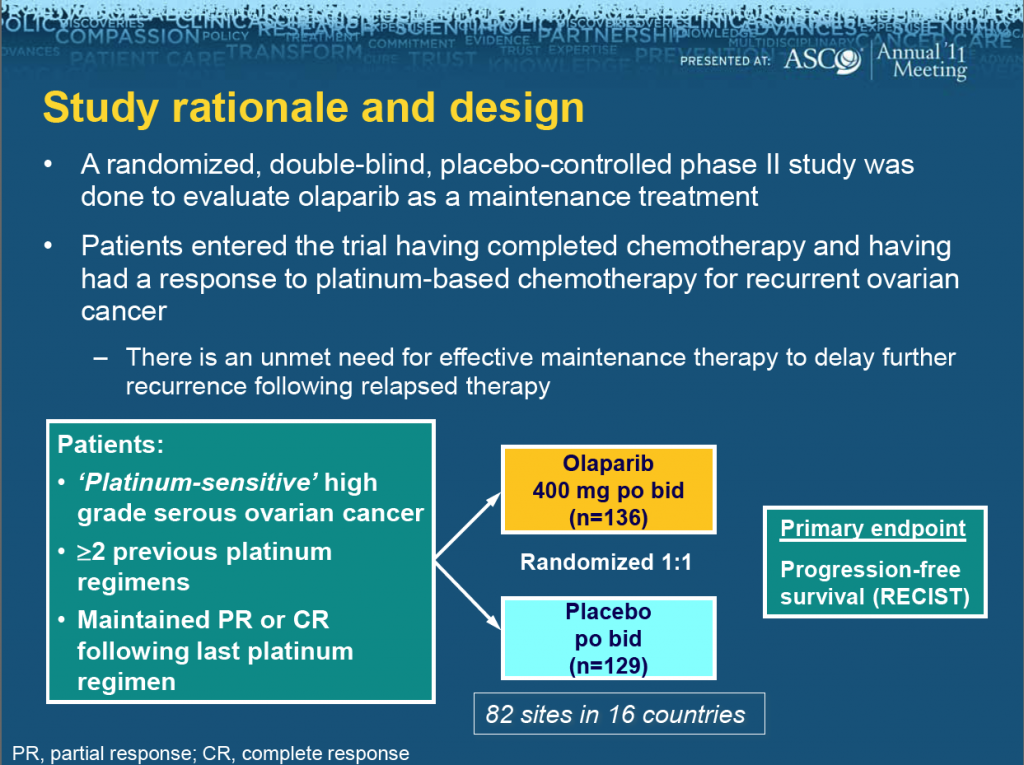
Here is the phase II study design in serous ovarian cancer:

Olaparib serous ovarian cancer phase II trial design

What was in interesting in this study was that, overall, Dr Ledermann noted that they found that women in the olaparib arm lived for 8.4 months before progression, compared to 4.8 months on placebo.  This 3.6 month improvement in PFS was statistically significant.

We will know more about the details of this study on Saturday 4th June at ASCO, but for now, two things stand out:

  • This is the first study to demonstrate a statistically significant benefit of maintenance treatment for ‘platinum-sensitive’ relapsed serous ovarian cancer
  • 50% of olaparib and 16% of placebo patients were still on treatment at the time of the analysis

These results seem pretty compelling and important to me.

If you’re around at ASCO on Saturday, the ovarian cancer session is on from 3-6pm in room E354a – check it out!

For those interested, there are also some new data being presented on Abbott’s PARP inhibitor, ABT-888 (veliparib) combined with temozolomide in refractory colorectal cancer.  This is also on Saturday afternoon from 4.30-6pm in the Clinical Science Symposium in Hall D1.

No doubt many of us will be running around up and down the escalators on the very first day, some Segways with hooters might help!  Still, I dream/long for the future when ASCO follows AACR’s lead and organises sessions around molecular targets and pathways instead of tumour types… maybe that won’t be too far into the future after all 🙂

References:

ResearchBlogging.orgAudeh, M., Carmichael, J., Penson, R., Friedlander, M., Powell, B., Bell-McGuinn, K., Scott, C., Weitzel, J., Oaknin, A., Loman, N., Lu, K., Schmutzler, R., Matulonis, U., Wickens, M., & Tutt, A. (2010). Oral poly(ADP-ribose) polymerase inhibitor olaparib in patients with BRCA1 or BRCA2 mutations and recurrent ovarian cancer: a proof-of-concept trial The Lancet, 376 (9737), 245-251 DOI: 10.1016/S0140-6736(10)60893-8

5 Comments

Treatment for ovarian cancer hasn't changed much in the last ten years, reflecting the lack of biomarkers and biochemical targets for the disease. Chemotherapy with a platinum (carboplatin or cisplatin) and a taxane (paclitaxel or docetaxel) has therefore formed the bedrock of therapy, along with other options such as gemcitabine or pemetrexed, as illustrated in the latest NCCN Guidelines.

The good news is that the use of paclitaxel-based combination chemotherapy has been shown to increase progression free survival (PFS) and overall survival (OS) in women with primary peritoneal or ovarian cancers.

While a proportion of ovarian cancers have been shown to be highly chemosensitive, a large number unfortunately fail to respond to primary taxane therapy, leading to the emergence of resistant disease.

The big unanswered questions are therefore why does this happen and what can be done about it to improve outcomes and overall prognosis?

It was with great interest that I read about the findings of a new study just published in Cancer Cell from researchers at MD Anderson (see e-link in the references below).  According to the MD Anderson news alert:

"For the first time, Salt Inducible Kinase 2 (SIK2) has been found to play a critical role in cell division and to regulate the response of some ovarian cancers to chemotherapy."

It's not often when you see the mention of both a potential target and prognostic/predictive biomarker mentioned in the same sentence as ovarian cancer, so this is huge news!  The press release went on to claim:

"Researchers found that depleting SIK2 from ovarian cancers sensitized the cancer cells to paclitaxel, a commonly prescribed chemotherapeutic agent that inhibits cell division, making the drug more effective in stopping the cancer's growth. Levels of the SIK2 protein are increased in approximately 30 percent of ovarian cancers and are associated with poorer survival in women with the disease."

The researchers analysed nearly 780 pools of siRNAs to identify proteins that alter sensitivity to paclitaxel. They found that SIK2 regulates sensitivity to paclitaxel and prevents cell division. This means that SIK2 may offer a useful therapeutic target for pipeline drugs to be developed in ovarian cancer.

What was even more fascinating was that another related article on ovarian cancer from Bast's group appeared in the same journal. In essence, they used siRNA-loaded nanoparticles to stifle a protein, Zeste homolog 2 (EZH2), which is associated with poor survival. This resulted in inhibition of angiogenesis (formation of new blood vessels) to the tumour and caused a steep reduction in the tumour burden in a mouse model of ovarian cancer.

In this study, the authors looked at human 180 ovarian cancer tumours and found that the protein was overexpressed in the tumour samples (66%) and in the endothelial cells (67%). It is relevant to note that endothelial cells line the inside of blood vessels and play a crucial role in angiogenesis.

In practice, they found that women with increased EZH2 levels in their tumours had a median survival of 2.5 years compared to 7.33 years for those without. Looking at overexpression in the endothelial cells, the difference was 2.33 years versus 8.33 years for those with normal levels.

Like me, you're probably wondering how these nanoparticles work.  According to MD Anderson:

"The nanoparticles accumulate in the cancer cell and vasculature passively as they circulate in the blood stream. Chitosan nanoparticles are so small that they can flow through tiny holes in the tumor vasculature. They also accumulate in other organs, so the researchers are working to add a targeting molecule that will limit nanoparticle uptake to tumors and their vasculature."

Targeting EZH2 may have application beyond ovarian cancer, since it been associated with the progression and spread of bladder, breast, prostate and gastric cancers and cancer of the pharynx.

All in all, a really interesting pair of papers from Bast's group, which may have clinical promise and real application to the future treatment of ovarian cancer.


ResearchBlogging.org Ahmed, A., Lu, Z., Jennings, N., Etemadmoghadam, D., Capalbo, L., Jacamo, R., Barbosa-Morais, N., Le, X., Vivas-Mejia, P., & Lopez-Berestein, G. (2010). SIK2 Is a Centrosome Kinase Required for Bipolar Mitotic Spindle Formation that Provides a Potential Target for Therapy in Ovarian Cancer Cancer Cell, 18 (2), 109-121 DOI: 10.1016/j.ccr.2010.06.018

Lu, C., Han, H., Mangala, L., Ali-Fehmi, R., Newton, C., Ozbun, L., Armaiz-Pena, G., Hu, W., Stone, R., & Munkarah, A. (2010). Regulation of Tumor Angiogenesis by EZH2 Cancer Cell, 18 (2), 185-197 DOI: 10.1016/j.ccr.2010.06.016

1 Comment

We've heard a lot about the impact of KRAS in colorectal cancer as a useful biomarker for determining whether or not to treat with EGFR therapy, depending on whether the mutation is wild-type or mutated, but now new evidence has emerged for it's possible role in ovarian cancer.

A paper by Ratner et al., from Yale University, looked at the relationship between an increased risk of OC and a KRAS variant.

Overall, the data demonstrated that a variant of the KRAS oncogene was present in 25% of all ovarian cancer patients. The same variant was also found in 61% of ovarian cancer patients with a family history of breast and ovarian cancer. Up until now though, it has proven impossible to tell which women with a strong family history of breast and ovarian cancers would go on to develop the disease. These results therefore offer some new clues in the puzzle.

Related research from another team from the UK, Denmark and US, published last year, looked at tagging single-nucleotide polymorphisms (SNPs) in candidate oncogenes and the susceptibility to ovarian cancer in approx. 1,800 women with invasive ovarian cancer compared with controls (n=3,000). The goal was to identify moderate/low-risk susceptibility alleles of the proto-oncogenes BRAF, ERBB2, KRAS, NMI, and PIK3CA, but no evidence of ovarian cancer association was found with these SNPs. When stratified by
histologic subtype, however, one common variant allele have borderline evidence of association with epithelial ovarian cancer.

What was interesting to me in the latest research from Yale is that all the women in the study had a strong family history of cancer, but only half had known genetic markers of ovarian cancer risk such as BRCA1 or BRCA2 mutations. The results, albeit from a small sample (n=157), suggest that the KRAS variant may offer a more sensitive than currently available. 

The Yale group had previously established that the KRAS-variant is not somatic but germline, meaning it is identical in person's normal and tumour tissues, thereby enabling the researchers to collect primarily germline DNA from either blood or saliva, rather than from tumour biopsy samples.  This is huge from a patient perspective and physician point of view in terms of ease of use and convenience.

This study is important because ovarian cancer is the single most deadly form of women's cancer and is usually diagnosed in advanced stage disease.  Part of the reason is because of the lack of known risk factors or genetic markers of risk.  To this end, the authors concluded:

"Our findings strongly support the hypothesis that the KRAS-variant is a genetic marker for increased risk of developing ovarian cancer, and they suggest that the KRAS-variant may be a new genetic marker of cancer risk for hereditary breast and ovarian cancer families without other known genetic abnormalities."

What we now need is validation in large scale clinical trials to determine whether the genetic marker can be used commercially to determine prognostic risk for ovarian cancer earlier.  If the results ultimately prove useful in clinical trials, then this finding relating to the KRAS variant may well have important implications for future therapeutic strategies and pipeline development in ovarian cancer as well as for prognostic testing and earlier detection for improved outcomes. 

ResearchBlogging.org
Ratner, E., Lu, L., Boeke, M., Barnett, R., Nallur, S., Chin, L., Pelletier, C., Blitzblau, R., Tassi, R., Paranjape, T., Hui, P., Godwin, A., Yu, H., Risch, H., Rutherford, T., Schwartz, P., Santin, A., Matloff, E., Zelterman, D., Slack, F., & Weidhaas, J. (2010). A KRAS-Variant in Ovarian Cancer Acts as a Genetic Marker of Cancer Risk Cancer Research DOI: 10.1158/0008-5472.CAN-10-0689 

Quaye, L., Song, H., Ramus, S., Gentry-Maharaj, A., Høgdall, E., DiCioccio, R., McGuire, V., Wu, A., Van Den Berg, D., Pike, M., Wozniak, E., Doherty, J., Rossing, M., Ness, R., Moysich, K., Høgdall, C., Blaakaer, J., Easton, D., Ponder, B., Jacobs, I., Menon, U., Whittemore, A., Krüger-Kjaer, S., Pearce, C., Pharoah, P., & Gayther, S. (2009). Tagging single-nucleotide polymorphisms in candidate oncogenes and susceptibility to ovarian cancer British Journal of Cancer, 100 (6), 993-1001 DOI: 10.1038/sj.bjc.6604947

Chin, L., Ratner, E., Leng, S., Zhai, R., Nallur, S., Babar, I., Muller, R., Straka, E., Su, L., Burki, E., Crowell, R., Patel, R., Kulkarni, T., Homer, R., Zelterman, D., Kidd, K., Zhu, Y., Christiani, D., Belinsky, S., Slack, F., & Weidhaas, J. (2008). A SNP in a let-7 microRNA Complementary Site in the KRAS 3' Untranslated Region Increases Non-Small Cell Lung Cancer Risk Cancer Research, 68 (20), 8535-8540 DOI: 10.1158/0008-5472.CAN-08-2129

It's only 3 weeks to go to the Annual ASCO meeting in Chicago so I thought it would be a good time to kick off the annual preview of key data.  One of the things that sets the tone of the meeting is which abstracts are in the plenary session.  Sometimes I don't attend the session if it looks arcane, but this year looks really interesting and worthwhile attending.

The selected abstracts comprise the following:

#LBA1: Phase III trial of bevacizumab (BEV) in the primary treatment of advanced epithelial ovarian cancer (EOC), primary peritoneal cancer (PPC), or Fallopian tube cancer (FTC): A Gynecologic Oncology Group study.

#2: Weekly paclitaxel combined with monthly carboplatin versus single-agent therapy in patients age 70 to 89: IFCT-0501 randomized phase III study in advanced non-small cell lung cancer (NSCLC).

#3: Clinical activity of the oral ALK inhibitor, PF-02341066, in ALK-positive patients with non-small cell lung cancer (NSCLC).

#4: A phase III, randomized, double-blind, multicenter study comparing monotherapy with ipilimumab or gp100 peptide vaccine and the combination in patients with previously treated, unresectable stage III or IV melanoma.

Now, three of these trials promise some excitement.  The one I'm surprised about is the French Intergroup study looking at a taxane plus platinum in lung cancer.  In case anyone is wondering, the trial (link) states that:

"It thus seemed to us justified to compare a standard arm, the vinorelbine or the gemcitabine (with the choice of the center) in monotherapy with an experimental arm, association carboplatine + paclitaxel."

Carboplatin plus paclitaxel (with or without bevacizumab) is pretty much standard as first-line treatment for non-small cell lung cancer (NSCLC), so now we know that the doublet is likely more effective than single agent gemcitabine or navelbine in the elderly too, but for me all four are old drugs, likely available as generics and it's all an iteration of what we mostly know already.  I'm particularly interested in new and exciting agents that are coming through or new indications or more recent drugs as we see them expand their utility.

The results are no doubt important, but plenary important?  It could
have well led off an oral lung cancer session and received attention at
Best of ASCO perhaps, but for me, the plenary sessions should be
about groundbreaking new therapies or indications, which the other three
clearly are.

Still, the Korean study in ALK-positive people with NSCLC really gets my attention because we've only heard about a US study in the past, so seeing how this evolves Globally is vitally important.  Pfizer have done a nice job speeding this agent, PF-02341066 (crizotinib), through development having recognised the significance of the rearrangements and then invested significant resources to moving it forward.  They should be commended for that and I sincerely hope the results continue to be positive. 

What is also nice is that I've come across a few new ALK inhibitors at AACR and elsewhere that may work in patients where crivotinib stopped working, perhaps as a reult of new mutations.  This is an exciting area of research, even if it just affects a small subset of patients.  Cancer is a heterogeneous disease so researching and identifying different subtypes that can be then targeted with new therapeutics is critical.

After excitedly listening to the BMS R&D Day, I was expecting that ipilimumab might have a chance of a plenary with the melanoma data because the example they gave just took your breath away – this is what we all live for in cancer research – something that really makes a difference to the disease and makes you go, "oh wow!"  You can read more about that commentary hereRoche and Plexxikon also have a promising compound in development (PLX4032) that targets BRAF.  At Roche's R&D Day, they noted that they planned to present the phase II data later this year at a melanoma meeting.  That's how the timing rolls sometimes.

The bevacizumab (Avastin) data in ovarian cancer was previously announced by Roche earlier this year to be positive, so this is excellent news for women with ovarian cancer.  I really look forward to seeing the results in full.  What's particularly important about this trial is that it is the first positive phase III study of an anti-angiogenic therapy in advanced ovarian cancer.  I think Judah Folkman would be mightily pleased with the progress of angiogenesis inhibitors such as Avastin so far, if he could see them.  It's all too easy to forget the visionaries in research and focus on the results.

For some reason, ovarian cancer always seems to be the poor cousin to breast and lung cancers and regimens that work in either tend to dribble down to ovarian cancer years later, but all three share many similar regimens.

From tomorrow, I'll start an ASCO series taking a look at some of the bionic biotechs with interesting data and a review of some of the big cancers and the potentially interesting data that may be worth highlighting and checking out.

5 Comments

After yesterday's news regarding the negative data for bevacizumab (Avastin) in gastric cancer, I wasn't expecting to hear any more from Roche this week, however, the opposite happened and this morning positive data was sitting waiting for me in my inbox today!

What's new?

Well, results from phase III study demonstrated the combination of bevacizumab and chemotherapy followed by maintenance use of bevacizumab increased the time women with advanced ovarian cancer lived without their disease worsening as measured by progression-free survival (PFS) compared to chemotherapy alone. Advanced ovarian cancer generally has a poor prognosis, so new therapy options are much needed.

Roche's press release declared that:

"This is the first positive phase III study of an anti-angiogenic therapy in advanced ovarian cancer and continues to support Avastin and anti-angiogenesis as a fundamental pillar of cancer treatment today."  

What does the data show?

The Gynecologic Oncology Group (GOG) completed a three-arm trial in women with newly diagnosed advanced ovarian cancer who already had surgery to remove as much of the tumour as possible were randomised to receive one of the following: 

  1. Placebo in combination with commonly-used chemotherapy (ie carboplatin (AUC 6 IV) and paclitaxel (175mg/m2) for 6 cycles), followed by placebo for a total treatment duration of up to 15 months. 
  2. Bevacizumab (5mg/kg for 5 cycles starting at cycle 2) in combination with carboplatin and paclitaxel (6 cycles), followed by placebo for a total treatment duration of up to 15 months. 
  3. Bevacizumab in combination with carboplatin and paclitaxel, followed by the continuation of bevacizumab alone as maintenance therapy, for a total treatment duration of up to 15 months. 

Overall, the trial showed that women who continued maintenance use of bevacizumab alone, after receiving bevacizumab in combination with chemotherapy (Arm 3), lived longer without the disease worsening compared to those who received chemotherapy alone.  Women who received bevacizumab in combination with chemotherapy, but did not continue maintenance therapy with bevacizumab (Arm 2), did not live longer without the disease worsening compared to chemotherapy alone.

The full results will be presented at ASCO in June.

Meanwhile this is an interesting development in ovarian cancer, given that J&J have a filing for trabectedin (Yondelis) with the FDA for the same disease, although ODAC expressed concerns about the risk-benefit profile given the side effects associated with the chemotherapy.

Time will tell what will happen later this year but at the moment it's looking more promising for Roche/Genentech than J&J.

error: Content is protected !!