Pharma Strategy Blog

Commentary on Pharma & Biotech Oncology / Hematology New Product Development

Posts tagged ‘MEK’

“I’ve missed more than 9000 shots in my career.  I’ve lost almost 300 games.  26 times, I’ve been trusted to take the game winning shot and missed.  I’ve failed over and over and over again in my life.  And that is why I succeed.”

Michael Jordan, Chicago Bulls

Michael Jordan, Chicago Bulls

Source: wikipedia

Continuing the sporting metaphors this week, I was catching up on blog reading last night and noticed that Jim Lefevere put up a nice post on Digital Strategist about how:

Domain Expertise + Work Ethic + Time = Success

He used Michael Jordan as an example to illustrate the competitiveness that is required for the top level.

While talking to scientists and researchers at the recent AACR PI3K-mTOR meeting about their myriad of iterative experiments with GWAS, Western Blots and such, you can imagine the parallels with scientific research.

It struck me how the scientists in this particular field of cancer research are both highly collaborative and competitive at the same time, while also being very focused and intense on the end game (implications for clinical research), perhaps more so than other sub specialty areas I’ve come across lately.

The main message I learned from the meeting can be summed up in this little forumla:

Driver Mutation + Adaptive Pathway + Ligand + Patient Selection = Possible Success

A lot of data on PI3K and mTOR can be expected at forthcoming annual meetings at AACR (April) and ASCO (June), so it will be interesting to see how the new combinations of PI3K or mTOR with AKT or MEK, for example, are panning out and in which tumour types.


1 Comment

Over the last couple of years, our knowledge and understanding of non-small cell lung cancer (NSCLC) has improved as mutations and translocations that drive tumour growth and survival have been identified.

Unfortunately, while we have many new targeted agents in the clinic, few have so far made it to market for broader use in every day clinical practice.  EGFR inhibitors such as erlotinib (Tarceva) and gefitinib (Iressa) were probably the first to gain people’s attention and soon we will hopefully have crizotinib for ALK translocations, since Pfizer have begun the rolling NDA submission to the FDA.

Lowly and Carbonne (2011) discussed the progress with lung cancer subsets in a short piece in Nature Reviews Clinical Oncology that is well worth checking out (see reference below).   They point out that identifying these groups based on their molecular peculiarities is important because patients can be identified and better response rates obtained in a more targeted population:

“Patients with lung cancers harboring EGFR mutations have dramatically greater clinical responses when treated with the oral EGFR tyrosine kinase inhibitors (TKIs) erlotinib or gefitinib, compared with patients without these mutations. In 2009, two seminal trials (the Iressa Pan-Asia Study [IPASS] and the Spanish Lung Cancer Group) demonstrated response rates of around 70% to EGFR TKIs in this cohort of patients, compared to a response rate of 30–40% with traditional platinum-based chemotherapy.”

They went onto describe the molecular subsets found to date:

Molecular Subsets in Lung Cancer

Note that approx. half of the aberrant mutations have yet to be found and about one-eighth have been identified, but clinical trials are still ongoing with various inhibitors, so there is more hope for the future if any of these pan out with positive data.

Of course, what everyone wants to know is what is the next target that may emerge after crizotinib and ALK.  I think PI3-kinase inhibitors look the most promising and there are a few being evaluated in trials right now.  However, my suspicion is that we will be very lucky to get it right first time and it may well take some more creative combinations than at present before we figure it out.  We may see a few failures before someone cracks the optimal solution based on biomarker and research into resistance mechanisms.

I’ll be off to San Francisco later this month to attend the AACR meeting on the PI3-kinase/mTor pathway in cancer to see what progress is being made.  Watch this space for updates on what the key opinion leaders think.

References:

ResearchBlogging.orgLovly, C., & Carbone, D. (2011). Lung cancer in 2010: One size does not fit all Nature Reviews Clinical Oncology, 8 (2), 68-70 DOI: 10.1038/nrclinonc.2010.224

2 Comments

That was the question from a reader that greeted me in my inbox recently, it’s a good point.   Sorafenib has received FDA approval in this indication, while Pfizer terminated their phase III trial of sunitinib in HCC for futility last year.

At first, I couldn’t remember the subtle differences between them, since they both inhibit VEGF and PDGF, although sunitinib also inhibits KIT, until a friend reminded that sorafenib also targets RAF.  On checking out the IC50 values of several multi-kinase TKIs, it turned out to be true, good catch:

Why does sorafenib work in HCC but sunitinib doesn't

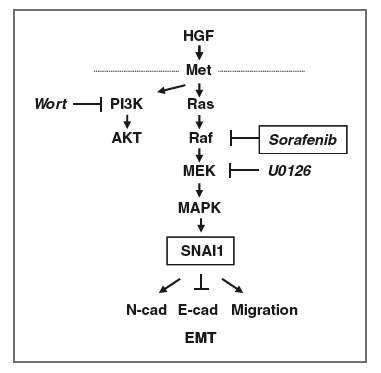
In addition, there was a paper just published from Nagai et al., (2011) in Molecular Cancer Therapeutics, which demonstrated sorafenib inhibits the hepatocyte growth factor (HGF) mediated epithelial mesenchymal transition (EMT) in hepatocellular carcinoma (HCC).  EMT is a key developmental program that is often activated during cancer invasion and metastasis.  It is a highly complex area that is receiving a lot of research attention at the moment.

Nagai et al., essentially demonstrated that:

“Sorafenib and the MEK inhibitor U0126 markedly inhibited the HGF-induced morphologic changes, SNAI1 upregulation, and cadherin switching, whereas the PI3 kinase inhibitor wortmannin did not.

Collectively, these findings indicate that sorafenib downregulates SNAI1 expression by inhibiting mitogen-activated protein kinase (MAPK) signaling, thereby inhibiting the EMT in HCC cells.”

If we look at the potential pathway, it would look like this:

HGF-RAF-EMT pathway

Based on these findings, it would be interesting to find out whether adding a MEK inhibitor to sorafenib would improve efficacy further to cut off feedback loops.

On checking out the clinical trials database, I found two trials either ongoing or about to begin enrolling with sorafenib and AZD6244 (ARRY 142886), a MEK inhibitor from AstraZeneca/Array Pharma.  The former should have data emerging soon, if it hasn’t already done so.  I think EMT is a fertile area of research where we may see more science and emerging this year.

References:

ResearchBlogging.org Nagai, T., Arao, T., Furuta, K., Sakai, K., Kudo, K., Kaneda, H., Tamura, D., Aomatsu, K., Kimura, H., Fujita, Y., Matsumoto, K., Saijo, N., Kudo, M., & Nishio, K. (2011). Sorafenib Inhibits the Hepatocyte Growth Factor-Mediated Epithelial Mesenchymal Transition in Hepatocellular Carcinoma Molecular Cancer Therapeutics, 10 (1), 169-177 DOI: 10.1158/1535-7163.MCT-10-0544

Some of the most frequently searched words on this blog or those that arrive via organic Google searches centre around:

  • Melanoma
  • Ipilimumab
  • PLX4032

Interestingly, few are searching for RG7204, the Roche code for their compound being developed in partnership with Plexxikon or BRAF, the actual kinase target involved.

As background, you can read up on the past developments with BRAF V600 mutated melanoma herehere and here, including the phase II NEJM data, mechanisms of resistance (MEK or AKT) and how targeting CRAF as well as BRAF can lead to the development of squamous cell lesions in some patients.

This morning, Roche and Plexxikon announced the long awaited results of the phase III study (BRIM3) in newly diagnosed patients with metastatic melanoma:

“RG7204 (PLX4032) met its co-primary endpoints showing a significant survival benefit in people with previously untreated BRAF V600 mutation-positive metastatic melanoma.

Study participants who received RG7204 lived longer (overall survival) and also lived longer without their disease getting worse (progression-free survival) compared to participants who received dacarbazine, the current standard of care.”

The good news is that the survival benefit observed in the Phase II trials appears to be confirmed although the press release was rather short on specifics, presumably because the actual data will be presented at a cancer meeting later this year. However, given the current timing, I’m thinking this may augur well for an ASCO data submission. If so, ASCO is going to be interesting in metastatic melanoma this year with data anticipated from PLX4032 and ipilimumab (BMS).

Clearly, Roche intend filing the positive data with the Health Authorities, and in the meantime, they have announced plans to expand the access to PLX4032:

“Roche is now working closely with global health authorities to expand the recently announced RG7204 Early Access Program (EAP). The global EAP will be extended to include people with previously untreated, BRAF V600 mutation-positive metastatic melanoma.”

Now that we know more about the mechanisms of BRAF V600 resistance in metastatic melanoma, I’m also wondering when we might see some logical new trials evolve with PLX4032 in combination with a MEK or AKT inhibitor or perhaps sequenced, but to me it would make more sense to combine them.  It will be very interesting to see:

  • What the final survival advantage for PLX4032 is over dacarbazine
  • If a BRAF-MEK combination would further improve the OS

Fortunately, Genentech actually have two MEK inhibitors in development, GDC-0623 and GDC-0973 in solid tumours, so this approach is certainly feasible for them.

We’ll have to wait and see, but to put things in context, the phase II trial reported by Flaherty et al., (2010) in the NEJM demonstrated an approx. 6 month survival advantage in favour of PLX4032 before resistance set in.

2 Comments

Metastatic melanoma is quite a hot topic right now with a rich pipeline of products in development after a decade of little or no progress.  Of course, it is a bit like three London buses coming along at once after an hour long wait in the winter weather, but better late than never.

Many of you will remember the recent data from ipilimumab (BMS), an immunotherapy that showed increased survival, albeit with some severe adverse events, from the phase III trial in newly diagnosed metastatic melanoma presented at ASCO in the plenary session earlier this year, followed by a publication in the NEJM.  The FDA filing was subsequently submitted on the basis of the positive data.

Yesterday, BMS announced that the FDA have moved the PDUFA date back 3 months from Dec 25th to March 26th, 2011.  A precise reason for the delay wasn’t given , but the company did say:

“In response to an FDA request, Bristol-Myers Squibb submitted further analysis of data pertaining to the current application for pre-treated advanced melanoma and the agency considers this to be a major amendment to the drug’s BLA.”

I’m not going to speculate on the reasons for the extra review time or what the new data was, but it is an interesting and unexpected development.

Meanwhile, there’s also been a lot of buzz around targeted BRAF inhibition in melanoma lately, specifically around the initial stunning results seen with PLX4032 (Plexxikon & Roche).  So far, it seems that responses of around 6-12 months, with a median of around 8 months are possible with an kinase inhibitor that specifically targets the V600E mutation associated with BRAF, although there two problems:

  1. The responses are not durable as resistance (eg associated with MEK or AKT amplification) sets in.
  2. Inhibiting CRAF as well as BRAF appears to lead to an unwanted excess proliferation of squamous cells, which is reversible on withdrawal of treatment.

In the first case, a couple of recent papers have looked at mechanisms of resistance around BRAF inhibition that give us some clues of where to go next.

Gopal et al., (2010) decided to see what happened with AZD6244 or selumetinib (Array and AstraZeneca), a MEK and MAP/ERK inhibitor, and whether it would have any impact in mitigating BRAF resistance, given the potential close interaction within the RAS-RAF-MAPK pathway and downstream events that could be impacted through cross-talk and feedback loops:

“We analyzed a panel of Braf mutant human cutaneous melanoma cell lines for their sensitivity to growth and survival inhibition by AZD6244. We compared these effects with the baseline activation status of signaling pathways in the cells, and with AZD6244 treatment–induced changes in signaling networks.

These studies have identified the phosphoinositide 3-kinase (PI3K)-AKT pathway as a critical regulator of the efficacy of AZD6244 in Braf-mutant melanomas, including in cells without baseline activation of the pathway.”

In order to determine possible mechanisms of resistance in the cell lines, they compared the effects of AZD6244 treatment on their signaling pathways with effects in sensitive cell lines and found:

“Although all four of these Braf-mutant cell lines showed similar degree and duration of MAPK inhibition and several other proteins, the resistant cell lines increased their P-AKT levels following exposure to AZD6244, which was not observed in the sensitive cell lines.”

They went on to note:

“The functional significance of AKT activation is supported by the fact that inhibition of AKT activity, either by AKT knockdown or concurrent treatment with the mTORC1/2 inhibitor AZD8055, resulted in synergistic cell killing in the resistant cell lines.”

AstraZeneca and Merck have an ongoing partnership with their MEK (AZD6244) and AKT (MK-2206) kinase inhibitors, so combining them in a clinical trial to try and reduce resistance via feedback loops here would be an interesting approach worth trying.  Such a combination trial is currently recruiting in advanced solid tumours, not melanoma per se.  It is, however, a classic catch-all phase I study to see what kinds of cancers might respond and determine the MTD, but I would be very interested to see the data from patients with metastatic melanoma if they are enrolled.

Now, it has been shown in breast cancer cell lines showed that MEK inhibition resulted in cross-activation of the EGFR tyrosine growth factor receptor, but EGFR has not been shown to be relevant in melanoma, so Gopal et al., considered what other receptors might be responsible for mediating the effects.   In the discussion, an interesting snippet caught my eye:

“AZD6244 treatment induced a slight increase of IGF-I secretion by the cells, and knockdown of IGF-I also blocked P-AKT induction by AZD6244.  Supporting a specific role for the pathway in cell survival, recombinant IGF-I treatment blocked AZD6244-induced cell death, but not growth arrest, in the sensitive WM35.”

This might also suggest another useful combination approach to consider in clinical trials.

Previously, it has been shown that targeting BRAF can not only inhibit the important driver in melanoma, the V600E mutation, but it can also stimulate cellular signaling through the MEK-ERK pathway by activating the related family member C-RAF. This may explain the squamous cell proliferation seen in some patients with PLX4032. The more ideal BRAF inhibitor would therefore specifically target BRAF V600E, without activating CRAF at the same time.

Related to the subject of malignant melanoma, Kamata et al., (2010) just published a paper that looked at the relationship between BRAF and CRAF in the disease.  Previously it has been shown that D594A BRAF lacks kinase activity, but can induce the related gene product CRAF in addition to the mitogen-activated protein/extracellular signal-regulated kinase (ERK) kinase (MEK)/ERK pathway.  What they found was really interesting.  In a nutshell:

“We show that the aneuploid phenotype is dependent on Craf. Treatment with the MEK inhibitor U0126 did not attenuate the emergence of aneuploidy but prevented the growth of aneuploid cells.  These results provide a previously unidentified link between Craf and chromosomal stability, with important implications for our understanding of the development of cancers with driver mutations that hyperactivate Craf.”

Aneuploidy is an abnormal number of chromosomes and can lead to genetic instability, a key cancer hallmark. It’s an important concept here because Kamata et al., have offered a different reason for the CRAF proliferation observed with some BRAF inhibitors:

“Impaired activity BRAF mutants are frequently coincident with oncogenic RAS mutations in human cancers (26) and in these, albeit rare, cancers, we may expect the hyper-activated CRAF induced by the combination of both oncogenes to enhance the aneuploidy response compared with mutation of either oncogene alone.  Such a situation is likely to be highly detrimental to the individual and, indeed, this mechanism may well account for the highly aggressive melanomas we observed following the combined expression of D594A Braf and G12D Kras in melanocytes.”

All in all, this is a very complex yet fascinating area of research and for those of you interested in this field, I would highly recommend reading the latest papers.

Photo Credit: Wikipedia

References:

ResearchBlogging.org Boni, A., Cogdill, A., Dang, P., Udayakumar, D., Njauw, C., Sloss, C., Ferrone, C., Flaherty, K., Lawrence, D., Fisher, D., Tsao, H., & Wargo, J. (2010). Selective BRAFV600E Inhibition Enhances T-Cell Recognition of Melanoma without Affecting Lymphocyte Function Cancer Research, 70 (13), 5213-5219 DOI: 10.1158/0008-5472.CAN-10-0118


Garnett MJ, Rana S, Paterson H, Barford D, & Marais R (2005). Wild-type and mutant B-RAF activate C-RAF through distinct mechanisms involving heterodimerization. Molecular cell, 20 (6), 963-9 PMID: 16364920

Gopal, Y., Deng, W., Woodman, S., Komurov, K., Ram, P., Smith, P., & Davies, M. (2010). Basal and Treatment-Induced Activation of AKT Mediates Resistance to Cell Death by AZD6244 (ARRY-142886) in Braf-Mutant Human Cutaneous Melanoma Cells Cancer Research, 70 (21), 8736-8747 DOI: 10.1158/0008-5472.CAN-10-0902

Kamata, T., Hussain, J., Giblett, S., Hayward, R., Marais, R., & Pritchard, C. (2010). BRAF Inactivation Drives Aneuploidy by Deregulating CRAF Cancer Research, 70 (21), 8475-8486 DOI: 10.1158/0008-5472.CAN-10-0603

4 Comments

One of the current challenges with developing new targeted agents in oncology is the tendency to rush various agents, whether monoclonal antibodies (mAB) or tyrosine kinase inhibitors (TKIs) into the clinic before we know how they might best work or in what potential combinations based on the precise underlying biology.

Another challenge I see is old school chemotherapy approaches permeating new development thinking. By this, I mean the traditional concept of testing therapies in advanced, metastatic and highly refractory disease where the tumour burden is high and the chances of getting a decent response is low.

This is one reason I love the I-SPY neoadjuvant concept in breast cancer. Testing a range of compounds prior to surgery based on the potential drivers of the cancer will let us know very early which agents are working or not and which could potentially be selected for subsequent adjuvant treatment after surgery.

Background

Recently, I reading a couple of papers (see references below) on phase I and II trials with a MEK inhibitor (PD-0325901), but it was a little bit with a sinking feeling because the trial design was rather old fashioned and traditional, ie take a bunch of solid tumours in phase I, see what (mixed) signals you get:

"PD-0325901 showed preliminary clinical activity. The maximum tolerated dose, based on first cycle dose-limiting toxicities, was 15 mg BID continuously. However, 10 and 15 mg BID continuous dosing and 10 mg BID 5 days on/2 days off schedules were associated with delayed development of RVO; thus, further enrollment to this trial was stopped."

Where RVO was retinal vein occlusion.

Next, do a phase II in a big (ie large potential patient numbers), advanced, metastatic and highly refractory cancer.  Predictably, the results were unsurprising:

"PD-0325901 did not meet its primary efficacy end point."

If we looked at those results in isolation, we might be tempted to dismiss the idea that the MEK inhibitor doesn't work and abandon it.

A different way of thinking

That said, I was much more encouraged by another article from another group that looked at the problem completely differently with exactly the same MEK agent.  If you think about it, a focused sniper rifle strategy is often going to be more effective than a bludgeoning blunderbuss.

They looked at the basic evidence that:

"Mutational activation of PIK3CA, which commonly co-occurs with KRAS mutation, provides resistance to MEK inhibition through reactivation of AKT signaling"

And then set out to look at this relationship more clearly in animal models:

"to determine the MEK dependence of tumors with mutational activation of the pathway. These studies indicate that many KRAS mutant tumor cell lines are, contrary to the prevailing view, sensitive to the MEK inhibitor PD0325901, and hence, dependent on the RAF/MEK/ERK signaling arm.

Resistance to MEK inhibitors in the relevant cell lines is not an intrinsic feature of KRAS oncogenic function but instead mutational activation of PIK3CA is present in most, but not all, MEK resistant KRAS mutant cancers."

It's hard to argue with that logical approach.

Findings

The article is well worth reading and nicely put together, but here are the main findings of the research:

  1. A subset of KRAS mutant cells depends on MEK/ERK signaling
  2. Coexistent KRAS and PIK3CA mutations prevent cyclin D degradation and sensitivity to MEK inhibition
  3. Selective knockout of mutant PIK3CA allele confers MEK/ERK dependence
  4. Sustained cyclin D expression and bypass of MEK inhibitor–induced G1 arrest correlates with MEK antagonist efficacy
  5. Combined inhibition of both MEK/ERK and PI3K/AKT pathways suppresses the growth of tumors with coexisting KRAS and PIK3CA mutations


Implications for the future

The thoughtful approach behind Halilovic et al's data is particularly interesting:

"Mutational activation of KRAS is a common event in human tumors. Identification of the key signaling pathways downstream of mutant KRAS is essential for our understanding of how to pharmacologically target these cancers in patients.

We show that PD0325901, a small-molecule MEK inhibitor, decreases MEK/ERK pathway signaling and destabilizes cyclin D1, resulting in significant anticancer activity in a subset of KRAS mutant tumors in vitro and in vivo."

KRAS mutant tumours are particularly relevant to colorectal cancer.  Recently, we have seen that patients with colorectal cancer who have wild type, but not mutant, KRAS are more much more likely to respond to treatment with EGFR therapy ie Erbitux and Vectibix, allowing for careful patient selection and exposure.

What about melanoma where mutant RAS may stop the activity of RAS inhibitor such as PLX4032? Could adding a MEK inhibitor help overcome the problem in some cases, or perhaps that would be too simple? We don't know, but I'd love to see some research data in appropriate xenograft models in this area.

The problem is that there is currently no therapeutic agent that directly inhibits KRAS function, so the Halilovi data have very important implications for tumours driven by mutant RAS.

What the new data tells us:

"These data suggest that tumors with both KRAS and phosphoinositide 3-kinase mutations are unlikely to respond to the inhibition of the MEK pathway alone but will require effective inhibition of both MEK and phosphoinositide 3-kinase/AKT pathway signaling."

Bingo!  Now that's a much more elegant approach to defining which patient populations are most likely to respond based on preclinical research before attempting clinical trials and randomly exposing patients who had no hope of responding to the systemic side effects of a treatment.  

Personally, I would dearly love to see more clinical trial selection based on logical, well researched preclinical data rather than a scattergun let's hope and see approach.

We need to get smarter and faster at well designed research that points us in the right direction to increase the chances of better success and improved outcomes.  It will also conserve precious R&D dollars and focus it where it's needed most.


References

ResearchBlogging.org Halilovic, E., She, Q., Ye, Q., Pagliarini, R., Sellers, W., Solit, D., & Rosen, N. (2010). PIK3CA Mutation Uncouples Tumor Growth and Cyclin D1 Regulation from MEK/ERK and Mutant KRAS Signaling Cancer Research, 70 (17), 6804-6814 DOI: 10.1158/0008-5472.CAN-10-0409

Haura, E., Ricart, A., Larson, T., Stella, P., Bazhenova, L., Miller, V., Cohen, R., Eisenberg, P., Selaru, P., Wilner, K., & Gadgeel, S. (2010). A Phase II Study of PD-0325901, an Oral MEK Inhibitor, in Previously Treated Patients with Advanced Non-Small Cell Lung Cancer Clinical Cancer Research, 16 (8), 2450-2457 DOI: 10.1158/1078-0432.CCR-09-1920

LoRusso, P., Krishnamurthi, S., Rinehart, J., Nabell, L., Malburg, L., Chapman, P., DePrimo, S., Bentivegna, S., Wilner, K., Tan, W., & Ricart, A. (2010). Phase I Pharmacokinetic and Pharmacodynamic Study of the Oral MAPK/ERK Kinase Inhibitor PD-0325901 in Patients with Advanced Cancers Clinical Cancer Research, 16 (6), 1924-1937 DOI: 10.1158/1078-0432.CCR-09-1883

2 Comments

Over the past few years it has been interesting to watch AACR organise and group it's sessions by pathways, so you end up with a higgledy piggledy collection of different inhibitors, therapeutics, chemotherapies etc as well as a mix of different tumour types.  This works well for the scientist, less so for the clinician who may specialise in only a few cancer types.  

Meanwhile, at ASCO, everything is organised by cancer track, so if you want to search for data on say, MEK, AKT or c-MET inhibitors for example, then the data is now all over the place and trying to get round and find it all is much more difficult.  The chances of missing something, or worse, having clashes in interesting sessions is much higher.  I'm already looking a potential schedule with too many clashes and periods of nothing.  That's not a very efficient way to organise the data, yet this was not something I experienced at AACR to the same extent.

image from farm4.static.flickr.comPersonally, I find myself much preferring the AACR approach because it's ultimately logical and allows you to see patterns and trends more strategically, providing you approach it sensibly. You do need to think in 3D though, much like that 3 level chess board beloved by Spock in the original Star Trek. This way allows you to see potential connections and future approaches more easily rather than being hemmed in by tumour siloes.

In the long run, I confidently predict that the future trend of personalised medicine is going to be more based on a pathways approach allied with mutational analysis based on constitutive activation, rather than simply thinking in terms of cancer type by line of therapy.  Once you start understanding which subsets exist and which inhibitors can be combined together, it is not hard to see a new world evolving out there that may lead to better outcomes and improved quality of life.

Who knows, we might even be able to get rid of toxic chemotherapies altogether and prescribe a cocktail of more targeted agents based on the patients characteristics.

Now that would be a fine thing indeed.  Thoughts?

Photo Credit: GiftsforyouBiz

One of the interesting things about scientific conferences such as AACR and ASCO is that everyone looks at the same data differently as if it were through a kaleidoscope.

Brand marketers focus on their competition by tumour type or disease, scientists look at specific mechanisms or pathways, investors look at particular companies and so on. 

Someone asked me the other day how I analyse the data.  I hadn't really thought about it much until then, but on reflection what I'm interested in is trends and how research evolves from a big picture science view so that means I look at pathways like a true biochemist.  This also teaches us where the gaps are and what opportunities may arise in the future.  It's not exactly rocket science, but it is a useful approach sometimes.

Phosphoinositide 3-kinasesImage via Wikipedia

One of the clear trends emerging at AACR the other week is that dual inhibition of both the PI3K-mTOR and RAS-ERK pathways may be necessary in some cancers such as melanoma to reduce cross-talk, feedback and feedforward loops, drug resistance and loss of PTEN gain of function, just as one might also target IGF-1R and EGFR to reduce cross-talk and add in another inhibitor, eg MEK or AKT.

Given the increasingly critical role of MEK and AKT in various combinations in the future to reduce the potential for drug resistance occurring, this bodes well for a host of companies.  I wasn't, therefore, surprised to see Novartis snap up Array's MEK inhibitor (ARRY-162) given they already have an mTOR on the market (everolimus, Afinitor), two PI3-kinases in development and others including a RAS inhibitor.  Having a MEK inhibitor as well may therefore give them a lot of flexibility with different combinations in multiple cancer types if this approach pans out. 

Merck are also following a similar approach with their mTOR inhibitor, ridaforolimus, which they have finally grabbed commercial control of from their partner, Ariad.  Let's not forget they also have an AKT inhibitor, dalotuzumab and a MEKi through their partnership with AstraZeneca to play with too.

This is all good news for several biotech companies though, if some big Pharma companies start catching onto the trend and realise they need may a PI3K-mTOR inhibitor and a MEK or AKT inhibitor to stock up in their pipeline before the field gets too crowded.

Which companies might have new and interesting data in this area?

Well, Keryx and Aeterna Zentaris, Semafore, Calistoga, Intellikine and a few others all have PI3K inhibitors in development, while Exelixis have a deal in place with sanofi-aventis for XL147 and XL765 and Roche/Genentech have a pan-PI3K inhibitor, GDC-0941.  Novartis have two (BEZ235 and BKM120). Some of these compounds are single PI3K inhibitors and some are dual inhibitors of PI3K-mTOR.

Looking at the ASCO abstract titles, Exelixis appear to have the most abstracts in this area this year, so it will be interesting to see what sort of data they have across a range of different tumour models and early phase I results in solid and hematologic malignancies, with a variety of different combinations. 

One session I'm really looking forward to at this year's ASCO is a Clinical Science Symposium entitled, "Paths for Clinical Development of PI3K Inhibition" with some of the heavyweights in the field such as Neil Rosen (MSKCC), Skip Burris (Sarah Cannon), Jose Baselga (Spain) and Carlos Arteaga (Vanderbilt).  Arteaga is presenting a talk in that session entitled, "Next steps in clinical development of PI3K inhibitors?"

More later on this blog after the posters and the data become available at the meeting.

Reblog this post [with Zemanta]
1 Comment

There are a lot of clinical trials out there right with tyrosine kinase inhibitors; unfortunately many will fail because they were rushed into phase II or III trials without thinking through all the options.  There are, however, some smart companies out there who do think.

What was noticeable at AACR this year, was the surfeit of posters and presentations regarding logical combinations designed to eliminate escape routes and hence resistance.  For example, cross-talk is a common problem between ligands, eg IGF-1R and EGFR, so combining the two may reduce the problem but that isn't the whole story.

Feedback loops also exist, so targeting PI3-kinase alone is less likely to be effective than targeting both PI3-kinase and mTOR.  Neal Rosen from MSKCC showed some interesting data to this effect and argued cogently that oncogenes tend to lead to constitutive negative feedback.  He also noted that the BRAF mutation predicts for sensitivity to MEKi, for example.  Michael Korn also discussed the feedback activation loop between the RAS-ERK and PI3K pathways and how the inhibition of autophagy (where cells self digest themselves) can enhance apoptosis and the anti-tumour effect with smart combinations.

Targeting both MEK and AKT may therefore also have more effect than either alone, as you can see in the chart below: 

Picture 10Source: Array Biopharma

In a recent trial reported at the the ASCO GI meeting in January, Merck described an elegant design where IGF-1R, EGFR and AKT inhibitors were all combined to target advanced pancreatic cancer, with promising early results.  I thought this was a prescient approach at the time, since it clearly sought to eliminate both cross-talk and feedback, so it was interesting to see numerous researchers advocating similar approaches in different tumour types based on the overexpression profiles at AACR last week. The design is based on rational biochemistry, which regular PSB readers will know I'm a big fan of, rather than randomly adding a kinase inhibitor to whatever is the standard chemotherapy of the day in a haphazard blunderbuss approach.

There are a number of MEKi and AKTi inhibitors out there (I counted nearly a dozen last time I checked), as well as a plethora of PI3-kinase and mTOR inhibitors, either alone or in combination.  Merck and AstraZeneca announced an interesting deal earlier this year to jointly pursue research with their AKT (MK-2206) and MEK (AZD6244) inhibitors.  This collaboration makes a lot of sense biochemically.  Novartis (a client) have one of a broadest kinase pipelines in the industry and just added to it prior to AACR in a deal with Array BioPharma to license their MEK inhibitors, of which ARRY-162 is the lead candidate. 

The compounds that ultimately win the race may not necessarily be the ones furthest ahead in clinical trials right now, but the ones with the smartest clinical trial designs to eliminate some of the issues associated with kinase inhibition – cross-talk, feedback, feed-forward loops and additional mutations. 

MEKi and AKTi are two of my favourite kinase approaches right now because they offer the flexibility to add to existing TKI's such as erlotinib, sorafenib or everolimus, for example, potentially improving the outcomes further in a variety of different cancers, never mind the future combination possibilities.  It's going to be a very interesting and hot area to watch in the near future, that's for sure.

If you have any thoughts or questions on this fascinating topic, please do add them in the comments below.


4 Comments

South Texas Accelerated Research Therapeutics (START) has enrolled its first patient in a phase 1 clinical trial of a combination anticancer regimen made up of two investigational compounds.

The two drugs are being developed by Merck & Co. Inc. and AstraZeneca. The two pharmaceutical companies announced in June 2009 that they would collaborate on this project.

The START Center for Cancer Care in San Antonio was chosen as the first phase 1 center to test the drug combination. START specializes in conducting Phase 1 clinical trials for oncology drugs.

Preclinical evidence showed that the two compounds (MK-2206 and AZD6244) could enhance their anticancer properties.

The agreement between Merck and AstraZeneca is significant, say START officials, because it involves two major pharmaceutical companies collaborating at an early stage of drug development.

via bizjournals.com

This is the beginning of the collaboration between Merck and AZ that began last summer.

Merck's MK-2206 is an AKT inhibitor we originally discussed last year at ASCO (see http://www.pharmastrategyblog.com/2009/05/sanofiaventis-and-exelixis-agree-licensing-deal.html), while AstraZeneca's AZD6244 is a MEK inhibitor that has also been shown to target RAS and BRAF.

Anthony Tolcher's group at the START center in San Antonio are running the early trials, so it will be interesting to see what comes of the collaboration.

Posted via web from sally church's posterous

error: Content is protected !!