Pharma Strategy Blog

Commentary on Pharma & Biotech Oncology / Hematology New Product Development

Posts tagged ‘Afinitor’

Today on 10th November, it’s the Second Annual Worldwide NET (Neuroendocrine Tumor) Cancer Awareness Day. Granted that’s a bit of a mouthful, but it also seems poignant given so many of my news feeds this morning were still full of Steve Jobs, who sadly passed away from the disease last month.

I’ve been meaning to post an update on this rare form of cancer all year, given that we now have targeted therapies now approved by the FDA for treatment, but things were hectic at the office and then with Jobs passing, the timing just seemed tacky and inappropriate.

The idea though, of an Awareness Day for a rare disease such as NET to improve both education and awareness seems an inherently good one to me, especially as there has been some progress clinically in 2011. According to Kulke et al., (2011) NET has an incidence of around 1 per 100,000 individuals. This excellent review covers the key essentials of both the disease and the treatments:

“Patients with pancreatic NET present with diverse symp- toms related to hormonal hypersecretion, tumor bulk, or both. Accurate diagnosis of this condition and differentiation of pancreatic NET from the more common pancreatic adenocarcinomas is a critical first step in developing an appropriate treatment plan.”

It has been quite the landmark year for NET since not one, but two, new therapies were approved by the FDA in May this year with very different mechanisms of action:

  • Everolimus (Afinitor) from Novartis targets the mammalian target of rapamycin (mTOR), a serine-threonine kinase, downstream of the PI3K/AKT pathway.
  • Sunitinib (Sutent) from Pfizer is a multikinase inhibitor of VEGF, PDGFR (α and β), KIT, FLT3, RET and CSF-1R.

Both of these drugs are also approved for the treatment of renal cell cancer, which while nearby geographically in the body, is a completely different type of GI cancer. They are now approved for pancreatic neuroendocrine tumours (pNET) that have progressed and cannot be treated with surgery.

It is important to note, that while NET is a rare form of pancreatic cancer, it is not the same thing as the more common pancreatic adenocarcinoma – a fact that the media often got wrong in the case of Steve Jobs and drove me potty at their ignorance and inability to grasp a simple concept.  NET is not an adenocarcinoma and has a much larger endocrinology/metabolism component and starts in the hormone-producing cells of the pancreas. There are two types of pancreatic NET:

  1. Functional (overproduce hormones)
  2. Nonfunctional (do not overproduce hormones) and are more common

There are some great resources for patients (and caregivers) want to know more about this disease – here are some examples I came across:

Let’s take a look at the new clinical data.  Both sunitinib and everolimus were compared to placebo in the phase III trial of refractory patients who were ineligible for surgery and had disease progression.

Here’s what the survival curves look like, based on the data from their respective prescribing information: 12

In the case of sunitinib, we can see that the median progression-free survival (PFS) 10.2 months versus 5.4 months for the placebo arm. This difference was highly significant (P 0.000146, HR 0.427):

sunitinib

Looking at the everolimus data, we also see a significant trend in favour of therapy over placebo, i.e. a median PFS of 11.04 months compared with 4.6 months for placebo (P 0.001, HR 0.35):

everolimus

These studies produced very comparable responses from a survival perspective and overall response rates of 9% and 5%, respectively.

While it is good to see some excellent progress on the efficacy front, these new therapies for NET are not without their challenges and side effects though.

In particular, in the phase III study, sunitinib, hypertension was the most common grade 3 event in 10% of patients (a classic function of the VEGF class of drugs) and was also shown to cause cardiac failure leading to death in 2/83 (2%) patients on therapy compared with no patients on placebo.

In contrast, everolimus should be avoided with concomitant use of strong CYP3A4 inhibitors (e.g., ketoconazole, itraconazole, clarithromycin, atazanavir, nefazodone, saquinavir, telithromycin, ritonavir, indinavir, nelfinavir, voriconazole). The most common grade 3/4 adverse reactions (incidence ≥ 5%) in the phase III pNET trial were stomatitis and diarrhea.

As Kulke et al., observed:

“Surgical resection remains the mainstay of treatment for patients with localized disease.”

However, for patients who are unresectable or have progressed there are at last new options:

“Recent studies have also reported that the tyrosine kinase inhibitor sunitinib and the mTOR inhibitor everolimus improved progression-free survival in patients with pancreatic NET, further expanding the therapeutic arsenal available to patients with this disease.”

In the future, we may well see sequencing studies emerge as well as other targeted therapies to prolong outcomes for patients with this rare disease.

References:

ResearchBlogging.orgKulke MH, Bendell J, Kvols L, Picus J, Pommier R, & Yao J (2011). Evolving diagnostic and treatment strategies for pancreatic neuroendocrine tumors. Journal of hematology & oncology, 4 PMID: 21672194


  1. Sunitinib PI accessed  ↩
  2. Everolimus PI accessed  ↩

“Ipilimumab is not recommended for the treatment of advanced (unresectable or metastatic) malignant melanoma in people who have received prior therapy.

The Committee was satisfied that ipilimumab meets the criteria for being a life-extending, end-of-life treatment and that the trial evidence presented for this consideration was robust.

The Committee acknowledged that few advances had been made in the treatment of advanced melanoma in recent years and ipilimumab could be considered a significant innovation for a disease with a high unmet clinical need.

Despite the combined value of these factors the Committee considered that the magnitude of additional weight that would need to be assigned to the QALY gains for people with advanced (unresectable or metastatic) melanoma would be too great for ipilimumab to be considered a cost-effective use of NHS resources.”

NHS NICE Guidance

In other words, it’s too expensive and the NHS doesn’t want to pay the £80K ($120K) sticker price. This news is no great surprise given the cost-benefit ratio when considering that there is no way to tell who might benefit most from treatment upfront.
The is, however, a huge difference between hope and false hope, as NPR Shots astutely noted when discussing Avastin in breast cancer earlier this week and in some ways that sentiment applies here too. By this I mean it would be much more compelling to both patients and NICE if an oncologist could talk about a new therapy in specific and useful terms.

Examples of doctor-patient conversations about treatment in the near future might look more like this….

Either:

“You have an 70-80% chance of responding to this therapy because you have X (mutation, translocation, biomarker etc), where this drug has been shown to be highly effective and extends life by over 2 years in many of our advanced patients with this disease to date.”

Or:

“This drug may do more harm than good in your case, as it has been shown to effectively target X (mutation, translocation, biomarker etc), which you do not have, and therefore, are unlikely to respond. I believe it would be better to consider these alternatives in your situation… “

We all know about heterogeneity – it’s the very underpining of what makes a cancer survive despite our best efforts to tame it until we can subset into more homogenous and predictable groups.  This means that offering a broad therapy to all patients with a given advanced cancer without any idea of its predictive value is fast becoming a misnomer in today’s world of emerging targeted therapies.  Now, manufacturers (marketers even) might think it’s better not to ‘limit’ their market opportunity, but the reality is many healthcare systems are looking at ways to limit treatments to where it’s needed most, not only for cost reasons, but also to direct resources where they are more likely to work. The current model is not sustainable in the long run.

Of course, if a predictive biomarker was available to determine which patients are more likely to respond to ipilimumab, then the QALY calculation would be considerably different, and possibility even within the realms of the current guidelines.

That’s a whole different ballgame, but hopefully one that will begin to emerge as we have seen with new targeted therapies such as vemurafenib (Zelboraf) in BRAF V600E malignant melanoma, crizotinib (Xalkori) in ALK-positive advanced lung cancers and everolimus (Afinitor) in combination with exemestane in ER/PR+ HER2- breast cancers that have relapsed after initial aromatase inhibitor therapy.

It will be interesting to see how NICE handles all of those situations in the future, since they are all targeted agents showing a significant impact on a patients ability to live longer,with a more precise, and therefore, limited patient definition.  As a Brit and a scientist, I may have reasonable expectations that NICE will make a rational and logical decision in the face of limited resources, but this is also tinted with a large dose of healthy scepticism after the trastuzumab (Herceptin) debacle in HER2-positive breast cancers that lead to the utterly ridiculous and unfair post code lottery in the UK.

We are not talking absolute costs here, but the relative costs of seeing real efficacy benefits of six months or more in those patients most likely to respond, while at the same time giving an offering that truly extends life in a meaningful fashion without exposing too many to the toxic side effects of a given treatment. Dealing with cancer is tough enough without being treated with a regimen that had absolutely no hope of helping people live longer and feel better.

This year I decided to write some longer posts from the ECCO/EMCC meeting owing to the amount of potentially paradigm changing data coming out. These in depth op eds will roll out over the next few days.

Quite a few people have been asking what my picks of the conference are, so here goes, in order of Wow factor (purely from my perspective):

  1. Everolimus BOLERO-2 data in ER/PR+ HER2- breast cancer
  2. Alpharadin in advanced prostate cancer
  3. T-DM1 in HER2+ breast cancer
  4. Vismodegib phase III data in basal cell carcinoma

You can read more about the Alpharadin data on the companion Biotech Strategy Blog, but I will put up a post in the pros and cons of this therapeutic later in the week. It’s going to be very interesting indeed to see how this pans out.

Why did I pick the everolimus (Afinitor) data first over the others?

Well, regular readers here on PSB will know that I’m a great believer in

a) targeted therapies and
b) identifying mechanisms of resistance to determine logical combinations

We know that the PI3K-mTOR pathway is dysregulated in hormonal sensitive breast cancer leading to resistance, so a logical approach would be to treat women whose initial AI therapy has failed with another, but add in an mTOR or PI3K inhibitor. That’s exactly the case here.

The results? Simply stunning!

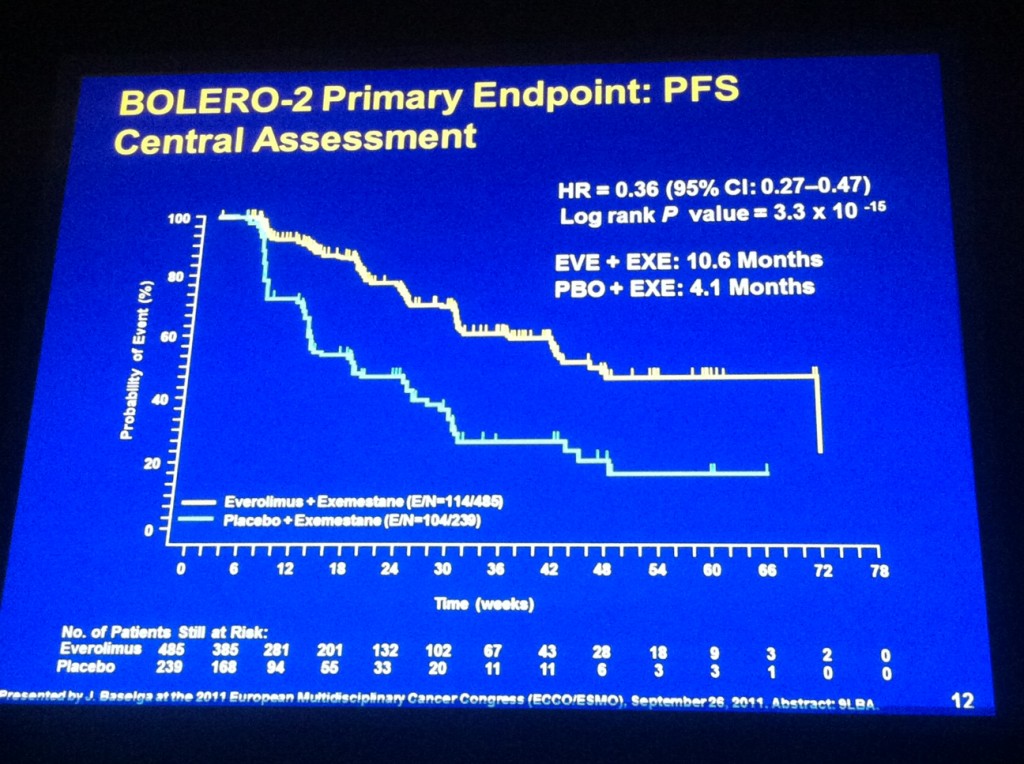
Jose Baselga presented the BOLERO-2 data to a packed audience. When he showed the slide for PFS, there were gasps in the audience around me – a shift in favour of the treatment arm (everolimus plus exemestane) over control (placebo + exemestane) not of the usual 1-2 months, but 6.5 months:

BOLERO-2 data at ECCO 2011

The side effect profile was consistent with what we know about mTOR and Aromatase inhibitors. One thing I would very much like to see is some subset analysis to see what factors separated the super responders from the average responders. This trial tested the combination in a general unselected population, but it would be nice to see if any factors can be derived from the data that suggests what might be predictive of response.

While these results are a major paradigm shift in women with hormonally sensitive breast cancer, the big question is can we do even better?

We also know from basic science that mTOR upregulates AKT, so eventually adaptive resistance will occur through that route too, but you can see where the next round of logical therapies might emerge in future. The current batch of AKT inhibitor have some challenging side effects when used in combination, but next generation of inhibitors might have a more tolerable and improved side effect profile.

All in all, I thought the BOLERO-2 data were my pick of the conference for major practice changing data and I hope to see this data submitted for approval to the Health Authorities very soon. This development is very good news indeed for women with ER/PR+ breast cancer.

5 Comments

It’s that time of year in the dog days of summer when many people in the industry are either incredibly busy, heads down, rolling out new things for the third quarter or else it’s a pleasant lull between the strategic and tactical phases and a good time to catch your breath.  Here in the Icarus office, we’re busy creating and writing a new series of syndicated reports in a variety of different tumour types and pathways.  I have hundreds of snippets and notes saved electronically from various cancer meetings this year, making it a great opportunity to collate and process them into broader insights. If you have any particular needs in this area, now is a good time to let us know, so do email me and your wishes may get added to the list.

Last week I was in Boston and happened by chance to walk past the Whitehead Institute. This reminded me that I had David Sabatini’s new mTOR paper in Science queued up to blog about on Pharma Strategy Blog.

The mTOR pathway is highly complex and consists of a huge network of interwined proteins and kinases:

Source: wikipedia

Hsu et al., (2011) described what they found from defining the mTOR-regulated phosphoproteome using quantitative mass spectrometry and protein libraries to build a complete picture:

“The adaptor protein Grb10 was identified as an mTORC1 substrate that mediates the inhibition of phosphoinositide 3-kinase typical of cells lacking tuberous sclerosis complex 2 (TSC2), a tumor suppressor and negative regulator of mTORC1.

Our work clarifies how mTORC1 inhibits growth factor signaling and opens new areas of investigation in mTOR biology.”

We know, for example, that mTORC1 inhibits PI3K-Akt signaling, but the precise molecular connections involved are poorly understood.  S6K1 phophosphorylation, which destabilises the insulin receptor substrate 1 (IRS1), is one mechanism known to be involved.  Hsu et al., demonstrated that other mechanisms are also critical:

“mTORC1 inhibits and destabilizes IRS1 and simultaneously activates and stabilizes Grb10.”

They went to separate the effects of acute and chronic stimulation of mTOR:

“Whereas acute mTORC1 inhibition leads to dephosphorylation of IRS1 and Grb10, chronic mTORC1 inhibition leads to changes in the abundance of IRS and Grb10 proteins, which are likely the most important effects of mTOR inhibitors to consider in their clinical use.”

This important article is particularly relevant because not long after the publication, Novartis announced positive data with their mTOR inhibitor, everolimus (Afinitor) in patients with tuberous sclerosis complex (TSC).

TSC is a genetic disorder that affects affects approximately 1-2 million people worldwide and is associated with a variety of resulting disorders including seizures, swelling in the brain, developmental delays and skin lesions. It can also cause non-cancerous tumours to form and can affect many different parts of the body such as the brain and kidney, for example.

The rationale behind such as study was described in the Novartis press release:

“Tuberous sclerosis complex is caused by defects in the TSC1 and/or TSC2 genes. When these genes are defective, mTOR activity is increased, which can cause uncontrolled tumor cell growth and proliferation, blood vessel growth and altered cellular metabolism, leading to the formation of non-cancerous tumors throughout the body, including the brain.”

In other words, giving an mTOR inhibitor such as everolimus may help by reduce cell proliferation, blood vessel growth and glucose uptake associated with the TSC defect.

In patients with brain lesions, surgery is usually considered the only viable option, so a study showing a 35% response rate (50% reduction or more) in the SEGA lesions, is a positive step forward.  The new data was from a phase III trial (n=117) and appears to support the initial positive phase II study, so it will likely lead to a registration filing in this indication for everolimus.


References:

ResearchBlogging.orgHsu, P., Kang, S., Rameseder, J., Zhang, Y., Ottina, K., Lim, D., Peterson, T., Choi, Y., Gray, N., Yaffe, M., Marto, J., & Sabatini, D. (2011).  The mTOR-Regulated Phosphoproteome Reveals a Mechanism of mTORC1-Mediated Inhibition of Growth Factor Signaling. Science, 332 (6035), 1317-1322 DOI: 10.1126/science.1199498

A new drug in development, Afinitor (everolimus, RAD001) appears to extends life without tumour growth by almost 5 months compared to 1.9 months with placebo.  In addition, a quarter of the patients in the study remained progression free beyond 10 months of treatment.  This is the first therapy to show significant benefit after failure with initial tyrosine kinase therapy (Sutent or Nexavar).  It is currently being reviewed by the FDA for treatment of advanced kidney cancer after failure of initial therapy.

Initial therapy with kinase inhibitors has demonstrated signifcant progression free survival (PFS).  Nexavar, for example, demonstrated a doubling of median PFS in patients with no prior
cytokine therapy of 25 weeks vs. 12 weeks with placebo.   Sutent was compared to interferon-alpha and demonstrated a PFS of 47.3 weeks compared to 22 weeks with interferon-alpha.

What makes Afinitor different and why does it appear to work well, even in patients who have failed stand therapy?  Well, the answer lies in it's mechanism of action.  Both Sutent and Nexavar are multiple kinase inhibitors, principally of Vascular Endothelial Growth Factor (VEGF), that appears to be important in renal cell cancer.   Solid cancers survive by extending their network of tumour vasculature, a process known as angiogenesis. Inhibiting VEGF therefore inhibits the tumours ability to grow.  They also inhibit Platelet Derived Growth Factor (PDGF), which is important in cell proliferation.

Afinitor, on the other hand, inhibits the mammalian target of rapamycin (mTOR) is an intracellular protein that
acts as a central regulator of multiple signaling pathways (IGF, EGF,
PDGF, VEGF, amino acids) that mediate abnormal growth, proliferation,
and angiogenesis in cancer.  mTOR is a critical component of the PI3K/AKT pathway, a key signaling pathway that is frequently dysregulated in many cancers.

RAD001_IMG

Image courtesy of Novartis Oncology

By targeting a different pathway, the activity of the tumour can be further reduced, even after patients have stopped responding to their initial therapy.  This is one of the new key approaches to attacking cancer – find multiple inhibitors of different critical pathways and then determine the best sequencing for the regimens, thereby improving survival.

All three drugs mentioned so far are oral therapies, which are convenient and easy for cancer patients to take each day.  Another drug approved for renal cancer is Torisel (temsirolimus), a mTor inhibitor that is given by intravenous infusion over 30-60 minutes on a weekly basis.  This drug significantly extended survival in renal cancer patients compared to interferon-alpha treatment (10.9 vs. 7.3 months).  When standardised in weeks to enable comparison to Sutent, this means the PFS was approx. 49 weeks compared to 47 for Sutent.

It should be noted that rare bowel perforations are possible with these therapies, a class effect of inhibiting the VEGF pathway.  Sutent and Nexavar have also been asssociated with raised blood pressure and hypertension, whereas Torisel may result in hyperglycemia and hyperlipemia. This may result in the need
for an increase in the dose of, or initiation of, insulin and/or oral
hypoglycemic agent therapy and/or lipid-lowering agents, respectively.

Additional new results with these agents are expected at the Annual Society of Clinical Oncology meeting in mid 2009.  Afinitor is currently being evaluated by the FDA and EMEA for approval and could be available on the market by March-April 2009.

Reblog this post [with Zemanta]

The annual American Society of Clinical Oncology (ASCO) conference begins later this month and the data has just been released.  Here are some key abstracts prior to the presentations:

Eli Lilly’s Alimta (pemetrexed) slowed the spread of non-small cell lung cancer in patients with advanced disease. It’s approved for use in patients who have failed chemotherapy; this study suggests it may be added to treatment earlier in the course of disease.  Lilly are reportedly filing the early data in patients with select histology later this year.  It was recently approved for first-line use in the EU.

Novartis' RAD001 (everolimus/Afinitor); nearly two-thirds of renal cell cancer patients taking had progression of their disease delayed by a year, a significantly better result than in those taking placebo.  The disease did not progress for one year in 65 percent of patients taking RAD001, taken once daily orally, compared to 37 percent in those taking placebo, according to detailed results from a late-stage trial, which was stopped early because it met its main target.

GSK 's Tykerb (lapatinib) demonstrated positive data from the first-ever randomized, multi-center, open label Phase III trial of the combination of two targeted agents, lapatinib and trastuzumab (Herceptin), in women with HER2-positive metastatic breast cancer who had previous been heavily pre-treated with taxanes and anthracyclines.

Genentech's Avastin (bevacizumab) showed improved survival for patients with recurring brain cancer. The Phase II trial compared Avastin with irinotecan chemotherapy to Avastin alone in patients with relapsed glioblastoma multiforme (GBM), the most common and aggressive type of brain cancer.  Median survival was 9.2 months in the Avastin-only arm and 8.7 months in the Avastin and irinotecan arm.  According to historical estimates, only 15 percent of patients with relapsed GBM would be expected to live without their cancer advancing for six months.

ImClone/BMS's Erbitux (cetuximab) new gene findings indicate a simple gene test could allow doctors to predict in advance which patients are likely to benefit from the therapy, ie those without KRAS mutations, since there is evidence that they are more likely to respond to treatment.  The same approach would also apply to Amgen's Vectibix (panitumumab).

error: Content is protected !!