Pharma Strategy Blog

Commentary on Pharma & Biotech Oncology / Hematology New Product Development

Posts tagged ‘approval’

Abiraterone (Zytiga)This afternoon the FDA approved Ortho Biotech’s abiraterone acetate (Zytiga) in combination with prednisone for the treatment of castrate resistant prostate cancer in patients who have received prior chemotherapy with docetaxel.

Abiraterone was filed on December 20th, 2010 and received fast track designation, so the FDA approval comes 2 months ahead of the expected PDUFA date of June 20th.

It represents another exciting advance for this disease after what Dr Bernard Tombal described as a “Grand Cru” year for prostate cancer in 2010 following the successive launches of cabazitaxel (Jevtana), sipuleucel-T (Provenge) and denosumab (Xgeva), the first since docetaxel (Taxotere) was approved back in 2006 for chemotherapy naive metastatic disease.

I’ve written much about the clinical data from various oncology meetings over the last nine months such as ESMO last September and EAU in Vienna last month.  You can check out the data in the related posts below.

The big question on everyone’s mind, though, has been price.  Docetaxel is now generically available, Sanofi-Aventis’s cabazitaxel is around $6K per cycle (assumes ~$48K if 6 cycles are completed), Dendreon’s sipuleucel-T is $93K for three infusions.

Ruth Coxeter of CNBC Health Sciences was the first to tweet the confirmed abiraterone price of $5K per month, with a median of eight months of therapy.  This gives a treatment price of  ~$40K, which I think is very fair, although some patients will obviously take it for longer than that.
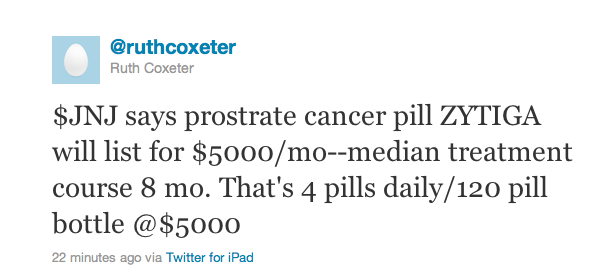
Ruth Coxeter, CNBC Pharma's Market

For those interested in the press release, you can read more here.

What does this approval mean?

abiraterone acetate (Zytiga)

For men with castrate resistant prostate cancer (CRPC) who have previously received chemotherapy, there is now a new treatment option for them to choose other than more chemotherapy with cabazitaxel in the form of easy to take pills (four per day).

The data from the 302 trial in the pre-chemo setting is expected later this year and is expected to be better than the 3.9 months overall survival benefit seen in the post chemotherapy setting reported at EAU last month.

In the analysis for the FDA approval, the overall survival benefit had increased further according to Ortho Biotech:

“In an updated analysis, results were consistent with those from the interim analysis with a 4.6 month difference between the two arms in median survival (15.8 months vs. 11.2 months [HR = 0.74]).”

At the European Association of Urology meeting earlier this year, Dr Johann De Bono (Royal Marsden) told a packed audience that the data for the circulating tumour cells (CTCs) would finally be available at the ASCO annual meeting in June.  It will be interesting to see whether this is a better surrogate measure of response than PSA. With the American Urology Association meeting coming up in a few weeks in DC, not doubt there will be more to discuss then.

All in all, it is good to see new treatment options emerge for the treatment of castrate resistant prostate cancer.

7 Comments

There is a provocative article in this week’s New England Journal of Medicine asking whether the accelerated approval process should be used for more cancer drugs:

“The striking results of recent phase 1 trials of targeted cancer drugs have provoked serious discussion about shortening the road to drug approval.”

The main thrust of the argument was that it takes on average seven years from entering human trials to approval if phase III trials are included in the oncology drug development process.

“Of the 23 oncologic drugs given accelerated approval between 1993 and 2008, two were ultimately withdrawn from the U.S. market — gemtuzumab because of toxicity and gefitinib because of lack of efficacy.”

The author argues that:

“Phase 3 trials are expensive and time-consuming, usually taking at least 2 to 3 years to reach survival end points. The news of a highly successful new compound in phase 1 or 2 rapidly reaches physicians and patients, creating demand for early access.”

While we have seen some successes with the Accelerated Review process with imatinib (Gleevec), erlotinib (Tarceva), cetuximab (Erbitux), bevacizumab (Avastin) and others, there has also been a flood of promising phase II agents that duly flopped in randomised phase III trials, with Pfizer’s figitumumab, Novartis/Antisoma’s ASA404 and sanofi-aventis’ iniparib to name a few off the top of my head.

One of the challenges here is that companies often take a targeted therapy but strangely test it in an unselected patient population, which will increase the chances of failure in a more rigorous randomised phase III trial.  In an ideal world, several carefully designed adaptive phase II trials would help develop logical combinations and markers of response, thus increasing the chances of success in phase III studies.

The big problem as I see it then, is that while we have exciting new agents likely to be approved in 2011 such as:

  • crizotinib in lung cancer
  • ipilimumab (Yervoy) and PLX4032 (vemurafenib) in metastatic melanoma
  • brentuximab vedotin in Hodgkin Lymphoma
  • abiraterone acetate (Zytiga) in prostate cancer

we don’t always know how to carefully select patients to enable treatment based on the underlying molecular basis of the disease.

Of those mentioned above, with crizotinib (ALK), vemurafenib (V600E BRAF) and brentuximab (CD30) we clearly do, but with abiraterone and ipilimumab the issue of patient selection seems less clear at the moment.  Sadly there are not any biomarkers available to tell us which patients are most likely to benefit from treatment in targeted therapies already approved such as bevacizumab.

The fate of bevacizumab in breast cancer has yet to be determined.  It was approved under the FDA Accelerated Review process based on the initial phase II data, with the assumption that the phase III trials would show an improvement in overall survival.  The AVADO and RIBBON1 trials showed a benefit in progression free survival or PFS (ie a surrogate marker of event free survival), but unfortunately were not positive for overall survival, which is the ultimate measure of disease progression and the condition required to be met under the fast track process.

The FDA are therefore recommending withdrawal based on the lack of overall survival as per the accelerated agreement and Roche offering the counter argument that there was evidence of patient benefit.  That issue will no doubt continue to be debated for much of 2011 until the public hearing later this year.  There is an excellent analysis of the impact of the FDA recommendation on bevacizumab uptake in the US in Oncology Business Review for anyone interested in trends.

Ultimately, we need have a better understanding of the molecular basis of the cancer types and drugs developed to target that aberration in a more carefully selected patient population.  The arguments for and against accelerated review will run and run – probably for longer than the debate about how to pronounce some of the new names!

My position on the accelerated review process?

When it works, it works well.  However, problems can arise when you get phase III trials that do not support the full approval due to a lack of a proven overall survival advantage in the population evaluated.  The FDA can find themselves in an impossible position especially given the high emotions that run in breast cancer, for example.  The onus should be on the company to do further research or trials better defining the patients who are most likely to respond rather than risk exposing thousands of patients to the systemic effects of a drug that may not offer meaningful benefit to the majority.

References:

ResearchBlogging.orgChabner, B. (2011). Early Accelerated Approval for Highly Targeted Cancer Drugs New England Journal of Medicine, 364 (12), 1087-1089 DOI: 10.1056/NEJMp1100548

3 Comments

Amgen’s recent announcement of phase III trial data showing that it’s monoclonal antibody, denosumab was superior to Novartis’ Zometa (zoledronic acid) for the treatment of breast cancer patients with bone mestastases is further news that scientifically driven drug development can yield exciting results.

Denosumab is in essence a targeted therapy like Gleevec, Avastin or Herceptin.  It’s development came about from basic research that discovered the cellular control of bone remodelling and regulation of bone density is reglated by the RANK Ligand pathway.

RANK Ligand is a TNF famly member, a protein that is expressed on the sufrace of marrow, stromal cells and osteoblasts (the cells responsible for bone formation). When RANK-L binds with its receptor RANK it stimulates the activity of osteoclasts (cells responsible for bone resorption).  In the body, RANK-L production is naturally regulated by the protein Osteoprotegerin (OPG), which binds with RANK-L thereby preventing it from binding to its receptor, RANK.  When there is insufficient OPG, or too much RANK-L produced, excess bone loss occurs.   This occurs in post-menopausal women or in cancer related bone loss.

Denosumab acts by attaching itself to RANK-L, thereby inhibiting its action. Deprived of RANK-L, osteoclasts cannot form, function or survive.  The result is less bone destruction and bone loss.  Understanding the RANK Ligand pathway has been a breakthrough step in understanding bone biology.

Many cancer patients end up with bone metastases that not only causes pain, but also bone destruction.  Roodman, in a 2004 New England Journal article, proposed the “vicious cycle” hypothesis to explain this: Tumor cells produce parathyroid hormone-related peptide (PTHrP), which stimulates osteoblasts to produce RANK ligand leading to less production (downregulation) of osteoprotegerin (OPG), thereby stimulating osteoclasts to resorb more bone.  At the same time, production of PTHrP promotes tumor growth directly.  Therefore, it should come as no surprise that denosumab would be effective in cancer patients with bone mets and skeletal related events.

What does the future hold for denosumab?  In the postmenopausal osteoporosis market, a once or twice yearly injection is extremely attractive given its ease of use. Compliance is a real issue with bisphosphates such as alendronate or risedronate where a daily pill must be taken.  Many primary care physicians are not set-up to administer an infusion, which is what Novartis’ once a year osteoporosis treatment, Reclast requires.

However, despite impressive clinical data, Amgen does not yet have a home run.  It lacks a large sales force and infrastructure to sell to primary care physicians. Also with generic fosamax (alendronate) available, the cost/benefit trade off is going to be a key factor in uptake.  The cost of denosumab will need to be carefully considered for Amgen to enter this competitive market.  The FDA advisory board meets on August 13 to discuss Amgen’s BLA application and consider whether to recommend approval for the treatment and prevention of osteoporosis, and treatment of bone loss in patients undergoing hormone ablation for prostrate and breast cancer.  Given the positive data from the phase III pivotal studies, a positive recommendation is expected with approval by the FDA expected in October.

For cancer patients, denosumab could become the gold-standard for treatment of bone metastases given its superiority over Novartis’ Zometa.  For oncologists, the fact that denosumab only requires an injection while Zometa requires an infusion is less of an issue.  The key to success for oncology drugs is based solely on the data. If the positive results continue, Amgen are likely to take market share from Zometa once approval for the treatment of bone metastases is obtained in 2010 or 2011.

So, my take on this is that denosumab is a real winner for Amgen.  Whether it will capture the market for postmenopausal osteoporosis remains to be seen, but it is an exciting new drug that will benefit cancer patients.  Further data on denosumab can be expected from the September meeting of the American Society of Bone and Mineral Research (ASBMR) in Denver.

Reblog this post [with Zemanta]
error: Content is protected !!