Pharma Strategy Blog

Commentary on Pharma & Biotech Oncology / Hematology New Product Development

Posts tagged ‘brentuximab vedotin’

The Cancer Research journal has an interesting review of ADC and immunotoxin technology and their potential role in hematologic malignancies that is well worth reading (see references below).

Fitzgerald et al., (2011) observe that:

Immunotoxins and ADCs are assembled in a number of different ways. Antibody fragments or whole antibodies are combined with either protein toxins or low-molecular-weight toxic drugs. Linkage options include gene fusions (peptide bonds), disulfide bonds, and thioether bonds.

Design goals dictate that immunotoxins and ADCs remain intact while in systemic circulation but disassemble inside the target cell, releasing the toxic payload.

Uncoupling the toxin or drug from the antibody is accomplished by protease degradation, disulfide bond reduction, or hydrolysis of an acid-labile bond. Toxin or drug attachment to the antibody must not interfere with antigen binding.

I was particularly struck by the number of immunotoxins and ADCs currently in clinical development each focused on different targets. The article highlights a number of agents in the clinic, as of January this year.

A quick overview is provided in the table below:
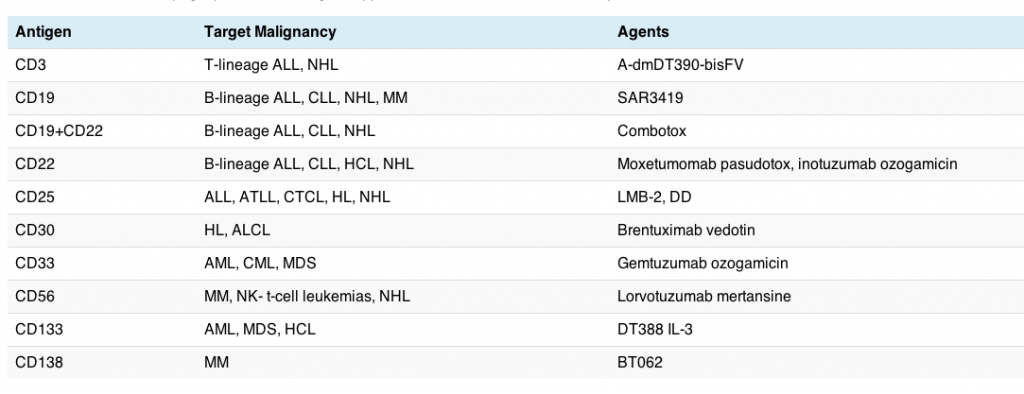
ADC

The good news is that some of these agents have already been approved in the US, although not all have seen a successful launch. While the current rising star from Seattle Genetics and Millennium, brentuximab vedotin (Adcetris), received fast track approval from the FDA in HL and ALCL earlier this year, gemtuzumab ozogamicin (Mylotarg) was voluntarily withdrawn from the US market by Pfizer last summer.  Part of Mylotarg’s problems lay in the early generation linker technology that release the active substance too early, thereby causing more extensive side effects than would be preferred.  Linker technology has evolved considerably since then, which is good news for patients since active drug can now be targeted more precisely where it is most needed.

As the antibody and linkage technology continues to improve, thereby allowing the active drug to be released in the tumour or on the surface of the cancer cells, I would expect to see more of these agents make it to market successfully with fewer toxicities.

One promising agent in this list, moxetumomab pasudotox (MedImmune), had some promising early data presented at ASH in 2010 in relapsed, refractory hairy cell leukemia (HCL) that is worth checking out.

The regular deadline for this years ASH abstracts has already closed, while the late breaker deadline is this month. I’m hoping we will see some more promising data emerge in December.

References:

ResearchBlogging.orgFitzGerald, D., Wayne, A., Kreitman, R., & Pastan, I. (2011). Treatment of Hematologic Malignancies with Immunotoxins and Antibody-Drug Conjugates Cancer Research, 71 (20), 6300-6309 DOI: 10.1158/0008-5472.CAN-11-1374

This morning, Seattle Genetics announced that the expected fast track approval from the FDA has been forthcoming for brentuximab vedotin (Adcetris) following the recent unanimous ODAC voting in both refractory Hodgkin Lymphoma (HL) and Anaplastic Large Cell Lymphoma (ALCL).  Clearly, the company and the agency have come to agreement on the confirmatory trials as part of the condition of accelerated review.  The final prescribing information (PI) can be found on the Adcetris website.

For those of you looking for more information on Adcetris, please check out the related posts section below for previous reports on this novel ADC therapy.

I missed the conference call this morning announcing the pricing details, but Luke Timmerman from Xconomy had a nice summary:

“The company set the price at $13,500 per dose, given intravenously every three weeks. If patients get eight infusions on average, consistent with clinical trial experience, then it will cost $108,000 per patient.”

Based on the data from the clinical trials, most patients will probably need 7-9 cycles, so this would make the overall course in the $94,500 – $121,500 per treatment range, with $108K being the average based on 8 cycles.  The overall treatment cost will therefore typically be less than the $120K cost of treatment for BMS’s ipilimumab (Yervoy) in metastatic melanoma.

Ever since Dendreon announced the $93K course of treatment for Provenge in asymptomatic castrate resistant prostate cancer (CRPC), there has been a noticeable trend upwards in the cost of treating advanced cancers.  We probably spend more treating the last 6 months of a cancer patients life than any of the other stages combined with incremental rather than dramatic improvements.  In the long run, this is likely to be unsustainable, but for now companies will continue to charge what they think the market will bear.

The good news is that Adcetris offers excellent clinical proof of concept for antibody drug conjugate (ADC) technology and has the distinction of being the first such agent approved, beating Roche’s T-DM1 to market, which has been filed with the FDA for the treatment of HER-2 breast cancer.

In the meantime, we also have several other novel therapies awaiting final review by the FDA.  Aside from T-DM1, Pfizer filed crizotinib for ALK-positive lung cancer and now has a brand name, Xalkori, which I thought sounded rather Vulcan :).  Should these two agents also receive FDA approval in the very near future, 2011 will likely be a bumper year for new cancer drug approvals.


2 Comments

This weekend heralded the sixteenth annual meeting of the European Hematology Association (EHA) conference at the ExCel centre in the London Docklands. Completing back to back ASCO and EHA conferences across two continents will test any delegates stamina!

Like ASCO, this year was a relatively quiet one at EHA, with most of the data already known or presented elsewhere.   There were some gems in the program though.

In the latest video highlights I discuss three things that caught my attention:

  1. Is high dose cytarabine (ara-C) really necessary in AML?
  2. Brentuximab vedotin in anaplastic large cell lymphomas (ALCL)
  3. Adherence with chronic TKI therapy in CML

We have previously covered the excellent data for brentuximab vedotin (Adcetris) in Hodgkin Lymphoma, but the new data presented in ALCL in the poster session was, in ways, even more dramatic as you can see from the before and after pictures included.

You can see from the video, shot on location, that the damp windy weather and rundown surroundings created a rather industrial ambience – not quite the image many may have of the Docklands and Canary Wharf, which is a couple of stops earlier on the Docklands Light Railway (DLR).

Of course, there are unplanned escapades, such as nearly missing the 8am session on Sunday morning after the Jubilee line didn’t begin until 7.20am (first train at 7.35am), then the DLR had a “system failure” at Canning Town. A quick dash down to the adjacent bus station, a frantic climb over a fence in glad rags and a rare taxi was thankfully secured for the mad dash to the ExCel centre!

Still, there is something rather edgy about hosting convention centres in marginal areas in the middle of nowhere-land, quite a trek on the Tube and DLR from the Central London:

All in all, I enjoyed the meeting in my hometown and the more relaxed academic atmosphere after the frenetic pace of ASCO, but by the end of ten days on the road it was nice to return home. It’s not all work and no play though, as you can see from this post about some of the pomp and circumstance that inevitably goes with being in London.

{UPDATE:  The day after this posted, Seattle Genetics announced they have an ODAC scheduled for July 14th.   The PDUFA date is August 30th, so with any luck, we may see this drug approved by the FDA sooner rather than later – great news for patients in the US!}

Over the rest of this week I’m going to take some topics related to oncology and discuss them in more detail as part of a mini series about how cancer research is changing.

We all know that cancer isn’t one disease, but actually a myriad of different subsets, often even within each tumour type.  You can see the gradual shift aware from treating a type of cancer eg breast, lung, lymphoma, leukemia, melanoma etc to finding the driving the mutations and matching the patient to the therapy.

London Eye and Houses of Parliament

Having just returned from the European Hematology Association (EHA) meeting in London, I can say I was absolutely fascinated by the phase II data on brentuximab vedotin or Adcetris as it is now known (Seattle Genetics and Millennium), the antibody drug conjugate (ADC) in anaplastic large cell lymphoma (ALCL). Previously, we discussed the amazing data in Hodgkin Lymphoma but the photos of the patient responses in ALCL before and after treatment were amazing.

The connection?

Targeting the CD30 antibody on the surface of the cancer cells.

We can clearly see that as we learn more from basic research about the underlying mechanisms of growth, proliferation, survival and metastases, so our knowledge and ability to slow down disease progression and perhaps even stop the disease in it’s tracks also improves dramatically in some areas.

In the future, I can see triple negative breast cancer being segmented in various subtypes, for example, each with a different driving mutation and treating accordingly with carefully selected therapies, rather than treating them all as one homogenous subset of breast cancer, when they are in fact, heterogeneous.

There are several areas where we have made huge strides over the last five years:

  1. Earlier diagnosis
  2. Chemoprevention and slowing the inflammatory response
  3. Identifying biomarkers, both prognostic and predictive of responses
  4. Preventing metastases
  5. Translational scientist-clinicians

Over the next few days, I’m going to take a deeper look at these areas and discuss some of the new technology and research that is emerging in oncology as part of an updated landscape overview in cancer research.

If you have any other areas you would like covered, please do make suggestions in the Comments below.

3 Comments

Quite a few questions have hit my inbox recently from people wanting to know more about Antibody Drug Conjugates (ADCs) and how they work.

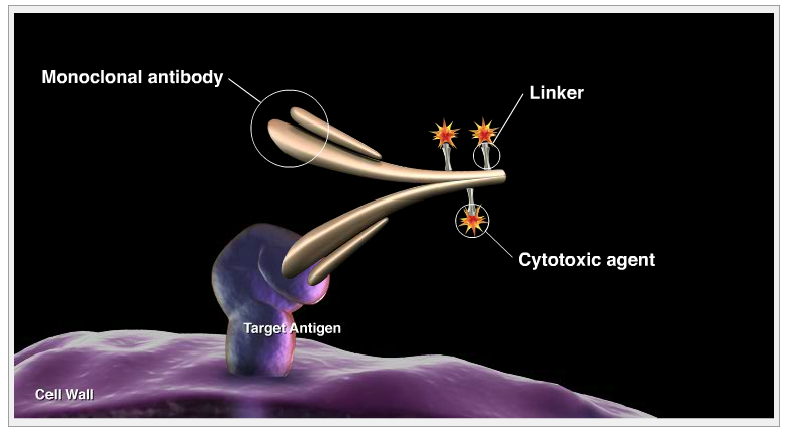
They basically consist of three things:

  1. Monoclonal antibody
  2. Linker
  3. Cytotoxic agent

Antibody Drug Conjugate (ADC)

Source: Roche

The goal is to create a new molecule that essentially is greater than the sum of its parts by making it more targeted, like a guided missile against the cancer cells.

With normal monoclonal antibodies, they bind to atarget antigen that is a tumor-specific antigen on the surface of a tumour cell. With an ADC, the monoclonal antibody part of the molecule still latches onto the target antigen in the same way, but in this case it now has a powerful cytotoxic attached to potentiate the effect.

As Emeril would say, “Bam!”

You can see a video of how the ADC technology works HERE.

Unfortunately, the site only allows you to watch it there or download the video; it’s not easily sharable with others, short of emailing it.  Sadly, I couldn’t embed it here on the blog post for easy consumption either.

A nicer way would have been to put the educational videos on a company YouTube channel and allow it to be shared through social media via Facebook, Twitter etc. Imagine clicking on a link in Twitter and being taken to YouTube on your iPad, iPhone or Android smartphone?  Or watching an embedded video on someone’s blog post?

That’s a much more fun and immediate way to communicate ideas and technology from a medical or scientific learning perspective than a old fashioned static website.

It is good to see Pharma and Biotech companies active on social media, but they have a long way to go yet in terms of how they can help improve learning about the science behind new cancer research and development in an integrated way that helps the end users, ie the scientists, healthcare professionals, patients in clinical trials and analysts who might be interested.

We really do need to get away from the old web 1.0 world into the 21st century of sharing ideas, tools and medical or scientific information using social media in the web 2.0 era.

That said, there are some advanced ADC’s in clinical development at the moment.  The three leading compounds I’ve come across so far are:

  • Brentuximab vedotin (Seattle Genetics) in Hodgkin Lymphoma (HL) and systemic anaplastic large cell lymphoma (ALCL) targets CD30 and now has a brand name, Adcetris.
  • T-DM1 (Roche/Genentech) in HER2+ breast cancer
  • SGN-75 (Seattle Genetics) in RCC and NHL

Overall though, Roche/Genentech probably have the largest active research in this area, with a large portfolio of agents in development across a multitude of different tumour types.  You can check out this full ADC pipeline here.

Seattle Genetics have a couple of abstracts on their ADCs at ASCO this year and Roche have an abstract on the phase III EMILIA trial comparing T-DM1 with lapatinib plus capecitabine in metastatic breast cancer, all on Monday 6th that I hope to check out, that is if the sessions don’t clash!

14 Comments

I was delighted to see, amongst all the big news this morning on President Obama and Osama Bin Laden, that there was a little gem for Biotech – Seattle Genetics announced that the FDA have accepted their BLA filings for antibody drug conjugate (ADC), brentuximab vedotin, and awarded Priority status.  The company stated that the Prescription Drug User Fee Act (PDUFA) date is now set for August 30th, based on the Feb 28th filing date.

Two BLA filings were submitted, one for relapsed Hodgkin Lymphoma (HL) and another for relapsed or refractory systemic anaplastic large cell lymphoma (ALCL).  These two hematologic cancers share a commonality, ie CD30, which is the defining marker of the disease and the target for the ADC therapy.

Based on the data we saw at the recent American Society of Hematology meeting in December, the recent NEJM publication, this is very good news indeed for patients.

New treatment options in rare or difficult to treat diseases are always most welcome. With the American Society of Clinical Oncology (ASCO) and European Hematology Association (EHA) meetings both coming up in June, I’m really looking forward to an update of the data and to see how this exciting new concept (antibody drug conjugates) are progressing.

This is an area where I think we will see many more developments in the very near future, with Genentech’s T-DM1 also likely to have data at ASCO in breast cancer.

error: Content is protected !!