Pharma Strategy Blog

Commentary on Pharma & Biotech Oncology / Hematology New Product Development

Posts tagged ‘cancer oncology’

Life has been very busy on the consulting front so I’m finally catching up on my news reading and what hot’s in the oncology space.  November is lung cancer month so it is apt that we kick off the Pharma Strategy Blog this month with some interesting news on that topic.

One thing that jumps out that may well impact things for many people, including the probably rather relieved insurers, came from results eagerly anticipated after the recent data presented at the World Lung Congress was not yet fully mature.

Gracelogo There was an excellent post from Dr Pennell on the GRACE cancer website, which is one of my favourite cancer sites with commentary from practising physicians and a community debate where you can ask questions.  Great concept.  It’s a non-profit venture established by the dynamic Dr Jack West and well worth supporting if you have an interest in cancer.

The post refers to a really interesting snippet of news that has much relevance in the treatment lung cancer:

“On October 15th there was a press release that, as far as I can tell, went almost entirely unnoticed. News outlets reported that Roche (owner of Genentech, the maker of Avastin (bevacizumab)) reported
to OSI Pharmaceuticals (the maker of Tarceva (erlotinib)) the final
overall survival results from the ATLAS trial.”

What’s even more interesting is that neither Roche/Genentech or OSI Pharma have made an official announcement about the supposed results on their sites so far (as of 11/2), which according to CNBC was not positive for the combination.  It’s unclear whether this is truth or rumour from the CNBC snippet but Dr Pennell did say that he had confirmed it with an OSI contact.  In some ways, if true, this is not really a surprise as there was much debate about early versus late maintenance therapy with several drugs at the recent ASCO meeting, previously discussed on this blog here and the ATLAS trial design here.

Dr Nasser Hanna was quite scathing in his ASCO discussion of the lung cancer oral session about early vs. delayed TKI therapy, arguing that waiting 3 months or so probably gave patients the chance to recover from first line chemotherapy, among other things.

Dr Pennell sensibly concluded that:

“My guess is that this should be enough to say that the combination of Tarceva and Avastin probably won’t achieve regulatory approval in the maintenance setting.”

I’m inclined to agree with him, but we’ll have to wait and see.

Reblog this post [with Zemanta]

Germ cells are sensitive to genotoxins, and ovarian failure and infertility are major side effects of chemotherapy in young patients with cancer. Here we describe the c-Abl–TAp63 pathway activated by chemotherapeutic DNA-damaging drugs in model human cell lines and in mouse oocytes and its role in cell death. In cell lines, upon cisplatin treatment, c-Abl phosphorylates TAp63 on specific tyrosine residues. Such modifications affect p63 stability and induce a p63-dependent activation of proapoptotic promoters.

For many individuals with cancer, protecting fertility from the damaging effects of radiation and chemotherapy is complicated by factors such as age, marital status, the time they have to delay treatment, even the uncertainty of surviving their disease.

Recent research and access to information about the fertility threats of treatment and the options for fertility preservation have improved significantly.

This can only be a good thing.

While this research is preclinical, it does offer hope for cancer patients because the findings could lead to new ways to protect germ cells from the damaging effects of toxic cancer treatments such as cisplatin, which is commonly used for treating breast and gynaecologic cancers.

Posted via web from sally church's posterous

The white whales were victims of intestinal cancers caused by industrial pollutants released into the St. Lawrence River by nearby aluminum smelters.

Now research points to environmental pollutants as the cause of deadly cancers in several wildlife populations around the world. Normally rare in wildlife, cancers in California sea lions, North Sea flounder and Great Lakes catfish seem to have been triggered or accelerated by environmental contaminants.

Other animals, including Tasmanian Devils, sea turtles, woodchucks, eels and sperm whales, also have been stricken with cancers, although they appear to stem from natural causes, including viruses, spontaneous tumors, or genetic factors.

In some cases, the survival of a species and the stability and biodiversity of an ecosystem is jeopardized. The cancers also highlight the dangers that industrial activities pose – not just to animals, but to people in the same areas, exposed to the same compounds.

Cancer is very rare in animals, it's pretty much a man-made disease in various guises.

What then, of the people who worked in the surrounding region in Quebec? Well, it seems people who worked in smelters near the cancer-stricken belugas have reported many cases of lung and bladder cancers linked to coal tar exposure at the factories. Other residents have high rates of digestive tract and breast cancers.

This is an interesting SciAm article worth reading and reflecting on.

Posted via web from sally church's posterous

The IGF-1 receptor was first cloned in 1986 by a Genentech scientist, Axel Ullrich, and in 1989, Carlos Arteaga at Vanderbilt demonstrated that monoclonal antibodies that target the receptor could arrest tumours in mice. 

The perfect target for cancer therapy, however, is one that is expressed only in cancer cells and not normal cells, thus reducing the potential for horrific side effects while attacking the cause of the disease.  This approach has seen some spectacular success with Herceptin for HER2+ breast cancers and Gleevec in BCR-ABL Philadelphia-chromosome positive CML, for example.  The goal is to target the aberration causing the proliferation, which essentially acts like as a thermostat switch with the heat permanently on during the hottest day of the year.

In contrast, chemotherapy as we all know, hits everything in it's path, attacking both normal and cancer cells, wreaking considerable biochemical toxicity and destruction as it goes round the bloodstream.  Imagine my surprise, then, that many companies are suddenly looking at the insulin growth factor receptor (IGF-1R) as potential target for cancer therapeutics.  This is frought with difficulties for several reasons. 

Firstly, IGFR is ubiquitously expressed throughout the body in both cancer cells and normal cells.  It is also overexpressed in many cancers, a suspicious fact in itself, and may not be the aberrant critical factor driving tumour growth.  IGF-1 receptor signalling has been shown to block apoptosis, though it is not as strong in stimulating proliferation of cells, except when it stimulates angiogenesis.

Secondly, there is a solid reason why many drug companies hesitated for so long –
they were concerned about accidentally hitting the insulin receptor
with anticancer drugs might also block insulin receptor signalling and
cause diabetes, as well as the potential for cardiotoxicity.

Thus the big question in my mind, is how do you target the receptor tyrosine kinase (RTK) for IGF-1R in cancer cells while leaving the normal cells largely alone given the ubiquity?  Is it even possible?  In theory, what needs to happen is downregulation of the receptor so that the cells die, because if you give a drug that inhibits the IGF-1 receptor without downregulating, you may stop growth, but then it will merrily resume when you stop treatment.

Image via Wikipedia

Irrespective of the theoretical concerns, a number of companies have active research programs going now with small molecules and monoclonal antibodies to IGF-1R in the clinic.  It is a fair question to test the concept out in research and at least see whether it is successful of not.

At last weekend's ASCO meeting there were a number of abstracts published with IGF-1R inhibitors in a range of cancers.  These include the following examples, which is in no way exhaustive (abstracts via clickable link):

Inhibitor     Company         Phase      Tumour     Abstract 

XL228             Exelixis             I              ST/Hem        #3512
OSI-906           OSI                   I              ST                #2559
AMG-479         Amgen              I              ST                #3545
R1507             Roche               I              Sarcoma       #10503
Figitumumab  Pfizer                I             NSCLC, CRC   #8072
BMS-754807    BMS                   I             ST                 #e14501
MK-0646         Merck                II            mCRC            #4127            
IMC A12         Imclone/Lilly      II            CRPC            #5142       

These are just a few examples, as there are many others in R&D, from companies such as sanofi-aventis, Novartis, Eisai, BiogenIdec etc, so it will be interesting to see how this class pans out.  The data reported at ASCO this year was very preliminary and isolated responses were seen here and there so perhaps still too early to tell whether it will be a viable target or not.

Aside from monoclonal antibodies and small molecule TKIs, there are also other molecular agents such as antisense and small interfering RNAs.  Over the next few years we will see what happens with toxicity due
to normal tissue IGF1R expression and cross-reactivity with the insulin
receptor. 

It's definitely a pathway to watch out for.

If you enjoy this blog, you can subscribe by email for convenient updates:

Enter your email address:

Delivered by FeedBurner

Reblog this post [with Zemanta]

One of the coolest things about cloud services like Twitter is that if you follow other people who tweet at cancer conferences such as ASCO, ASH and AACR, you can keep track of other parallel sessions while sitting in a different one.  Thus Kerry Wachter tweeted about the pediatric neuroblastoma session she was in earlier this week at ASCO and I couldn’t help but suddenly realize it is 32 years since I had a largish lump the size of a small football removed from my adrenal gland and kidney.  32 years is quite a long time and I haven’t really thought much about it in those intervening years.  Gilles Frydman from ACOR challenged/encouraged me to tell my story, so here it is for the first and only time, gulp.

It all started during a field hockey match at school, the month before my 13th birthday.  The end of someone’s stick somehow wellied me in the left belly and the person commented that I was rather solid there as it hurt their hand.  On the Sunday afterwards, I was sitting in the dining room at home doing my homework after lunch and rubbed the offending spot absent mindedly.  It was a bit hard.  Harder than the right side in fact.  That was odd for a right hander, I thought, so lifted up my tee shirt and poked my belly a bit.  One side was larger than the other and much, much harder.

“Mum!  Come here a minute, look at this, what do you think?  My left side is harder and bigger than the right!”

Thus was set a chain of events in motion that went at Star Trek warp speed.  My mother, a former nurse and slightly concerned, thought I had a deep hematoma from the hockey or something so dragged me off to the GP after school.  The doctor, normally polite but very dithery, straightened up sharply after examination and declared that he was referring me immediately to a specialist at Queen Elizabeth Hospital in Hackney later that week.  My mother went pale and looked a bit shocked.  I was none too pleased because Thursday was hockey practice after school and didn’t really want to miss it with a big game coming up against a rival school.

Off to Hackney we went by train and bus.  A big adventure from Kent in those days.  The specialist turned out to be a surgeon, a tall, spare older chap with greying hair and a dour demeanour.  More poking and prodding ensued with much mumbling to the medical students present about this being ‘really quite rare and unusual’.  Eh?  Finally, he solemnly declared to my nervous parents that I would have to stay in for tests and an operation the following week to remove the ‘lump’.  My mother was almost in tears, my father very pale.  I don’t remember my reaction, just that he answered all my questions and patted my shoulder a lot.

The next week was a whirlwind of trips here and there around London in a shuttle bus to various institutions for tests; blood tests, urine tests, cat scans, MRI’s, x-rays… the lot.  I learnt a lot about medicine, London geography and outposts of the University of London in those few weeks.  A 24 hour urine collection was needed to track levels of VMA, or vanilyl mandelic acid, because stress on the adrenal glands leads to an excess of the chemical in the urine.  Years later, I remembered this while an undergraduate at college studying sport science and used the idea to devise an experiment to prove that athletes taking steroids would have higher levels of VMA in their urine compared to non-steroid takers because the drugs are excreted via the kidneys and add to the stress on the adrenals.  Amazing what you can remember and re-apply.

The highlight was a trip to some imaging place near Pentonville and Kings Cross.  On getting out of the van, you were greeted with the cool grey, overcast weather, dust, grime, paper on the streets, boarded up doors and windows and plenty of London grot and grime.  The street was desolate and empty, like a scene from a black and white Hitchcock movie.

Ushered inside, there was an hour or two of instant hell… backwards and forwards inside a claustrophobic white machine, holding my breath for what seemed like an eternity, relax, back through the horrible tunnel, repeat many times.

Of course, I realised years later that it was a brand new fangled CAT scan and they were taking sections of the tumour, slice by slice, to help guide the surgeon with excision.  Back then, it just seemed like torture.  The worse part was having to take off my hearing aid, which rendered the technicians microphone instructions to hold breath or relax totally useless.  Eventually, we agreed a sensible strategy; wait until the conveyor belt moved, count to 6, hold breath, wait until you see light the other end, relax.  That went on forever and I was quite knackered by the end, mostly from the sheer claustrophobia.  To this day I still hate scans and MRI’s for that reason.

While I was changing out of the hospital gown, the technicians printed the pictures; brown and cream affairs in little boxes on sheets like x-rays.  They were so engrossed they didn’t see me wander in and watch/peer from behind them then start asking questions.  After looking nervously at each other, they asked if I was interested in science and biology.  I beamed and said yes.  So, probably breaking all the rules in the book, a high stool was found and they treated me to a little science lecture on the scans, explaining the shapes and illustrating my ‘lump’.  Even I could see it was rather big compared to everything else.  Wow.  I was simply awed by the wonders of modern technology – even a lump can look beautiful sometimes.

Back in the children’s ward at the hospital, things were quite a riot.  We had great food, including Baked Alaska for pudding, we played boisterous football matches in the ward between the beds with a soft knitted ball, much to Matron’s displeasure and annoyance!
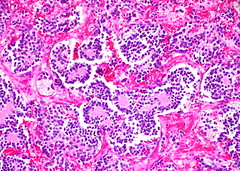
Neuroblastoma of the Adrenal Gland (1)Neuroblastoma cells: Image by euthman via Flickr

The doctors, however,  got nagged and nagged because I wanted to see the lump myself, which horrified the nurses.  Eventually the surgeon relented and took me down to the biochemistry and pathology labs himself for an afternoon of practical dissections, microscope peering and also to be the live patient for the lecture he was giving to the medical students on pediatric neuroblastoma.  That was awesome and I still remember it to this day.

It was there that I realised just how lucky I was.  This is a highly malignant tumour that arises out of germ cells at birth and is usually fatal by age 5 due to unrestrained proliferating metastases.  Who knows why mine, fortuitiously, was still in one big lump at age 12 or that it grew around the kidney, leaving it in bathed in blood in a hollow centre so that it could be saved by the excellent skill of a very good surgeon?  Luck, chance, fate, whatever.  I lived to tell the tale and 30 odd years survival is not bad.  Hopefully it will let parents realise that good things do indeed happen sometimes.

Meanwhile, we had daily self study in the ward ‘school room’, which meant writing up projects based upon research in the well stocked little library, given as donations from many grateful parents. I discovered some fascinating books on cetaceans with beautiful pictures of whales, dolphins and porpoises for a biology project, an awesome book on the Amazon rain forest for a geography essay and my favourite, an enormous heavy book about New York, with stunning pictures of the city by day and night for an English essay on ‘My Dream is to…’

I kept those visions of New York in my head for years, 20 of them in fact, and eventually made it out to New York to live.  Naturally, I picked an apartment on the other side of the Hudson river with stunning views of the Big Apple.  After all, who wants to look at New Jersey by night?  To this day, I still love taking the Staten Island ferry to see Lady Liberty and looking at Manhattan by night based on stunning pictures from the books in that little library.  They became my inspiration.

After a week of tests, the surgeon finally announced it was time for the operation and sat down to talk to me in the ward.  He must have been over 6ft and looked quite amusing perched on a children’s chair at the communal table, while I blithely finished colouring a huge picture based on a forest scene that my best friend’s Mum had given me.  Even the surgeon joined in and doodled a little green on a leaf.  It became a fun ward project.

The operation lasted hours and wasn’t helped by me reacting to the anaesthesia on waking (still a problem even as a adult), but I made it to the ward in one piece and had to spend a week learning to walk again, getting the anaesthetic out and shuffling around like a old lady bent double.  A huge white dressing covered my belly.  Eventually, I got to see underneath as they removed every other stitch a week later before I went home.  There were 26 stitches in all, stretched across in an immaculate thin red line.  My mother was horrified…  It looked like a shark had taken a hungry bite, I thought it was rather cool.

A week at home ensued, during which I drove my poor mother nuts and escaped to get rid of excess energy on my bike.  Another trip back to the QE2, stitches all out and 3 weeks after entering hospital, I was back at school, albeit on strict instructions to ‘take it easy’.  A week after that, I was playing in the big hockey game against a rival school in goal because they didn’t want me running around as centre half and getting damaged. Hah, the other side sensed victory and attacked a lot so the strategy defeated its purpose and the defence was very busy.  Of course, being an avid footballer, I just dived into the thick of it and got stuck in, much to the PE teacher’s horror.  Still, we won, that’s all that mattered!

Nothing much happened in the intervening years… monthly visits stretched out to 3, then 6 and finally annually.  At 18, one is supposed to go to the adult clinic but instead they transferred me to the children’s clinic at St Bartholomews Hospital when the surgeon retired and I continued going there for years on an ad hoc basis.  It was more fun doing that and seeing the kids go through it, talk to their parents and the nurses as they became staff nurses or the Sister.  It was almost like family in the end.

So that’s my story; 1977 is a long time ago, the Queen’s silver jubilee year, I think it was as one of my friends saved me a mug that were given out at school to celebrate the event.  I aced my exams that Christmas, despite being away for 3 weeks.  How come?  The self study sessions at the hospital taught me to think independently, to ask questions and pay attention to detail; somehow, it frees your mind more than just sitting in class learning by rote and you never go back.  We had to write an English essay based on what we wanted to be when we grew up.  I knew I want to be a scientist, a biochemist in fact; the idea that different diseases might lead to changes in biochemistry that could be detected fascinated me.  Now I come to reflect on it, it still does.

5 Comments

After spending the long weekend listening and learning about literally 100's of cancer studies and hearing about the tragic Air France flight that resulted in the loss of over 200 lives, I was reminded of how fragile and short life can sometimes be, how pure chance can change the course of things forever.

For me, this afternoon is quiet time for reflection and restoration of one's karma after the hurly burly of life with a long walk in a local park.  Getting out for fresh air on a glorious day can't be beat!

IMG_1301

The Pharma Strategy Blog will be back tomorrow refreshed and energised, with a series of updates based on news from ASCO in a variety of pathways and tumour types.

For now, adios!

Reblog this post [with Zemanta]
2 Comments

One of the most noticeable things about this year's annual meeting is how many of the pathways that were being discussed at AACR research in recent years are now producing early data in the clinic.  One such pathway is PARP, where two oral abstracts were presented today. 

In the plenary session, Dr Joyce O'Shaughnessy presented the phase II data for BiPar and sanofi-aventis' PARP inhibitor, BSI-201.  This was preceeded, however, by a most entertaining presentation on the pathway by Dr Merrill Egorin from Pittsburgh.  Through his exceelntly distilled synopsis we learned that PARP is a key regulator of DNA damage and repair processes, including DNA base excision repairs.  More detailed inofrmation can be found in two technical papers published in Nature by Drs Farmer and Bryant, both in 2005.

Dr O'Shaughnessy described tumours as essentially a situation in which cancer cells have lost the ability to repair damaged DNA. In this study, data was presented in triple negative breast cancer (TNBC), which has a typically poorer prognosis compared with other subsets of breast cancer.  Patients were randomised 1:1 to receive either a chemothrapy doublet (gemcitabine plus carboplatin) or chemotherapy plus BSI-201.

The primary endpoints were clinical benefit rate and PFS.  Secondary endpoints included overall survival, although this data will not be available until fourth quarter of 2009.

Results reported in the patients so far were as follows:

                           Gem/Carbo     Gem/Carbo + BSI-201

ORR                           16%                     48%
CBR                            21%                    62%

PFS                           3.3 mon              6.9 mon
OS                             5.7 mon             9.2 mon

There were no differences in non-hematologic toxicities and grade 3/4 were uncommon to date.

The authors concluded that PARP1 is upregulated in most TNBC's, BSI-201 was well tolerated and patients showed significant clinical outcomes.  On the basis of these results, a phase III trial is being established and is expected to be open in late June.

A second phase II trial looking at PARP inhibition was presented by Dr Tutt et al.  They examined the effect of olaparib (AZD2281) from AstraZeneca and KuDOS in BRCA1 and BCRA2 breast cancer.  This study looked at refractory disease where patients had previous received chemotherapy such as an anthracycline and a taxane.  They compared the impact of two different doses of olaparib orally, i.e. 400mg BID and 100 mg BID, on overall response rate and complete/partial responses. 

The results were as follows:

                    400 mg BID      100 mg BID

ORR                   41%              22%

CR                       4%               0% 

PR                      37%             22%

PFS                     5.7 mon      3.8 mon    

However, the combination was not without toxicities, with grade 3 adverse events occurring more frequently in the higher dose arm, and the most common (grade 3 or more) being fatigue (15%) and nausea (19%).

The authors of this trial concluded that it was the first report for a therapy designed for BCRA1/2 in breast cancer patients.  Single agent activity in the 400mg arm was substantial compared to the 100mg arm and the treatment was well tolerated.

There are few options in BRCA positive disease – it occurs in both breast and ovarian cancers – so AstraZeneca may try seek an accelerated approval for this agent.  It will be interesting to see sanofi-aventis and AZ battle it out for the honour of the first PARP inhibitor approved in breast cancer.  Watch this space!

Reblog this post [with Zemanta]
3 Comments

Yesterday at ASCO was frantic, there is no other way to describe it as one hurtled from one session to the next.  There is little time for reflection in a huge meeting of over 30,000 squeezed into a small space, but one thought crossed my mind while sitting in the lung and colorectal cancer sessions.  Namely, the abstracts often contain preliminary data from several months back and the data should be taken with a large pinch of salt.  A good example of this was OSI/Genentech's Tarceva, which at first glance suggested a small benefit of only 8 days as maintenance therapy.  The data being presented this morning is a little more robust than that, so the media should beware of jumping to hasty conclusions.

Typically, advanced lung cancer patients get 4 cycles of chemotherapy and then their progress is monitored until progression, whereupon another therapy is tried.  The big question raised recently, is whether adding a new treatment or combination as maintenance therapy would improve the survival.  At this ASCO meeting a number of trials attempted to answer this important question.

Let's look at Tarceva therapy compared to placebo in this setting.  The final results of the SATURN trial demonstrate that Tarceva actually significantly improved PFS in chemo naive patients with both squamous and non-squamous cell lung carcinoma by 41% compared to placebo.  Patients with an EGFR mutation achieved a 10 fold increase in the time they lived without their disease worsening.  Sadly though, the biomarker data suggested that KRAS mutation status was not a predictor of efficacy in NSCLC in patients treated with Tarceva, as had been hoped.

A second trial, called ATLAS, looked at the combination of Tarceva with Avastin following standard chemotherapy as maintenance therapy after first-line treatment with chemotherapy plus Avastin in patients non-squamous histology.  Patients treated with this combination saw their cancer growth slow more than a control group treated with Avastin alone.

Over 750 patients were randomized to receive Avastin and placebo, or Avastin and Tarceva. Patients in  the Tarceva group survived an average of 4.8 months before the cancer started growing again, compared to 3.7 months for the control group.  This eqautes to a 29 percent reduced risk of disease progression for patients who took the Tarceva and Avastin combination compared to Avastin alone.

Vincent Miller, the presenter stated that, "This is the first study to show that adding
erlotinib (Tarceva) to maintenance therapy with bevacizumab (Avastin)
delays disease progression in patients who have already received
bevacizumab as part of their initial chemotherapy."

In a third trial with Alimta (Lilly), 663 non-squamous patients with metastatic lung cancer were randomised to receive Alimta or placebo.  Preliminary results showed that patients who took the drug lived 26 percent longer compared to the control group, ie 13.4 months compared with 10.6 months.

The lead author and presenter said that, "Maintenance therapy with Alimta (pemetrexed) offers a new paradigm for patients who have advanced lung cancer, because it has a low toxicity and can be given on an ongoing basis over a prolonged period of time to extend patients' lives."

There was very little hot news to report from yesterday's colorectal cancer sessions, but the data in advanced lung cancer could well change the landscape and significantly improve survival for patients with the disease.  That's great news all around.  Mind you, I wouldn't like to be one of the companies with ongoing trials in this area though, the standard of care could well have changed with these results and the bar raised a little higher for new entrants.  That's good news for patients though!

Reblog this post [with Zemanta]
2 Comments

It's that time of year when the annual American Society of Clinical Oncology meeting rolls around, this year from the heat and humidity of Orlando. 

Some people are tweeting the different sessions using the #ASCO tag and others #ASCO09.  Still others are just typing ASCO or @ASCO, although the poor organisers might be a little overwhelmed by that as all tweets will show up in their @mentions.  Rather than do repeated searches on Twitter, you can follow them all via the handy little CoverIt widget below:

Reblog this post [with Zemanta]
1 Comment

This morning I woke up to the news in an email alert that one of my client companies, sanofi-aventis, has been busy on the licensing front again after their recent deal with BiPar.  This time they have licensed two compounds from Exelixis, which are PI3-kinase inhibitors, XL-147 and XL-765.  You can read more about the deal itself on Mike Huckman's CNBC blog.  Regular readers of this blog will recall some previous posts on PI3-kinase inhibition such as here and here

XL765_targets It's an interesting and relatively 'hot' pathway with the advent of mTOR inhibitors and the role of AKT-PI3-Kinase pathway in potentially reducing drug resistance and limiting the feedback loop seen with mTOR.

The deal with a big Pharma suitor was inevitable after Exelixis signalled their intentions last December during the end of year pipeline update, according to my notes made at the time.  The slight development lead in this area turned into  a profitable deal for Exelixis. 

At the recent AACR meeting in Denver, I noticed there were several others not far behind and some phase I data is expected to be presented next week at ASCO by Semafore on their PI3-kinase inhibitor, SF1126. 

According to one of the abstracts:

"SF1126 is composed of the pan PI3K inhibitor LY294002 conjugated to an RGD targeting peptide. It is designed to increased solubility and binding to integrins expressed on tumor vasculature. This targeted prodrug enhances tumor delivery of the active inhibitor, improving antitumor efficacy and tolerability in xenograft models."

Other companies with receptor tyrosine kinase inhibitors (RTKIs) in phase I development include Novartis, who have two PI3-kinase inhibitors BEZ235 and BGT226, Genentech with GDC-0941 and Merck, who have an AKT inhibitor, MK-2206.  There are also others in preclinical development.  The number of mTOR inhibitors in R&D is now too numerous to mention in addition to the three already available commercially (sirolimus, temsirolimus and everolimus).

In the final analysis though, this looks a very good deal for Exelixis, who get another couple of their portfolio licensed out and relatively low risk for sanofi-aventis but neither PI3-K inhibitor will address the urgent shortfall they face when both Taxotere and Eloxatin go off patent in the very near future.  Some late phase II/III compounds are still a glaring gap in the French company's pipeline.

Reblog this post [with Zemanta]
1 Comment
error: Content is protected !!