Pharma Strategy Blog

Commentary on Pharma & Biotech Oncology / Hematology New Product Development

Posts tagged ‘cell signaling’

At the recent International Society of Gastroenterological Carcinogenesis (ISGC) meeting hosted by MD Anderson Cancer Centre that I attended in Houston, one of the topics mentioned the potential role of Fibroblast Growth Factor Receptors (FGFR) in carcinogenesis. I thought this was a great opportunity to research the area further.

A recent review of the role of FGFR in carcinogenesis fortuitiously appeared in Molecular Cancer Research:

“The fibroblast growth factor receptors (FGFR) play essential roles both during development and in the adult.  Upon ligand binding, FGFRs induce intracellular signaling networks that tightly regulate key biological processes, such as cell proliferation, survival, migration, and differentiation. Deregulation of FGFR signaling can thus alter tissue homeostasis and has been associated with several developmental syndromes as well as with many types of cancer.

In human cancer, FGFRs have been found to be deregulated by multiple mechanisms, including aberrant expression, mutations, chromosomal rearrangements, and amplifications.”

They also went on to define what carcinogenesis is based on what we learned from Hanahan and Weinberg (2000) in their classic paper, The hallmark of Cancer:

“Carcinogenesis is a multistep process during which normal cells are transformed into cancer cells by accumulating several genetic changes and acquiring several common features that promote the malignant phenotype, often referred to as the hallmarks of cancer.

The six classic hallmarks of cancer include self-sufficiency in growth signals, insensitivity to antigrowth signals, limitless replication, evasion of apoptosis, sustained angiogenesis, and the ability to invade tissue and form metastasis.”

Bearing in mind that Hanrahan and Weinberg’s paper was published over a decade ago, there were some interesting observations that hold true:

“It is increasingly apparent that the growth deregulation within a tumor can only be explained once we understand the contributions of the ancillary cells present in a tumor—the apparently normal bystanders such as fibroblasts and endothelial cells—which must play key roles in driving tumor cell proliferation.”

Their article is now open access, so you can see how they described the role of these cells with cancer cells.

Going back to Haugsten et al., (2010) review, we learn new developments in carcinogenesis that have taken place over the last decade relating to FGFR, which has received much less attention than other receptors such as VEGF, PDGF, EGFR and IGF-1R as a potential target.   The FGFR family consists of four genes encoding the tyrosine kinase receptors (FGFR1 to FGFR4).  Downstream, the pathway becomes quite complex, so it will be interesting to see which factors emerge as escape routes through cross-talk and feedback loops.
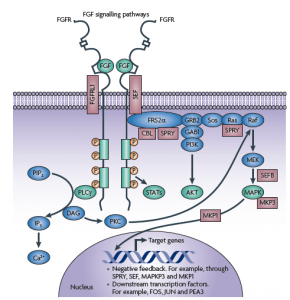
FGFR pathway in Cancer

The potential role of FGFR in cancer carcinogenesis is summarised in the table below:
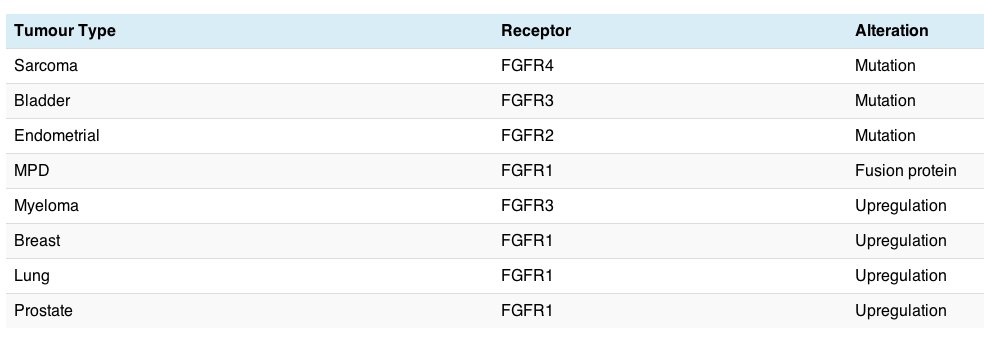
FGFR in Cancer

There are a variety of different cancers potentially affected, but FGFR is not always overexpressed where it is amplified and may not always be contained in the amplification.  Sometimes overexpression merely indicates a poorer prognosis or the development of resistance.

The chances of it being a drugable target and therefore more likely to have a meaningful clinical impact is probably greater where there are mutations or fusion proteins, since these often (but not always) have aberrant activity associated with them.  The challenge is therefore figuring where it might be a passenger or a driver gene.

Turner and Grosse (2010) also reviewed the FGFR pathway as a new area of research:

“Although FGF signalling can drive tumorigenesis, in different contexts FGF signalling can mediate tumour protective functions.  The identification of the mechanisms that underlie these differential effects will be important to understand how FGF signalling can be most appropriately therapeutically targeted.”

Obviously, we won’t know the answer until clinical trials with the small molecule inhibitors and monoclonal antibodies are completed, but it certainly looks to be a worthwhile area of exploration.  Hynes and Dey (2010) discussed the potential role in breast cancer in more detail, noting the findings of Roidl et al (2009):

“In breast cancer cell lines, it has been reported that increased levels of FGFR4 are found in cells resistant to chemotherapeutics.”

This suggests a combination strategy in those cases may be worthwhile.

For those who missed it, I also posted about the potential role of FGFR1 in lung cancer last month, which also included some of the inhibitors emerging in this class.

References:

ResearchBlogging.orgHaugsten, E., Wiedlocha, A., Olsnes, S., & Wesche, J. (2010). Roles of Fibroblast Growth Factor Receptors in Carcinogenesis Molecular Cancer Research, 8 (11), 1439-1452 DOI: 10.1158/1541-7786.MCR-10-0168

Hanahan, D., & Weinberg, R. (2000). The Hallmarks of Cancer Cell, 100 (1), 57-70 DOI: 10.1016/S0092-8674(00)81683-9

Turner, N., & Grose, R. (2010). Fibroblast growth factor signalling: from development to cancer Nature Reviews Cancer, 10 (2), 116-129 DOI: 10.1038/nrc2780

Hynes, N., & Dey, J. (2010). Potential for Targeting the Fibroblast Growth Factor Receptors in Breast Cancer Cancer Research, 70 (13), 5199-5202 DOI: 10.1158/0008-5472.CAN-10-0918

Roidl A, Berger HJ, Kumar S, Bange J, Knyazev P, & Ullrich A (2009). Resistance to chemotherapy is associated with fibroblast growth factor receptor 4 up-regulation. Clinical cancer research : an official journal of the American Association for Cancer Research, 15 (6), 2058-66 PMID: 19240166

2 Comments

At the annual American Association of Cancer Research (AACR) annual meeting earlier this year, Prof Bert Vogelstein presented a fascinating lecture on the critical cancer pathways and how targeting the aberrant signalling may potentially lead to new breakthroughs in treatment.  I've been meaning to write a series on those particular pathways, but things have been very busy since the conference in DC!

It was therefore with great interest that a new paper came out yesterday in the Cancer Research journal entitled, "Gamma-Secretase Inhibitors Enhance Temozolomide Treatment of Human Gliomas by Inhibiting Neurosphere Repopulation and Xenograft Recurrence."

This is also hot on the heels of negative news from Lilly the other week regarding their gamma secretase inhibitor, semagacestat, in Alzheimer's disease. Now, if I were on their oncology team, I'd snap it up and investigate the possibilities in cancer indications, because one's man's poison is another man's nectar: there aren't too many NOTCH inhibitors in oncology development that I know of, and those that are, are still in relatively early phase I development.  More about the pipeline compounds later.

So what's all the fuss about and how does γ-Secretase connect with NOTCH signalling?  Let's take a look at the basic pathway:

Picture 1Source: Cell Signal

NOTCH signalling is an evolutionary pathway that has been shown to regulate cell-fate determination (renewal) during development and also in stem cells.  Without going into too much biochemistry, it essentially enables cell-cell communication and continually enables renewal of adult tissues such as blood, skin, and gut epithelium not only to maintain stem cells in a proliferative, pluripotent, and undifferentiated state.

You can gather from this, therefore, that aberrant NOTCH signalling might also drive or be involved with the dreaded word in cancer: proliferation.  Why?  Because Notch signaling appears to play a role in regulating the cellular actions of VEGF, ie angiogenesis. For those interested in this area, there is a link to a review article on angiogenesis and NOTCH below.

You can also see from the picture above that gamma secretase is a protease that cleaves the NOTCH ligand across the cell membrane.  How then does this relate to gliomas?  According to the study authors:

"Notch activity is upregulated in many gliomas and can be suppressed using gamma-secretase inhibitors (GSI)."

What they found was very interesting:

Basically, in a mouse xenograft model adding a gamma-secretase inhibitor to a standard glioma drug, temozolomide, reduced tumour growth and recurrence and increased survival more effectively than either drug alone.  When you consider that NOTCH may play a role in angiogenesis, these findings make a lot of sense.

What about NOTCH inhibitors in the pipeline?

Merck (MK0752)

This is good news for Merck in particular, since they market temozolomide, a standard treatment for gliomas and have a gamma-secretase inhibitor, MK-0752, in phase I development for breast and pancreatic cancers.  There is also a single agent phase I dose finding trial ongoing with recurrent or refractory CNS tumours, but the new data from Cancer Research may excite their scientists to consider combining MK-0752 with temozolomide in gliomas.  It's certainly worth a shot.

Lilly (semagacestat)

We mentioned Lilly's agent, semagacestat, but as far as I know that is only being tested in Alzheimer's disease although they appear to be testing a NOTCH inhibitor in oncology, as this advanced solid tumour trial suggests.  It may a different compound, however, as the agent is not named.

Roche/Genentech (RO4929097)

The only other NOTCH inhibitor I'm aware of is from Roche/Genentech (RO4929097), which is being tested in a much broader range of cancers than Merck's, including a trial about to start in newly diagnosed gliomas, with temozolomide and a phase II study as a single agent in relapsed/refractory glioblastomas.  Nice work, Roche/Genentech!

If you know of any other NOTCH or gamma secretase inhibitors in development for cancer indications, do drop a note in the comments.  I'm sure Vogelstein would agree that this is a very promising area of research indeed so far.


ResearchBlogging.org Gilbert, C., Daou, M., Moser, R., & Ross, A. (2010).  -Secretase Inhibitors Enhance Temozolomide Treatment of Human Gliomas by Inhibiting Neurosphere Repopulation and Xenograft Recurrence Cancer Research DOI: 10.1158/0008-5472.CAN-10-1378

Cook, K., & Figg, W. (2010). Angiogenesis Inhibitors: Current Strategies and Future Prospects CA: A Cancer Journal for Clinicians, 60 (4), 222-243 DOI: 10.3322/caac.20075

4 Comments

Recently at a couple of scientific cancer meetings, American Urology Association (AUA) and American Society of Clinical Oncology (ASCO), Frank McCormick described a fascinating talk about how a wac-a-mole approach to figuring out how the phosphatidylinositol 3′-kinase (PI3-kinase or PI3K) pathway could be targeted effectively with therapeutics. The reason for research in this area is PI3K has been shown to play a major role in proliferation and survival in a wide variety of human cancers, thus making is a potential target for therapeutic intervention.

I’ve been following this target for a couple of years now and data is now starting to emerge that’s worth discussing on a broader scale, given the implications.  Here’s a quick snapshot of the PI3K pathway and related pathways:

image from www.nature.com
Source: Workman et al., Nature

As many of us well know, however, simply targeting one element of an aberrant pathway can lead to cross-talk and feedback loops as the cancer tries to maintain the signals important for it’s survival, so a more cunning approach is needed whereby the escape routes are closed off one by one by targeting different kinases as well as PI3K.

McCormick’s talk was a fascinating lecture that basically went through multiple pathways explaining, ‘well we tried X and this happened, so we tried blocking Y as well and this happened…’  kind of approach in a very logical and systematic fashion.  Eventually, all options will be explored and a new paradigm might emerge.

It was therefore with great interest that I read a series of new papers in AACR’s journal, Clinical Cancer Research (see references below) over the weekend on both the pathway itself, and also new data with targeted PI3K agents in both breast and renal cancers.

The Data so far:

Miron et al., looked at PI3K mutations in in situ and invasive breast carcinomas and reported:

“This is the first study to show that PIK3CA mutation is a relatively early event in breast tumorigenesis preceding invasion because the frequency of PIK3CA mutations was the same in pure DCIS as in DCIS adjacent to IDC and in IDC.”

Given the frequency of mutations was the same for the 3 groups they studied (pure ductal carcinoma in situ (DCIS), DCIS adjacent to invasive carcinoma, and invasive ductal breast carcinomas), the data suggest that the PI3K mutation may play a greater role in breast tumor initiation than in invasive progression.

If this is the case, targeting PI3K early, for example in neoadjuvant therapy, may have a positive beneficial effect.

In the O’Brien paper, the researchers looked for predictive biomarkers of sensitivity to Roche/Genentech’s PI3Ki, GDC-0941 in preclinical models of breast cancer:

“We found that models harboring mutations in PIK3CA, amplification of human epidermal growth factor receptor 2, or dual alterations in two pathway components were exquisitely sensitive to the antitumor effects of GDC-0941.  We found that several models that do not harbor these alterations also showed sensitivity, suggesting a need for additional diagnostic markers.”

Identifying suitable biomarkers in preclinical studies, such as the HER2 amplification and the PIK3CA mutation (but not PTEN deficiency) previously identified in other studies and now validated in O’Brien et al’s GDC-0941 study, will hopefully help in better design of future clinical studies.  They also noted that decreased ERBB3 expression in PIK3CA mutant cell lines, and ERBB3 expression was increased in response to treatment with a PI3K inhibitor, suggesting that ERBB3 expression levels might be used as a biomarker for high activation of PI3K signaling and increased sensitivity to PI3K inhibitors.  This kind of rigourous approach would potentially enable selecting which people are most likely to respond up front to the agent, rather than exposing those who are unlikely to get a response to additional toxicities and side effects.

In a well written editorial, Turke and Engelman, also emphasised that:

“A novel expression profile was developed to identify other breast cancers sensitive to PI3K inhibitors. These expression studies highlighted feedback networks connecting TORC1, PI3K, and mitogen-activated protein kinase (MAPK) pathways, and underscored the potential for combination therapies.”

They also went on to observe:

“It will be interesting to determine if PI3K inhibitors induce substantial apoptosis in vitro and tumor regressions in vivo in these cancer models (without HER2 amplification or PIK3CA mutation).  Of course, it will be crucial to assess biomarkers identified in laboratory studies in clinical samples from patients who respond to PI3K inhibitors.  Neo-adjuvant trials in breast cancer patients can be leveraged to address these translational goals, because they correlate clinical efficacy and pathologic signs of response (e.g., changes in Ki67 levels and induction of caspase cleavage) with the presence of potential biomarkers.”

In another study, Cho et al., looked at the effects of a dual PI3-Kinase/mTOR Inhibitor
NVP-BEZ235 compared with rapamycin in renal cancer (RCC) with BEZ235 (Novartis). The proof of concept for mTOR has already been shown clinically with the approval of two drugs in this indication, temsirolimus (Pfizer) and everolimus (Novartis):

“These agents induce only modest tumor regression and extend progression-free survival only a few months in most patients.”

The big question here is whether targeting PI3K as well as mTOR would have any extra beneficial effects?  The results demonstrated that dual inhibition of PI3K/mTOR with BEZ235 induced growth arrest in RCC cell lines both in vitro and in vivo more effectively than inhibition of TORC1 alone. If reproduced in the clinic, this may offer a new and more effective approach to treatment of the disease.

The Future:

The PI3-kinase field is particularly interesting, with several companies snapping up PI3K inhibitors including sanofi-aventis (from Exelixis) and more recently, Infinity (from Intellikine).  Other oncology companies already have some in their pipeline, such as Novartis (BEZ235) and Roche/Genentech (from Piramed).  Meanwhile, smaller biotechs such as Semafore and Calistoga also have some promising early phase compounds in development.  Some of these compounds target PI3-kinase alone, while others target PI3K and mTOR.

This is not going to be a straightforward approach to targeting cancer and identifying biomarkers along the way will be key, as well working out the best combinations that might make a more effective therapeutic approach than single agent activity. Figuring out when best to test these agents (early or late) will also be critical. The I-SPY breast cancer trials have already led the way in creating protocols for testing novel agents in the neoadjuvant setting in breast cancer, and it may well be that PI3K inhibitors would be a good class to test in this setting based on the new evidence from Miron et al’s study.

What is particularly interesting to me is that PI3K signalling may also have a role to play in asthma and COPD (the area I did my doctoral research in) rather than just cancer.  Now that would be really fascinating as the biochemical and molecular biology overlap have long been suspected, but very little research has really evolved this way. Part of that is due to drug manufacturer silos and the inability to effectively spearhead cross-therapeutic research.

It will be fascinating to watch how the PI3K data shakes out in practice over the next few years.

What do you think?

ResearchBlogging.org O’Brien, C., Wallin, J., Sampath, D., GuhaThakurta, D., Savage, H., Punnoose, E., Guan, J., Berry, L., Prior, W., Amler, L., Belvin, M., Friedman, L., & Lackner, M. (2010). Predictive Biomarkers of Sensitivity to the Phosphatidylinositol 3′ Kinase Inhibitor GDC-0941 in Breast Cancer Preclinical Models Clinical Cancer Research, 16 (14), 3670-3683 DOI: 10.1158/1078-0432.CCR-09-2828

Turke, A., & Engelman, J. (2010). PIKing the Right Patient Clinical Cancer Research, 16 (14), 3523-3525 DOI: 10.1158/1078-0432.CCR-10-1201

Miron, A., Varadi, M., Carrasco, D., Li, H., Luongo, L., Kim, H., Park, S., Cho, E., Lewis, G., Kehoe, S., Iglehart, J., Dillon, D., Allred, D., Macconaill, L., Gelman, R., & Polyak, K. (2010). PIK3CA Mutations in In situ and Invasive Breast Carcinomas Cancer Research, 70 (14), 5674-5678 DOI: 10.1158/0008-5472.CAN-08-2660

Cho, D., Cohen, M., Panka, D., Collins, M., Ghebremichael, M., Atkins, M., Signoretti, S., & Mier, J. (2010). The Efficacy of the Novel Dual PI3-Kinase/mTOR Inhibitor NVP-BEZ235 Compared with Rapamycin in Renal Cell Carcinoma Clinical Cancer Research, 16 (14), 3628-3638 DOI: 10.1158/1078-0432.CCR-09-3022

9 Comments
error: Content is protected !!