Pharma Strategy Blog

Commentary on Pharma & Biotech Oncology / Hematology New Product Development

Posts tagged ‘early detection’

One way to potentially improve long term cancer statistics is earlier detection, and in high risk patients, appropriate initiation of earlier treatment, since it is well known that the survival in stage II or III breast cancer is noticeably better than that for stage IV metastatic disease.

A critical question then, is how do we improve earlier detection?

There are a number of ways to achieve this:

  1. Imaging techniques
  2. Prognostication
  3. Diagnostics
  4. Biomarkers

Historically, breast cancer has often been picked up using classic, but rather crude, imaging techniques such as mammography and ultrasound, although both have their limitations and challenges. Biopsies are also challenging and invasive, especially in early stage disease when the tumour(s) may be very small. I’m particularly interested in biomarkers because it offers a lot of untapped near-term promise. We know that as tumours begin to develop, they leave tell tall signs and signatures – how can we develop ways to detect these earlier and with greater accuracy than at present?
Source: wikipedia

I was fascinated to read a paper in PLoSONE (open access, see references below) this morning looking at circulating microRNAs (miRNA) as a potential blood based marker for early stage breast cancer detection.

miRNA were defined by Schrauder et al., (2012) as:

“MicroRNAs (miRNAs, miRs) are a class of small, non-coding RNA molecules with relevance as regulators of gene expression thereby affecting crucial processes in cancer development.”

They were first described by Lee et al., (1993) in C. elegans (open access, see references below) and have since been found to be stable in blood, making them ideal biomarker material.

In the current research, the authors set out to determine whether miRNA could discriminate early stage breast cancer (n=48) from healthy controls (n=57) using microarray analysis.

What did the research show?

The initial results appear promising:

“We found that 59 miRNAs were differentially expressed in whole blood of early stage breast cancer patients compared to healthy controls. 13 significantly up-regulated miRNAs and 46 significantly down-regulated miRNAs in our microarray panel of 1100 miRNAs.”

Two of the miRNAs (miR-202, miR-718) were subsequently validated by RT-qPCR in an independent cohort.

What do these results mean?

I thought these results were encouraging, although it should be noted that there is no doubt that blood-based miRNA-profiling is behind the improvements seen in tissue-based miRNA-profiling. The advantage though, of blood-based profiling, is that it clearly offers:

“The potential for early, non-invasive, sensitive and specific BC detection and screening.”

Of course, there is a long way to go yet, although similar early studies have been performed in other tumour types such as lung cancer (Foss et al., 2011; Boeri et al., 2011), ovarian cancer (Häuser et al., 2010) and others.

Using miRNA as a potential biomarker for early detection is not without its challenges, though. Shrauder et al., noted that Chen et al., (2008) observed that:

“Comparing serum and blood cells from the same healthy individual an almost identical miRNA profile can be found, but in cancer patients the profiles differ.”

Other studies have not shown complete congruence in the results or findings, so it may well be a while before some clarity emerges with miRNA as a potential diagnostic, most likely with improved standardisation of sample handling, protocols, detection methods and patients (stage of disease, etc).

That said, miRNA looks to be a promising but fledgling area for biomarker research in the early detection of cancer. No doubt this field will evolve further with new and more sensitive techniques.

References:

ResearchBlogging.orgSchrauder, M., Strick, R., Schulz-Wendtland, R., Strissel, P., Kahmann, L., Loehberg, C., Lux, M., Jud, S., Hartmann, A., Hein, A., Bayer, C., Bani, M., Richter, S., Adamietz, B., Wenkel, E., Rauh, C., Beckmann, M., & Fasching, P. (2012). Circulating Micro-RNAs as Potential Blood-Based Markers for Early Stage Breast Cancer Detection PLoS ONE, 7 (1) DOI: 10.1371/journal.pone.0029770

Lee, R., Feinbaum, R., & Ambros, V. (1993). The C. elegans heterochronic gene lin-4 encodes small RNAs with antisense complementarity to lin-14 Cell, 75 (5), 843-854 DOI: 10.1016/0092-8674(93)90529-Y

Foss KM, Sima C, Ugolini D, Neri M, Allen KE, & Weiss GJ (2011). miR-1254 and miR-574-5p: serum-based microRNA biomarkers for early-stage non-small cell lung cancer. Journal of thoracic oncology : official publication of the International Association for the Study of Lung Cancer, 6 (3), 482-8 PMID: 21258252

Boeri M, Verri C, Conte D, Roz L, Modena P, Facchinetti F, Calabrò E, Croce CM, Pastorino U, & Sozzi G (2011). MicroRNA signatures in tissues and plasma predict development and prognosis of computed tomography detected lung cancer. Proceedings of the National Academy of Sciences of the United States of America, 108 (9), 3713-8 PMID: 21300873

Häusler, S., Keller, A., Chandran, P., Ziegler, K., Zipp, K., Heuer, S., Krockenberger, M., Engel, J., Hönig, A., Scheffler, M., Dietl, J., & Wischhusen, J. (2010). Whole blood-derived miRNA profiles as potential new tools for ovarian cancer screening British Journal of Cancer, 103 (5), 693-700 DOI: 10.1038/sj.bjc.6605833

3 Comments

Recently, I was browsing an edition of  Science magazine I missed with a hectic travel and conference schedule this quarter.   There was an article from Ting et al., (2011) at Mass General entitled,

“Aberrant overexpression of satellite repeats in Pancreatic and other epithelial cancers.”

What caught my eye was a footnote at the end that stated:

“Massachusetts General Hospital and the authors (D.A.H., D.L., S.M., D.T.T.) have filed a patent application relating to detection of satellite and LINE sequences in human cancers.”

It seems that patent applications, or rather the declaration of them, are very much a trend on the rise lately.  Certainly, researchers and institutions appear to be more aggressively pursuing them than in the past.

So what did they find?

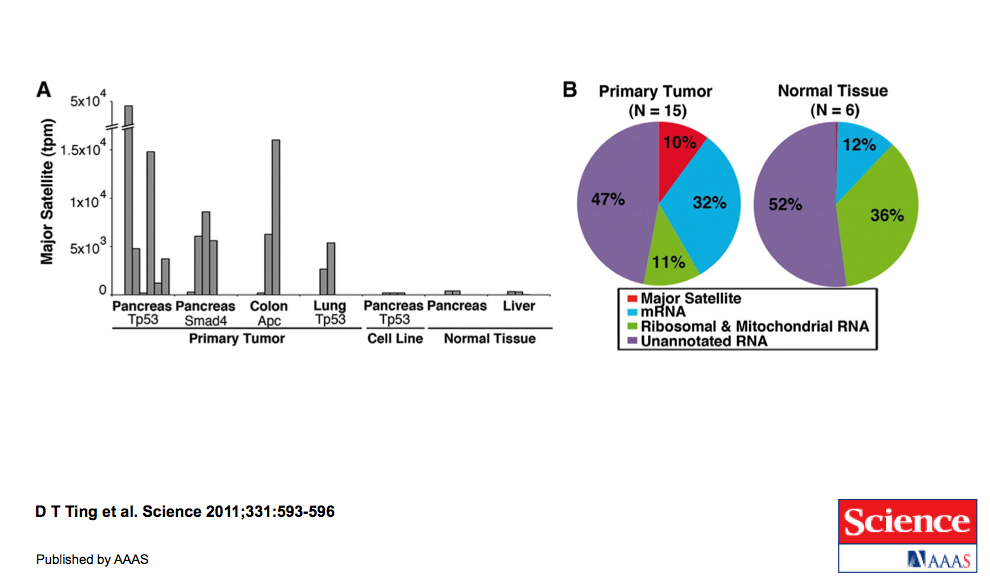
In this research, massive expression of major satellites in mouse pancreatic tumours in primary tumour cell lines compared with normal tissues was found.  The researchers represented these findings graphically in a pie chart, which makes it easier to see the patterns at a glance:

Massive expression of major satellites in mouse pancreatic tumours

What at the implications of this research?

The researchers suggested that the data may have important findings:

“The overexpression of satellite transcripts in cancer may reflect global alterations in heterochromatin silencing and could potentially be useful as a biomarker for cancer detection.”

The emphasis is mine, but what if the findings could be repeated in other cancers?  That would be quite interesting indeed.   So far, they have looked at a couple of other solid tumour cells lines:

“Similar patterns were observed in cancers of the lung, kidney, ovary, colon, and prostate.”

This research may well be worth following to see how it develops going forward.

One should note, however, that what we often see in cell lines isn’t always repeated in humans… this is a worthwhile start, but it has a long way to go yet before we possibly see solid validation in large scale clinical trials and some significant meaningful clinical benefit emerge.

References:

ResearchBlogging.orgTing, D., Lipson, D., Paul, S., Brannigan, B., Akhavanfard, S., Coffman, E., Contino, G., Deshpande, V., Iafrate, A., Letovsky, S., Rivera, M., Bardeesy, N., Maheswaran, S., & Haber, D. (2011). Aberrant Overexpression of Satellite Repeats in Pancreatic and Other Epithelial Cancers Science DOI: 10.1126/science.1200801

The Holy Grail of colorectal cancer prevention – a reliable screening test that users don’t dread and avoid – appears to be getting close.

A novel test that detects telltale DNA markers in stool samples correctly identified 85 percent of colon cancers, 64 percent of significant precancerous polyps, and 90 percent of healthy samples, researchers announced Thursday in Philadelphia at a conference held by the American Association for Cancer Research.

“There is no other noninvasive screening test for colon cancer that comes close” to that accuracy rate, said David Ahlquist, a Mayo Clinic researcher who invented part of the technology and who is working with the commercial developer, Exact Sciences of Madison, Wis.

The DNA test is still experimental, hasn’t been validated under real-life conditions, and will take at least another year of development, he said.

via Researchers at Philadelphia conference announce progress toward noninvasive colon cancer test | Philadelphia Inquirer | 10/29/2010.

This was a most interesting new test in development that was covered here at the AACR colorectal cancer biology to therapy meeting in the press briefing yesterday.

Current methods of colorectal cancer (CRC) screening for people over 50 involve either colonoscopy, which is invasive, or virtual colonoscopy, which is not covered extensively by insurers.  Both require a not inconsiderate amount of time to do, not to mention the inevitable nervousness that goes with such procedures.  Routine fecal tests currently available have unfortunately been shown to miss most advanced pre-cancers, so there is an real opportunity to develop a more sensitive and useful detection approach.

This new test takes a stool sample and looks for markers that indicate early presence of adenomas in the colon in a small validation study (n=59) by testing people who were being evaluated for CRC by colonoscopy, in other words, they had a high risk for CRC or were strongly suspected of having cancer. Such well characterised patients allows for quick segmentation into normal and cancerous groups, rather than waiting for long term epidemiology follow-up to see who develops cancer or not, which can take years.

According to the Mayo Clinic scientists, several combinations of methylation markers based on tissue DNA were found that discriminate colorectal neoplasia from normal mucosa.  These were evaluated as part of the test validation process.  The markers that were found to be useful included 3 methylated genes (TPFI2, BMP3, NDRG4), plus human DNA.

A huge advantage of this simpler approach is that I can see that potentially, primary care doctors could order it as part of routine screening at an annual physical, thereby finding colon adenomas early rather than waiting for a carcinoma to develop later in life.

The test from Exact Sciences looks at 4 genes known to be associated with the development of colorectal cancer and appears to be able to detect them with 85% sensitivity.  Another DNA test is also being developed in Germany by Epigenomics AG, but differs in that it uses blood samples and looks at changes in Septin 9, which is not used in the Exact Sciences test.  It is currently available to physicians in Germany.

The development of non-invasive easy to use tests like these is important because we all know that the earlier we detect abnormal growth, the easier it is to cure and improve overall outcomes for any cancer, as Bert Vogelstein emphasised in his talk the other evening and Tyler Jacks did in his keynote at the Xconomy meeting in Boston the other week.  Colon cancer, for example, has a 90% cure rate when detected and treated early with surgery.

The lead investigator, Dr David Ahlquist, told me that the Mayo clinical studies with the Exact Sciences test are due to run until the end of 2012, so if all goes well we may see an approved validated test for wide scale testing available by 2013.  Certainly the timeline is looking like the next couple of years rather than a much longer timeframe, which is very encouraging to all of us who have lost family members to the disease.  While a better screening test won’t bring them back, it does offer hope that we may be able to avoid losing other people to the disease because their cancer was detected too late to do anything about it.

The pace and new advances in the early detection of cancer is something we can all be cheered about.  Long may the trend continue!

5 Comments

Following my live tweets from the AACR molecular diagnostics and cancer therapeutics meeting here in Denver this week, some interesting offline discussions continued. A big focus here was on biomarkers and systems biology. Several readers observed that oncology seems to be ahead compared to other therapy areas.

What is interesting though, is that while oncology is heavy on science, pathways, targeted therapies and multiple mechanisms of actions, it is surprisingly low on predictive biomarkers. It does fare a little better on prognostic biomarkers, granted. In contrast, Alzheimer’s Disease (AD) in many ways, seems to be almost the opposite in that various biomarkers abound, but the field lags in effective targeted drugs and a deep understanding of the underlying biology (relative to oncology that is).

One area where we are likely to see more progress in the near future is in the use of imaging biomarkers for the diagnosis of early Alzheimer’s Disease.

Amyloid beta_adSeveral companies are currently undertaking clinical trials with imaging biomarkers for AD including Bayer with florbetaben (BAY 94-9172), Avid Radiopharmaceuticals with AV-45 and GE Healthcare with flutemetamol. All three are in phase III development.

Currently the use of Pittsburgh compound B (PiB) in combination with PET allows the imaging of beta-amyloid plaques in the brain that are indicative of AD. However, there are limitations with the use of PiB since it requires use of an on-site cyclotron.

A recent paper by Rik Vandenberghe from the Catholic University Leuven, published in the September edition of the Annals of Neurology caught my attention on this topic. It reported phase 2 trial results from the use of 18F flutemetamol imaging in AD.

In this clinical trial, sponsored by GE Healthcare, blinded visual assessments of 18F- flutemetamol scans were undertaken in 27 subjects with probable early-stage AD and mild cognitive impairment (MCI). The results showed a sensitivity of 93.1% in the ability of the scan to diagnose early AD, as compared to clinical diagnosis as the Standard of Truth (25 out of 27 patients). 18F-flutemetamol was also shown in 20 subjects to have comparable regional standardized uptake value ratios (SUVRs) when compared to 11C-Pittsburgh compound B (11C-PiB). Correlation coefficients ranged from 0.89 to 0.92.

What makes the use of the 18F-labeled PiB derivative interesting is that 18F-flutemamol does not require the use of an on-site cyclotron, unlike 11C-PiB. As the study reports this may make it easier to access PET technology for clinical trials and research into AD.

GE Healthcare have already started a phase 3 trial program with flutemetamol, so it will be interesting to see whether the promising phase 2 results are confirmed when the phase 3 data is available after the study is completed later this year.

Data from other phase III clinical trials make this an area to watch out for. Hopefully the development of imaging biomarkers that allow for early diagnosis, will insoire both more basic research into the underlying biological mechanisms and also stimulate companies develop more targeted drugs for the treatment of what is essentially a horrible, progressive disease.

Photo Credit: Avid Radiopharmaceuticals

Top: Elderly Patient Control

Bottom: 18F AV-45 imaging of amyloid plaque in a patient with Alzheimer’s disease

References:

ResearchBlogging.org Vandenberghe, R., Van Laere, K., Ivanoiu, A., Salmon, E., Bastin, C., Triau, E., Hasselbalch, S., Law, I., Andersen, A., Korner, A., Minthon, L., Garraux, G., Nelissen, N., Bormans, G., Buckley, C., Owenius, R., Thurfjell, L., Farrar, G., & Brooks, D. (2010). 18F-flutemetamol amyloid imaging in Alzheimer disease and mild cognitive impairment: A phase 2 trial Annals of Neurology, 68 (3), 319-329 DOI: 10.1002/ana.22068

"Dr. Skovronsky thought he had a way to make scans work. He and his team had developed a dye that could get into the brain and stick to plaque. They labeled the dye with a commonly used radioactive tracer and used a PET scanner to directly see plaque in a living person’s brain. But the technology and the dye itself were so new they had to be rigorously tested.

And that is what brought Dr. Skovronsky, a thin and eager-looking 37-year-old, to his e-mail that recent day. 

Five years ago, Dr. Skovronsky, who named his company Avid in part because that is what he is, had taken a big personal and professional gamble. He left academia and formed Avid Radiopharmaceuticals, based in Philadelphia, to develop his radioactive dye and designed a study with hospice patients to prove it worked. 

Hospice patients were going to die soon and so, he reasoned, why not ask them to have scans and then brain autopsies afterward to see if the scans showed just what a pathologist would see. Some patients would be demented, others not. 


Some predicted his study would be impossible, if not unethical. But the F.D.A. said it wanted proof that the plaque on PET scans was the same as plaque in a brain autopsy."
 

Source: NY Times

If you haven't already read the article in the NY Times, click on the link above and check it out. It's well worth reading. How many of us have elderly parents who have Alzheimer's, who sadly died from the devastating condition or know friends going through the trials and tribulations as caregivers?

I love this story – a scientist gets germ of an idea, is convinced it will work, leaves his employment and sets up a company (Avid Radiopharmaceuticals) to research the possibilities. That's the very entrepreneurial spirit that made America great.

Basically, the concept is that using a special dye to highlight the plaques would show up on brain scans in Alzheimer's patients.  At moment, the only known way of showing proof of the disease is when a pathologist looks for the black specks of plaques in the brain during a post mortem.  Finding a way to be sure that the disease exists earlier has proven elusive so far.  In the NY Times article, they showed what Dr Skovronsky has found so far.  You can see the plaque buildup (red) in Alzheimers on the bottom compared to someone who did not have the disease:

image from graphics8.nytimes.com
Source: Dr Skovronsky in the NY Times 

If the results prove conclusive and the dye gets FDA approval, researchers will have the first reliable method of detecting the disease early and also a potential marker of determining whether any future therapies are having an impact in reducing the plaques.

The data is being presented next month at the Alzheimer's Association so there is bound to be a lot of excitement and anticipation surrounding the data.  This is the sort of thing we scientists get excited about, even if it's not in our field.  My first thoughts on reading the NY Times were, "A dye? Wow, I wish I had thought of that!"  I got goosebumps just reading it.  

Of course there is a long way to go, but let's hope for the future of new drugs in the pipeline that the dye will turn out to be a great marker and the tide turns on future development of better and earlier pharmaceutical intervention for a devastating disease.

"Researchers have developed a novel immunoassay for detecting early-stage pancreatic cancer that identifies and quantifies blood levels of the PAM4 protein – a unique antigen present in almost 90 percent of pancreatic cancers and precancers."

ASCO GI Cancer Symposium, 2010

Wow, that little snippet from the ASCO press releases from the Gastrointestinal symposium in Florida woke me up while sipping coffee this morning!

The reason is that pancreatic cancer is an insidious disease and most patients are diagnosed late, usually in stage IV when there is little that can be done to successfully attentuate the cancer.  For years, researchers have struggled with ways of detecting the cancer earlier when treatments are more likely to be effective without confusing cancer from pancreatitis.

Approximately 7% of pancreatic cancer cases are detected at an
early stage, before the cancer has spread to other parts of the body. 
The survival rate for early stage pancreatic cancer is around 20%, compared with just 1.8% for those diagnosed when the disease has metastasized.

The PAM4 antibody, also called clivatuzumab, from Immunomedics ($IMMU) used in the assay reacts with a protein produced by pancreatic cancer cells.  It appears that the protein is not detectable in normal pancreatic cells and is rarely detected in pancreatitis (inflammation of the pancreas), making it potentially highly specific for pancreatic cancer.

The researchers evaluated an immunoassay for the PAM4 protein in 68 patients who had pancreatic cancer surgery and 19 healthy controls.  They found that the test was 62% sensitive for detecting stage 1 pancreatic cancer (disease confined to the pancreas), 86% sensitive for stage 2 disease (disease which has spread to nearby organs) and 91% sensitive for stage 3/4 cancers (local and distant spread).  Overall, the assay was 81% sensitive for detecting all stages of pancreatic cancer; while not perfect, it would represent an enormous improvement on current detection rates.

The obvious next step is to validate the test on a larger scale with more patients to determine if it has utility as a diagnostic tool to detect people at risk for pancreatic cancer such as patients with a history of tobacco use, or those with genetic or other medical factors on a yearly basis, to enhance the chance of early detection.

The investigators also suggested that the clivatuzumab antibody may also prove useful for treating the disease by acting as a carrier for agents (such as radioactive isotopes labelled with Y90) that can target and kill cancer cells, but this idea is pure supposition at present and as yet, unproven.  Immunonomedics have a phase I trial ongoing with clivatuzumab in pancreatic cancer

At the ASCO GI symposium there was, however, some interesting new data in the treatment of pancreatic cancer as Pfizer announced the final results from a randomized Phase III
trial of sunitinib (Sutent) in patients with advanced pancreatic
neuroendocrine tumors, a type of cancer which originates in the
hormone-producing area of the pancreas. 

Sunitinib appeared to more than double the
time the patients with lived without
disease progression compared with patients treated with placebo; results showed that median progression-free survival (PFS) was 11.4
months in patients treated with sunitinib compared with 5.5 months in
patients treated in the placebo arm.  Overall survival was also prolonged. 
Adverse events were similar to those observed in other sunitinib
studies.

The sunitinib results are particularly interesting, not only because they improve survival beyond the six months typically seen with the disease, but also because other VEGF inhibitors such as bevacizumab (Avastin) previously did not appear to be effective in slowing the disease.  Sunitinib, though, is a multi-kinase inhibitor that also targets other pathways other than VEGF, including c-KIT, PDGF, FLT3 and RET, suggesting that dual inhibition of perhaps VEGF and PDGF is necessary in this disease.

On the basis of these results, Pfizer filed supplemental applications
for approval in pancreatic neuroendocrine tumours with the US, EU and
Canadian authorities, so help for patients may well be coming sooner than expected.

Reblog this post [with Zemanta]

Five years ago this summer my father died of prostate cancer after a brave battle with the disease. Currently, some of my friends are also going through the same experience with their fathers. The fact that it is one of the more common cancers in men does not lessen the pain for families.

Regular checkups and annual PSA screening can help, but like many cancers, this one can go from benign to malignant and spread around other areas of the body in less than a year.

Cancers begin with some form of genetic change where material is added or subtracted. The challenge scientists face is in tracking these abnormalities down and then designing drugs to either reverse the damage in the early stages or slow the growth of the disease.

Today it was announced that scientists in Iceland have identified a common genetic marker that may indicate a higher risk of developing prostate cancer. This is important because for widespread screening to be successful and effective, it pays to identify those most at risk and follow them more closely.

The finding is not going to bring my Dad back or help my friends Dads who all have end-stage disease, but it does give hope to future generations that screening and earlier identification of prostate cancer may be feasible. Most cancers are curable if detected early and surgery is possible.

Prostate_cancer_cells_dividing_1

Click here for the news article and more information

Click here for information on prostate cancer

error: Content is protected !!