Pharma Strategy Blog

Commentary on Pharma & Biotech Oncology / Hematology New Product Development

Posts tagged ‘ECCO 2011’

This year I decided to write some longer posts from the ECCO/EMCC meeting owing to the amount of potentially paradigm changing data coming out. These in depth op eds will roll out over the next few days.

Quite a few people have been asking what my picks of the conference are, so here goes, in order of Wow factor (purely from my perspective):

  1. Everolimus BOLERO-2 data in ER/PR+ HER2- breast cancer
  2. Alpharadin in advanced prostate cancer
  3. T-DM1 in HER2+ breast cancer
  4. Vismodegib phase III data in basal cell carcinoma

You can read more about the Alpharadin data on the companion Biotech Strategy Blog, but I will put up a post in the pros and cons of this therapeutic later in the week. It’s going to be very interesting indeed to see how this pans out.

Why did I pick the everolimus (Afinitor) data first over the others?

Well, regular readers here on PSB will know that I’m a great believer in

a) targeted therapies and
b) identifying mechanisms of resistance to determine logical combinations

We know that the PI3K-mTOR pathway is dysregulated in hormonal sensitive breast cancer leading to resistance, so a logical approach would be to treat women whose initial AI therapy has failed with another, but add in an mTOR or PI3K inhibitor. That’s exactly the case here.

The results? Simply stunning!

Jose Baselga presented the BOLERO-2 data to a packed audience. When he showed the slide for PFS, there were gasps in the audience around me – a shift in favour of the treatment arm (everolimus plus exemestane) over control (placebo + exemestane) not of the usual 1-2 months, but 6.5 months:
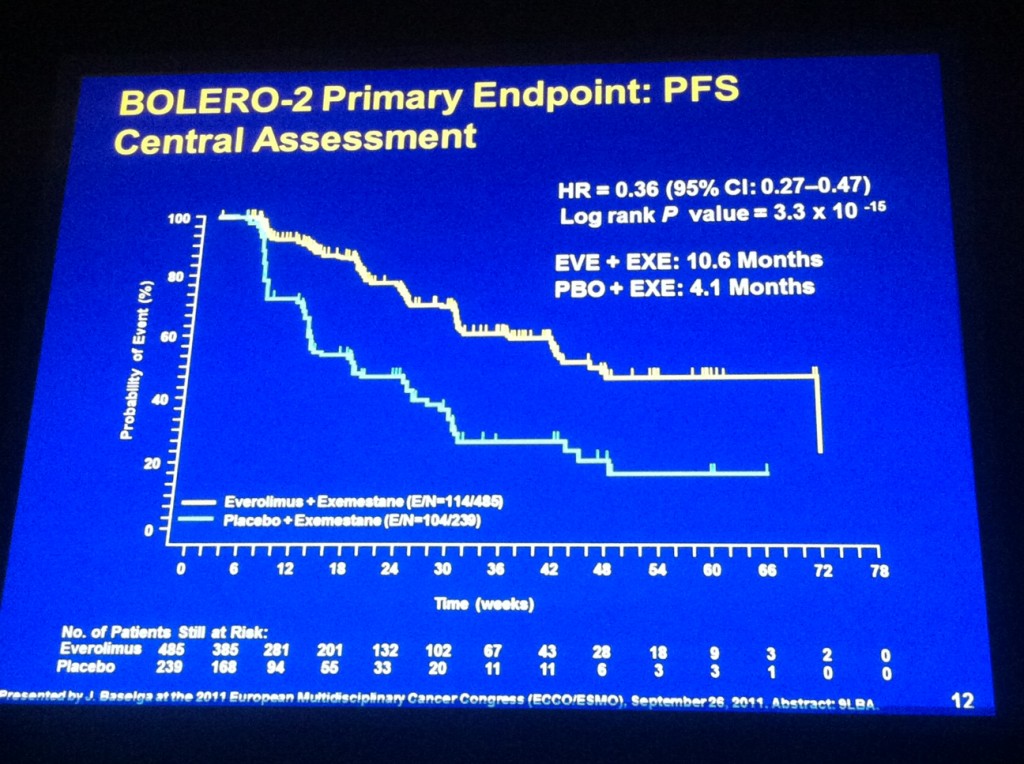
BOLERO-2 data at ECCO 2011

The side effect profile was consistent with what we know about mTOR and Aromatase inhibitors. One thing I would very much like to see is some subset analysis to see what factors separated the super responders from the average responders. This trial tested the combination in a general unselected population, but it would be nice to see if any factors can be derived from the data that suggests what might be predictive of response.

While these results are a major paradigm shift in women with hormonally sensitive breast cancer, the big question is can we do even better?

We also know from basic science that mTOR upregulates AKT, so eventually adaptive resistance will occur through that route too, but you can see where the next round of logical therapies might emerge in future. The current batch of AKT inhibitor have some challenging side effects when used in combination, but next generation of inhibitors might have a more tolerable and improved side effect profile.

All in all, I thought the BOLERO-2 data were my pick of the conference for major practice changing data and I hope to see this data submitted for approval to the Health Authorities very soon. This development is very good news indeed for women with ER/PR+ breast cancer.

5 Comments

Hopefully, by the time y’all read this we have arrived here we are in Stockholm after a nighmarish week with Continental and United messing up big time with flights booked six months ago. Sometimes big corporations really fail to understand the importance of communication and customer loyalty. Eventually, it is only when there is competition, they stop and wonder why many people used the Law of Two Feet and walked. Maybe that is a subconscious metaphor for Big Pharma 🙂

Anyway, enough of all that. Let’s take a look at some of the social media tools being used at the ECCO conference this week as it seems to be an increasing trend for conference organisers to incorporate social media into their event. They have taken several forms, including downloadable apps for the schedule, subscription to talks and webcasts on iTunes or encouraging open dialogue on Twitter and Facebook amongst participants.

Two excellent examples I’ve seen this year, in terms of well organised and integrated social media tools, have been the American Association for Cancer Research (AACR) and American Urological Association (AUA). While the American Society of Clinical Oncology (ASCO) inevitably gets the largest volume of tweets by dint of its sheer size, the smaller organisations have perhaps been more aggressive and creative in developing and utilising the tools more effectively for their members.

I’m really looking forward to seeing how things have progressed in Europe at the ECCO meeting, having had a very positive experience with planning most of my schedule on their new app. You can browse the sessions by day or type and add them easily to your calendar in local time in Stockholm. They appear in my calendar as ET but adjusted for the time zone. That’s a very nice touch many forget about and so the schedule goes wonky if you download it one time zone and attend the sessions in another! It looks like that will not be a problem with this app. Excellent!

Let’s take a look at what I could find in the ECCO program.

Social Media tools at ECCO

As mentioned yesterday, the official hashtag for Twitter is #emcc2011 and you can also follow the ECCO organisation on:

They also have some slick apps accessible by links or QR codes as preferred, to enable you to search and plan your schedule from the program:

Tweets will most likely gather steam on Friday with the corporate symposia kicking off, as Thursday was the travel day for many.

Meanwhile, for those interested in following the conversations, as usual, we’re curating all the conference tweets below.

1 Comment

After a wild day yesterday once we realised Continental had mysteriously and unaccountably changed our flights to Stockholm from Weds to Weds to Thurs to Tues, it seems that Cinderella will be going to the ball after all.

European Multidisciplinary Cancer Conference (EMCC) here we come, whew!

There are a couple of sessions I’m particularly looking forward to this year:

    1. Presidential Symposium on Sat 25th with talks from some of the leading lights in translational research:
      • Tak Mak (U Toronto) on metabolism and cancer
      • Jose Baselga (MGH) on the challenges of personalised medicine
      • Gordon Mills (MDACC) on the future of personalised medicine


    1. Various abstract highlights include:
      • Update on phase II ERIVANCE data for the Hedgehog inhibitor, vismodegib, in basal cell carcinoma (see phase I data from AACR)
      • Biomarkers, including VEGF-A in the bevacizumab trials and an update on KRAS
      • Phase II T-DM1 (trastuzumab emtansine) data in breast cancer
      • Reversing drug resistance in breast cancer (Mon 27th)
      • Updated data from the phase I and III (BRIM3) studies of vemurafenib (Zelboraf) in BRAF V600E-mutation positive metastatic melanoma (will be interesting to see how this compares to the ASCO data
      • Update on therapies in prostate cancer, including new phase III Alpharadin data (see Biotech Strategy Blog)


  1. Scientific symposia on PARP inhibitors and PI3K inhibitors (both on Tues 28th). I’m gutted these two important sessions clash, as they are both key events I’d love to attend 🙁

All in all, it promises to be a fun and interesting meeting. For those interested, here’s the link to the full details of the EMCC programme.

Social media comes to ECCO


The official Twitter hashtag of the meeting is #emcc2011, a bit long I know, and I would much rather have the shorter, more descriptive and well known #ECCO or #ESMO, but it is a three organisation event afterall, with ECCO, ESMO and ESTRO all involved. You can also follow the EMCC conference organisers on Twitter (@EuropeanCancer).

This inevitably creates branding issues given it seems everyone in the industry has been seemingly asking me over the last two weeks if I’m going to ECCO or ESMO in equal measures! None outside of Twitter have mentioned EMCC at all. Ah well.

9 Comments
error: Content is protected !!