Pharma Strategy Blog

Commentary on Pharma & Biotech Oncology / Hematology New Product Development

Posts tagged ‘FGFR’

At the recent International Society of Gastroenterological Carcinogenesis (ISGC) meeting hosted by MD Anderson Cancer Centre that I attended in Houston, one of the topics mentioned the potential role of Fibroblast Growth Factor Receptors (FGFR) in carcinogenesis. I thought this was a great opportunity to research the area further.

A recent review of the role of FGFR in carcinogenesis fortuitiously appeared in Molecular Cancer Research:

“The fibroblast growth factor receptors (FGFR) play essential roles both during development and in the adult.  Upon ligand binding, FGFRs induce intracellular signaling networks that tightly regulate key biological processes, such as cell proliferation, survival, migration, and differentiation. Deregulation of FGFR signaling can thus alter tissue homeostasis and has been associated with several developmental syndromes as well as with many types of cancer.

In human cancer, FGFRs have been found to be deregulated by multiple mechanisms, including aberrant expression, mutations, chromosomal rearrangements, and amplifications.”

They also went on to define what carcinogenesis is based on what we learned from Hanahan and Weinberg (2000) in their classic paper, The hallmark of Cancer:

“Carcinogenesis is a multistep process during which normal cells are transformed into cancer cells by accumulating several genetic changes and acquiring several common features that promote the malignant phenotype, often referred to as the hallmarks of cancer.

The six classic hallmarks of cancer include self-sufficiency in growth signals, insensitivity to antigrowth signals, limitless replication, evasion of apoptosis, sustained angiogenesis, and the ability to invade tissue and form metastasis.”

Bearing in mind that Hanrahan and Weinberg’s paper was published over a decade ago, there were some interesting observations that hold true:

“It is increasingly apparent that the growth deregulation within a tumor can only be explained once we understand the contributions of the ancillary cells present in a tumor—the apparently normal bystanders such as fibroblasts and endothelial cells—which must play key roles in driving tumor cell proliferation.”

Their article is now open access, so you can see how they described the role of these cells with cancer cells.

Going back to Haugsten et al., (2010) review, we learn new developments in carcinogenesis that have taken place over the last decade relating to FGFR, which has received much less attention than other receptors such as VEGF, PDGF, EGFR and IGF-1R as a potential target.   The FGFR family consists of four genes encoding the tyrosine kinase receptors (FGFR1 to FGFR4).  Downstream, the pathway becomes quite complex, so it will be interesting to see which factors emerge as escape routes through cross-talk and feedback loops.
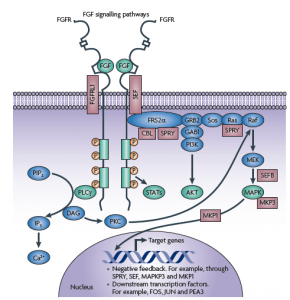
FGFR pathway in Cancer

The potential role of FGFR in cancer carcinogenesis is summarised in the table below:
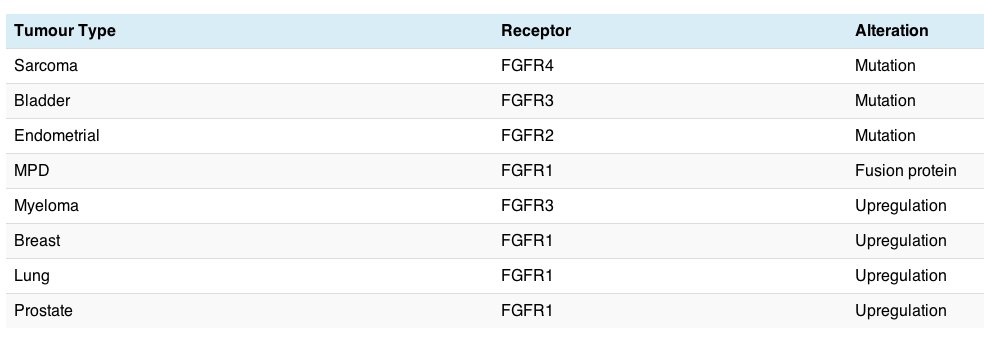
FGFR in Cancer

There are a variety of different cancers potentially affected, but FGFR is not always overexpressed where it is amplified and may not always be contained in the amplification.  Sometimes overexpression merely indicates a poorer prognosis or the development of resistance.

The chances of it being a drugable target and therefore more likely to have a meaningful clinical impact is probably greater where there are mutations or fusion proteins, since these often (but not always) have aberrant activity associated with them.  The challenge is therefore figuring where it might be a passenger or a driver gene.

Turner and Grosse (2010) also reviewed the FGFR pathway as a new area of research:

“Although FGF signalling can drive tumorigenesis, in different contexts FGF signalling can mediate tumour protective functions.  The identification of the mechanisms that underlie these differential effects will be important to understand how FGF signalling can be most appropriately therapeutically targeted.”

Obviously, we won’t know the answer until clinical trials with the small molecule inhibitors and monoclonal antibodies are completed, but it certainly looks to be a worthwhile area of exploration.  Hynes and Dey (2010) discussed the potential role in breast cancer in more detail, noting the findings of Roidl et al (2009):

“In breast cancer cell lines, it has been reported that increased levels of FGFR4 are found in cells resistant to chemotherapeutics.”

This suggests a combination strategy in those cases may be worthwhile.

For those who missed it, I also posted about the potential role of FGFR1 in lung cancer last month, which also included some of the inhibitors emerging in this class.

References:

ResearchBlogging.orgHaugsten, E., Wiedlocha, A., Olsnes, S., & Wesche, J. (2010). Roles of Fibroblast Growth Factor Receptors in Carcinogenesis Molecular Cancer Research, 8 (11), 1439-1452 DOI: 10.1158/1541-7786.MCR-10-0168

Hanahan, D., & Weinberg, R. (2000). The Hallmarks of Cancer Cell, 100 (1), 57-70 DOI: 10.1016/S0092-8674(00)81683-9

Turner, N., & Grose, R. (2010). Fibroblast growth factor signalling: from development to cancer Nature Reviews Cancer, 10 (2), 116-129 DOI: 10.1038/nrc2780

Hynes, N., & Dey, J. (2010). Potential for Targeting the Fibroblast Growth Factor Receptors in Breast Cancer Cancer Research, 70 (13), 5199-5202 DOI: 10.1158/0008-5472.CAN-10-0918

Roidl A, Berger HJ, Kumar S, Bange J, Knyazev P, & Ullrich A (2009). Resistance to chemotherapy is associated with fibroblast growth factor receptor 4 up-regulation. Clinical cancer research : an official journal of the American Association for Cancer Research, 15 (6), 2058-66 PMID: 19240166

2 Comments

Here’s an interesting paper in a new journal I recently signed up for, Science and Translational Medicine.  The journal provides little snapshots of how research can potentially be applied to real life disease.  Here’s a snippet from this particular abstract:

“Lung cancer remains one of the leading causes of cancer-related death in developed countries. Although lung adenocarcinomas with EGFR mutations or EML4-ALK fusions respond to treatment by epidermal growth factor receptor (EGFR) and anaplastic lymphoma kinase (ALK) inhibition, respectively, squamous cell lung cancer currently lacks therapeutically exploitable genetic alterations.

We conducted a systematic search in a set of 232 lung cancer specimens for genetic alterations that were therapeutically amenable and then performed high-resolution gene copy number analyses.

We identified frequent and focal fibroblast growth factor receptor 1 (FGFR1) amplification in squamous cell lung cancer (n = 155), but not in other lung cancer subtypes, and, by fluorescence in situ hybridization, confirmed the presence of FGFR1 amplifications in an independent cohort of squamous cell lung cancer samples (22% of cases).”

Now, squamous cell histology tends to be more associated with smokers than non-smokers and chemotherapy has pretty much been the bedrock of treatment for this group, although it should be noted that in general, currently available therapies either have weak activity or are specifically contraindicated, as in the case of bevacizumab.

Compare this with non-squamous histology, particularly adenocarcinomas, where new molecular targeted therapies have begun to evolve that have extended life and the population tends towards more non-smokers.

Essentially, this is almost like treating two different diseases based on the underlying biology, but this is the first time I’ve seen a potential molecular target reported to be associated with squamous cell histology.

The researchers expanded on their finding that FGFR1 may be a useful target in squamous cell lung cancer by taking an FGFR inhibitor (PD173074) and testing it in an appropriate lung cancer model to see what happened:

“The compound inhibited growth and induced apoptosis specifically in those lung cancer cells carrying amplified FGFR1.”

Next, they looked at an in vivo model with the same FGFR inhibitor and found that it induced tumour shrinkage, which is very promising.

Meanwhile, I did a search in the literature and found a research paper from Pardo et al., who looked at the effects of the same FGFR inhibitor in small-cell lung cancer (SCLC), which accounts for approx. 15% of lung cancers, and is more commonly associated with smoking than non-smoking.  In this disease, many patients are chemo-sensitive, but tend to relapse as resistance sets in.  Pardo’s group found that the FGFRi potentiated the effects of cisplatin, the most commonly used chemotherapy in SCLC.

They also found something else of note:

“More dramatically, in H-69 xenografts, PD173074 induced complete responses lasting >6 months in 50% of mice. These effects were not a consequence of disrupted tumor vasculature but instead correlated with increased apoptosis (caspase 3 and cytokeratin 18 cleavage) in excised tumors.”

Overall, it will be interesting to see what happens with FGFR inhibitors in the clinic going forward.  There are a number in development already, including the following:

  • TKI258 (dovitinib), Novartis
  • AP24534 (ponatinib)
  • AZD4547 (AstraZeneca)
  • FP-1039 (Five Prime)
  • XL999 (Exelixis/GSK) – may have been discontinued

Of note, some of these agents are multi-kinase inhibitors and target other kinases as well, some inhibit FGFR 1 or 2 or 3 and some inhibit FGFR1, 2 and 3, so it will be interesting to see how these shake out.  Advanced solid tumours, leukemia and breast cancer appear to be a common target, but few, if any are considering lung cancer (either squamous NSCLC or SCLC) as a possibility as far as I can see.

ResearchBlogging.org Weiss, J., Sos, M., Seidel, D., Peifer, M., Zander, T., Heuckmann, J., Ullrich, R., Menon, R., Maier, S., Soltermann, A., Moch, H., Wagener, P., Fischer, F., Heynck, S., Koker, M., Schottle, J., Leenders, F., Gabler, F., Dabow, I., Querings, S., Heukamp, L., Balke-Want, H., Ansen, S., Rauh, D., Baessmann, I., Altmuller, J., Wainer, Z., Conron, M., Wright, G., Russell, P., Solomon, B., Brambilla, E., Brambilla, C., Lorimier, P., Sollberg, S., Brustugun, O., Engel-Riedel, W., Ludwig, C., Petersen, I., Sanger, J., Clement, J., Groen, H., Timens, W., Sietsma, H., Thunnissen, E., Smit, E., Heideman, D., Cappuzzo, F., Ligorio, C., Damiani, S., Hallek, M., Beroukhim, R., Pao, W., Klebl, B., Baumann, M., Buettner, R., Ernestus, K., Stoelben, E., Wolf, J., Nurnberg, P., Perner, S., & Thomas, R. (2010). Frequent and Focal FGFR1 Amplification Associates with Therapeutically Tractable FGFR1 Dependency in Squamous Cell Lung Cancer Science Translational Medicine, 2 (62), 62-62 DOI: 10.1126/scitranslmed.3001451

Pardo, O., Latigo, J., Jeffery, R., Nye, E., Poulsom, R., Spencer-Dene, B., Lemoine, N., Stamp, G., Aboagye, E., & Seckl, M. (2009). The Fibroblast Growth Factor Receptor Inhibitor PD173074 Blocks Small Cell Lung Cancer Growth In vitro and In vivo Cancer Research, 69 (22), 8645-8651 DOI: 10.1158/0008-5472.CAN-09-1576

2 Comments

Read and writing about malignant brain cancers, gliomas or glioblastoma multiforme (GBM) always makes me sad as life span from diagnosis is often only a year. Over the last decade we have seen many advances in surgery, radiation, chemotherapy and targeted therapies in many cancers, yet this one remains largely immune to significant progress.

Background

Angiogenesis inhibitors targeting the VEGF signaling pathway have been shown to be effective both in preclinical cancer models and in clinical trials. This has led to the approval of several agents targeting VEGF in cancer, including bevacizumab (Avastin), sorafenib (Nexavar) and sunitinib (Sutent). To date, bevacizumab, has been approved for the treatment of relapsed glioblastomas in the US, at a dose of 10 mg/kg IV every 2 weeks. The approval in GBM was based on objective response rate, not survival.

There have been concerns in the past about the use of anti-angiogenic therapy (see references below) with malignant gliomas, principally malignant progression of the tumours with increased local invasion and distant metastasis. In other words, the cancer become more aggressive, which is not a good thing.  Still, the concerns and risk involved must be balanced with the severity of the disease and relatively poor prognosis. Development of resistance is also an ongoing problem.

This morning though, I was a little more cheered about the topic after someone kindly sent me a new clinical paper on angiogenesis and GBM.  

Angiogenesis 

Brunkhorst et al., (2010) looked more closely at the mechanisms underlying tumour angiogenesis, principally angiopoeitins, and found some interesting relationships:

"We establish that Ang-4 is upregulated in human GBM tissues and cells. We show that, like endothelial cells, human GBM cells express Tie-2 RTK."

In simple terms, angiopoietins (Ang-1, Ang-2, and Ang-4) are the ligands of the Tie-2 receptor tyrosine kinase (RTK). More details can be found in an excellent review of angiopoietins and Tie2 in a review by Huang et al., (2010).  While the roles of Ang-1 and Ang-2 are reasonably well known, little is understood about the role of Ang-4, so Brunkhorst et al., set out to research this in more detail.

What they found was really interesting:

"Our results establish the novel effects of Ang-4 on tumor angiogenesis and GBM progression and suggest that this pro-GBM effect of Ang-4 is mediated by promoting tumor angiogenesis and activating Erk1/2 kinase in GBM cells.

Together, our results suggest that the Ang-4–Tie-2 functional axis is an attractive therapeutic target for GBM."

The pipeline

There aren't too many inhibitors of Tie-2 in development, as this is a relatively new area of research.  That said, I did find a couple in my database:

  • ARRY-614 (Array): inhibits p38, Abl, Tie2 and VEGFR2, research in MDS
  • XL-184 (Exelixis): inhibits VEGFR-2, MET, c-KIT, FLT-3, and Tie2
  • ABT-869/linifarnib (Abbott): Inhibits VEGF, FLT3, Tie2, c-FMS, PDGF, c-kit
  • AP-24534/ponatinib (Ariad): inhibits BCR-ABL, FLT3, VEGFR, FGFR, Tie2 
  • AMG-386 (Amgen): inhibits angiopoeitin 1 and 2, thus Tie2 is indirectly inhibited.

Insights

Regarding the relationship between angiopoetin and Tie2, Herbst et al., summarised it succinctly:

"AMG 386 is an investigational peptide-Fc fusion protein (ie, peptibody) that inhibits angiogenesis by preventing the interaction of angiopoietin-1 and angiopoietin-2 with their receptor, Tie2."

Mita et al., (2010) have generated some initial research looking at this compound in a catch-all phase I trial in advanced solid tumours with the standard combinations and dose finding approach. It's too early to say whether the agent will pan out, but some evidence of anti-tumour activity was seen.

In the original article on GBM and angiopoeitins, Brunckhorst et al., (2010) demonstrated that Ang-4 promotes GBM progression by promoting tumour angiogenesis. What was also clear from their data is that Ang-4 seems to display a more potent proangiogenic activity than Ang-1.  

More importantly, they found that GBM cells express Tie-2 and thus there may be a novel role for Ang-4 in promoting Erk1/2 kinase activation in GBM cells and in enhancing GBM cell viability.

Clearly, we still have a long way to go in figuring out the precise details around the broader angiogenesis process involved in tumour growth and development, but expanding the potential targets beyond VEGF into angiopoeitins, Tie2 and even platelet derived growth factor (PDGF), fibroblast growth factor (FGFR) and others will hopefully yield some productive bench to bedside success in the near future. 


References

ResearchBlogging.org Brunckhorst, M., Wang, H., Lu, R., & Yu, Q. (2010). Angiopoietin-4 Promotes Glioblastoma Progression by Enhancing Tumor Cell Viability and Angiogenesis Cancer Research, 70 (18), 7283-7293 DOI: 10.1158/0008-5472.CAN-09-4125

Verhoeff, J., van Tellingen, O., Claes, A., Stalpers, L., van Linde, M., Richel, D., Leenders, W., & van Furth, W. (2009). Concerns about anti-angiogenic treatment in patients with glioblastoma multiforme BMC Cancer, 9 (1) DOI: 10.1186/1471-2407-9-444

Pàez-Ribes, M., Allen, E., Hudock, J., Takeda, T., Okuyama, H., Viñals, F., Inoue, M., Bergers, G., Hanahan, D., & Casanovas, O. (2009). Antiangiogenic Therapy Elicits Malignant Progression of Tumors to Increased Local Invasion and Distant Metastasis Cancer Cell, 15 (3), 220-231 DOI: 10.1016/j.ccr.2009.01.027

Herbst, R., Hong, D., Chap, L., Kurzrock, R., Jackson, E., Silverman, J., Rasmussen, E., Sun, Y., Zhong, D., Hwang, Y., Evelhoch, J., Oliner, J., Le, N., & Rosen, L. (2009). Safety, Pharmacokinetics, and Antitumor Activity of AMG 386, a Selective Angiopoietin Inhibitor, in Adult Patients With Advanced Solid Tumors Journal of Clinical Oncology, 27 (21), 3557-3565 DOI: 10.1200/JCO.2008.19.6683

Mita, A., Takimoto, C., Mita, M., Tolcher, A., Sankhala, K., Sarantopoulos, J., Valdivieso, M., Wood, L., Rasmussen, E., Sun, Y., Zhong, Z., Bass, M., Le, N., & LoRusso, P. (2010). Phase 1 Study of AMG 386, a Selective Angiopoietin 1/2-Neutralizing Peptibody, in Combination with Chemotherapy in Adults with Advanced Solid Tumors Clinical Cancer Research, 16 (11), 3044-3056 DOI: 10.1158/1078-0432.CCR-09-3368

Huang, H., Bhat, A., Woodnutt, G., & Lappe, R. (2010). Targeting the ANGPT–TIE2 pathway in malignancy Nature Reviews Cancer, 10 (8), 575-585 DOI: 10.1038/nrc2894

1 Comment

It came as no big surprise this morning to hear that Exelixis and BMS have announced they are terminating their agreement over XL184.  The compound is being tested in medullary thyroid cancer, glioblastoma multiforme (GBM) and non-small cell lung cancer (NSCLC).  This is a small molecule that inhibits several targets, namely MET, RET and VEGFR2.

According to Exelixis, the CEO stated in their press release:

"We certainly understand BMS' need to make pipeline and prioritization decisions."

It looks as if they couldn't agree on the priorities for the clinical development, which would be a little odd given the $240M invested in XL184 and XL281 in 2008, with the same indications planned.

It could also be a question of risk management for several reasons:

  1. Thyroid cancer is slow growing and thus development times will be relatively long, lung cancer is notoriously difficult to crack, as is GBM.
  2. BMS also have another VEGF inhibitor in late stage development called brivanib (BMS582664), which is in phase III and inhibits both VEGFR2 and FGFR.  This compound is being tested in a number of indications, including liver and colon cancers.

Recent BMS analyst meetings from have focused on brivanib as one of the promising new oncology agents in the pipeline, so my suspicion is that they probably decided they only needed one VEGF inhibitor and killed the Exelixis agent rather than their own homegrown one.  These things happen all the time. Sometimes you develop several molecules in the hope that one looks more promising in trials.

A few years ago, I remember reading about an incredibly brave and strong patient in one of the early brivanib trials, for advanced cancer.  In this case, the feisty young lady had a non-differentiated spindle cell sarcoma and blogged about the encouraging impact of her new treatment:

"My Scans came back with wonderful results. The Brivanib pills are working! My tumors are stable and haven't grown since my last scan! One tumor in my lymph node has actually died! There is no blood flow to the tumor! This is the best news I could get. My doctor is so happy with these results. 

I will be on the pills for 12 weeks. After that I will be given either a Placebo or continue on the pills. Because it is a trial it's a 50, 50 shot that I could get the Placebo. Booooo! I will know right away by how I am feeling. The reaction happens within 15 minutes after I take the pills. I am a walking zombie. If I do get the Placebo, I can then go back on the trial."

You can follow her incredible journey back to health here; it's an inspiration to us all.  

Thankfully, she's still blogging 2 years later, a testament to her resolve and ability to fight the disease. Long may she continue! Not everyone who gets cancer is elderly, often many people are diagnosed in their teens, twenties and thirties too.

I don't know about you, but I love happy stories and hope to be following her blog for a very long time.

7 Comments
error: Content is protected !!