Pharma Strategy Blog

Commentary on Pharma & Biotech Oncology / Hematology New Product Development

Posts tagged ‘non-squamous’

Last Friday, Peregrine announced their initial phase IIb results with bavituximab in second line non squamous non-small cell lung cancer (NSCLC). The topline results were most interesting to say the least, since the company suggested that adding bavituximab to docetaxel in second line doubled the rate of survival in these patients. The data was presented by Dr David Gerber (University of Texas, Southwestern in Dallas) at the Chicago meeting of the Multidisciplinary Symposium in Thoracic Oncology in the late breaking session.

What is bavituximab?

Bavituximab is a monoclonal antibody that targets phospholipid phosphatidylsterine (PS), which exists in the membrane of vascular endothelial cells.

In normal conditions, PS is hidden in the inner membrane, but in cancer conditions, the tumour microenvironment can cause the PS cells to also be expressed on the outer membrane. It is thought that chemotherapy can also heighten the PS exposure in the tumour microenvironment, leading to reduced anti-tumour responses.

Bavituximab’s role is to bind to the activated PS on the outer membrane, essentially blocking PD mediated tumour suppression. This is an immune effect, similar to PD–1, whereby it allows the body to recognise the presence of cancer and stimulates it to fight the tumour.

What was the trial design?

The phase II trial randomised patients with non-squamous NSCLC (n=121) to receive one of the following:

1) Docetaxel 75mg/m2 3qw + placebo for up to 6 cycles (n=40)
2) Docetaxel 75mg/m2 3qw + bavituximab 1mg/Kg qw for up to 6 cycles (n=40)
3) Docetaxel 75mg/m2 3qw + bavituximab 3mg/Kg qw for up to 6 cycles (n=41)

Each of the groups then received maintenance therapy ie placebo or bavituximab (1 or 3mg/Kg) until progression.

The primary endpoint of the trial was response rate and the secondary endpoints included PFS, OS, safety and duration of response.

Where were the centres?

Aside from University of Texas Southwestern in Dallas, other US sites included Hershey, several regional cancer centres and a number of community oncology sites, presumably US Oncology. Internationally, the centers included sites in Russia, India and Ukraine.

The trial details can be found in the clinical trials database.

What did the results show?

Based on the company’s press release, the interim data analysis appeared to suggest that adding bavituximab to docetaxel doubled the overall survival from 5.6 months with docetaxel/placebo to 12.1 months in the pooled bavituximab arm.  Each active arm was 11.1 and 13.1 months for 1 and 3 mg/Kg respectively.  I’m not sure that the individual arms were significantly different from docetaxel alone or just the pooled data, which naturally doubles the N number and hence power in determining the difference.  That’s quite a different proposition to start with.

While these results are not unheard of, they require caution for a number of reasons.  We need to remember that they are reminsicent of other, similar small company phase II trials in lung cancer such as Antisoma’s ASA–404, where an increase of 8 months or so in the phase II study was not repeated in a large scale randomised phase III trial. I do think there is enough here from the current bavituximab study to warrant testing the immunotherapy in phase III RCT, but I would urge caution in extrapolating the results at this time.

What are the potential issues with this study?

a) Small phase 2 trials in oncology are fraught with bias, which often disappears when tested on a larger scale in reputable US and EU centers.

b) Not all patients in Eastern Europe are aggressively treated to progression upfront in the same way they are in the US, in other words they may be relatively undertreated, which can influence the subsequent outcome.

c) We don’t have a breakdown by country of the results across groups – did the Eastern EU and Indian patients do better than the US ones? How many patients came from each country that participated and in which arm?

d) It is always tricky to extrapolate from small N numbers of this size, especially when no data for how well the groups were matched in terms of prognostic factors is provided beyond age, performance status etc. There was, howver, a noticeable lower number of caucasians and a higher number of asians in the 3mg bavituximab arm, for example. Would this affect the results? Who knows in a small sample!

e) No mutational analysis was made available – this means more patients with a poorer prognosis could confound the data in the 3 groups and we have no idea why some patients did better than others.

f) The amount of prior Avastin varied across the groups – from 20% (placebo) to 18% and 15% in the bavituximab arms and although not significant in a small sample size, the groups should have been better balanced for this. I would be very wary if these numbers were repeated in a much larger scale trial, especially when considering the bleeding events were higher in the bavituximab 1mg group, which also received more prior Avastin than the 3mg group but a lower number overall any adverse events or grade 3+ events.

g) It’s also difficult to interpret these data in a small sample size, especially when you consider that the toxicities in the docetaxel plus bavituximab 1mg group appear to be better than docetaxel alone. This make little sense to me.

When considering the efficacy data, there are also some other noticeable anomalies:

1) The differences in PFS are small (3.0, 4.2 and 4.5 months) between the three groups but the OS curves show a more dramatic difference. This is normally an obvious red flag – you wouldn’t predict this to happen from the marginal PFS data based on central review.

You can see the OS data as shown on Yahoo Finance:

bavituximab
bavituximab

2) The other odd thing about the PFS data is that at around month 7, the curve for the 3mg bavituximab arm suddenly drops below the 1mg arm and parallels the placebo arm, yet the OS is still better in the bavituximab arm compared with docetaxel alone? Crossover does occur in trials, but it does seem an odd drop and leads me to wonder why and what happened at that point? In addition, with immunotherapy there is usually a delayed effect rather than an upfront effect so one would expect the results in the bavituximab arm to prolong over time if the agent is working effectively.

3) While PFS of 3–4 months for a docetaxel combination is normally acceptable in second line, I would have expected the OS to be longer than 5–6 months for docetaxel alone. It is possible, however, that MOS has not yet reached and these data will improve over time since 10–11 months is a realistic target. If median OS has not yet been reached since this is interim data, then we need to wait and see what the final data will be – with and without bavituximab – since any initial benefit seen before MOS can potentially disappear over time.

Overall:

These data are very early and offer both hints of promise and portends to future doom (ie a negative phase III trial).  Three things I would like to see:

1) Full data analysis with median rather than interim OS for the phase II trial
2) Subset analysis by country and prognostic factors such as mutational analysis
3) Phase III results from a randomised controlled trial involving US and EU academic centres that eliminates inevitable phase II bias

I would also caution readers to avoid extrapolating too far from interim data from small phase II trials based on the Antisoma experience in NSCLC!

 

In the final article on the lung cancer mini series this week, it’s time to discuss one of my least favourite topics – chemotherapy.

Regular readers will remember the guest post from Dr Al Lalani just prior to ASCO on the acronymania that pervaded the abstract book this year for various clinical trials.  I was therefore much amused to play ‘buzzword bingo’ at the meeting and see how many of his list I came across 😉

One trial in particular stood out in a session on lung cancer called PARAMOUNT.  Three years ago, I wrote about the FDA approval of pemetrexed (Alimta) in front line treatment of NSCLC in non squamous histology.

The new phase III data looked at whether it was safe and effective to continue pemetrexed as maintenance therapy after initial induction treatment with the pemetrexed plus cisplatin doublet for four cycles.  A total of 939 patients with advanced nonsquamous NSCLC were enrolled in the study.

Patients whose disease had not progressed during the induction, and had a good performance status of 0-1 (n=439), were randomized to receive either:

  1. Pemetrexed maintenance (500 mg/m2 on day one of a 21-day cycle) plus best supportive care (n=359) OR
  2. Placebo plus best supportive care (n=180) until disease progression.

All patients received vitamin B12, folic acid and dexamethasone. The main goal of the trial was to determine if progression-free survival (PFS) was improved by maintenance therapy with pemetrexed.

The final analysis demonstrated that the primary endpoint was met:

  1. Median PFS of 3.9 months (95% CI: 3.0-4.2) in the pemetrexed arm versus 2.6 months (95% CI: 2.2-2.9) in the placebo arm.
  2. In addition, disease control rate (% patients with response/stable disease) was 71.8% in the pemetrexed group and 59.6% in the placebo arm (P=0.009).

Toxicities were in line with those expected for pemetrexed based on previous studies, ie anemia, fatigue and neutropenia were all greater than placebo.  Discontinuations due to AEs were 5.3% with ALIMTA and 3.3% with placebo.

Overall, when considering the question of whether pemetrexed improves PFS as maintenance therapy for non-squamous NSCLC patients, it looks to be a safe and viable option, albeit with a small additional increase of 1.3 months in survival.


5 Comments

Continuing our mini series on molecular targets and lung cancer this week, today I’m going to focus on MET amplications for this post.

MET confers resistance to EGFR inhibitorsA few years ago, Jeffrey Engelman’s group at Mass General (see Reference section below) reported that MET amplication leads to resistance with EGFR inhibitors such as gefitinib (Iressa) by activating ERBB3 signalling:
“MET amplification was detected in 4 of 18 (22%) lung cancer specimens that had developed resistance to gefitinib or erlotinib. We find that amplification of MET causes gefitinib resistance by driving ERBB3 (HER3)–dependent activation of PI3K, a pathway thought to be specific to EGFR/ERBB family receptors.”

Others have shown similar results in non-small cell lung cancer (NSCLC) with erlotinib.

Subsequent to this, a number of MET inhibitors have entered the clinic looking at the impact of combining a MET inhibitor with erlotinib in adenocarcinomas that are EGFR mutation positive.

Two of the leading compounds in phase II/III development are described below:

  1. ARQ-197 (ArQule/Daiichi Sankyo) a small molecule inhibitor of c-MET
  2. METMab (Roche/Genentech) a monoclonal antibody to c-MET

ArQule currently has two phase III trials both in the refractory setting looking at non-squamous NSCLC in combination with erlotinib versus erlotinib alone – one is currently enrolling while the other will soon be open to recruitment.

Of course, there are other MET inhibitors in earlier development (eg crizotinib is a weak inhibitor of c-MET, but is being evaluated in ALK translocated NSCLC).

What was interesting at ESMO last September was the phase II data that was presented on both agents in the same session.  The ARQ-197 data grouped all the patients together as one group and showed a trend in favour of the combination arm vs erlotinib plus placebo (7.3 vs 3.6 months) in terms of time to new metastases.

Since then, the ArQule phase III trials have been set up and appear to be looking at:

“The status of the following biomarkers will be collected in this study: EGFR and KRAS mutation status prior to randomization, and MET status post randomization.”

I think that is a good approach, because the METMab data at that conference clearly showed that MET High and MET Low patients had very different outcomes, based on the limited phase II data I saw at ESMO.

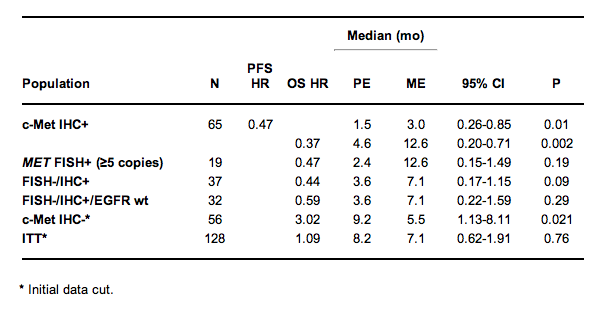
Meanwhile, the final METMab phase II data was presented from the OAM4458g study at ASCO this month, with no major change from the interim data presented last Fall ie MET High patients appear to have superior responses with the combination than erlotinib monotherapy.  The results clearly illustrate the importance of accurate biomarker analysis in these types of studies because while some patients did well on the combination, others did not, some did worse and the unselected group overall showed no difference.

Which begs the all important question – which patients did well on METMab plus erlotinib?

Those who had high MET expression, confirming the theory that resistance can be attenuated, at least for a while, with a dual combination approach of MET plus EGFR inhibitors but only in a very select subgroup of patients.

To illustrate this we can see that the addition of METMAb to erlotinib almost doubled the median time that those who were MET High (positive) were free of disease from 1.5 months to 2.9 months (HR 0.53; P=0.04) as you can see in the table from the ASCO abstract.  The combination also tripled median OS from 3.8 months to 12.6 months (HR 0.37; P=0.002):

Erlotinib +/- METMab in NSCLC at ASCO 2011

I would imagine that a phase III trial in NSCLC will evolve very soon and it will be most interesting to see how the design and patient selection criteria for the trial will evolve, based on the known findings to date.  These factors may determine whether a successful difference can be seen with the combination based on biomarkers to define a more homogenous group.

Interestingly, a phase II study is currently enrolling with METMab in triple negative breast cancer.  This is a complex three arms design looking at the impact of:

  • MetMAb + bevacizumab + paclitaxel
  • MetMAb + placebo + paclitaxel
  • Placebo + bevacizumab + paclitaxel

In theory, this should tell us whether eith METMab or bevacizumab have any advantage over paclitaxel chemotherapy.

What does the data with MET inhibitors mean?

The trials with both ARQ-197 and METMab teach us some important lessons in NSCLC:

  1. Catch-all studies of homogenous groups are a recipe for the dreaded words, “there was no significant difference in survival between the two groups”
  2. The importance of biomarkers in teasing out those most likely to respond
  3. The importance of careful patient selection in achieving those aims

When we think about this year’s ASCO conference theme of “Patients. Pathways. Progress,” we should be mindful of the fact that in order to match the therapy to the patient’s mutations, we need to continue to devise studies that seek to do exactly that – sometimes good drugs fail, not because they didn’t work, but because the relevant biomarker wasn’t found to illustrate which patients did respond.  When that happens, it’s a failure of R&D, not the drug itself.

Going back to the quote above from the Engelman et al., (2007) paper, I do wonder if MET plus erlotinib is the ideal combination in the relapsed/refractory setting with adenocarcinomas, even allowing for MET-High status?  Would a pan-EGFR inhibitor that also inhibits HER3 be a better partner with MET inhibitors than erlotinib in these patients?  Who knows, but hopefully someone will test that hypothesis out in a phase II trial at some point.

References:

ResearchBlogging.orgEngelman, J., Zejnullahu, K., Mitsudomi, T., Song, Y., Hyland, C., Park, J., Lindeman, N., Gale, C., Zhao, X., Christensen, J., Kosaka, T., Holmes, A., Rogers, A., Cappuzzo, F., Mok, T., Lee, C., Johnson, B., Cantley, L., & Janne, P. (2007). MET Amplification Leads to Gefitinib Resistance in Lung Cancer by Activating ERBB3 Signaling Science, 316 (5827), 1039-1043 DOI: 10.1126/science.1141478

2 Comments

Last week’s post on FGFR1 mutations in squamous cell lung cancer and the new EGFR/ALK combination agent, AP26113 (Ariad) drew a lot of attention from readers, with many writing in for more details or correctly suggesting an update in squamous cell carcinoma was long overdue.

Oddly, there wasn’t much in the way of new or exciting data in lung cancer at the recent American Society of Clinical Oncology (ASCO), but there are some recent developments that are worth looking at in EGFR, ALK+ and squamous cell carcinoma.

Let’s take a look at each in turn over a series of blog posts.

In the old days, lung cancer was first divided into Small Cell Carcinoma (SCC) and Non-Small Cell Lung Carcinoma (NSCLC), which have a broad split of about 20:80.  As we learned more about the disease, NSCLC was eventually divided further in squamous and non-squamous histology, as therapies such as pemetrexed (non-squamous) and bevacizumab (non-squamous) emerged.

Erlotinib was found to work best in adenocarcinomas, ie EGFR mutation-positive tumours.  As far as I know, there are no approved targeted therapies for the treatment of squamous histology and much of the focus has been in mutations associated with adenocarcinomas, which mostly (but not always) tend to be associated with non-smokers.

ELM4-ALK translocations

Within adenocarcinomas, we are learning that EGFR isn’t the only mutation that might be a potential target, as the recent data in crizotinib published in the NEJM by Kwak et al., (2010) on ELM4-ALK translocations has shown.

For those of you interested in the development of the ALK translocations in lung cancer, Dr Ross Camidge also provided an excellent overview when we interviewed him on Pharma Stratgy Blog last year.  It’s worth checking out if you missed it, and has become one of our most popular posts since last October.

Dr Jack West from GRACE has diligently curated a huge volume of posts, interviews and webcasts on lung cancer, including this nifty chart showing the currently identified mutations in adenocarcinomas:

Mutations in lung cancer

Source: GRACE

Of course, as luck would have it, EGFR mutations and ALK translocations tend to be mutually exclusive, so there would probably be little benefit in combining agents that target EGFR or ALK mutations, even in adenocarcinomas.

Crizotinib, the first ALK inhibitor to successfully make it past phase II trials, has already been filed by Pfizer for approval with the FDA and should provide a new option for lung cancer patients with this translocation very soon.  This is an exciting development because oncologists will be able to order a FISH test using the companion diagnostic developed by Abbott (also submitted to the FDA) to determine if their patients will be suitable for crizotinib therapy.

Although crizotinib was originally developed as a c-MET inhibitor, its activity there was very weak (the Roche and ArQule compounds, MET-Mab and ARQ197 respectively, are much more potent and continue to look promising in phase II trials), the discovery of the ALK translocation changed the clinical development plan dramatically and for the better.

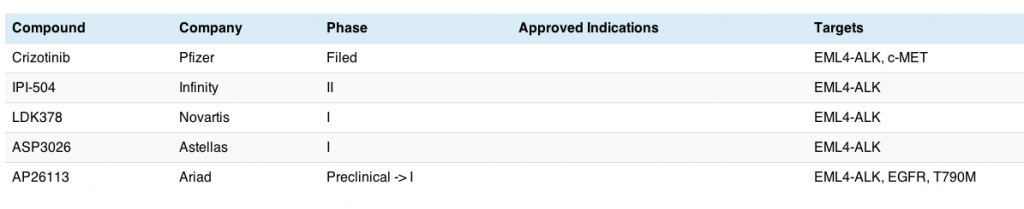
Unsurprisingly, there aren’t too many ALK inhibitors in development to date, with crizotinib being the lead compound:

ALK Inhibitors

This is a small, but rapidly growing niche; already we can see that compounds are emerging into the clinic hot on crizotinib’s heels.  The Infinity compound is a little different – it’s a heat shock protein (Hsp), while both the Novartis and Astellas agents are small molecule TKIs.  As far as I know, there isn’t a monoclonal antibody or antibody drug conjugate in the clinic for this particular target yet.

Like crizotinib, AP26113 is also a small molecule TKI, but differs in that it appears to be a dual inhibitor of ALK and EGFR, including the T790M mutation that has been shown to confer resistance to EGFR inhibitors such as erlotinib in adenocarcinomas (see Hammerman et al., 2009).

Conclusions

The time between the discovery of the ELM4-ALK translocation in adenocarcinomas and moving crizotinib into clinical trials was pretty rapid, and a tribute to Pfizer’s scientists and clinicians who made that happen so expeditiously.  It will be interesting to how this niche develops once FDA approval has occurred, and whether the other inhibitors in development will be merely ‘me-too’ agents or able to raise the bar beyond crizotinib in terms of efficacy, safety or overcoming resistance due to the structure forming a different binding shape in the kinase domain.  Time will tell.

Disclosure: I am an unpaid member/volunteer of the GRACE Board.

{UPDATE: Thanks to Luke Timmerman of Xconomy tweeting about Tesaro, I noticed they now have a deal as of March with Amgen for unnamed ALK inhibitors in their pipeline.}


References:

ResearchBlogging.orgKwak EL, Bang YJ, Camidge DR, Shaw AT, Solomon B, Maki RG, Ou SH, Dezube BJ, Jänne PA, Costa DB, Varella-Garcia M, Kim WH, Lynch TJ, Fidias P, Stubbs H, Engelman JA, Sequist LV, Tan W, Gandhi L, Mino-Kenudson M, Wei GC, Shreeve SM, Ratain MJ, Settleman J, Christensen JG, Haber DA, Wilner K, Salgia R, Shapiro GI, Clark JW, & Iafrate AJ (2010). Anaplastic lymphoma kinase inhibition in non-small-cell lung cancer. The New England Journal of Medicine, 363 (18), 1693-703 PMID: 20979469

8 Comments

After writing the first two posts in the series, I was much amused to see this tweet in my Twitter stream from one of buddies:

Picture 155
When you've been blogging on science, marketing, PR and cancer topics for several years you begin to wonder if it actually beneficial to anyone, so today's post is dedicated to Miguel in Barcelona for making me smile :-).  If you're on Twitter, please do
follow him because he's a great guy and shares a lot of very interesting pharma related links.  Give him some Twitter love!

Today's topic is about a new generation flavanoid, ASA-404, from Novartis.  Of course, under FTC guidelines, I should disclose that as many of you know, I'm a former employee and have also done consulting work for the company, but not on this particular product.

ASA-404 is an interesting agent in phase III development.  It's a vascular disrupting agent (VDA) with a tubulin dependent mechanism of agent.  Unlike taxanes, which target the microtubulin in DNA, this agent is also part anti-angiogenic agent because it selectively disrupts the tumour vasculature with both direct and indirect effects.  In simple terms, I think of it as a kind of hybrid cross between an anti-angiogenic such as bevacizumab (Avastin) and a taxane such as paclitaxel or docetaxel.

Dr Mark McKeage presentation at the AACR lung cancer meeting was focused on the phase II that has been published to date, including a publication in the British Journal of Cancer (see bottom of article). 

The drug was well tolerated in phase I trials, achieving an MTD of 3700 mg/m2.

In a phase II trial, paclitaxel and carboplatin (pc) therapy was used as the reference arm, and ASA-404 added to the standard chemotherapy in the other arm to determine if the agent added any extra benefit for newly diagnosed patients with non-small cell lung cancer (NSCLC) with either a squamous or non-squamous histology. They looked at 2 different doses of ASA-404 – 1200mg/m2 was used in the randomised comparison with carbo-tax and 1800mg/m2 with out the comparator arm but in combination as before. 36 patients were accrued into the reference pc arm, 37 in the lower dose ASA-404 arm and 31 in the higher dose ASA-404 arm.  This gave a total of 104 patients in the pooled phase II study.

Overall, similar rates of adverse events (AE's) were seen in the squamous and non-squamous patients, except for a slight increase in AE's related to blood/lymphatic effects.  No serious AE's associated with vascular effects of bleeding, hemorrhage or hemoptysis were seen.  There was an increase in hematologic toxicities (anemia, neutropenia and thrombocytopenia) but these were not significant and none rose above 20%.  There was no apparent increase in neutropenia related sepsis.

In terms of efficacy and median overall survival, McKey reported:

PCA  vs. PC

14.0 vs. 8.8 mos for 1200mg/m2

14.9                  for 1800mg/m2

Thus we can clearly see that adding ASA-404 to standard carboplatin-paclitaxel therapy improved median overall in frontline NSCLC by 5 months.

Recently, the FDA has approved several therapies in NSCLC in different histologies, due to either issues with side effects (bevacizumab and bleeding issues) or lack of efficacy (pemetrexed), while others such as erlotinib have been shown to be particularly effective in non-smoking female asians with an adenocarcinoma histology, although the approval is not based on histology.

Let's take a look at the ASA-404 histology data:

                Squamous:                Non-Squamous:          Overall:               

                PCA         PC             PCA         PC              PCA          PC

ORR (%)    40.0        14.3          31.7        25.0           34.4          22.2

One third of the patients had a squamous histology, but experienced no bleeding issues seen with VEGF agents.

While the results are higher for those with a squamous histology, there was also a trend towards higher efficacy in the non-squamous patients.  The positive results provided support and evidence for the drug's effectiveness and rationale for beginning the phase III triala, ATTRACT-1 in first line and ATTRACT-2 in second line NSCLC without restriction on histology.

To put the 5 months improvement in median OS with ASA-404 in context, I checked out the PI for other therapies.  Bevacizumab was approved on the basis of 12.3 months vs. 10.3 months, ie a 2 month improvement, while pemetrexed was approved on the basis of non-inferiority when comparing pemetrexed plus cisplatin to gemcitabine plus cisplatin (ie 10.3 months of overall survival in each arm).

The front-line trial has completed accrual and is ongoing, but the ATTRACT-2 trial for patients who have had prior chemotherapy is still enrolling.  You can find it here: ATTRACT-2.

Of course, these are early days yet and positive phase II data does not always translate to phase III success, but they are a hopeful sign of good things to come.  If the data are repeated, it will be good news for patients with NSCLC.  


ResearchBlogging.org
McKeage, M., Von Pawel, J., Reck, M., Jameson, M., Rosenthal, M., Sullivan, R., Gibbs, D., Mainwaring, P., Serke, M., Lafitte, J., Chouaid, C., Freitag, L., & Quoix, E. (2008). Randomised phase II study of ASA404 combined with carboplatin and paclitaxel in previously untreated advanced non-small cell lung cancer British Journal of Cancer, 99 (12), 2006-2012 DOI: 10.1038/sj.bjc.6604808

1 Comment
error: Content is protected !!