Pharma Strategy Blog

Commentary on Pharma & Biotech Oncology / Hematology New Product Development

Posts tagged ‘olaparib’

Today’s Science Friday post looks at the identification of a potential new biomarker and possible strategies for expanding use of PARP inhibitors in patients most likely to respond to them as a way to validate the the approach prospectively.  This has important implications for future clinical trial designs with this class of drugs.

Photo Credit: Ben Sutherland via flickr

Photo Credit: Ben Sutherland via flickr

Regular readers will be very familiar at my rants against broad catch-all studies and phase III trials with targeted agents that do not have a biomarker or even a logical well defined subset of patients because it’s akin to blindfolding an archer, turning him around 360 degrees and then asking him to hit a bullseye 50 or 100 yards hence.

How can you hit a target you can’t see?

PARP inhibitors have had a bit of a chequered history after the initial excitement was later followed by a series of rather disappointing clinical trial results, which occurred for a multitude of reasons.  Several of the approaches sadly fell into the category of ‘Five things not to do in R&D’ as delineated in my recent tongue-firmly-in-cheek post on the topic.  I’ll leave interested and curious readers to ponder at length exactly which of the no-nos they managed to break!

That said, we do know a few things of relevance:

  1. PARP1/2 inhibitors have produced sustained anti-tumor responses in patients with germ-line BRCA gene mutations
  2. Biomarkers other than BRCA1 and BRCA2 are clearly needed to predict responses to PARP inhibitors
  3. Catch-all trials without segmenting for BRCA mutations and biomarkers are highly unlikely to be successful (recall the spectacular phase III failure in triple negative breast cancer with iniparib, for example)
  4. Next generation PARP inhibitors have focused on more clearly defined subset populations with greater success (and potency).

Chris Lord and Alan Ashworth’s lab have recently published some nice work (open access, see Refs below) that is worthy of discussion. Bajrami et al., (2013) decided to dive a little deeper and look at what genes and mutations might affect the responses to PARP inhibition:

“In hypothesizing that additional genetic determinants might direct use of these drugs, we conducted a genome-wide synthetic lethal screen for candidate olaparib sensitivity genes.  In support of this hypothesis, the set of identified genes included known determinants of olaparib sensitivity, such as BRCA1, RAD51 and Fanconi’s anemia susceptibility genes.”

The main reason behind this approach quickly becomes apparent – there is a huge need for it:

“One of the major issues in the clinical development of PARP1/2 inhibitors is the identification of biomarkers other than BRCA1 and BRCA2 gene mutations that predict a favourable response to therapy.”

While patients with germline BRCA mutations have a greater tendency to respond, they don’t account for all the responses that have been seen in the clinic.  What else is involved?

What did they find?

“Integration of the list of candidate sensitivity genes with data from tumor DNA sequencing studies identified CDK12 deficiency as a clinically relevant biomarker of PARP1/2 inhibitor sensitivity.”

In other words, when CDK12 was low, PARP sensitivity was high, making it a potential predictive biomarker for response to therapy with a PARP inhibitor.

What does this mean?

“The appearance of CDK12 in our olaparib sensitization gene list, alongside the CDK12 mutational data, suggested the possibility that loss of CDK12 function could sensitize tumor cells to PARP1/2 inhibitors and that loss of CDK12 function in HGSOVCa could be a predictive biomarker for response to this developmental class of agents.”

In other words, it would be useful to evaluate loss of CDK12 as a biomarker of response for PARP inhibitors in prospective clinical trials in breast and ovarian cancers, with and without germ-line BRCA mutations.

CDK12 is only one of nine genes known to be mutated in high grade serous ovarian cancer (HGS-OVCa), for example, so should patients be identified upfront who have loss of CDK12, then it may be enough to ensure response to a PARP inhibitor, irrespective of BRCA status.  Clearly this work is still very early, but it creates a smart and well argued rationale that can be tested in clinical trials.

Should the approach be validated, then it could well expand the utility of PARP inhibitors in the clinic based on a predictive biomarker.  I would be interested to see what happens not only with olaparib, but also the new generation of PARP inhibitors from Abbott (veliparib), Biomarin (BMN 673) and Clovis (rucaparib), to name a few who are conducting trials in breast or ovarian cancers.

If this works, it will be a thing of beauty.

References:

ResearchBlogging.orgBajrami I, Frankum JR, Konde A, Miller RE, Rehman FL, Brough R, Campbell J, Sims D, Rafiq R, Hooper S, Chen L, Kozarewa I, Assiotis I, Fenwick K, Natrajan R, Lord CJ, & Ashworth A (2014). Genome-wide Profiling of Genetic Synthetic Lethality Identifies CDK12 as a Novel Determinant of PARP1/2 Inhibitor Sensitivity. Cancer research, 74 (1), 287–97 PMID: 24240700

Photo Credit: Ben Sutherland

Well, after just getting back from the American Society of Clinical Oncology (ASCO) meeting in Chicago, I’m heading off to Europe for the European Hematology Association (EHA) meeting – no rest for the wicked!

ASCO was a rather flat meeting this year – the stars were undoubtedly the imatinib 36 vs 12 month data in adjuvant GIST (clearly superior) and Roche/Plexxikon/Daiichi Sankyo’s vemurafenib in BRAF V600E metastatic melanoma. The ipilimumab data was strangely disappointing in the upfront setting – only 2 months improvement in survival when added to DTIC.

On the Sarcoma front, the catch-all nature of the study came back to haunt Merck with an improvement in PFS but no overall survival benefit for ridaforolimus as maintenance therapy after 1-3 cycles of chemotherapy. That filing will likely result in a highly charged ODAC meeting debating the merits of some awkward results.

Ovarian cancer data was a mixed bag – olaparib continues to look promising in this setting, although the Avastin OCEANS data caught a few people by surprise – yet another PFS endpoint met but no overall benefit in survival and the expected incidence in bowel perforations. I think this will likely be reserved for high risk women, if used.

There was a lot of interesting/promising data in phase II, which are too numerous to mention right now – check back as I will be adding some notes on some of the emerging compounds that I liked.

Meanwhile, I’m aggregating the tweets from the hematology meeting using the #EHA11 hashtag – you can track them in the widget below if interested in following along remotely. Most of the tweets from me will likely be on leukemias, lymphomas and multiple myeloma.

2 Comments

This weekend I’m heading off to Chicago for the annual meeting of the American Society of Clinical Oncology (ASCO).  I’ll be writing some in depth pieces and daily highlights from the conference, but in the meantime, many of you will be wondering what might be interesting amongst the 5,000 or so abstracts.

Here’s a quick snapshot of some data I’m looking forward to catching up on – there’s no clapperboard or guy with a teleprompter behind the camera, just a few ideas and some things to watch out for:

http://youtu.be/TNwQvV4aYl8

.

1 Comment

Last week the American Society of Clinical Oncology (ASCO) held a press briefing to highlight some of the studies at the forthcoming annual meeting in Chicago next month.

ASCO Annual Meeting 2011 Patients, Progress, PathwaysASCO president, Dr George Sledge of Indiana, announced that the meeting theme for this year is “Patients, Pathways, Progress” to reflect the growing focus on molecular targets to identify and treat patients more effectively.
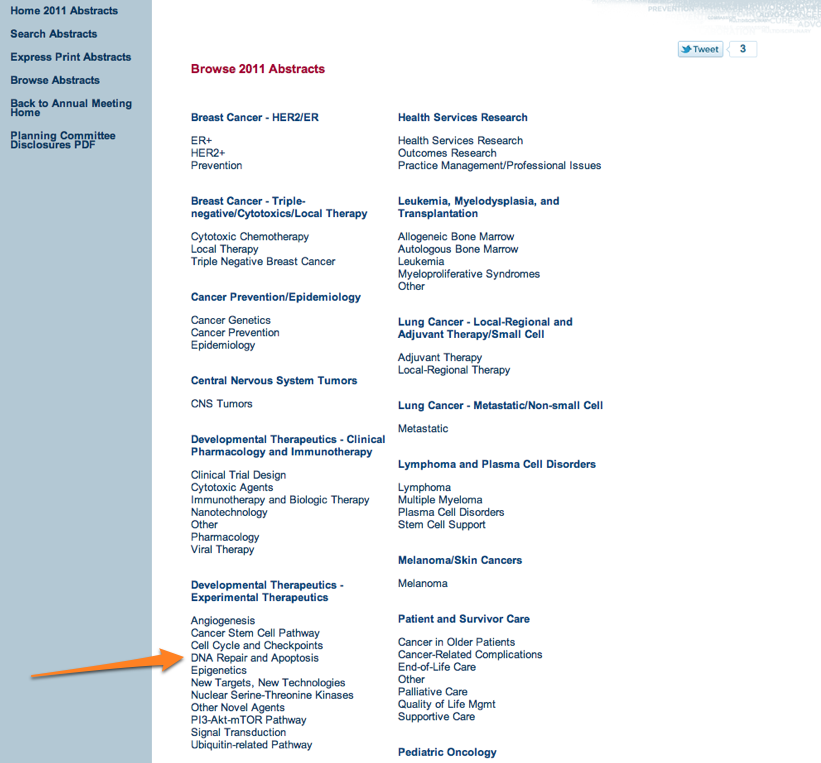
Traditionally, ASCO has organised their meeting around tumour types such as breast, lung, prostate and colon cancers, for example, but this year I was delighted to see that the Developmental Therapeutics section is getting more attention with a greater focus on the molecular targets that are now emerging:

ASCO 2011 Annual Meeting Pathways

Of the abstracts covered in the briefing, two in particular really stood out for me.  One was on Exelixis’ cabozantinib (XL184) in bone metastases, which my colleague wrote about on Biotech Strategy Blog and the other was the data for AstraZeneca’s PARP inhibitor, olaparib, in serous ovarian cancer.

Many of you will know that I’ve been covering PARP inhibitors on this blog since 2006 – although they have had somewhat of a chequered history to date.  After the recent failure of Sanofi’s iniparib in triple negative breast cancer and AstraZeneca deciding to put a phase III breast cancer trial on hold while they reformulate the drug from capsules to a tablet to make it easier for people to take, many weren’t sure what was happening with the PARP class of compounds.

Would they be consigned to the drug dustbin or would they come back from the dead?

Dr Jonathan Ledermann (University College London) presented an overview of the phase II results in serous ovarian cancer.  These were women both with, and without, the BRCA gene.  It has previously been shown by Audeh et al., (2010) that ~30% of inherited BRCA mutated tumours respond to PARP inhibitors, particularly those that have ‘platinum-sensitive’ disease.

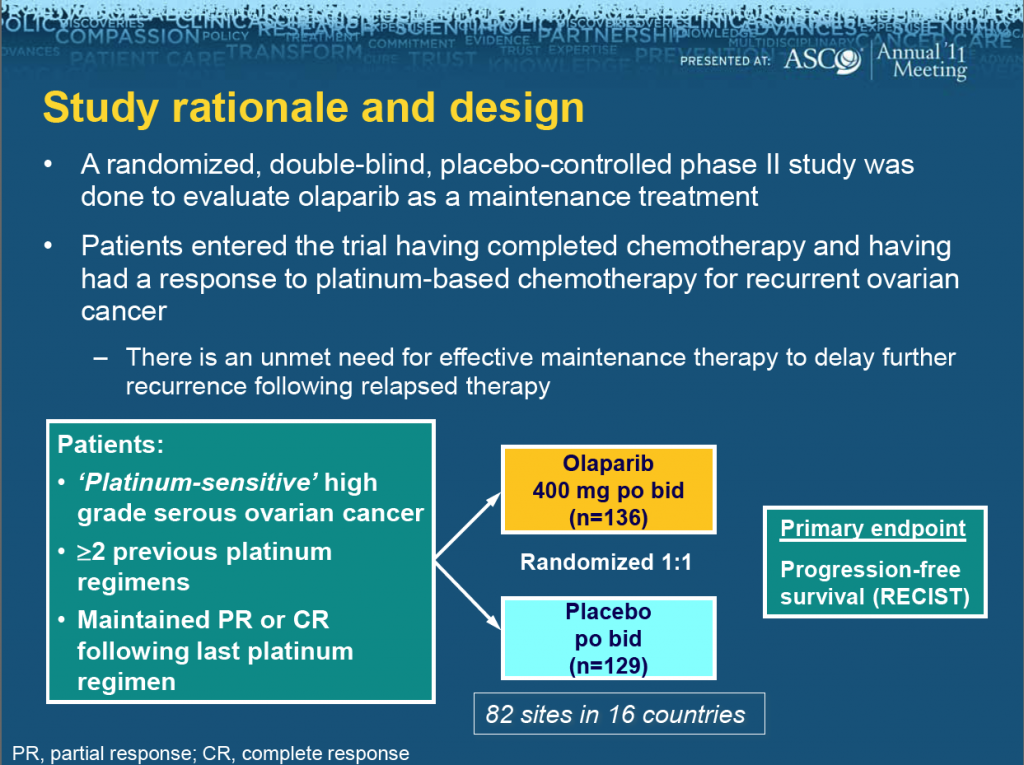
Here is the phase II study design in serous ovarian cancer:

Olaparib serous ovarian cancer phase II trial design

What was in interesting in this study was that, overall, Dr Ledermann noted that they found that women in the olaparib arm lived for 8.4 months before progression, compared to 4.8 months on placebo.  This 3.6 month improvement in PFS was statistically significant.

We will know more about the details of this study on Saturday 4th June at ASCO, but for now, two things stand out:

  • This is the first study to demonstrate a statistically significant benefit of maintenance treatment for ‘platinum-sensitive’ relapsed serous ovarian cancer
  • 50% of olaparib and 16% of placebo patients were still on treatment at the time of the analysis

These results seem pretty compelling and important to me.

If you’re around at ASCO on Saturday, the ovarian cancer session is on from 3-6pm in room E354a – check it out!

For those interested, there are also some new data being presented on Abbott’s PARP inhibitor, ABT-888 (veliparib) combined with temozolomide in refractory colorectal cancer.  This is also on Saturday afternoon from 4.30-6pm in the Clinical Science Symposium in Hall D1.

No doubt many of us will be running around up and down the escalators on the very first day, some Segways with hooters might help!  Still, I dream/long for the future when ASCO follows AACR’s lead and organises sessions around molecular targets and pathways instead of tumour types… maybe that won’t be too far into the future after all 🙂

References:

ResearchBlogging.orgAudeh, M., Carmichael, J., Penson, R., Friedlander, M., Powell, B., Bell-McGuinn, K., Scott, C., Weitzel, J., Oaknin, A., Loman, N., Lu, K., Schmutzler, R., Matulonis, U., Wickens, M., & Tutt, A. (2010). Oral poly(ADP-ribose) polymerase inhibitor olaparib in patients with BRCA1 or BRCA2 mutations and recurrent ovarian cancer: a proof-of-concept trial The Lancet, 376 (9737), 245-251 DOI: 10.1016/S0140-6736(10)60893-8

5 Comments

A PSB reader wrote in asking whether an update on the PARP inhibitors and the clinical trials would be possible.   Following on from the last update in January that covered Sanofi’s negative iniparib phase III data in triple negative breast cancer and AstraZeneca’s decision in February not to pursue olaparib in hereditary BRCA1 and 2 positive breast cancers, it would be a good idea to see what’s left of this once highly promising class of compounds.

I first wrote about PARP inhibitors way back in 2006 and like many, I’m rather disappointed with the results we’ve seen so far.  However, all is not lost.  Abbott’s veliparib is going strong, while Pfizer (PF-01367338) and Cephalon (CEP-9722) are just getting started with their programs.

Iniparib was probably the weakest inhibitor of the class and perhaps not potent enough, since there was no increase in toxicities in the TNBC study (that can be a good and a bad thing), while olaparib has proven to be potent but challenging to combine with chemotherapy.  It doesn’t mean that a different compound or clinical approach will be unsuccessful.

The saddest thing about the iniparib trial is the lack of BRCA1 and 2 testing, given the heterogeneous nature of triple negative breast cancer. We will likely never know which different subsets responded and why from that trial, it probably could have been better designed and included more rigorous biopsies for biomarker analysis, but once done it is too late.  This is one of the dangers of applying old-style chemotherapy trial designs to targeted therapies – first know your molecular targets – or potential targets – and evaluate the biomarkers over time in response to therapy.  Otherwise, it’s a bit like blindfolding an archer and asking him to hit a target s/he can’t even see.

I don’t think all is lost with AstraZeneca’s olaparib yet, but we will have to wait and see what the current ongoing studies bring in terms of answers.  Certainly, both AstraZeneca and Abbott have a broad range of clinical trials that may yield some interesting results. We shall see.

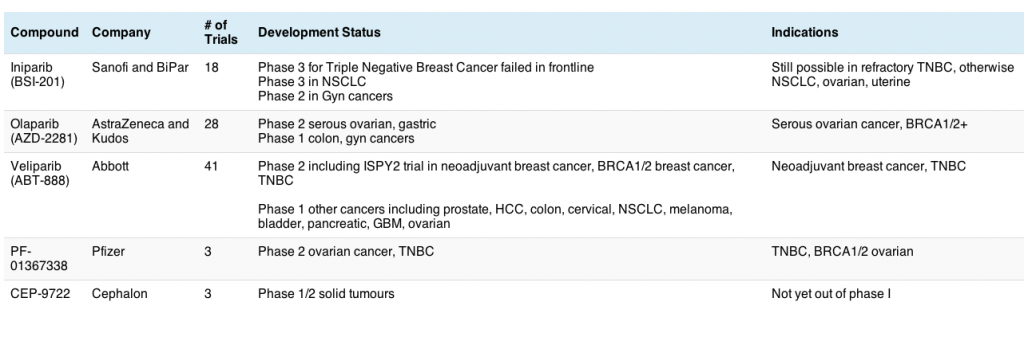
I took a quick look at the clinical trials database and sifted through the available data for PARP inhibitors. This is what we have so far:

Parp Inhibitors

One trial I’m eagerly awaiting the results of is the ISPY2 trial in neoadjuvant breast cancer, which included veliparib as one of the treatment options in a molecular based approac,h much in the same way the BATTLE trial worked in lung cancer.  For those interested in the background to this approach in breast cancer, you can find the details in an interview with Sue Desmond-Hellmann (UCSF), when the trial was first announced.  It will be a while before we know the results, but one that is very eagerly awaited in the breast cancer community.

11 Comments

Now that the dust has settled on the news from sanofi-aventis yesterday that iniparib did not achieve it’s primary survival endpoints in the phase III trial in newly diagnosed triple negative breast cancer (TNBC), it’s time to take stock of this class.

Yesterday was another major snow shovelling day in New Jersey so I missed the AstraZeneca year end conference call.  A Pharma Strategy Blog reader kindly filled me in with some relevant information – the company discontinued the development of their PARP inhibitor, olaparib, in BRCA breast cancer – scroll down to the discontinued section to see the note.

Our source also listened to the Q+A and in response to questions on olaparib from the analysts, Martin Mackay, the Head of R&D observed that:

“We decided to focus on serious ovarian cancer, and really focus our attention to that in the first instance and wait to see how those results play out in Phase III. Then we’ll revisit… breast cancer.”

This raises some interesting questions about PARP inhibitors in general.

Yesterday, we noted the fine line that needs to be trod between potency/efficacy and tolerability.  Last ASCO we saw how challenging it was to manage the toxicities with olaparib in combination with chemotherapy.  Iniparib doesn’t appear to add to the adverse event profile in combination, but missed its efficacy endpoints.

Meanwhile, Abbott’s PARP inhibitor, veliparib, is being tested in the I-SPY breast cancer trial, so while it will be a while before we see any data, it will be interesting to see how it pans out given that it is also more potent than iniparib.  Pfizer, BMS and Merck are also potential players in the PARP class, but their inhibitors are in earlier stage development. Based on the latest news with iniparib and olaparib it will be fascinating to see what they decide to do.

The latest developments in triple negative breast cancer also raise other critical issues:

  1. Was the olaparib decision based on toxicities, lack of efficacy or being behind iniparib, since they recently announced their phase II results?
  2. How will neliparib fare in the neoadjuvant setting and what toxicities might be expected?
  3. TNBC are mainly basal cell histology so many will also be BRCA1 or 2 positive – did these women do better in the olaparib trial?
  4. Will the Pfizer and Merck compounds have a better risk:benefit profile?
  5. What biomarkers will emerge to indicate subsets or predict response to therapy?
  6. If (5) does evolve, how will this develop from a diagnostics perspective?
  7. What will happen in ovarian, lung and prostate cancers, all of which have a very small proportion of people who have the BRCA1 or 2 mutation.

The current situation with iniparib and olaparib raises more questions than answers, so it will be interesting to see what learnings emerge from the data and whether the once promising class is salvageable or dead.

All in all, 2011 is turning out to be an interesting year and we have yet to get past January.

10 Comments
error: Content is protected !!