Pharma Strategy Blog

Commentary on Pharma & Biotech Oncology / Hematology New Product Development

Posts tagged ‘screening’

Patient advocacy is something I care about and spend time actively supporting two worthwhile causes, including the lovely folks at Fight Colorectal Cancer, headed by the indefatigueable Carlea Bauman and Nancy Roach.  As someone who has lost several family members to colon or rectal cancer, this is something dear to my heart.  I got involved largely through being inspired by the incredible Kate Murphy, who sadly passed away last summer.

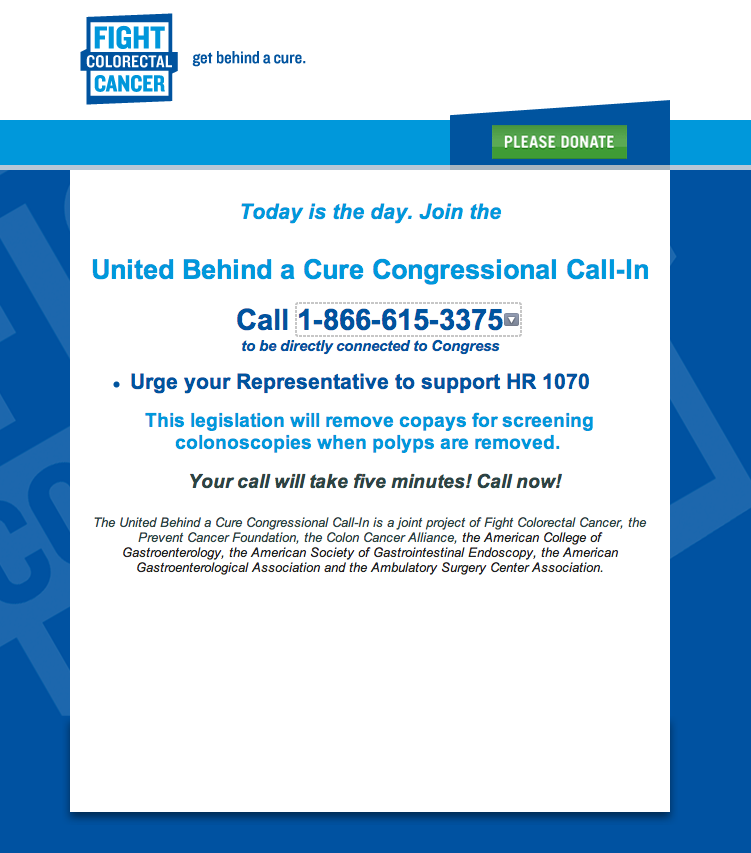
Today, Fight CRC is spearheading a campaign to improve access to colonoscopies, a valuable scrrening tool to pick up the disease early.  By some odd Medicare quirk, as far as I’m aware, there’s no co-pay for colonoscopies unless a polyp is picked up and removed.  Obviously, it’s more straightforward to remove the polyp then and there rather than go through the prep and procedure again, but that incurs a co-pay… which in turn provides a barrier to more people being screened.  Removing the co-pay would make colonoscopies more affordable for millions of people.  We all know that prevention is better than cure.

You can do a number of things to help and join the fight!

  1. Follow the campaign efforts on Twitter using the hashtag #conc2013
  2. Donate to the Fight Colorectal Cancer cause
  3. Call the number below to be put through to your representative to urge them to co-sponsor HR 1070, which has a worthy aim:

“To amend title XVIII of the Social Security Act to waive coinsurance under Medicare for colorectal cancer screening tests, regardless of whether therapeutic intervention is required during the screening.”

The more co-sponsors on the bill… the greater the chance of its enactment, another barrier to screening is removed and more saving of lives from colorectal cancer.

CallonCongress HR1070

1 Comment

“Current and former heavy smokers can now be screened more effectively for lung cancer. Results from the National Lung Screening Trial (NLST) revealed that detecting small lung cancers with computed tomography (CT) reduces lung cancer specific mortality by 20 percent.”

MD Anderson Cancer Center (MDACC) press release

Wow, how amazing is that?  Thanks to the MDACC Provost, Dr Ray DuBois for sharing it on Twitter and to Dr Jack West (Swedish) for Re-Tweeting it or I may well have missed it. The action is as a direct result of The National Lung Screening Trial (NLST), which was conducted to evaluate whether screening with low-dose CT scans could reduce mortality from lung cancer.

Yesterday, The National Lung Screening Trial Research Team published the results of a landmark study (see references below) that may well have a huge impact on cancer centres around the USA.  Here are the basic details of the study:

“Eligible participants were between 55 and 74 years of age at the time of randomization, had a history of cigarette smoking of at least 30 pack-years, and, if former smokers, had quit within the previous 15 years.

Persons who had previously received a diagnosis of lung cancer, had undergone chest CT within 18 months before enrollment, had hemoptysis, or had an unexplained weight loss of more than 6.8 kg (15 lb) in the preceding year were excluded.

A total of 53,454 persons were enrolled; 26,722 were randomly assigned to screening with low-dose CT and 26,732 to screening with chest radiography.”

Emphasis mine. That’s a huge epidemiology study that took place over two years of enrollment and 5 years of screening!

What did the results show?

Essentially, my understanding is that screening with the low-dose CT did indeed reduce mortality from lung cancer compared with radiography:

“In the NLST, a 20.0% decrease in mortality from lung cancer was observed in the low-dose CT group as compared with the radiography group.

The rate of positive results was higher with low-dose CT screening than with radiographic screening by a factor of more than 3, and low-dose CT screening was associated with a high rate of false positive results.”

Until only very recently, people with lung cancer were given radiography, tested for histology and categorised according to small cell or non-small cell, and then the latter in to squamous or non-squamous and then treatment (mostly with chemotherapy) decided from there on.

As MDACC noted:

“Prior to the trial, lung cancer, often diagnosed in the later stages of the disease, had shown no benefit from screening because screening with standard chest X-rays did not detect cancers early enough.”

We’ve come a very long way in five years.

These results now mean that with the advanced in low dose CT, we can now potentially detect lung cancer earlier, thereby improving their chances of better outcomes.  On the Global Resource for Advancing Cancer Education, GRACE, Dr Thomas Hensing (U. of Chicago) summarised it succinctly:

“As the first trial that shows lung cancer screening can save lives, the NLST will no doubt have a significant impact on how we practice in this country and should be viewed as a very hopeful result for lung cancer advocates.”

Curious as to what the impact might be at major cancer centres, I asked Dr West on Twitter whether Swedish would be doing screening following the response.  His response, I’m delighted to say, was enthusiastic:

“Yes, Swedish is very inclined to roll out screening program for current/ex-smokers.”

The results of this study, coupled with rapid implementation in many cancer centres, may have a huge impact on earlier detection, diagnosis and outcomes five years from now. That’s great news for patients and caregivers and gives hope to all.  In fact, it gives me goosebumps thinking about it!

Imagine if we can detect lung cancer earlier, that not only means a better chance of outcomes per se by dint of treating earlier disease, but add in what we now know about molecular aberrations in adenocarcinomas and squamous cell carcinomas as well, and things really start to snowball.  The overall impact may well be greater than we can imagine at present.

If you are interested in more information, MDACC put together a short video explaining the background and impact of the NLST study that is well worth checking out.

Disclosure: I’m an unpaid member of the GRACE advisory board.

References:

ResearchBlogging.orgThe National Lung Screening Trial Research Team (2011). Reduced Lung-Cancer Mortality with Low-Dose Computed Tomographic Screening New England Journal of Medicine DOI: 10.1056/NEJMoa1102873

1 Comment

The Holy Grail of colorectal cancer prevention – a reliable screening test that users don’t dread and avoid – appears to be getting close.

A novel test that detects telltale DNA markers in stool samples correctly identified 85 percent of colon cancers, 64 percent of significant precancerous polyps, and 90 percent of healthy samples, researchers announced Thursday in Philadelphia at a conference held by the American Association for Cancer Research.

“There is no other noninvasive screening test for colon cancer that comes close” to that accuracy rate, said David Ahlquist, a Mayo Clinic researcher who invented part of the technology and who is working with the commercial developer, Exact Sciences of Madison, Wis.

The DNA test is still experimental, hasn’t been validated under real-life conditions, and will take at least another year of development, he said.

via Researchers at Philadelphia conference announce progress toward noninvasive colon cancer test | Philadelphia Inquirer | 10/29/2010.

This was a most interesting new test in development that was covered here at the AACR colorectal cancer biology to therapy meeting in the press briefing yesterday.

Current methods of colorectal cancer (CRC) screening for people over 50 involve either colonoscopy, which is invasive, or virtual colonoscopy, which is not covered extensively by insurers.  Both require a not inconsiderate amount of time to do, not to mention the inevitable nervousness that goes with such procedures.  Routine fecal tests currently available have unfortunately been shown to miss most advanced pre-cancers, so there is an real opportunity to develop a more sensitive and useful detection approach.

This new test takes a stool sample and looks for markers that indicate early presence of adenomas in the colon in a small validation study (n=59) by testing people who were being evaluated for CRC by colonoscopy, in other words, they had a high risk for CRC or were strongly suspected of having cancer. Such well characterised patients allows for quick segmentation into normal and cancerous groups, rather than waiting for long term epidemiology follow-up to see who develops cancer or not, which can take years.

According to the Mayo Clinic scientists, several combinations of methylation markers based on tissue DNA were found that discriminate colorectal neoplasia from normal mucosa.  These were evaluated as part of the test validation process.  The markers that were found to be useful included 3 methylated genes (TPFI2, BMP3, NDRG4), plus human DNA.

A huge advantage of this simpler approach is that I can see that potentially, primary care doctors could order it as part of routine screening at an annual physical, thereby finding colon adenomas early rather than waiting for a carcinoma to develop later in life.

The test from Exact Sciences looks at 4 genes known to be associated with the development of colorectal cancer and appears to be able to detect them with 85% sensitivity.  Another DNA test is also being developed in Germany by Epigenomics AG, but differs in that it uses blood samples and looks at changes in Septin 9, which is not used in the Exact Sciences test.  It is currently available to physicians in Germany.

The development of non-invasive easy to use tests like these is important because we all know that the earlier we detect abnormal growth, the easier it is to cure and improve overall outcomes for any cancer, as Bert Vogelstein emphasised in his talk the other evening and Tyler Jacks did in his keynote at the Xconomy meeting in Boston the other week.  Colon cancer, for example, has a 90% cure rate when detected and treated early with surgery.

The lead investigator, Dr David Ahlquist, told me that the Mayo clinical studies with the Exact Sciences test are due to run until the end of 2012, so if all goes well we may see an approved validated test for wide scale testing available by 2013.  Certainly the timeline is looking like the next couple of years rather than a much longer timeframe, which is very encouraging to all of us who have lost family members to the disease.  While a better screening test won’t bring them back, it does offer hope that we may be able to avoid losing other people to the disease because their cancer was detected too late to do anything about it.

The pace and new advances in the early detection of cancer is something we can all be cheered about.  Long may the trend continue!

5 Comments

Approximately 150,000 Americans are affected by colorectal cancer each year as well as 500,000 worldwide.  Much of the morbidity and mortality of the disease could be prevented if we understood more about the risk of the cancer developing and were able to intervene with appropriate treatment.

3-4% of colorectal cancer cases are inherited as a familial syndrome. Coloncancercell The most common of these is Lynch syndrome, which is also know as hereditary nonpolyposis colorectal cancer. It is caused by a mutation in one of four mismatched genes.  The identification of such patients is important, but it is impractical to screen every patient for these mutations because current tests cost around $3,000.  Clinical algorithms have therefore evolved to estimate risk of developing Lynch Syndrome.

Some Scottish researchers recently reported on a new algorithm to identify patients who present with one of the 4 mismatched genes.  They used a population based approach in newly diagnosed patients under 55 years and used clinical features to develop a better predictive model to estimate which patients with the disease was a likely mutation carrier.

Genetic testing can then be performed on a smaller pool of likely patients. They published the algorithm on a website for anyone who is interested (link).

CrcHereditary cancers occur in several tumour types, including ovarian, breast and colorectal cancers.  Lynch Syndrome is probably the most prevalent, occurring in 1 or 2 per 1,000 people, so the syndrome is neither common nor rare.  It is important to identify it early because it is grows from a benign tumour to a carcinoma (cancer) much more quickly than sporadic colorectal cancer in the general population. Fortunately, there are clear markers for the syndrome that are not present in the other hereditary cancers.

The findings of the Scottish research suggest, for example, that there should be around 3300 to 6000 carriers of detectable mutations in the genes of patients with newly diagnosed colorectal cancer in the US and similarly for Europe.  Each carrier has a family; the job of the medical profession is now to find them.  There is a demonstrated survival benefit in patients with Lynch Syndrome under surveillance than not, so tracking down the patients and their families of carriers will affect many future generations.

To find out more information on colorectal cancer, click here.

error: Content is protected !!