Pharma Strategy Blog

Commentary on Pharma & Biotech Oncology / Hematology New Product Development

Posts tagged ‘seeding’

Early this morning I saw a headline float by my Twitter stream from yesterday with a link to an article or paper suggesting that yes, we can indeed predict metastasis. I can’t remember who shared it, or what was the exact news article but a quick Google search for latest news found some noise around a potential biomarker, CPE-ΔN. The paper (open access) in the references link below, is from the Journal of Clinical Investigation.

Now, the idea that a biomarker might be able to predict metastasis is important because it signals the need for more aggressive treatment as the disease is advancing. Equally, if someone is doing well, you don’t want to intensify therapy needlessly but resection may be more appropriate.   Clearly, the earlier you detect the cancer, the better, but conversely, figuring out when to change treatment and prevent or slow metastasis is also important.

Reading the paper carefully, the authors stated:

“We report here that the carboxypeptidase E gene (CPE) is alternatively spliced in human tumors to yield an N-terminal truncated protein (CPE-ΔN) that drives metastasis.”

In the research, they used a liver cancer model (or hepatocellular cancer, HCC) to see what was happening with the protein.  Interestingly, CPE-ΔN tended to be present and have high levels in tumours that have metastasised.

They followed a group of patients with HCC (n=99) and looked to determine whether high or low levels of CPE-ΔN was associated with prognosis, with interesting results:
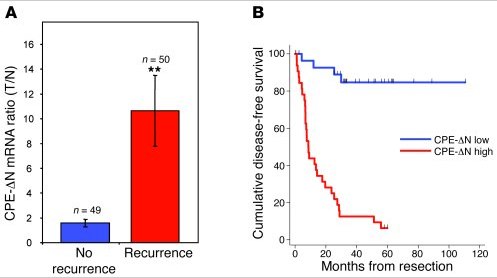
Can cancer metastasis be predicted?

They also looked at patients with stage 2 disease that had only spread within the liver, as well as patients with a rare adrenal disease and colon cancer.  The patients with stage II HCC have a low chance of recurrence, but it can happen, so the question was could the biomarker be used to predict those most at risk?

The answer was yes.

Of the patients with early HCC (n=18):

  • Thirteen had low levels of CPE-ΔN and 10 of those were still cancer-free three years after surgery.   However, three with low CPE-delta N levels did have recurrence, giving an accuracy level of 77% in predicting metastasis.
  • Five had high levels of CPE-ΔN and in four of them recurrence occurred, giving an accuracy level of 90%.

All in all, it’s a good piece of solid research that may have important implications for future research.  Be warned, the paper is a little heavy to read though!

The next steps for the group are:

  1. Find a therapeutic method of blocking CPE-ΔN, preferably with a small molecule
  2. Determine the mechanism by which CPE-ΔN is activated, thereby figuring out how the switching on of metastasis works

All in all, although this research, while still at the very early stage, looks promising and worth following to see how the idea pans out.  I can’t help wondering how this research will impact the Norton and Massagué cancer seeding theory – it should add to it.  Now, if only we can find out what activates the CPE-ΔN protein, thereby triggering the metastasis, that could well be a key piece in the puzzle.

References:

ResearchBlogging.orgLee, T., Murthy, S., Cawley, N., Dhanvantari, S., Hewitt, S., Lou, H., Lau, T., Ma, S., Huynh, T., Wesley, R., Ng, I., Pacak, K., Poon, R., & Loh, Y. (2011). An N-terminal truncated carboxypeptidase E splice isoform induces tumor growth and is a biomarker for predicting future metastasis in human cancers Journal of Clinical Investigation DOI: 10.1172/JCI40433
“Ubiquitin-dependent mechanisms have emerged as essential regulatory elements controlling cellular levels of Smads and TGFβ-dependent biological outputs such as epithelial–mesenchymal transition (EMT).

In this study, we identify a HECT E3 ubiquitin ligase known as WWP2 (Full-length WWP2-FL), together with two WWP2 isoforms (N-terminal, WWP2-N; C-terminal WWP2-C), as novel Smad-binding partners. We show that WWP2-FL interacts exclusively with Smad2, Smad3 and Smad7 in the TGFβ pathway.

Interestingly, the WWP2-N isoform interacts with Smad2 and Smad3, whereas WWP2-C interacts only with Smad7. In addition, WWP2-FL and WWP2-C have a preference for Smad7 based on protein turnover and ubiquitination studies. Unexpectedly, we also find that WWP2-N, which lacks the HECT ubiquitin ligase domain, can also interact with WWP2-FL in a TGFβ-regulated manner and activate endogenous WWP2 ubiquitin ligase activity causing degradation of unstimulated Smad2 and Smad3.

Consistent with our protein interaction data, overexpression and knockdown approaches reveal that WWP2 isoforms differentially modulate TGFβ-dependent transcription and EMT.

Finally, we show that selective disruption of WWP2 interactions with inhibitory Smad7 can stabilise Smad7 protein levels and prevent TGFβ-induced EMT.

Collectively, our data suggest that WWP2-N can stimulate WWP2-FL leading to increased activity against unstimulated Smad2 and Smad3, and that Smad7 is a preferred substrate for WWP2-FL and WWP2-C following prolonged TGFβ stimulation.

Significantly, this is the first report of an interdependent biological role for distinct HECT E3 ubiquitin ligase isoforms, and highlights an entirely novel regulatory paradigm that selectively limits the level of inhibitory and activating Smads.”

Source: Oncogene

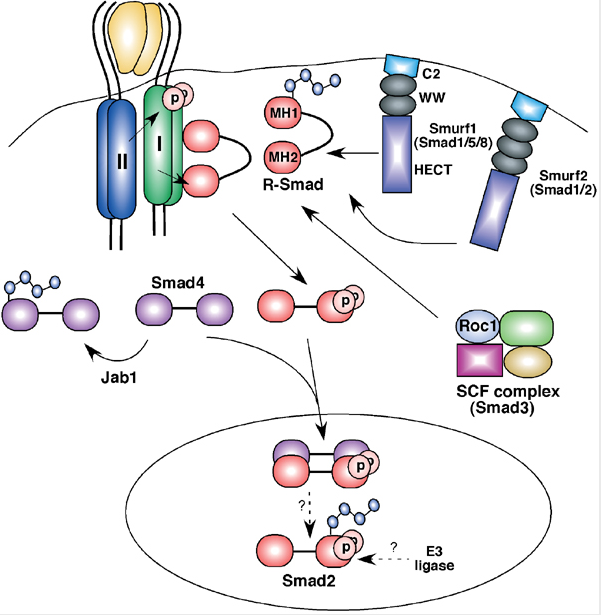
That was an abstract I was browsing over coffee in my oncology RSS feeds and while it was a bit heavy for early in the day, I was intrigued because Smads have been cropping up in GI sessions at meetings over the last six months or so.  Smads are signal transducers for members of the transforming growth factor-beta (TGF-beta) superfamily, so they occupy a key role in transcription of proteins:

The biology of TGF-beta and Smads

In addition, I’ve included a link to an open access article on the biology of Smads in the references below.

Essentially, the translational research from Soond and Chantry (2011) is suggesting that blocking the WWP2 gene could prevent metastasis, ie cancers from spreading to other organs of the body.  Many of you will remember the post on Norton and Massague’s cancer cell seeding theory and this new finding could well have implications for that research too.

Overall, the latest findings mean that if we have a valid target, we can design a drug to target the rogue gene sending signals.

Of course, these are still very early days yet, but it will be interesting to see if the basic science can be translated into R&D and eventually, a real clinical impact in the long run.

For those of you wanting a simpler version of the abstract, BBC Health did a nice job of putting the research into plain English.  Do check out their short report with pretty pictures here.

References:

ResearchBlogging.orgSoond, S., & Chantry, A. (2011). Selective targeting of activating and inhibitory Smads by distinct WWP2 ubiquitin ligase isoforms differentially modulates TGFβ signalling and EMT Oncogene DOI: 10.1038/onc.2010.617

Attisano, L., & Tuen Lee-Hoeflich, S. (2001). The Smads Genome Biology, 2 (8) DOI: 10.1186/gb-2001-2-8-reviews3010

Izzi, L., & Attisano, L. (2004). Regulation of the TGFβ signalling pathway by ubiquitin-mediated degradation Oncogene, 23 (11), 2071-2078 DOI: 10.1038/sj.onc.1207412

At the annual NY Chemotherapy Foundation symposium the other week, one of the highlights for me was listening to Larry Norton (MSKCC) give a 30 minute keynote entitled:

“Cancer Cell Seeding: a hypothesis with therapeutic implications”

He talked at length about what he described as some of the breast cancer mysteries, namely the puzzles associated with:

  1. Phenotypic consistency (hyperplasia, anaplasia, rapid growth, angiogenesis, large tumour size, invasion, metastases and latency)
  2. Disorderly order
  3. Unclear clear margins

Several main points were then raised from this quick synopsis:

  • The phenotypic elements are so inextricably linked that they must be related, but how?
  • Sentinel node mapping proves that progression is orderly. Yet it isn’t! How?
  • RT must kill cells that are beyond clear margins.  How do they get there? What is their relationship to distant recurrence?
  • That RNA expression is prognostic and predictive challenges the notion of tumour-initiating cells being rare.

These issues or assumptions may be true or not true so the question then becomes how are we going to solve them?

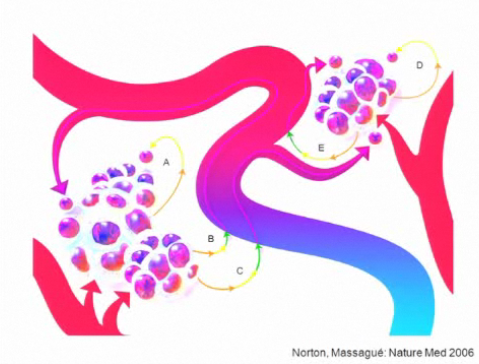
Norton noted that one way these concepts may be related is that the tumour is essentially metastasing to itself and showed a nice schematic from 2006 that he and Massague used in their Nature Medicine paper.  Tumours thus grow by metastasis back to itself and will promote increased growth and bigger tumour size:

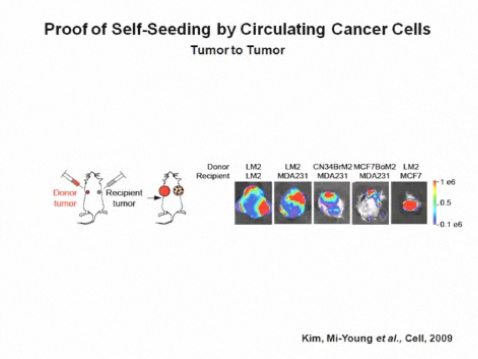
However, it took until late 2009 to research and publish proof that this idea is true (see reference below for the paper):

The other concept that caught my attention is the idea of a ‘toxic sponge’ that followed on from this as Norton was putting the story back together in terms of breast cancer.  In short, the primary tumour and region act as a sponge for circulating tumour cells.  When the sponge is removed or sterilised, circulating tumour cells seek distant sites since they cannot metastasise back to the primary tumour anymore.  Seeding the new sanctuary sites may also create reservoirs for feeding future distant metastases.  Research is now underway to determine whether RT has accelerates or potentiates the metastasis process in the long run.

All in all, a very interesting and well put together talk.

ResearchBlogging.org Norton L, & Massagué J (2006).  Is cancer a disease of self-seeding? Nature medicine, 12 (8), 875-8 PMID: 16892025

Kim, M., Oskarsson, T., Acharyya, S., Nguyen, D., Zhang, X., Norton, L., & Massagué, J. (2009).  Tumor Self-Seeding by Circulating Cancer Cells Cell, 139 (7), 1315-1326 DOI: 10.1016/j.cell.2009.11.025

3 Comments
error: Content is protected !!