Pharma Strategy Blog

Commentary on Pharma & Biotech Oncology / Hematology New Product Development

Posts tagged ‘Zelboraf’

One of the interesting themes for that emerged for me at AACR this year was the amount of effort that is being expended on strategies to overcome drug resistance. This was particularly noticeable in metastatic melanoma and non-small cell lung cancer (NSCLC).  More on lung cancer in another post, as today I want to focus on melanoma.

In the advanced melanoma, vemurafenib is given to patients with the BRAFV600E mutation, which occurs in approximately 50% of patients. This oncogene drives activity of the tumour, but inhibition with vemurafenib (Zelboraf) has shown some remarkable effects, as the stunning before and after photos from Levi Garraway’s group demonstrate.

The challenge, however, is that adaptive or acquired resistance can occur in response to treatment and patients sadly find their melanoma returning after approximately 6-9 months on continuous daily therapy.

At last year’s ASCO, we saw that adding a MEK inhibitor such as trametinib to a BRAF inhibitor such as dabrafenib added around an extra 3 months over single agent BRAF therapy before the resistance set in and the disease returned, sometimes with a deadly vengeance.

I’ve written here on this blog about numerous mechanisms of resistance in advanced melanoma from MEK to COT and others (see related posts below for background reading).

The big question at this AACR was how is the field progressing with new research?

Sometimes, we have to go back to the lab to study animal models of resistance before returning to the clinic with new ideas.
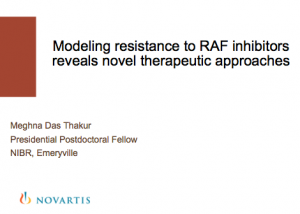
Screen Shot 2013-04-15 at 2.54.50 PMThat’s what a young Novartis Postdoctoral fellow from NIBR, Meghna Das Thakur, did. She asked critical questions and attempted to answer them in a series of elegant experiments with mice as well as retrospectively test the concept in patient data. The cool thing is that while many of the oral sessions were taken up by the Major League researchers is that it’s also nice to see up and coming young scientists present some nicely done research.

What Dr Thakur did was really interesting…

Her hypothesis was simple – that resistant tumours are ‘less fit’ than sensitive cells and have a selective disadvantage over sensitive cells in the absence of drug.

If this were true then we would expect to see dependence on drug for growth of resistant tumours in xenografts, much as we do in humans, with vemurafenib. The data clearly showed that vemurafenib resistant tumours were dependent on drug for growth. They also observed that:

1) p-ERK levels increased following withdrawal of vemurafenib in resistant tumours
2) There was a great deal of heterogeneity in the mechanisms of resistance

The key question then becomes how can we use this information to prevent resistance?

One way to explore this is to look at selective pressure, since vemurafenib is usually given continuously…

  • Treating continuously means that selective pressure enriches resistant cells
  • However, withdrawing the drug means that resistant cells suffer a fitness deficit

Essentially, the researchers noted that, “alternating the selective pressure prevents the emergence of a resistant population.”

In comparing continuous vs intermittent dosing, two things could be concluded from the model:

1) Resistant tumours emerge more rapidly under continuous dosing with vemurafenib
2) Intermittent dosing in multiple tumor xenograft models forestalled resistance

What can we learn from retrospective patient data?

What they did next was to look at computed tomography (CT) scans analysed for evidence of vemurafenib-dependence in patients treated with vemurafenib in the BRIM-3 and vemurafenib safety study, which were identified from the clinical trials database at the Royal Marsden Hospital. In particular, they focused on patients who stopped treatment because of progressive disease (PD).

Of 42 patients identified, 19 of these had CT scans performed after cessation of vemurafenib available for review, while 23 patients did not have a CT available for review and in 16 patients this was because of rapid PD.

For each of those 19 patients with a post-vemurafenib CT, the total tumour volume on three consecutive CT scans was recorded:

  • The CT performed prior to stopping vemurafenib
  • The CT performed when progressive disease was diagnosed and vemurafenib stopped
  • The CT performed after vemurafenib was stopped and prior to the initiation of further therapy

They found that 14 of the 19 patients experienced decreased tumour growth rate following cessation of vemurafenib, supporting the hypothesis that resistant tumours emerge more rapidly under continuous dosing with vemurafenib.

In this model, it is clear that intermittent dosing prolongs survival, but what is the underlying mechanism, and what does this mean for future treatment of patients and also clinical trial designs?

From this initial work it was clear that the MOA is not yet fully understood and further bench work will be needed to elucidate the mechanisms involved.  We don’t yet know, as the researchers point out, whether:

“Does resistance come from a clonal population or is it an adaptation or re-wiring of a selected few cells?”

What was clearer though, is that new clinical research will be needed to evaluate the potential for intermittent vs continuous dosing in patients, particularly in combination:

  • Will there be greater selective pressure from BRAF + MEK inhibitor combinations vs BRAF alone?
  • Identify combination partners that could be used during BRAF inhibitor holiday.

Overall…

I thought this was a very nice piece of well thought out research, perhaps one of my favourites from the AACR meeting this year.  Critically, we saw that the preclinical mouse xenograft model predicted a clinically-relevant resistance mechanism. Removal of drug from resistant cells leads to MAPK pathway hyper-activation and resistant cells experience a fitness deficit. Cycling the mice on and off therapy led to better outcomes than if they were dosed continuously, thereby giving us a new strategy to consider in melanoma patients.

The main impact of this preclinical study is that future clinical research in advanced melanoma should investigate the value of intermittent dosing strategies to improve patient outcomes.

The work turns the old concept of continuous dosing 365/24 on its head – suppressing the BRAFV600E oncogene continuously in melanoma may not necessarily be the best strategy in terms of superior outcomes.

This this does NOT mean that ALL tumours will behave in a similar fashion and intermittent dosing should be tested first in clinical trials where there is sufficient scientific evidence to warrant it.  If I were a patient, considering drug holidays without any evidence of effectiveness would NOT be a good idea.

I’m really looking forward to seeing the results of future combination trials with intermittent dosing to see if outcomes are indeed improved beyond would we currently see with continuous dosing either alone or in combination.


4 Comments

“Ipilimumab is not recommended for the treatment of advanced (unresectable or metastatic) malignant melanoma in people who have received prior therapy.

The Committee was satisfied that ipilimumab meets the criteria for being a life-extending, end-of-life treatment and that the trial evidence presented for this consideration was robust.

The Committee acknowledged that few advances had been made in the treatment of advanced melanoma in recent years and ipilimumab could be considered a significant innovation for a disease with a high unmet clinical need.

Despite the combined value of these factors the Committee considered that the magnitude of additional weight that would need to be assigned to the QALY gains for people with advanced (unresectable or metastatic) melanoma would be too great for ipilimumab to be considered a cost-effective use of NHS resources.”

NHS NICE Guidance

In other words, it’s too expensive and the NHS doesn’t want to pay the £80K ($120K) sticker price. This news is no great surprise given the cost-benefit ratio when considering that there is no way to tell who might benefit most from treatment upfront.
The is, however, a huge difference between hope and false hope, as NPR Shots astutely noted when discussing Avastin in breast cancer earlier this week and in some ways that sentiment applies here too. By this I mean it would be much more compelling to both patients and NICE if an oncologist could talk about a new therapy in specific and useful terms.

Examples of doctor-patient conversations about treatment in the near future might look more like this….

Either:

“You have an 70-80% chance of responding to this therapy because you have X (mutation, translocation, biomarker etc), where this drug has been shown to be highly effective and extends life by over 2 years in many of our advanced patients with this disease to date.”

Or:

“This drug may do more harm than good in your case, as it has been shown to effectively target X (mutation, translocation, biomarker etc), which you do not have, and therefore, are unlikely to respond. I believe it would be better to consider these alternatives in your situation… “

We all know about heterogeneity – it’s the very underpining of what makes a cancer survive despite our best efforts to tame it until we can subset into more homogenous and predictable groups.  This means that offering a broad therapy to all patients with a given advanced cancer without any idea of its predictive value is fast becoming a misnomer in today’s world of emerging targeted therapies.  Now, manufacturers (marketers even) might think it’s better not to ‘limit’ their market opportunity, but the reality is many healthcare systems are looking at ways to limit treatments to where it’s needed most, not only for cost reasons, but also to direct resources where they are more likely to work. The current model is not sustainable in the long run.

Of course, if a predictive biomarker was available to determine which patients are more likely to respond to ipilimumab, then the QALY calculation would be considerably different, and possibility even within the realms of the current guidelines.

That’s a whole different ballgame, but hopefully one that will begin to emerge as we have seen with new targeted therapies such as vemurafenib (Zelboraf) in BRAF V600E malignant melanoma, crizotinib (Xalkori) in ALK-positive advanced lung cancers and everolimus (Afinitor) in combination with exemestane in ER/PR+ HER2- breast cancers that have relapsed after initial aromatase inhibitor therapy.

It will be interesting to see how NICE handles all of those situations in the future, since they are all targeted agents showing a significant impact on a patients ability to live longer,with a more precise, and therefore, limited patient definition.  As a Brit and a scientist, I may have reasonable expectations that NICE will make a rational and logical decision in the face of limited resources, but this is also tinted with a large dose of healthy scepticism after the trastuzumab (Herceptin) debacle in HER2-positive breast cancers that lead to the utterly ridiculous and unfair post code lottery in the UK.

We are not talking absolute costs here, but the relative costs of seeing real efficacy benefits of six months or more in those patients most likely to respond, while at the same time giving an offering that truly extends life in a meaningful fashion without exposing too many to the toxic side effects of a given treatment. Dealing with cancer is tough enough without being treated with a regimen that had absolutely no hope of helping people live longer and feel better.

“The problem at the moment is that it takes $1bn [£600m] to get a drug to market and 15 years or more. That is the justification for the pharmaceutical industry charging high prices.

If on the other hand by the time you get to phase 2 you know exactly which patients it is going to work on, you only put those patients through and instead of 10% you get an 80% response rate.

You get a licence on the basis of the data and don’t have to go to phase 3 (a trial involving thousands of people). That saves vast sums of money and years of development. What that does to the business model is it means you can justify charging lower prices because it cost a lot less in the first place.

If we get this right, it changes the entire dynamics of the business model of the pharmaceutical industry.”

Source Harpal Kumar, the chief executive of Cancer Research UK (CRUK) via The Guardian

A UK friend kindly sent me this article today and provocatively asked me what I thought. Hmmm, a very interesting, meaty and relevant topic indeed.  Here goes…

Will this change the way we do business in cancer research?

The theory behind this statement by CRUK is that if we develop more targeted drugs to fewer patients and generate higher response rates e.g. 70-80% in a specific biologic subset, instead of say, 10% in a broader population, then the costs of development will come down and thus the treatment cost of the disease will ultimately lower.

Not so fast!

The reality might actually be different, and here’s why:

  1. For this to happen you need more translational research, biomarkers and companion diagnostics.
  2. The cost of researching and developing the targets is quite high.
  3. While clinical development costs might be lower with fewer large scale trials, the costs of iterative phase II trials will go up and the available pool of patients for commercialization is now much lower e.g. 5% of patients with the ALK translocation in lung cancer not 100% of all available relapsed patients.
  4. In order to maintain revenues, it is basic economics 101 that smaller patient niches will equal higher costs.

If you are not convinced of the last point, take a look at the costs of treating rare diseases or small subsets of patients.

Some good examples exist in the hematology space include:

  1. Alexion’s Soliris (eculizumab),which is approved for the treatment of patients with paroxysmal nocturnal hemoglobinuria (PNH). This is a rare hematologic disorder that affects approx. 8,000 to 10,000 people in North America and Europe. The cost is something like $400K per annum.
  2. Genzyme’s Fabrazyme (agalsidase beta) for the treatment of Fabry Disease, another rare hematologic condition, this time an inherited metabolic defect that affects 1 in every 40-50,000 people in the US. Fabrazyme lowers the amount of a substance called globotriaosylceramide (GL-3), which builds up in cells lining the blood vessels of the kidney and certain other cells. It’s very effective, but certainly not inexpensive at around $160K per annum.

What is the likely impact of the changing research paradigm?

Both of the above patient pool sizes are not out of the realm of reality for a comparison with oncology.

In the old model, clinical trials tended to involve more allcomer trials, i.e. patients with a particular tumor type (e.g. non-small cell lung cancer), stage of disease (metastatic) and line of therapy (frontline, relapsed or refractory).

In the new world order, things are changing in clinical trials already:

  1. Roche’s Zelboraf (vemurafenib) was recently approved in metastatic melanoma in patients with the BRAF V600E mutation, reducing the available pool who might respond by 50%. It was launched last week with a price tag of around $56.4K for an average of 6 months treatment.
  2. Crizotinib (Xalkori) is being evaluated in patients with NSCLC who have the ALK translocation and have failed prior therapy. That’s a tiny subset of patients. Patients with this aberration make up maybe 4-7% of the total NSCLC pool. Imagine how small the target population will be for other ALK inhibitors in crizotinib refractory disease?!
  3. The cost of funding and finding biomarkers that predict response is a huge undertaking.  Genentech have no doubt spent many millions looking for a predictive biomarker for Avastin, so far to little avail.

Of course, there are plenty of other exciting targets with small subsets being evaluated in the clinic, but there are several factors to consider:

  1. Small subsets = fewer patients = higher cost.
  2. Will combination strategies be affected by the cumulative costs that will inevitably result? e.g. Yervoy + Zelboraf in metastatic melanoma potential treatment cost = $170-180K if the studies are successful in showing that survival is improved.
  3. Since Dendreon’s Provenge ($93K) was recently given the green light by the CMS, the costs of new targeted entrants is creeping up over the $100K watershed marknot down, viz Yervoy ($120K) and Adcetris (~108K), for example.

In conclusion…

I admire the chutzpah of CRUK, but disagree with some of their conclusions, which I think are rather naive.

Today, I will go on record here and declare that I believe specialised treatment based on the underlying biology will ultimately cost more, not less, in the long run in terms of research and development, diagnostics/biomarkers and treatment costs of ever smaller subsets.

However, I have no doubt we will ultimately see better results clinically with this more scientific approach but this will come at a cost.  While that’s great news for patients and caregivers, it is not so great for the payers, Government or investors, because higher risks and R&D costs will inevitably equate to more failures and this drives higher costs in a spiral fashion.  Ultimately, those costs will trickle down to all of us in the form of higher co-pays and more expensive medical plans to cover the payers margins.  Success has to be paid for somewhere down the line.

And the constant refrain from everyone in Pharma of “let’s do more with less” will increase.

It’s a vicious cycle of unsustainability, with no end in sight.

9 Comments

This morning the FDA approved vemurafenib (Zelboraf), along with it’s companion diagnostic, for the treatment of metastatic melanoma in patients with the BRAF V600E mutation.

This is great news!

The approval has been granted ahead of time, as correctly mentioned in the Reuters article recently. This means we now have two new therapies for the treatment of metastatic melanoma after ipilimumab (Yervoy) was approved in March.

These two new drugs have been rapidly approved within the space of a couple of months following the presentation of the data at the ASCO plenary session in June.

Very little has changed in this landscape since the original approval of dacarbazine (DTIC) many years ago, but the good news is that oncologists now have two new agents to consider for treatment in 2011, which is very much a grand cru year for melanoma.

Zelboraf (link to PDF of the PI) differs from Yervoy in that it is not an immunotherapy to CTLA4, but a small molecule tyrosine kinase inhibitor that targets BRAF and more specifically, one of the mutations driving the disease, V600E.  This mutation is seen in approximately half of patients with metastatic melanoma.  The companion diagnostic (from Roche’s diagnostic division) will enable oncologists to test patients upfront and determine who should receive the therapy since the clinical results have only been demonstrated in those with the mutation.

The hot question is what is the price?

Well, according to Roche/Genentech, the monthly price of Zelboraf will be $9,400 and assumes an average of ~6 months of treatment based on the progression-free survival (PFS) data reported in the phase III BRIM3 (5.3 months) and phase II BRIM2 (6.1 months) studies. The overall survival had not been reached at that time. This means the course of treatment with Zelboraf will be approximately $56,400, but will obviously depend on how long it is taken for.  The comparative cost of treatment for ipilimumab for four infusions is $30K per infusion or $120K per full course.

In addition, the cost of the diagnostic test will likely vary depending upon the laboratory, but it is expected will be determined by the test volume and contract framework established with the laboratory.  The Average Selling Price (ASP) for the cobas BRAF test will be ~$120-150 per test in the US, which is very reasonable.

All in all, news like this will bring a smile to many today – it’s always good to hear of new drugs that make a difference to the lives of cancer patients.


2 Comments

A Reuters press release on vemurafenib (Zelboraf) caught my eye this morning, suggesting that it might be approved in BRAFV600E metastatic melanoma by the FDA might be “imminent” according to an unnamed source and much earlier than the expected PDUFA date in November October 28th (now confirmed by Roche/Genentech).

If so, that’s very good news.

However, what really caught my eye was a quote from a spokesperson at Roche Diagnostics, suggesting that the BRAFV600E test would could around $150.  That’s lower than I was expecting, although no doubt it will be considerably offset by the cost of vemurafenib itself.

It was also good to hear recently that Roche and BMS, the manufacturers of ipilimumab (Yervoy), have now met to discuss and finalise the much anticipated combination trial of Zelboraf and Yervoy.  It will be interesting to see if the combination will extend survival even further in patients with the V600E mutation.  There’s a long way to go before the results bear fruit, as an early dose finding and tolerability study will be the first step in the process.

Of course, pricing and reimbursement will be key, given that Yervoy was launched recently with a $120K price tag for four infusions.  On the 2Q earnings call the other week, BMS announced that the launch was going well and uptake was strong.  It is given as a 3mg infusion every three weeks for 4 cycles, over a 3 month period.  It will be interesting to see what the Zelboraf monthly price will be, assuming it successfully garners approval.   Should the combination work out in the future, the cost of treating metastatic melanoma will likely become even more expensive despite only small incremental survival benefits.


2 Comments
error: Content is protected !!