Pharma Strategy Blog

Commentary on Pharma & Biotech Oncology / Hematology New Product Development

Posts tagged ‘adenocarcinoma’

Continuing our mini series on molecular targets and lung cancer this week, today I’m going to focus on MET amplications for this post.

MET confers resistance to EGFR inhibitorsA few years ago, Jeffrey Engelman’s group at Mass General (see Reference section below) reported that MET amplication leads to resistance with EGFR inhibitors such as gefitinib (Iressa) by activating ERBB3 signalling:

“MET amplification was detected in 4 of 18 (22%) lung cancer specimens that had developed resistance to gefitinib or erlotinib. We find that amplification of MET causes gefitinib resistance by driving ERBB3 (HER3)–dependent activation of PI3K, a pathway thought to be specific to EGFR/ERBB family receptors.”

Others have shown similar results in non-small cell lung cancer (NSCLC) with erlotinib.

Subsequent to this, a number of MET inhibitors have entered the clinic looking at the impact of combining a MET inhibitor with erlotinib in adenocarcinomas that are EGFR mutation positive.

Two of the leading compounds in phase II/III development are described below:

  1. ARQ-197 (ArQule/Daiichi Sankyo) a small molecule inhibitor of c-MET
  2. METMab (Roche/Genentech) a monoclonal antibody to c-MET

ArQule currently has two phase III trials both in the refractory setting looking at non-squamous NSCLC in combination with erlotinib versus erlotinib alone – one is currently enrolling while the other will soon be open to recruitment.

Of course, there are other MET inhibitors in earlier development (eg crizotinib is a weak inhibitor of c-MET, but is being evaluated in ALK translocated NSCLC).

What was interesting at ESMO last September was the phase II data that was presented on both agents in the same session.  The ARQ-197 data grouped all the patients together as one group and showed a trend in favour of the combination arm vs erlotinib plus placebo (7.3 vs 3.6 months) in terms of time to new metastases.

Since then, the ArQule phase III trials have been set up and appear to be looking at:

“The status of the following biomarkers will be collected in this study: EGFR and KRAS mutation status prior to randomization, and MET status post randomization.”

I think that is a good approach, because the METMab data at that conference clearly showed that MET High and MET Low patients had very different outcomes, based on the limited phase II data I saw at ESMO.

Meanwhile, the final METMab phase II data was presented from the OAM4458g study at ASCO this month, with no major change from the interim data presented last Fall ie MET High patients appear to have superior responses with the combination than erlotinib monotherapy.  The results clearly illustrate the importance of accurate biomarker analysis in these types of studies because while some patients did well on the combination, others did not, some did worse and the unselected group overall showed no difference.

Which begs the all important question – which patients did well on METMab plus erlotinib?

Those who had high MET expression, confirming the theory that resistance can be attenuated, at least for a while, with a dual combination approach of MET plus EGFR inhibitors but only in a very select subgroup of patients.

To illustrate this we can see that the addition of METMAb to erlotinib almost doubled the median time that those who were MET High (positive) were free of disease from 1.5 months to 2.9 months (HR 0.53; P=0.04) as you can see in the table from the ASCO abstract.  The combination also tripled median OS from 3.8 months to 12.6 months (HR 0.37; P=0.002):
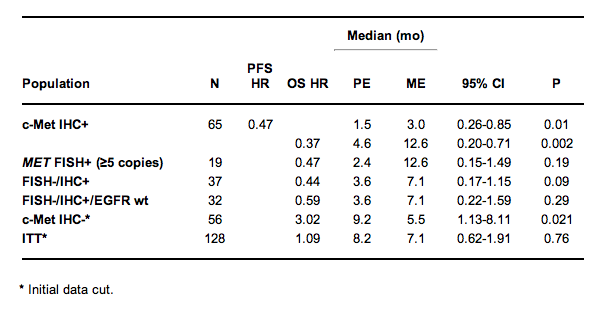
Erlotinib +/- METMab in NSCLC at ASCO 2011

I would imagine that a phase III trial in NSCLC will evolve very soon and it will be most interesting to see how the design and patient selection criteria for the trial will evolve, based on the known findings to date.  These factors may determine whether a successful difference can be seen with the combination based on biomarkers to define a more homogenous group.

Interestingly, a phase II study is currently enrolling with METMab in triple negative breast cancer.  This is a complex three arms design looking at the impact of:

  • MetMAb + bevacizumab + paclitaxel
  • MetMAb + placebo + paclitaxel
  • Placebo + bevacizumab + paclitaxel

In theory, this should tell us whether eith METMab or bevacizumab have any advantage over paclitaxel chemotherapy.

What does the data with MET inhibitors mean?

The trials with both ARQ-197 and METMab teach us some important lessons in NSCLC:

  1. Catch-all studies of homogenous groups are a recipe for the dreaded words, “there was no significant difference in survival between the two groups”
  2. The importance of biomarkers in teasing out those most likely to respond
  3. The importance of careful patient selection in achieving those aims

When we think about this year’s ASCO conference theme of “Patients. Pathways. Progress,” we should be mindful of the fact that in order to match the therapy to the patient’s mutations, we need to continue to devise studies that seek to do exactly that – sometimes good drugs fail, not because they didn’t work, but because the relevant biomarker wasn’t found to illustrate which patients did respond.  When that happens, it’s a failure of R&D, not the drug itself.

Going back to the quote above from the Engelman et al., (2007) paper, I do wonder if MET plus erlotinib is the ideal combination in the relapsed/refractory setting with adenocarcinomas, even allowing for MET-High status?  Would a pan-EGFR inhibitor that also inhibits HER3 be a better partner with MET inhibitors than erlotinib in these patients?  Who knows, but hopefully someone will test that hypothesis out in a phase II trial at some point.

References:

ResearchBlogging.orgEngelman, J., Zejnullahu, K., Mitsudomi, T., Song, Y., Hyland, C., Park, J., Lindeman, N., Gale, C., Zhao, X., Christensen, J., Kosaka, T., Holmes, A., Rogers, A., Cappuzzo, F., Mok, T., Lee, C., Johnson, B., Cantley, L., & Janne, P. (2007). MET Amplification Leads to Gefitinib Resistance in Lung Cancer by Activating ERBB3 Signaling Science, 316 (5827), 1039-1043 DOI: 10.1126/science.1141478

2 Comments

I’m on a lung cancer and systems biology roll at the moment, although partly that’s just how the interesting data rolls in the literature.

Here’s some new food for thought.  A group of respectable scientists published some fascinating data in PLOS Medicine (free article see reference below) entitled, “Nuclear Receptor Expression Defines a Set of Prognostic Biomarkers for Lung Cancer.”

Using PCR, they evaluated NR expression patterns associated with good and poor outcomes in patients with non-small cell lung cancer (NSCLC) and then validated the findings in lung adenocarcinomas (n=550) and squamous cell carcinoma (n=130) samples in three different analyses by comparing normal and lung cancer cells.  Two important factors emerged from the analysis:

“The prognostic signature in tumors could be distilled to expression of two nuclear receptors, short heterodimer partner (SHP) and progesterone receptor, as single gene predictors of NSCLC patient survival time, including for patients with stage I disease.”

The SHP protein was the better predictor of outcomes in patients with stage I disease; those with strong SHP expression had better overall survival rates of approx. 70% at 100 months compared with 45% among people with low SHP expression.  The survival curves in the paper were quite dramatic – check them out.  Interestingly, the same signatures were also predictive of recurrence based on normal tissue samples from the patients with NSCLC.  Progesterone receptor expression was, however, a much weaker predictor of any outcome based on this analysis.

Essentially, this means the study demonstrated:

“NR expression is strongly associated with clinical outcomes for patients with lung cancer, and this expression profile provides a unique prognostic signature for lung cancer patient survival time, particularly for those with early stage disease.”

What are nuclear receptors, you may be wondering?

“The NR superfamily contains 48 transcription factors (proteins that control the expression of other genes) that respond to several hormones and to diet-derived fats.  NRs control many biological processes and are targets for several successful drugs, including some used to treat cancer.”

Still, it’s not something that immediately springs to mind as a possible or logical prognostic biomarker.

That said, out of the 48 transcription factors, two were found to be related to poorer patient outcomes.  They were NGFIB3, a receptor associated with nerve growth factor, and NR3C2, a mineralocorticoid receptor protein:

“This study highlights the potential use of Nuclear Receptors (NRs) as a rational set of therapeutically tractable genes as theragnostic biomarkers, and specifically identifies short heterodimer partner and progesterone receptor in tumors, and NGFIB3 and MR in non-neoplastic lung epithelium, for future detailed translational study in lung cancer.”

Going forward, we still need to see more research to find out whether these particular NRs or others were involved with tumour development and growth.  If  they do, then NR’s may potentially offer new therapeutic targets for future research and development.

References:

ResearchBlogging.org Jeong, Y., Xie, Y., Xiao, G., Behrens, C., Girard, L., Wistuba, I., Minna, J., & Mangelsdorf, D. (2010). Nuclear Receptor Expression Defines a Set of Prognostic Biomarkers for Lung Cancer PLoS Medicine, 7 (12) DOI: 10.1371/journal.pmed.1000378


At the AACR meeting on the molecular origins of lung cancer yesterday, Dr Roy Herbst, head of thoracic medical oncology at the University of Texas M. D. Anderson Cancer Center in Houston opened the press briefing with a brief summary of the state of play today:

“Lung cancer is a very vexing problem.  In the US, approx. 200,000 people will be diagnosed this year and the sad part of it, is almost as many will die.  This disease tends to present having already spread, and it’s very heterogeneous.  If we’re going to make the next hurdle of personalised care, we need to better understand the tumour and use that knowledge to treat patients in more specific, effective and less toxic ways.

Lung cancer receives a lot less funding than most other cancers despite being the single biggest cause of death.  It lags behind in both private and public funding, as several of the panel members were quick to point out.  Of course, the disease is associated with smoking, with concomitant negative connotations.

Not all patients are smokers though.  Adenocarcinomas, for example, tend to
occur in non-smokers and younger patients (under 50 yo) who are often Asian and female. Why?  No one really knows yet. Take a look at this inspiring patient story –
from a young, fit and otherwise healthy white male who had never smoked, which we discussed in this post last October:

ELM4-ALK
Source: Lung Cancer Alliance via Inspire.com (click image to see larger version)

It’s ultimately a story that serves as a vivid reminder that no matter who we are or what we are doing, a fatal illness can strike anytime. There is a glimmer of hope though, because the trial the brave young man participated in was for a new drug class that targets the ELM4-ALK mutation, which is very rare, occurring in approximately 4% of adenocarcinoma patients. It was probably the first public report of a positive response to the targeted agent. I remember reading it about a week or so after the initial posting and followed the gentleman’s progress over time until sadly, I noticed he was no longer posting. A cruel turn of fate indeed.

That said, research in lung cancer has come a long way over the last decade as Dr Paul Bunn, another panel member, who is Executive Director of IASLC and Dudley Professor,
Univ. of Colorado Cancer Center illustrated:

Screen shot 2010-01-13 at 12.28.31 PM
Source: Dr Paul Bunn, AACR Press Briefing 1/12/2009 (click to enlarge image)

The ELM4-ALK mutation is a fusion oncogene that arises out of a translocation and has at least 7 variants. It was first identified and reported in 2007 in Nature by Soda et al.:

“The EML4–ALK fusion transcript was detected in 6.7% (5 out of 75) of NSCLC patients examined; these individuals were distinct from those harbouring mutations in the epidermal growth factor receptor gene. Our data demonstrate that a subset of NSCLC patients may express a transforming fusion kinase that is a promising candidate for a therapeutic target as well as for a diagnostic molecular marker in NSCLC.”

The fact that we have have inhibitors in development is an indication of how fast can sometimes move in response to findings in basic research.  Interestingly, the drug in the trial (Pfizer’s PF-02341066) was originally developed as a MET inhibitor, but it was subsequently noticed that it also effectively inhibited the ELM4-ALK mutation and since Soda and colleagues had identified a target, it was clearly worth pursuing further. It is now ongoing in phase III clinical trials.  There are other inhibitors in this class, but this one is currently furthest along in the development pipeline than the others.

There was also some interesting research reported in several studies across North America, EU and Asia to determine the frequency of the ELM4-ALK mutation. Shaw et al., (2009) reported on the clinical features of patients with the ELM4-ALK mutation from a North American population, but similar features and frequency were reported in other studies.   Essentially, it was concluded that patients were of either sex, predominantly never or light smokers with an adenocarcinoma histology. Several studies have shown that the approximate incidence of ELM4-ALK mutations in adenocarcinoma is in the order of 2-4%.

These distinguishing features also make screening patients for the trials much easier than an allcomers trial where you have no idea which patients will respond. As our knowledge of basic science and biology of the disease improves, so does the ability to focus more targeted therapies on particular aberrations that are driving the tumour growth and survival.

This more targeted approach may well lead to better and more effective therapies in the long run as well as more efficient use of resources because the patients receiving a given drug will be more likely to respond having been pre-selected upfront.

References:

ResearchBlogging.org Soda, M., Choi, Y., Enomoto, M., Takada, S., Yamashita, Y., Ishikawa, S., Fujiwara, S., Watanabe, H., Kurashina, K., Hatanaka, H., Bando, M., Ohno, S., Ishikawa, Y., Aburatani, H., Niki, T., Sohara, Y., Sugiyama, Y., & Mano, H. (2007). Identification of the transforming EML4–ALK fusion gene in non-small-cell lung cancer Nature, 448 (7153), 561-566 DOI: 10.1038/nature05945

Shaw, A., Yeap, B., Mino-Kenudson, M., Digumarthy, S., Costa, D., Heist, R., Solomon, B., Stubbs, H., Admane, S., McDermott, U., Settleman, J., Kobayashi, S., Mark, E., Rodig, S., Chirieac, L., Kwak, E., Lynch, T., & Iafrate, A. (2009). Clinical Features and Outcome of Patients With Non-Small-Cell Lung Cancer Who Harbor EML4-ALK Journal of Clinical Oncology, 27 (26), 4247-4253 DOI: 10.1200/JCO.2009.22.6993

5 Comments
error: Content is protected !!