Pharma Strategy Blog

Commentary on Pharma & Biotech Oncology / Hematology New Product Development

Posts tagged ‘denosumab’

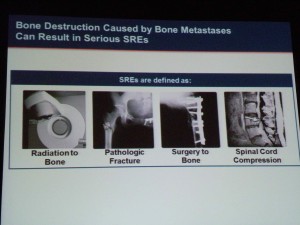
At the annual American Urological Association (AUA) meeting this week in Washington DC, Dr Matthew Smith from Mass General Hospital presented updated data from the phase III 147 trial comparing denosumab to placebo in managing skeletal related events (SREs) and bone metastases-free survival.   Skeletal complications are a major cause of prostate cancer morbidity.

The results were somewhat controversial, however, because while surrogate measures such as delaying time to SREs clearly show a benefit in favour of denosumab, no difference in overall survival was seen over placebo.

To find out whether these measures are clinically meaningful or not, I chatted with Dr Neal Shore, a urologist who is the Medical Director of the Carolina Urologic Research Center in Myrtle Beach, South Carolina as part of the ongoing Making a Difference series of interviews.

1 Comment

A little over ten years ago, I lost my Father to metastatic prostate cancer, a brave fight that lasted only a few years since he was diagnosed with stage IV disease.   In many ways though, it was a bittersweet moment because while it’s always heartbreaking to lose a parent, it was also a blessing that he was spared of any further pain.   In those days, the only bisphosphonates available in the UK were pamidronate (Aredia) and the awful clodronate.   The urologist managing my Father had no clue about either, so he suffered in silence instead.

I tell this story because, while difficult to discuss, sometimes we forget the importance of supportive care and pain management in improving the quality of life for patients with advanced cancer.

Based on my family’s experience, I can tell you that it makes a huge difference, not just to the patient, but also for other family members.   There is nothing more distressing to see someone in considerable pain from bone destruction and the doctors not doing anything about it because ‘it’s normal for the condition’ or they are considered ‘too old over 65’.   In the end, I suspect many give up the fight because the pain becomes unbearable.

Since my Father’s passing, clinical advances in managing skeletal related events (SREs) and bone pain have thankfully moved on with the approval of another more potent bisphosphonate, zoledronic acid (Zometa) and a RANK-L inhibitor, denosumab (Xgeva). Both of these therapies increase the time to SREs associated with metastases compared to placebo, but what about bone metastases and survival – do they make any difference?

New clinical data now available

This morning at the AUA annual meeting, data was presented by Dr Matthew Smith (Mass General) on the much awaited update on the 147 phase III trial in the late breaking plenary session.   The study compared denosumab (120 mg subcutaneously taken monthly) to placebo.

Overall, in terms of efficacy, denosumab significantly:

– Increased bone metastasis-free survival by a median of 4.2 months compared with placebo ie 29.5 and 25.2 months, respectively (hazard ratio [HR] 0.85; 95% CI: 0.73, 0.98; P=0.028; risk reduction of 15%)

– Delayed time to first bone metastasis compared with placebo (HR 0.84; 95% CI: 0.71, 0.98; P=0.032; risk reduction of 16%)

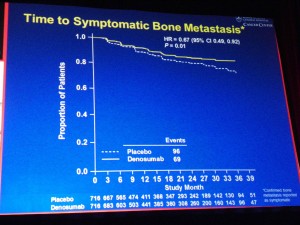
– Delayed time to symptomatic bone metastasis (HR 0.67; 95% CI: 0.49, 0.92; P=0.01).

However, it wasn’t all good news on the efficacy front though.

Median overall survival was similar between groups (HR 1.01; 95% CI: 0.85, 1.20; P=0.91).

In other words, patients did not live longer when given denosumab therapy compared to placebo.


Comparison of side effects

Overall, rates of adverse events (AEs) and serious AEs were generally similar between groups, with two exceptions, namely:

– Yearly cumulative incidence of osteonecrosis of jaw was similar to rates previously reported for monthly denosumab 120 mg (year 1: 1.1%, year 2: 2.9%, year 3: 4.2%), although the overall cumulative rate was 4.6% (n=33).

– Hypocalcemia occurred in 1.7% (n=12) denosumab and 0.3% (n=2) placebo patients.

To put this in context, in the zoledronic acid versus placebo trial, both ONJ and hypocalcemia were lower than that seen in the denosumab study.  According to Medscape Reference, this is not a side effect to be trifled with, since it can cause stroke and cardiopulmonary effects:

“Depending on the cause, unrecognized or poorly treated hypocalcemic emergencies can lead to significant morbidity or death.”

Clearly, some of the effects can be mitigated with calcium and vitamin D supplementation, although some patients, especially though with co-morbidities, may be challenging with adherence and compliance.

A critical question is are surrogate measurements clinically meaningful?

Dr Oliver Sartor raised this issue recently in a Nature publication, essentially challenging whether SRE was clinically meaningful or not, and arguing that better measurements would be a reduction in pain or improvement in the patient’s quality life when considering whether a therapy had an impact or not.

You can find out more about Dr Sartor’s insights in a recent blog post my colleague, Pieter Droppert, posted on Biotech Strategy Blog in the run-up to the AUA meeting.

In order to get to the bottom of this dilemma, I interviewed Dr Neal Shore, a urologist at the Carolina Urologic Research Center, and asked him what he thought of the significance of the data:

“This is a huge milestone in our understanding of the bone microenvironment”

On managing the adverse events versus the improved time to bone-free metastasis, Dr Shore replied,

“I think the risk benefit of preventing a skeletal metastasis versus the small, but albeit statistically real risk of ONJ, far outweighs that risk.”

The interview with Dr Shore will post tomorrow morning as a podcast as part of the Ongoing Making a Difference series – do check back to hear his insights on the 147 trial.

References:

ResearchBlogging.orgSartor, O. (2011). Denosumab in bone-metastatic prostate cancer: known effects on skeletal-related events but unknown effects on quality of life Asian Journal of Andrology DOI: 10.1038/aja.2011.33

7 Comments

After attending numerous basic research and clinical updates at the American Urologic Association (AUA) annual meeting in Washington DC, it is clear that the new and emerging therapies are not going to stop at the three grand crus from 2010.

Recently, abiraterone acetate (Zytiga) was approved, but there are a number of critical issues that need to considered, including:

  1. Sequencing
  2. Combinations
  3. Cost
  4. Patient selection

As we learn more about the molecular mechanisms behind resistance to androgen receptor signaling (up and downstream) and new targets emerge, so it may be possible to improve patient outcomes in castration-resitant prostate cancer.

Here’s a short video update of what I thought was interesting here at the conference:

3 Comments

In this week’s Nature, my eye was drawn to a Letter from Tan et al., (2011) discussing how inflammatory mechanisms influence tumorigenesis and metastatic progression, even in tumours that seemingly don’t involve pre-existing inflammation or infection such as breast and prostate cancers.

In advanced prostate cancer, metastasis is sadly inevitable.   So far as we know, lymphocytes infiltrate the tumour, causing upregulation of nuclear factor-KappaB (RANK) ligand (RANKL) and lymphotoxin (see Luo et al., 2007).

RANK signalling controls osteoclastogenesis and bone resorption and targeting it with denosumab has been shown to reduce the incidence of skeletal related events (SRE) but not overall survival in prostate cancer (see Fizzazi et al., 2011):
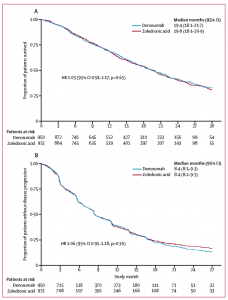
Overall Survival is similar in the denosumab and zoledronic acid arms

and other advanced cancers, including multiple myeloma (see Henry et al., 2011).  Overall survival was again not improved compared with zoledronic acid, as you can hear from this short podcast or read the accompanying editorial in the JCO from Dr Jack West of Swedish on the topic, which was both fair minded and well written, discussing additional factors that need to be considered, including costs, something that is all too often swept under the carpet.

What is less well known, however, is the source of RANKL and it’s role in metastasis. Tan and colleagues therefore decided to take a closer look at this.

What did they do?

In their research, Tan et al., (2011) decided to evaluate whether RANKL, RANK and IKK-a (nuclear factor kinase-alpha) are involved in cancer metastasis.  IKK-a is a protein kinase needed for the self renewal of cancer progenitors.  The question is, how do all these relate?  They used various cell lines and models to explore the relationships.

The NF-kB pathway looks like this:
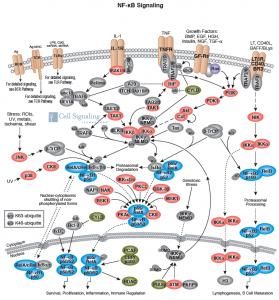
NF-kB signaling pathway

What did they find?

The results showed that RANK signalling in cancer cell lines overexpressing Erbb2 (HER2) was important for pulmonary metastasis.  This is also potentially relevant to breast cancer, since HER2 is frequently overexpressed in metastatic disease.

Using MT2 cells in Ragl-/- mamary glands, they looked at whether RANKL was involved in metastatic spread.  Most RANKL-producing T cells expressed forkhead box P3 (FOXP3), a transcriptional factor produced by T cells and were located next to stromal cells.

In all, the authors concluded that:

“Targeting RANKL-RANK can be used in conjunction with the therapeutic elimination of primary breast tumours to prevent recurrent metastatic disease.”

The challenge here though, is that while the preclinical models are very appealing in theory, in the clinic we must not forget that a significant reduction in SRE does not necessarily mean that patients live longer, as witnessed by the lack of OS benefit in the trials mentioned above.

References:

ResearchBlogging.orgTan, W., Zhang, W., Strasner, A., Grivennikov, S., Cheng, J., Hoffman, R., & Karin, M. (2011). Tumour-infiltrating regulatory T cells stimulate mammary cancer metastasis through RANKL–RANK signalling Nature, 470 (7335), 548-553 DOI: 10.1038/nature09707

Luo JL, Tan W, Ricono JM, Korchynskyi O, Zhang M, Gonias SL, Cheresh DA, & Karin M (2007). Nuclear cytokine-activated IKKalpha controls prostate cancer metastasis by repressing Maspin. Nature, 446 (7136), 690-4 PMID: 17377533

West, H. (2011). Denosumab for Prevention of Skeletal-Related Events in Patients With Bone Metastases From Solid Tumors: Incremental Benefit, Debatable Value Journal of Clinical Oncology DOI: 10.1200/JCO.2010.33.5596

Henry, D., Costa, L., Goldwasser, F., Hirsh, V., Hungria, V., Prausova, J., Scagliotti, G., Sleeboom, H., Spencer, A., Vadhan-Raj, S., von Moos, R., Willenbacher, W., Woll, P., Wang, J., Jiang, Q., Jun, S., Dansey, R., & Yeh, H. (2011). Randomized, Double-Blind Study of Denosumab Versus Zoledronic Acid in the Treatment of Bone Metastases in Patients With Advanced Cancer (Excluding Breast and Prostate Cancer) or Multiple Myeloma Journal of Clinical Oncology DOI: 10.1200/JCO.2010.31.3304

Fizazi K, Carducci M, Smith M, Damião R, Brown J, Karsh L, Milecki P, Shore N, Rader M, Wang H, Jiang Q, Tadros S, Dansey R, & Goessl C (2011). Denosumab versus zoledronic acid for treatment of bone metastases in men with castration-resistant prostate cancer: a randomised, double-blind study. Lancet PMID: 21353695
1 Comment

After hearing Amgen’s denosumab (Dmab) was approved late yesterday for skeletal related events (SRE) in the oncology solid tumour indications (but not multiple myeloma) and is now named Xgeva, I was tempted to write a Fun Friday post on how Pharma brand names make the mind boggle lately as you can see a few weird looking names have emerged this year alone.  Seriously, some of them look as though they’ve been hastily put together from Scrabble tiles sometimes, or represent words more usually associated with the old Soviet Eastern bloc countries, never mind figuring out how they ought to be pronounced!  {Update: this one is pronounced x-GEE-va not x-JAY-va as a European might think ;)}

According to the NY Times, the Wholesale price for Dmab in the oncology setting will be $1650 per month, making it around double the price of Zometa (Novartis).  Still, the good news for patients is that Amgen do have a patient assistance program for it and I understand from several sources that Amgen has a co-pay program that offers Xgeva to the patient with no co-pay the first month and only $25 afterwards.  There are apparently no income limits to participate, which if true, would be most unusual.  {Update: here is the link to actual details of the coupon program.}

At the NY Chemotherapy Foundation Symposium last week, several oncologists I spoke to said that a high price would be a significant barrier to use, so it would be reserved for those who do not respond or tolerate Zometa, or have poor renal function.  Urologists would probably be more interested in Xgeva, since Zometa is an infusion product and they tend to refer patients to the oncologist for this.  Xgeva, as a subcutaneous therapy, would therefore potentially be a more convenient option for urologists who have patients that progress to symptomatic metastatic prostate cancer.

The other interesting thing I noticed from the data presented on Dmab at the NY Chemotherapy Meeting, was that while time to SRE was significantly improved with Xgeva compared to Zometa, there was no difference in survival between either therapy, as measured by both progression-free survival (PFS) and overall survival (OS).  There is a risk that oncologists will look at that data and see no meaningful benefit in survival at twice the price for their cancer patients.  We’ll see what unfolds over the next few months, although the slow uptake of Prolia in the non-oncology setting does not portend well for Amgen.

Meanwhile, this week  I’m in the office working on client reports instead of having fun at cancer conferences such as the EORTC-AACR-NCI Molecular Targets meeting that is currently ongoing in Berlin 🙂

A couple of interesting stories in preclinical or early phase development have caught my eye from the meeting so far.

The BBC wrote about nanocarriers and brain cancers, based on some research in mice, for example.  We’ve previously covered nanotechnology at other AACR meetings (in pancreatic cancer), and this is probably one of my favourite disruptive technology concepts to emerge over the last twelve months.  It may be a while before something is actually approved for use in human cancer though.

Another interesting item was data on a new PARP inhibitor, MK-4827, from Merck.  I first posted on the science behind PARP inhibition way back in 2006, with quite a few subsequent posts on the clinical data since (you can find them all by using the Search widget on the right and typing PARP.   Three main compounds have already emerged with a growing body of clinical data, mainly in breast and ovarian cancers:

  1. Olaparib (KuDos/AstraZeneca)
  2. Iniparib (BiPar/Sanofi Aventis)
  3. Veliparib (Abbott)

We can now add the Merck compound to the growing list of PARP inhibitors with data in human trials from phase I and beyond.  According to the ECCO press release, the new data extends beyond breast and ovarian cancers:

“In a Phase I trial conducted at the H Lee Moffitt Cancer Center (Tampa Florida, USA), University of Wisconsin-Madison (Madison, USA) and the Royal Marsden Hospital (London, UK), MK-4827 was given to 59 patients (46 women, 13 men) with a range of solid tumours such as non-small cell lung cancer (NSCLC), prostate cancer, sarcoma, melanoma and breast and ovarian cancers.  Some patients had cancers caused by mutations in the BRCA1/2 genes, such as breast and ovarian cancer, but others had cancers that had arisen sporadically.”

These patients had metastatic, advanced disease, typically already received treatment with several other therapies and had experienced recurrence.  In this setting, response rates are expected to be low given the high tumour burden:

“The researchers saw anti-tumour responses in both sporadic and BRCA1/2 mutation-associated cancers.  Ten patients with breast and ovarian cancers had partial responses, with progression-free survival between 51-445 days, and seven of these patients are still responding to treatment.  Four patients (two with ovarian cancer and two with NSCLC) had stable disease for between 130-353 days.”

Of course, it’s still early days yet in a phase I trial, but it will be interesting to see how this new class of cancer agents evolves over the next couple of years.

Photo Credit: Amgen

2 Comments

Amgen’s recent announcement of phase III trial data showing that it’s monoclonal antibody, denosumab was superior to Novartis’ Zometa (zoledronic acid) for the treatment of breast cancer patients with bone mestastases is further news that scientifically driven drug development can yield exciting results.

Denosumab is in essence a targeted therapy like Gleevec, Avastin or Herceptin.  It’s development came about from basic research that discovered the cellular control of bone remodelling and regulation of bone density is reglated by the RANK Ligand pathway.

RANK Ligand is a TNF famly member, a protein that is expressed on the sufrace of marrow, stromal cells and osteoblasts (the cells responsible for bone formation). When RANK-L binds with its receptor RANK it stimulates the activity of osteoclasts (cells responsible for bone resorption).  In the body, RANK-L production is naturally regulated by the protein Osteoprotegerin (OPG), which binds with RANK-L thereby preventing it from binding to its receptor, RANK.  When there is insufficient OPG, or too much RANK-L produced, excess bone loss occurs.   This occurs in post-menopausal women or in cancer related bone loss.

Denosumab acts by attaching itself to RANK-L, thereby inhibiting its action. Deprived of RANK-L, osteoclasts cannot form, function or survive.  The result is less bone destruction and bone loss.  Understanding the RANK Ligand pathway has been a breakthrough step in understanding bone biology.

Many cancer patients end up with bone metastases that not only causes pain, but also bone destruction.  Roodman, in a 2004 New England Journal article, proposed the “vicious cycle” hypothesis to explain this: Tumor cells produce parathyroid hormone-related peptide (PTHrP), which stimulates osteoblasts to produce RANK ligand leading to less production (downregulation) of osteoprotegerin (OPG), thereby stimulating osteoclasts to resorb more bone.  At the same time, production of PTHrP promotes tumor growth directly.  Therefore, it should come as no surprise that denosumab would be effective in cancer patients with bone mets and skeletal related events.

What does the future hold for denosumab?  In the postmenopausal osteoporosis market, a once or twice yearly injection is extremely attractive given its ease of use. Compliance is a real issue with bisphosphates such as alendronate or risedronate where a daily pill must be taken.  Many primary care physicians are not set-up to administer an infusion, which is what Novartis’ once a year osteoporosis treatment, Reclast requires.

However, despite impressive clinical data, Amgen does not yet have a home run.  It lacks a large sales force and infrastructure to sell to primary care physicians. Also with generic fosamax (alendronate) available, the cost/benefit trade off is going to be a key factor in uptake.  The cost of denosumab will need to be carefully considered for Amgen to enter this competitive market.  The FDA advisory board meets on August 13 to discuss Amgen’s BLA application and consider whether to recommend approval for the treatment and prevention of osteoporosis, and treatment of bone loss in patients undergoing hormone ablation for prostrate and breast cancer.  Given the positive data from the phase III pivotal studies, a positive recommendation is expected with approval by the FDA expected in October.

For cancer patients, denosumab could become the gold-standard for treatment of bone metastases given its superiority over Novartis’ Zometa.  For oncologists, the fact that denosumab only requires an injection while Zometa requires an infusion is less of an issue.  The key to success for oncology drugs is based solely on the data. If the positive results continue, Amgen are likely to take market share from Zometa once approval for the treatment of bone metastases is obtained in 2010 or 2011.

So, my take on this is that denosumab is a real winner for Amgen.  Whether it will capture the market for postmenopausal osteoporosis remains to be seen, but it is an exciting new drug that will benefit cancer patients.  Further data on denosumab can be expected from the September meeting of the American Society of Bone and Mineral Research (ASBMR) in Denver.

Reblog this post [with Zemanta]
error: Content is protected !!