Pharma Strategy Blog

Commentary on Pharma & Biotech Oncology / Hematology New Product Development

Posts tagged ‘lung cancer’

One of the things that is both frustrating and fascinating is the development of resistance to therapies in cancer treatment.  By this, I mean clearly it’s not something we want to see from a patient or physician perspective and if possible, to delay it as long as feasible.  On the other hand, the mechanics behind the biology of drug resistance is a fertile field for curious scientists.

I never fail to feel a sense of awe when a group cracks open new mechanisms that improve our understanding of cancer.  It is, after all, a highly complex and fickle topic. I’ve often wondered why is it that some patients see resistance set in early and others do not? Why does resistance occur, period?

This morning my interest was piqued by a new paper published this month in Science Translational Medicine from William Pao’s group at Vanderbilt. They looked at the conundrum around EGFR inhibitors such as erlotinib, gefitinib and afatinib in non-small cell lung cancer (NSCLC) because patients treated with these drugs eventually develop acquired resistance to therapy and the cancer unfortunately starts growing again.  The big question are why and what?

“The most common mechanism of resistance is a second site mutation within exon 20 of EGFR (T790M), observed in ~50% of cases. This change leads to altered binding of the drug within the ATP pocket.”

In this elegant research, they looked at the behaviour in cell lines before and after the cells acquire resistance to targeted therapy:

“Because both drugs were developed to target wild-type EGFR, we hypothesized that current dosing schedules were not optimized for mutant EGFR or to prevent resistance.

To investigate this further, we developed isogenic TKI-sensitive and TKI-resistant pairs of cell lines that mimic the behavior of human tumors.”

What they found was really interesting

In simple terms, they noticed that NSCLC cells grow at different rates, which may possibly explain why some tumours become resistant to EGFR inhibitors faster than others.

What was surprising though, is that EGFR mutant (resistant) cells grew at a slower rate:

“On average, parental cells doubled ~1.22 times faster than T790M-containing resistant cells.”

It isn’t yet clear why this happens though.

In clinical practice, it has been noticed that patients with acquired resistance have re-responded to tyrosine kinase inhibitor (TKI) therapy after a drug holiday.  Chmielecki et al., found some evidence as to why this might happen, since they observed that:

“Lysates from parental cells and late-passage PC-9/BR–resistant cells treated with BIBW-2992 showed significantly reduced phosphorylation of EGFR and its downstream targets, extracellular signal–regulated kinase (ERK) and AKT, whereas lysates from resistant cells maintained in the presence of TKI and treated with the same concentrations of drug did not.”

Once the validity of the preclinical findings were established, they looked at evolutionary modelling to design optimal dosing strategies for the use of EGFR inhibitors in NSCLC. They incorporated PK data from clinical trials to ensure the drug doses proposed were feasible. The modelling appeared to be useful:

“This modeling predicted alternative therapeutic strategies that could prolong the clinical benefit of TKIs against EGFR-mutant NSCLCs by delaying the development of resistance.”

It is worth noting the strategy predicted by the model:

“We propose the use of high-dose pulsed once-weekly BIBW-2992 with daily low-dose erlotinib to delay the emergence of T790M-mediated resistance. PC-9 cells treated with this regimen required twice as long to develop resistance and did not show selection for T790M mutations.


In patients, the combination of two EGFR TKIs could lead to overlapping toxicities involving rash and diarrhea. Thus, in a phase IB dose-safety trial, we would recommend a more tolerable strategy, with lower doses of erlotinib still known to be effective against EGFR-mutant tumors (25 or 50 mg daily, orally).”

What’s also fascinating to me is that the overall study findings make sense for consideration when using other TKIs as well, since we know that GIST patients treated with imatinib can re-respond after a period of drug holiday (see Fumagalli et al., (2009).  Could different dosing strategies be adopted in some patients at a high risk of developing resistance based on the model approach?

It will be most interesting to see whether clinical trials in lung cancer with EGFR inhibitors evolve along the lines of those suggested by the researchers – that will be the ultimate proof of the pudding that resistance can be influenced in patients with NSCLC – until then, it’s a valuable hypothesis.

References:

ResearchBlogging.orgChmielecki, J., Foo, J., Oxnard, G., Hutchinson, K., Ohashi, K., Somwar, R., Wang, L., Amato, K., Arcila, M., Sos, M., Socci, N., Viale, A., de Stanchina, E., Ginsberg, M., Thomas, R., Kris, M., Inoue, A., Ladanyi, M., Miller, V., Michor, F., & Pao, W. (2011). Optimization of Dosing for EGFR-Mutant Non-Small Cell Lung Cancer with Evolutionary Cancer Modeling. Science Translational Medicine, 3 (90), 90-90 DOI: 10.1126/scitranslmed.3002356

E. Fumagalli, P. Coco, C. Morosi, P. Dileo, R. Bertulli, A. Gronchi, & P. G. Casali (2009). Rechallenge with imatinib in GIST patients resistant to second or third line therapy 15th Connective Tissue Oncology Society Meeting, Miami Beach, FL

3 Comments

Love this video from TEDxOverlake, where Dr Jack West (Swedish) describes what he is doing with his excellent forum and site, the Global Resource for Advancing Cancer Education (GRACE).  Currently, the main focus is on his specialty, Lung Cancer, but more tumour types are planned in the near future.

Jack talks about how physician led sites can actively and effectively reach out in a many-to-many fashion to improve education and learning, rather than in the traditional one-to-one fashion seen in a consultation.

He uses a great example of how a young patient with lung cancer was empowered to seek out better care for his condition and ended up in the crizotinib trial for ALK+ non-small cell lung cancer…

Check it out – it’s a compelling and very powerful story:

If you can’t see the video in your email subscription, you can find it here.


Disclosure: I’m an unpaid member of the GRACE Advisory Board (so of course, I will be biased 😉


“Current and former heavy smokers can now be screened more effectively for lung cancer. Results from the National Lung Screening Trial (NLST) revealed that detecting small lung cancers with computed tomography (CT) reduces lung cancer specific mortality by 20 percent.”

MD Anderson Cancer Center (MDACC) press release

Wow, how amazing is that?  Thanks to the MDACC Provost, Dr Ray DuBois for sharing it on Twitter and to Dr Jack West (Swedish) for Re-Tweeting it or I may well have missed it. The action is as a direct result of The National Lung Screening Trial (NLST), which was conducted to evaluate whether screening with low-dose CT scans could reduce mortality from lung cancer.

Yesterday, The National Lung Screening Trial Research Team published the results of a landmark study (see references below) that may well have a huge impact on cancer centres around the USA.  Here are the basic details of the study:

“Eligible participants were between 55 and 74 years of age at the time of randomization, had a history of cigarette smoking of at least 30 pack-years, and, if former smokers, had quit within the previous 15 years.

Persons who had previously received a diagnosis of lung cancer, had undergone chest CT within 18 months before enrollment, had hemoptysis, or had an unexplained weight loss of more than 6.8 kg (15 lb) in the preceding year were excluded.

A total of 53,454 persons were enrolled; 26,722 were randomly assigned to screening with low-dose CT and 26,732 to screening with chest radiography.”

Emphasis mine. That’s a huge epidemiology study that took place over two years of enrollment and 5 years of screening!

What did the results show?

Essentially, my understanding is that screening with the low-dose CT did indeed reduce mortality from lung cancer compared with radiography:

“In the NLST, a 20.0% decrease in mortality from lung cancer was observed in the low-dose CT group as compared with the radiography group.

The rate of positive results was higher with low-dose CT screening than with radiographic screening by a factor of more than 3, and low-dose CT screening was associated with a high rate of false positive results.”

Until only very recently, people with lung cancer were given radiography, tested for histology and categorised according to small cell or non-small cell, and then the latter in to squamous or non-squamous and then treatment (mostly with chemotherapy) decided from there on.

As MDACC noted:

“Prior to the trial, lung cancer, often diagnosed in the later stages of the disease, had shown no benefit from screening because screening with standard chest X-rays did not detect cancers early enough.”

We’ve come a very long way in five years.

These results now mean that with the advanced in low dose CT, we can now potentially detect lung cancer earlier, thereby improving their chances of better outcomes.  On the Global Resource for Advancing Cancer Education, GRACE, Dr Thomas Hensing (U. of Chicago) summarised it succinctly:

“As the first trial that shows lung cancer screening can save lives, the NLST will no doubt have a significant impact on how we practice in this country and should be viewed as a very hopeful result for lung cancer advocates.”

Curious as to what the impact might be at major cancer centres, I asked Dr West on Twitter whether Swedish would be doing screening following the response.  His response, I’m delighted to say, was enthusiastic:

“Yes, Swedish is very inclined to roll out screening program for current/ex-smokers.”

The results of this study, coupled with rapid implementation in many cancer centres, may have a huge impact on earlier detection, diagnosis and outcomes five years from now. That’s great news for patients and caregivers and gives hope to all.  In fact, it gives me goosebumps thinking about it!

Imagine if we can detect lung cancer earlier, that not only means a better chance of outcomes per se by dint of treating earlier disease, but add in what we now know about molecular aberrations in adenocarcinomas and squamous cell carcinomas as well, and things really start to snowball.  The overall impact may well be greater than we can imagine at present.

If you are interested in more information, MDACC put together a short video explaining the background and impact of the NLST study that is well worth checking out.

Disclosure: I’m an unpaid member of the GRACE advisory board.

References:

ResearchBlogging.orgThe National Lung Screening Trial Research Team (2011). Reduced Lung-Cancer Mortality with Low-Dose Computed Tomographic Screening New England Journal of Medicine DOI: 10.1056/NEJMoa1102873

1 Comment

In the final article on the lung cancer mini series this week, it’s time to discuss one of my least favourite topics – chemotherapy.

Regular readers will remember the guest post from Dr Al Lalani just prior to ASCO on the acronymania that pervaded the abstract book this year for various clinical trials.  I was therefore much amused to play ‘buzzword bingo’ at the meeting and see how many of his list I came across 😉

One trial in particular stood out in a session on lung cancer called PARAMOUNT.  Three years ago, I wrote about the FDA approval of pemetrexed (Alimta) in front line treatment of NSCLC in non squamous histology.

The new phase III data looked at whether it was safe and effective to continue pemetrexed as maintenance therapy after initial induction treatment with the pemetrexed plus cisplatin doublet for four cycles.  A total of 939 patients with advanced nonsquamous NSCLC were enrolled in the study.

Patients whose disease had not progressed during the induction, and had a good performance status of 0-1 (n=439), were randomized to receive either:

  1. Pemetrexed maintenance (500 mg/m2 on day one of a 21-day cycle) plus best supportive care (n=359) OR
  2. Placebo plus best supportive care (n=180) until disease progression.

All patients received vitamin B12, folic acid and dexamethasone. The main goal of the trial was to determine if progression-free survival (PFS) was improved by maintenance therapy with pemetrexed.

The final analysis demonstrated that the primary endpoint was met:

  1. Median PFS of 3.9 months (95% CI: 3.0-4.2) in the pemetrexed arm versus 2.6 months (95% CI: 2.2-2.9) in the placebo arm.
  2. In addition, disease control rate (% patients with response/stable disease) was 71.8% in the pemetrexed group and 59.6% in the placebo arm (P=0.009).

Toxicities were in line with those expected for pemetrexed based on previous studies, ie anemia, fatigue and neutropenia were all greater than placebo.  Discontinuations due to AEs were 5.3% with ALIMTA and 3.3% with placebo.

Overall, when considering the question of whether pemetrexed improves PFS as maintenance therapy for non-squamous NSCLC patients, it looks to be a safe and viable option, albeit with a small additional increase of 1.3 months in survival.


5 Comments

Continuing our mini series on molecular targets and lung cancer this week, today I’m going to focus on MET amplications for this post.

MET confers resistance to EGFR inhibitorsA few years ago, Jeffrey Engelman’s group at Mass General (see Reference section below) reported that MET amplication leads to resistance with EGFR inhibitors such as gefitinib (Iressa) by activating ERBB3 signalling:
“MET amplification was detected in 4 of 18 (22%) lung cancer specimens that had developed resistance to gefitinib or erlotinib. We find that amplification of MET causes gefitinib resistance by driving ERBB3 (HER3)–dependent activation of PI3K, a pathway thought to be specific to EGFR/ERBB family receptors.”

Others have shown similar results in non-small cell lung cancer (NSCLC) with erlotinib.

Subsequent to this, a number of MET inhibitors have entered the clinic looking at the impact of combining a MET inhibitor with erlotinib in adenocarcinomas that are EGFR mutation positive.

Two of the leading compounds in phase II/III development are described below:

  1. ARQ-197 (ArQule/Daiichi Sankyo) a small molecule inhibitor of c-MET
  2. METMab (Roche/Genentech) a monoclonal antibody to c-MET

ArQule currently has two phase III trials both in the refractory setting looking at non-squamous NSCLC in combination with erlotinib versus erlotinib alone – one is currently enrolling while the other will soon be open to recruitment.

Of course, there are other MET inhibitors in earlier development (eg crizotinib is a weak inhibitor of c-MET, but is being evaluated in ALK translocated NSCLC).

What was interesting at ESMO last September was the phase II data that was presented on both agents in the same session.  The ARQ-197 data grouped all the patients together as one group and showed a trend in favour of the combination arm vs erlotinib plus placebo (7.3 vs 3.6 months) in terms of time to new metastases.

Since then, the ArQule phase III trials have been set up and appear to be looking at:

“The status of the following biomarkers will be collected in this study: EGFR and KRAS mutation status prior to randomization, and MET status post randomization.”

I think that is a good approach, because the METMab data at that conference clearly showed that MET High and MET Low patients had very different outcomes, based on the limited phase II data I saw at ESMO.

Meanwhile, the final METMab phase II data was presented from the OAM4458g study at ASCO this month, with no major change from the interim data presented last Fall ie MET High patients appear to have superior responses with the combination than erlotinib monotherapy.  The results clearly illustrate the importance of accurate biomarker analysis in these types of studies because while some patients did well on the combination, others did not, some did worse and the unselected group overall showed no difference.

Which begs the all important question – which patients did well on METMab plus erlotinib?

Those who had high MET expression, confirming the theory that resistance can be attenuated, at least for a while, with a dual combination approach of MET plus EGFR inhibitors but only in a very select subgroup of patients.

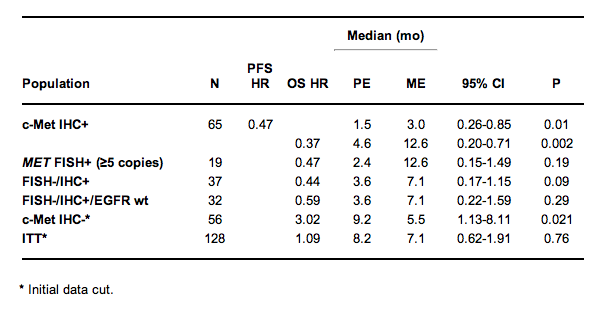
To illustrate this we can see that the addition of METMAb to erlotinib almost doubled the median time that those who were MET High (positive) were free of disease from 1.5 months to 2.9 months (HR 0.53; P=0.04) as you can see in the table from the ASCO abstract.  The combination also tripled median OS from 3.8 months to 12.6 months (HR 0.37; P=0.002):

Erlotinib +/- METMab in NSCLC at ASCO 2011

I would imagine that a phase III trial in NSCLC will evolve very soon and it will be most interesting to see how the design and patient selection criteria for the trial will evolve, based on the known findings to date.  These factors may determine whether a successful difference can be seen with the combination based on biomarkers to define a more homogenous group.

Interestingly, a phase II study is currently enrolling with METMab in triple negative breast cancer.  This is a complex three arms design looking at the impact of:

  • MetMAb + bevacizumab + paclitaxel
  • MetMAb + placebo + paclitaxel
  • Placebo + bevacizumab + paclitaxel

In theory, this should tell us whether eith METMab or bevacizumab have any advantage over paclitaxel chemotherapy.

What does the data with MET inhibitors mean?

The trials with both ARQ-197 and METMab teach us some important lessons in NSCLC:

  1. Catch-all studies of homogenous groups are a recipe for the dreaded words, “there was no significant difference in survival between the two groups”
  2. The importance of biomarkers in teasing out those most likely to respond
  3. The importance of careful patient selection in achieving those aims

When we think about this year’s ASCO conference theme of “Patients. Pathways. Progress,” we should be mindful of the fact that in order to match the therapy to the patient’s mutations, we need to continue to devise studies that seek to do exactly that – sometimes good drugs fail, not because they didn’t work, but because the relevant biomarker wasn’t found to illustrate which patients did respond.  When that happens, it’s a failure of R&D, not the drug itself.

Going back to the quote above from the Engelman et al., (2007) paper, I do wonder if MET plus erlotinib is the ideal combination in the relapsed/refractory setting with adenocarcinomas, even allowing for MET-High status?  Would a pan-EGFR inhibitor that also inhibits HER3 be a better partner with MET inhibitors than erlotinib in these patients?  Who knows, but hopefully someone will test that hypothesis out in a phase II trial at some point.

References:

ResearchBlogging.orgEngelman, J., Zejnullahu, K., Mitsudomi, T., Song, Y., Hyland, C., Park, J., Lindeman, N., Gale, C., Zhao, X., Christensen, J., Kosaka, T., Holmes, A., Rogers, A., Cappuzzo, F., Mok, T., Lee, C., Johnson, B., Cantley, L., & Janne, P. (2007). MET Amplification Leads to Gefitinib Resistance in Lung Cancer by Activating ERBB3 Signaling Science, 316 (5827), 1039-1043 DOI: 10.1126/science.1141478

2 Comments

Yesterday we discussed ELM4-ALK translocations associated with adenocarcinomas in non-small cell lung cancer (NSCLC).   Before ALK was identified, the main molecular target in this disease was EGFR mutations, which have been shown to be associated with improved responses when EGFR inhibitors such as erlotinib are given.

EGFR mutations

Although erlotinib is the EGFR inhibitor of choice in the US for patients with lung cancer who have EGFR mutations, unfortunately approx. 50% of them with development resistance as a new mutation evolves, known as T790M.  In addition, patients with EGFR mutant disease generally don’t respond well to erlotinib.

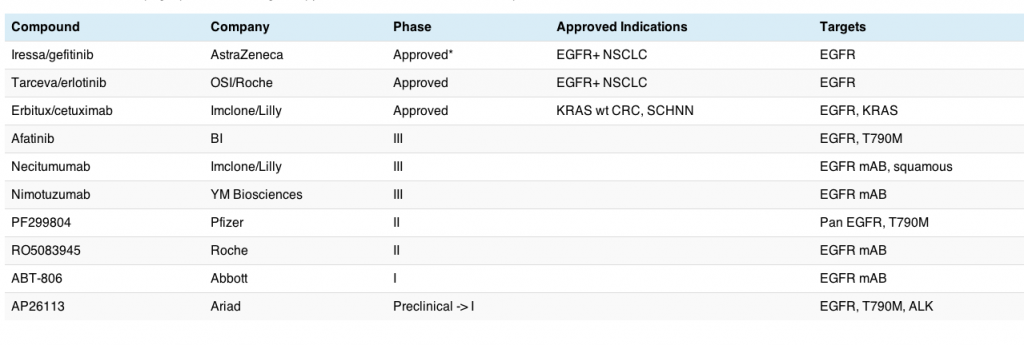
There are a number of EGFR inhibitors now in development for lung cancer, specially adenocarcinomas, and this market is rapidly getting fairly crowded, as the table shows:

EGFR Inhibitors

Note: *Although gefitinib was approved, there is very little use of this agent in the US since the FDA modified the PI to include mention of no overall survival benefit.

This table does not include all EGFR inhibitors in clinical development, since those focused on HER2+ breast and gastric cancers (trastuzumab, lapatinib, pertuzumab) and KRAS wt colorectal cancer (cetuximab and panitumumab) were excluded from this analysis. There are, no doubt, other EGFR inhibitors also being evaluated in lung cancer, but these are the main ones I’m following – it’s for illustrative purposes only!

What we can see here is that the EGFR market in lung cancer is getting pretty competitive in terms of clinical trials and is a much more mature market than the ALK one discussed yesterday, although only erlotinib is still currently available in the US for treatment of EGFR+ mutations.

Beyond that, there are at least three inhibitors in phase III trials alone:

  • Afatinib, which reported rather indifferent data in the LUX-LUNG1 trial at ESMO last September, with an improvement in response rate over placebo, but no advantage in overall survival, the primary endpoint of the trial.
  • Necitimumab, a monoclonal antibody being tested in squamous histology in combination with gemcitabine and cisplatin.
  • Nimotuzumab, another monoclonal antibody to EGFR, which is in phase III for oesophageal and H&N cancers, but currently enrolling in several phase II lung cancer trials at the moment.

Aside from the sheer awkwardness of trying to say either of the last two generic names and resorting, like many people to calling them Nessie and Nemo, I also have trouble remembering which one is which or my eyes glaze over!  The tongue twisters that are cropping up for a multitude of targeted therapies is more challenging than ever.  On top of that is the dreadful tendency of late to choose ugly brand names for cancer drugs that seem to have been purchased as a job lot from Eastern Europe brand agencies.

T790M confers resistance to erlotinib

We have known for a while that EGFR inhibitors do not work in all patients:

  • They are effective in wild type but not mutant EGFR
  • Some patients on EGFR therapy develop resistance due to a new mutation, T790M, appearing (see Hammerman et al., 2009).

There has been little progress in either of these two areas of late, although a multitude of clinical trials are now ongoing and we are awaiting data readouts.

Dr Jack West, Swedish

Dr Jack West, Swedish Cancer Institute

Dr Jack West from the Swedish Cancer Institute in Seattle blogged about his enthusiasm for the irreversible EGFR inhibitor, PF299804, in lung cancer last summer, based on the two small studies (one American and one Asian) that were reported at the time.  Another small Australian study on EGFR mutations and PF299804 was also presented at ASCO last year.

The Asian study looked promising enough at the time for Park et al., (2010) to conclude that the data from the Korean patients with KRAS wild-type NSCLC (adenocarcinoma histology) who were refractory to platinum-based chemotherapy and erlotinib (E) or gefitinib (G) that:

“Preliminary data consistent with Western trials show that in heavily treated Asian pts with NSCLC after E or G failure, PF299 is well tolerated and has antitumor activity without adversely impacting pts’ HRQOL. These results support the ongoing global P3 trial in pts with refractory NSCLC.”

KRAS mutations in NSCLC

I distinctly remember at ASCO in 2010 one of the three groups stated that a phase III trial (BR26) would be forthcoming in KRAS wt patients.  This trial is is now enrolling patients in the refractory setting after failure of erlotinib in both KRAS mutant and wild type patients, so we are unlikely to get a readout of this study before the end of 2012 at the earliest.

Dr Nathan Pennell, Taussig Cancer Center

Dr Nathan Pennell, Taussig Cancer Center

What was also interesting was another more recent post on GRACE by one of the faculty, Dr Nathan Pennell, discussing the combination of afatinib and cetuximab in EGFR+ lung cancer.

Like Dr Pennell, I would not have been enthusiastic about this potential combination after seeing the LUX-LUNG data presented by Dr Vincent Miller at ESMO last September, and knowing that cetuximab has shown weak activity in lung cancer at best, both alone and in combination with erlotinib.

However, as Dr Pennell described, the results with the afatinib plus cetuximab combination were much better than expected in erlotinib refractory lung cancer patients:

“The confirmed overall response rate in the first 45 evaluable NSCLC patients was 40%, with the response rate in the T790M patients being 50% unconfirmed (unconfirmed means they had not yet done a second set of scans to see if the tumor was still responding over 2 time points).”

Understandably, he was quietly excited by the outcome:

“This is the first time anyone has described activity for any targeted drug in the T790M EGFR population, and this provides the first glimmer of hope for the many patients out there who face the reality of knowing that their tumors are still dependent on EGFR mutations but for whom Tarceva simply doesn’t work anymore.”

This is most interesting, because while afatinib is a TKI that works similarly to erlotinib and gefitinib inside the cell on the EGFR ligand, cetuximab is a monoclonal antibody that works on the outside of the ligand, suggesting that targeting the ligand upstream and downstream may well be necessary to ensure complete EGFR inhibition in these patients ie EGFR, KRAS and T790M, we don’t know for sure, but now doubt a paper will be published soon explaining the scientific phenomenom.

The result is certainly a big surprise given the previous disappointing data for cetuximab combined with erlotinib (no responses out of 19 patients evaluated), so I’m not sure why afatinib is different given it is also a small molecule TKI.  Further large scale trials will needed to confirm these promising results.  A phase I trial with cetuximab and afatinib in NSCLC is currently enrolling patients.

For those interested, you can check out the simply stunning waterfall plot that Dr Pennell found for the combination of afatinib and cetuximab, with both EGFR+ and EGFR- patients responding.  I confess I nearly fell off my chair when I looked – the data is not what was expected at all!

Meanwhile, Pfizer also appear to be looking at PF299804 in HER2+ gastric cancer, which is logical given the activity previously demonstrated by trastuzumab.  There are over 20 studies with this pan-EGFR agent.  Although I’m sure I read somewhere that PF299804 specifically targets the T790M mutations that develop with erlotinib, it will be interesting to see what happens with wild-type and mutant subsets, since we know that erlotinib and gefitinib only work in wild type not mutant EGFR.  Another clinical trial is also enrolling patients with Pfizer’s pan-EGFR (PF299804) and MET inhibitor (crizotinib) in NSCLC.  More on c-MET inhibitors will follow in another post.

All that said, the rationale for targeting T790M mutations in erlotinib-refractory disease is fairly compelling in theory, but the trials will not be easy as there are several challenges that must be overcome:

  1. Design and implementation – patient and inhibitor selection will be crucial
  2. High risk, especially if the compound is a weak inhibitor
  3. Heavily pre-treated refractory patients tend to be sick with a higher tumour burden that is more resistant to therapy
  4. It is a small, difficult to treat subset
  5. Finding patients with good performance status who meet all the eligibility criteria is never easy in small refractory subset populations
  6. Would combinations be superior to single agent therapy or should sequencing be investigated?
  7. An upfront trial as a head to head with erlotinib would clearly be easier to execute, but also high risk if the agent is too similar

The more you look at the conundrum, the more one realises that addressing it is not as easy as it first looks.  Some basic research looking at sequencing versus combinations in cells lines and xenografts with different agents may be a useful starting point.

That said, the news last Friday that Ariad are advancing their dual EGFR-ALK inhibitor AP26113 into the clinic later this year is good news for patients with lung cancer, because more available options is always better than fewer.   It will be interesting to see how the drug fares in either ALK-refractory patients (refractory to crizotinib) or in EGFR mutations (refractory to erlotinib) as potential fast track to market strategies.

Conclusions

Overall, the landscape in lung cancer is rapidly changing as new molecular targets are being identified, along with new targeted therapies that specifically inhibit the driving cancerous activity.

EGFR mutations were the first major breakthrough in targeted therapies for lung cancer, but with the discovery of ALK translocations, T790M mutations, MET and FGFR1 ampliflication, and DDR2 mutations, we now have exciting opportunities to potentially match therapies to patients in across a range of different non-small cell lung cancer subsets in a new era of molecularly targeted and personalised therapy.

Beyond erlotinib, there is a clear high unmet medical need for new targeted therapies that specifically inhibit either the T790M mutation associated with resistance to initial therapy or will work in KRAS mutant EGFR lung cancers.  The afatinib + cetuximab combination in erlotinib refractory NSCLC looks very promising and I’m very much looking forward to watching all the new developments evolve in this area.

Disclosure: I am an unpaid member/volunteer of the GRACE Board.

References:

ResearchBlogging.orgHammerman PS, Jänne PA, & Johnson BE (2009). Resistance to Epidermal Growth Factor Receptor Tyrosine Kinase Inhibitors in Non-Small Cell Lung Cancer. Clinical Cancer Research, 15 (24), 7502-7509 PMID: 20008850

2 Comments

Last week’s post on FGFR1 mutations in squamous cell lung cancer and the new EGFR/ALK combination agent, AP26113 (Ariad) drew a lot of attention from readers, with many writing in for more details or correctly suggesting an update in squamous cell carcinoma was long overdue.

Oddly, there wasn’t much in the way of new or exciting data in lung cancer at the recent American Society of Clinical Oncology (ASCO), but there are some recent developments that are worth looking at in EGFR, ALK+ and squamous cell carcinoma.

Let’s take a look at each in turn over a series of blog posts.

In the old days, lung cancer was first divided into Small Cell Carcinoma (SCC) and Non-Small Cell Lung Carcinoma (NSCLC), which have a broad split of about 20:80.  As we learned more about the disease, NSCLC was eventually divided further in squamous and non-squamous histology, as therapies such as pemetrexed (non-squamous) and bevacizumab (non-squamous) emerged.

Erlotinib was found to work best in adenocarcinomas, ie EGFR mutation-positive tumours.  As far as I know, there are no approved targeted therapies for the treatment of squamous histology and much of the focus has been in mutations associated with adenocarcinomas, which mostly (but not always) tend to be associated with non-smokers.

ELM4-ALK translocations

Within adenocarcinomas, we are learning that EGFR isn’t the only mutation that might be a potential target, as the recent data in crizotinib published in the NEJM by Kwak et al., (2010) on ELM4-ALK translocations has shown.

For those of you interested in the development of the ALK translocations in lung cancer, Dr Ross Camidge also provided an excellent overview when we interviewed him on Pharma Stratgy Blog last year.  It’s worth checking out if you missed it, and has become one of our most popular posts since last October.

Dr Jack West from GRACE has diligently curated a huge volume of posts, interviews and webcasts on lung cancer, including this nifty chart showing the currently identified mutations in adenocarcinomas:

Mutations in lung cancer

Source: GRACE

Of course, as luck would have it, EGFR mutations and ALK translocations tend to be mutually exclusive, so there would probably be little benefit in combining agents that target EGFR or ALK mutations, even in adenocarcinomas.

Crizotinib, the first ALK inhibitor to successfully make it past phase II trials, has already been filed by Pfizer for approval with the FDA and should provide a new option for lung cancer patients with this translocation very soon.  This is an exciting development because oncologists will be able to order a FISH test using the companion diagnostic developed by Abbott (also submitted to the FDA) to determine if their patients will be suitable for crizotinib therapy.

Although crizotinib was originally developed as a c-MET inhibitor, its activity there was very weak (the Roche and ArQule compounds, MET-Mab and ARQ197 respectively, are much more potent and continue to look promising in phase II trials), the discovery of the ALK translocation changed the clinical development plan dramatically and for the better.

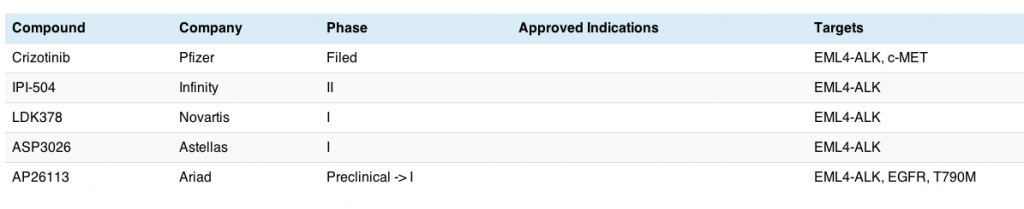
Unsurprisingly, there aren’t too many ALK inhibitors in development to date, with crizotinib being the lead compound:

ALK Inhibitors

This is a small, but rapidly growing niche; already we can see that compounds are emerging into the clinic hot on crizotinib’s heels.  The Infinity compound is a little different – it’s a heat shock protein (Hsp), while both the Novartis and Astellas agents are small molecule TKIs.  As far as I know, there isn’t a monoclonal antibody or antibody drug conjugate in the clinic for this particular target yet.

Like crizotinib, AP26113 is also a small molecule TKI, but differs in that it appears to be a dual inhibitor of ALK and EGFR, including the T790M mutation that has been shown to confer resistance to EGFR inhibitors such as erlotinib in adenocarcinomas (see Hammerman et al., 2009).

Conclusions

The time between the discovery of the ELM4-ALK translocation in adenocarcinomas and moving crizotinib into clinical trials was pretty rapid, and a tribute to Pfizer’s scientists and clinicians who made that happen so expeditiously.  It will be interesting to how this niche develops once FDA approval has occurred, and whether the other inhibitors in development will be merely ‘me-too’ agents or able to raise the bar beyond crizotinib in terms of efficacy, safety or overcoming resistance due to the structure forming a different binding shape in the kinase domain.  Time will tell.

Disclosure: I am an unpaid member/volunteer of the GRACE Board.

{UPDATE: Thanks to Luke Timmerman of Xconomy tweeting about Tesaro, I noticed they now have a deal as of March with Amgen for unnamed ALK inhibitors in their pipeline.}


References:

ResearchBlogging.orgKwak EL, Bang YJ, Camidge DR, Shaw AT, Solomon B, Maki RG, Ou SH, Dezube BJ, Jänne PA, Costa DB, Varella-Garcia M, Kim WH, Lynch TJ, Fidias P, Stubbs H, Engelman JA, Sequist LV, Tan W, Gandhi L, Mino-Kenudson M, Wei GC, Shreeve SM, Ratain MJ, Settleman J, Christensen JG, Haber DA, Wilner K, Salgia R, Shapiro GI, Clark JW, & Iafrate AJ (2010). Anaplastic lymphoma kinase inhibition in non-small-cell lung cancer. The New England Journal of Medicine, 363 (18), 1693-703 PMID: 20979469

8 Comments

One of the highlights of the recent American Association for Cancer Research annual meeting was a plenary session updating the results of the ongoing BATTLE trial at MD Anderson in non-small cell lung cancer (NSCLC).

The more scientific readers will want to check out the academic paper and commentaries published in Cancer Discovery, (see below) or listen to the complimentary AACR webcast of the plenary talk including Dr Hong’s Reverse Migration Strategy, but I realised that not everyone is familiar with, or understands the background, to this ground breaking study.

It therefore seems a great opportunity to use Storify to collate resources and snippets from social media sources to create a story around the events that have happened over the last year…


References:

ResearchBlogging.orgKim, E., Herbst, R., Wistuba, I., Lee, J., Blumenschein, G., Tsao, A., Stewart, D., Hicks, M., Erasmus, J., Gupta, S., Alden, C., Liu, S., Tang, X., Khuri, F., Tran, H., Johnson, B., Heymach, J., Mao, L., Fossella, F., Kies, M., Papadimitrakopoulou, V., Davis, S., Lippman, S., & Hong, W. (2011). The BATTLE Trial: Personalizing Therapy for Lung Cancer Cancer Discovery DOI: 10.1158/2159-8274.CD-10-0010

Sequist, L., Muzikansky, A., & Engelman, J. (2011). A New BATTLE in the Evolving War on Cancer Cancer Discovery DOI: 10.1158/2159-8274.CD-11-0044

Rubin, E., Anderson, K., & Gause, C. (2011). The BATTLE Trial: A Bold Step toward Improving the Efficiency of Biomarker-Based Drug Development Cancer Discovery DOI: 10.1158/2159-8274.CD-11-0036

1 Comment

I’m on a lung cancer and systems biology roll at the moment, although partly that’s just how the interesting data rolls in the literature.

Here’s some new food for thought.  A group of respectable scientists published some fascinating data in PLOS Medicine (free article see reference below) entitled, “Nuclear Receptor Expression Defines a Set of Prognostic Biomarkers for Lung Cancer.”

Using PCR, they evaluated NR expression patterns associated with good and poor outcomes in patients with non-small cell lung cancer (NSCLC) and then validated the findings in lung adenocarcinomas (n=550) and squamous cell carcinoma (n=130) samples in three different analyses by comparing normal and lung cancer cells.  Two important factors emerged from the analysis:

“The prognostic signature in tumors could be distilled to expression of two nuclear receptors, short heterodimer partner (SHP) and progesterone receptor, as single gene predictors of NSCLC patient survival time, including for patients with stage I disease.”

The SHP protein was the better predictor of outcomes in patients with stage I disease; those with strong SHP expression had better overall survival rates of approx. 70% at 100 months compared with 45% among people with low SHP expression.  The survival curves in the paper were quite dramatic – check them out.  Interestingly, the same signatures were also predictive of recurrence based on normal tissue samples from the patients with NSCLC.  Progesterone receptor expression was, however, a much weaker predictor of any outcome based on this analysis.

Essentially, this means the study demonstrated:

“NR expression is strongly associated with clinical outcomes for patients with lung cancer, and this expression profile provides a unique prognostic signature for lung cancer patient survival time, particularly for those with early stage disease.”

What are nuclear receptors, you may be wondering?

“The NR superfamily contains 48 transcription factors (proteins that control the expression of other genes) that respond to several hormones and to diet-derived fats.  NRs control many biological processes and are targets for several successful drugs, including some used to treat cancer.”

Still, it’s not something that immediately springs to mind as a possible or logical prognostic biomarker.

That said, out of the 48 transcription factors, two were found to be related to poorer patient outcomes.  They were NGFIB3, a receptor associated with nerve growth factor, and NR3C2, a mineralocorticoid receptor protein:

“This study highlights the potential use of Nuclear Receptors (NRs) as a rational set of therapeutically tractable genes as theragnostic biomarkers, and specifically identifies short heterodimer partner and progesterone receptor in tumors, and NGFIB3 and MR in non-neoplastic lung epithelium, for future detailed translational study in lung cancer.”

Going forward, we still need to see more research to find out whether these particular NRs or others were involved with tumour development and growth.  If  they do, then NR’s may potentially offer new therapeutic targets for future research and development.

References:

ResearchBlogging.org Jeong, Y., Xie, Y., Xiao, G., Behrens, C., Girard, L., Wistuba, I., Minna, J., & Mangelsdorf, D. (2010). Nuclear Receptor Expression Defines a Set of Prognostic Biomarkers for Lung Cancer PLoS Medicine, 7 (12) DOI: 10.1371/journal.pmed.1000378


Here’s an interesting paper in a new journal I recently signed up for, Science and Translational Medicine.  The journal provides little snapshots of how research can potentially be applied to real life disease.  Here’s a snippet from this particular abstract:

“Lung cancer remains one of the leading causes of cancer-related death in developed countries. Although lung adenocarcinomas with EGFR mutations or EML4-ALK fusions respond to treatment by epidermal growth factor receptor (EGFR) and anaplastic lymphoma kinase (ALK) inhibition, respectively, squamous cell lung cancer currently lacks therapeutically exploitable genetic alterations.

We conducted a systematic search in a set of 232 lung cancer specimens for genetic alterations that were therapeutically amenable and then performed high-resolution gene copy number analyses.

We identified frequent and focal fibroblast growth factor receptor 1 (FGFR1) amplification in squamous cell lung cancer (n = 155), but not in other lung cancer subtypes, and, by fluorescence in situ hybridization, confirmed the presence of FGFR1 amplifications in an independent cohort of squamous cell lung cancer samples (22% of cases).”

Now, squamous cell histology tends to be more associated with smokers than non-smokers and chemotherapy has pretty much been the bedrock of treatment for this group, although it should be noted that in general, currently available therapies either have weak activity or are specifically contraindicated, as in the case of bevacizumab.

Compare this with non-squamous histology, particularly adenocarcinomas, where new molecular targeted therapies have begun to evolve that have extended life and the population tends towards more non-smokers.

Essentially, this is almost like treating two different diseases based on the underlying biology, but this is the first time I’ve seen a potential molecular target reported to be associated with squamous cell histology.

The researchers expanded on their finding that FGFR1 may be a useful target in squamous cell lung cancer by taking an FGFR inhibitor (PD173074) and testing it in an appropriate lung cancer model to see what happened:

“The compound inhibited growth and induced apoptosis specifically in those lung cancer cells carrying amplified FGFR1.”

Next, they looked at an in vivo model with the same FGFR inhibitor and found that it induced tumour shrinkage, which is very promising.

Meanwhile, I did a search in the literature and found a research paper from Pardo et al., who looked at the effects of the same FGFR inhibitor in small-cell lung cancer (SCLC), which accounts for approx. 15% of lung cancers, and is more commonly associated with smoking than non-smoking.  In this disease, many patients are chemo-sensitive, but tend to relapse as resistance sets in.  Pardo’s group found that the FGFRi potentiated the effects of cisplatin, the most commonly used chemotherapy in SCLC.

They also found something else of note:

“More dramatically, in H-69 xenografts, PD173074 induced complete responses lasting >6 months in 50% of mice. These effects were not a consequence of disrupted tumor vasculature but instead correlated with increased apoptosis (caspase 3 and cytokeratin 18 cleavage) in excised tumors.”

Overall, it will be interesting to see what happens with FGFR inhibitors in the clinic going forward.  There are a number in development already, including the following:

  • TKI258 (dovitinib), Novartis
  • AP24534 (ponatinib)
  • AZD4547 (AstraZeneca)
  • FP-1039 (Five Prime)
  • XL999 (Exelixis/GSK) – may have been discontinued

Of note, some of these agents are multi-kinase inhibitors and target other kinases as well, some inhibit FGFR 1 or 2 or 3 and some inhibit FGFR1, 2 and 3, so it will be interesting to see how these shake out.  Advanced solid tumours, leukemia and breast cancer appear to be a common target, but few, if any are considering lung cancer (either squamous NSCLC or SCLC) as a possibility as far as I can see.

ResearchBlogging.org Weiss, J., Sos, M., Seidel, D., Peifer, M., Zander, T., Heuckmann, J., Ullrich, R., Menon, R., Maier, S., Soltermann, A., Moch, H., Wagener, P., Fischer, F., Heynck, S., Koker, M., Schottle, J., Leenders, F., Gabler, F., Dabow, I., Querings, S., Heukamp, L., Balke-Want, H., Ansen, S., Rauh, D., Baessmann, I., Altmuller, J., Wainer, Z., Conron, M., Wright, G., Russell, P., Solomon, B., Brambilla, E., Brambilla, C., Lorimier, P., Sollberg, S., Brustugun, O., Engel-Riedel, W., Ludwig, C., Petersen, I., Sanger, J., Clement, J., Groen, H., Timens, W., Sietsma, H., Thunnissen, E., Smit, E., Heideman, D., Cappuzzo, F., Ligorio, C., Damiani, S., Hallek, M., Beroukhim, R., Pao, W., Klebl, B., Baumann, M., Buettner, R., Ernestus, K., Stoelben, E., Wolf, J., Nurnberg, P., Perner, S., & Thomas, R. (2010). Frequent and Focal FGFR1 Amplification Associates with Therapeutically Tractable FGFR1 Dependency in Squamous Cell Lung Cancer Science Translational Medicine, 2 (62), 62-62 DOI: 10.1126/scitranslmed.3001451

Pardo, O., Latigo, J., Jeffery, R., Nye, E., Poulsom, R., Spencer-Dene, B., Lemoine, N., Stamp, G., Aboagye, E., & Seckl, M. (2009). The Fibroblast Growth Factor Receptor Inhibitor PD173074 Blocks Small Cell Lung Cancer Growth In vitro and In vivo Cancer Research, 69 (22), 8645-8651 DOI: 10.1158/0008-5472.CAN-09-1576

2 Comments
error: Content is protected !!