Pharma Strategy Blog

Commentary on Pharma & Biotech Oncology / Hematology New Product Development

Posts from the ‘Neurology’ category

One of the hallmarks of cancer is that even within different tumour types, there is an enormous degree of heterogeneity. Ultimately, in simple terms this means that individual patients will respond to different therapies depending upon their underlying biology.   The challenge, therefore, is defining and categorising the subtypes and working out which are the passenger and driver oncogenes, since the latter will cause aberrant tumour growth and survival, while the former may result as a consequence of changing pathway activity.

This morning I was researching gliomas and came across this old paper (March 2006) that looks at molecular subtypes of gliomas i.e. glioblastomas and astrocytomas.  The article concluded:

“Recent evidence suggests that gliomas may arise from a cell type with neural stem cell-like properties. The current work demonstrates that prognostic subtypes of glioma resemble key stages in neurogenesis and implicates signaling pathways that play critical roles in regulation of forebrain neurogenesis in control of tumor aggressiveness. Longitudinal analysis of glioma cases reveals a frequent pattern of disease progression into the mesenchymal phenotype, a state associated with robust angiogenesis.

This work suggests that molecular classification of glioblastoma may predict response to targeted therapies and suggests that greater understanding of neurogenesis in the adult forebrain may yield novel therapeutic insights for glial malignancies.”

The reason I was curious about this particular paper was because following the AACR Special Conference on PI3K and mTOR that I attended last week, it made sense to look at the literature on mTOR, PI3K and AKT in more detail.

In the glioma research, it was interesting to see what predicted poor prognosis:

“A robust two-gene prognostic model utilizing PTEN and DLL3 expression suggests that Akt and Notch signaling are hallmarks of poor prognosis versus better prognosis gliomas, respectively.”

Now, while Akt and Notch signalling may be important, it doesn’t mean that they make idea targets for drug therapy.  PTEN loss of function is also a difficult target at present and it isn’t clear if it is a driver per se.  What was very clear at AACR last week was that for every action there is an equal and opposite reaction, meaning that targeting one part of a pathway may lead to switching of aberrant activity to another part of the pathway as it adapts to the changing environment.

Neal Rosen from MSKCC gave perhaps one of the best talks of the AACR meeting. He succinctly and simply put out a few constructs based on what we know so far. I will summarise some of the talks in a conference report (sign up on the top right column), but what was relevant to the paper on gliomas is that while at first sight it might make sense to target Akt, that strategy will have consequences.

According to Rosen, in general, inhibiting PI3K also stimulates HER3 expression and phosphorylation, as well as other receptor tyrosine kinases in many cell lines.  In other words, we may need a multi-targeting approach based on the original aberrant driver, the adaptive pathway and the ligand driving activity.

Double and triple combinations make sense from a scientific perspective, but they will also incur far higher costs and more complex clinical trial designs. Who knows whether other adaptive mechanisms will also evolve as a result of pursuing that strategy?  It brings vividly to mind Frank McCormick’s wac-a-mole approach that he described last year at AACR on the challenges of targeting the PI3K pathway in general, irrespective of upstream or downstream targets.

Progress is slowly being made, but we have a long way to go yet with the PI3K-mTOR pathway, although I’m hopeful of some positive progress soon. Certainly there will be some new data emerging on the biology at AACR in April and clinical data at ASCO in June.

References:

ResearchBlogging.orgPhillips, H., Kharbanda, S., Chen, R., Forrest, W., Soriano, R., Wu, T., Misra, A., Nigro, J., Colman, H., & Soroceanu, L. (2006). Molecular subclasses of high-grade glioma predict prognosis, delineate a pattern of disease progression, and resemble stages in neurogenesis Cancer Cell, 9 (3), 157-173 DOI: 10.1016/j.ccr.2006.02.019

It’s not often that having multiple allergies is a good thing, but that certainly seems to be the case if a recent study published in Cancer, Epidemiology, Biomarkers and Prevention is accurate.  I was tempted to create a new category for ‘wacky findings’ but managed to resist the temptation, at least for now.

Study Details

Self-reported data on medically diagnosed allergies and antihistamine use for patients with glioma (n=419) and cancer-free patients (n=692) was studied by researchers at the University of Chicago.  The controls had no prior history of brain tumours or any other cancers, and did not have a history of neurodegenerative disease.

Respondents completed a web-based or telephone survey and were asked if they were medically diagnosed with allergies or asthma at least two years prior to the survey, and if so, the age of diagnosis.   In addition, they were also asked to indicate the number of individual allergies within each of the following categories:

  • Seasonal
  • Pets
  • Medications
  • Food
  • Others

Details on regular medication usage two years or more prior to the survey, and information on specific medication brands, frequency and duration of usage were also collected.

What did they find?

In short:

  1. Allergies appeared to be protective, providing a reduced risk for those with who have a higher number and more types of allergies.
  2. Age of allergy diagnosis and years since diagnosis were not associated with glioma risk.
  3. Antihistamine use, including diphenhydramine hydrochloride (a possible neurocarcinogen), did not appear to affect glioma risk separately from the effects of allergies.

In essence, the study suggests that there is a relationship between the immune system of allergy sufferers and glioma risk.

However, if you look at the literature, the answer is not as clear cut as the researchers themselves point out:

“Allergies and/or atopic disease, on the other hand, have been associated with a significantly decreased risk of glioma in many, but not all, studies.  The decreased risk associated with glioma has been hypothesized to be the result of an increase in immune surveillance related to atopic disease; this hyperactive immune surveillance may limit abnormal cell growth. However, the specific mechanism through which atopic disease may influence glioma risk has not been identified and noncausal associations with glioma risk have not been ruled out.”

They also went on to suggest that:

“A comprehensive study of allergies and antihistamine use using standardized questions and biological markers will be essential to further delineate the biological mechanism that may be involved in brain tumor development.”

To circle back to the original question…

Many of you will be very aware that discovering a relationship occurs between two variables does not imply causality, so until the mechanism of action for this phenomenon is delineated one way or the other, I would treat the results with a rather large pinch of salt.

References:

ResearchBlogging.orgMcCarthy, B., Rankin, K., Il’yasova, D., Erdal, S., Vick, N., Ali-Osman, F., Bigner, D., & Davis, F. (2011). Assessment of Type of Allergy and Antihistamine Use in the Development of Glioma Cancer Epidemiology Biomarkers & Prevention, 20 (2), 370-378 DOI: 10.1158/1055-9965.EPI-10-0948

2 Comments

Following on from yesterday’s post about FDA approvals, here’s another short Nature Reviews Drug Discovery synopsis, this time on Phase III drug submissions and failures trends between 2007 and 2010.

This caught my eye:

“The Centre for Medicines Research International has noted that the average for the combined success rate at Phase III and submission has fallen to ~50% in recent years.”

Ouch.  Bold highlight mine.

The overall picture looks like this, based on n=83 submission failures:

Source: Nature Reviews Drug Discovery

I was astonished to see that oncology contributes over a quarter of the filings, but much less surprised that lack of efficacy was the reason of the failure:

“Of the drugs that failed to show an improvement in efficacy as an add-on therapy, 58% were anticancer drugs, and of those that failed to show an improvement in efficacy versus placebo, 33% were nervous system drugs.”

The author suggested that perhaps the challenging environment has led to unwise or hasty filings:

“… but is perhaps also a result of the pressure on companies to replenish pipelines with drugs that have high potential for approval and reimbursement, particularly in a period during which patent expiries for major products are threatening future revenues.

Owing to this urgency, it seems that companies have progressed drugs into Phase III trials even though they only displayed marginal statistically significant efficacy in Phase II proof-of-concept studies; consequently, these drugs carry a greater than average risk of failure.”

Sometimes that may well be true, but quite frankly, cancer trials are a bit of a crapshoot at the best of times so I’m not sure I agree with the sweeping perspective.

Promising phase II data can often lead to spectacular and unexpected phase III flops as sanofi-aventis discovered with their PARP inhibitor, iniparib, in triple negative breast cancer only last week.   The phase II data was hardly marginal and was worthy of publication in the New England Journal of Medicine.

In the long run though, we learn more from failures than successes, so that others following in the wake can improve on the trial design and combination therapies used. Still, that’s not much comfort for those who blazed the path initially.

References:

ResearchBlogging.orgArrowsmith, J. (2011). Trial watch: Phase III and submission failures: 2007–2010 Nature Reviews Drug Discovery, 10 (2), 87-87 DOI: 10.1038/nrd3375

One of the nice things about 800 posts is that it becomes a useful database of cancer meetings, clinical papers and general observations.  Sometimes, I remember snippets of things covered at meetings from a year or two ago and find it helpful for jogging my memory about the data or any implications that may have emerged.

The challenge though, has been finding a way to search those posts and find relevant information rather than an unhelpful zero on the return string.

Lijit search worked beautifully on the old host but did not settle down well on the new one, so we tried several others with mixed results.  It drove me potty that searching for scientific terms was so tricky, especially with dashes in words.

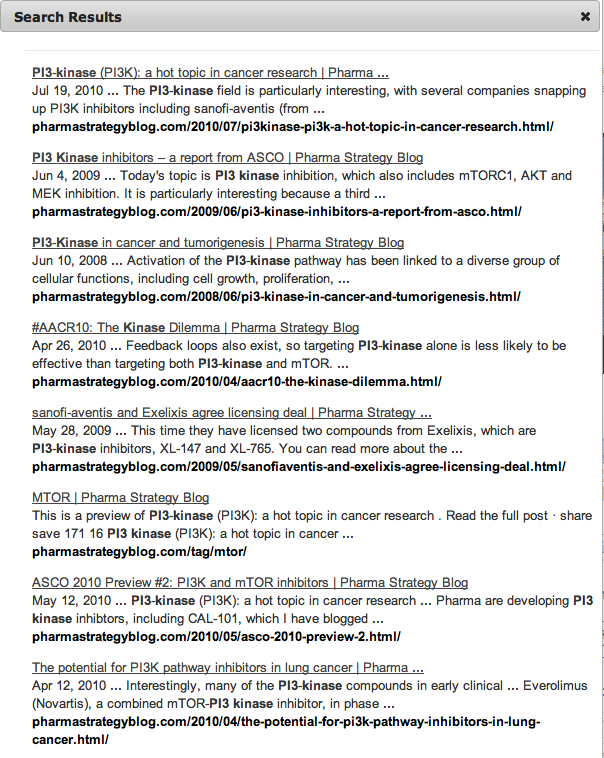
Finally, success!  We tried a Google search plugin, it just searches the blog but not the web, for relevant things, like this one on PI3-kinase, which the last two search widgets failed miserably at:

PI3-kinase in cancer

It’s located on the top right hand side of the blog if you ever need to search for various cancer drugs, conferences or pathways.  Let me know what you think.

One of my favourite journals, Cancer Research, has a new paper available via open access (i.e. free to the public, thank you AACR), which you can obtain from the link in the Reference section below.

It caught my attention because there was a fascinating symposium on angiogenesis at ESMO this summer with some heavyweight debates from Robert Kerbel (accelerated metastasis) and Lee Ellis (normalisation of tumour vessels) taking different viewpoints on the pros and cons of VEGF inhibition.  I took a few photos of the slides for private study and reflection, as they were going too fast for me to keep up with the key points with unreadable chicken scratch notes, but sadly my iPhone went missing in the exhibit hall less than an hour afterwards before I could download the photos :(.  That said, both sides argued with very compelling data for their perspective that I’m not sure which way I roll on the issue.

In this latest paper, di Tomaso et al., from Boston discuss the concept of recurrent glioblastomas and the tendency to relapse after VEGF therapy.  They noted that there are two current theories for how this might happen:

  1. Switch to VEGF-independent angiogenic pathways
  2. Vessel co-option

They therefore decided to investigate these mechanisms in patients with relapsed glioblastoma using a pan VEGF inhibitor, cediranib.  Now, it should be noted that cediranib (Recentin) is not yet approved and is a small molecule inhibitor, whereas another VEGF inhibitor, bevacizumab (Avastin), is a monoclonal antibody approved for relapsed GBM, so I’m sure why they didn’t use that instead.  It does make extrapolation of the findings a little more tricky though, as you cannot always assume a class effect.

Here are the key findings:

  • Endothelial proliferation and glomeruloid vessels were decreased
  • Vessel diameters and perimeters were reduced to levels comparable to the unaffected contralateral brain hemisphere
  • Tumour endothelial cells expressed molecular markers specific to the blood–brain barrier, indicative of a lack of revascularization despite the discontinuation of therapy
  • Cellular density in the central area of the tumour was lower than in control cases and gradually decreased toward the infiltrating edge, indicative of a change in growth pattern of relapsed GBM after cediranib treatment
  • Cediranib-treated GBMs showed high levels of PDGF-C (platelet-derived growth factor C) and c-Met expression and infiltration by myeloid cells, which may potentially contribute to resistance to anti-VEGF therapy

The authors therefore concluded that:

“rGBMs switch their growth pattern after anti-VEGF therapy—characterized by lower tumor cellularity in the central area, decreased pseudopalisading necrosis, and blood vessels with normal molecular expression and morphology—without a second wave of angiogenesis.”

Commentary:

What intrigued me in particular was not the lack of rebound vascularisation effect but the myeloid component.  Many of you will remember the AACR meeting last September on Molecular Diagnostics in Cancer Therapeutics, where AVEO presented data on their VEGF inhibitor in development and found that the myeloid component acted as a useful biomarker of response for tivozanib in renal cell cancer. You can read more about that here if you missed it.

This raises several interesting questions for me:

  1. Is the myeloid marker that AVEO found with tivozanib actually more useful and applicable to VEGF therapies in general?
  2. Does the myeloid component indicate acute inflammation, as we have seen with respiratory and other diseases?
  3. If PDGF and MET expression rise as resistance sets in, does that suggest logical combination therapies for the treatment of GBM?
  4. How can we better overcome the blood brain barrier, which is a physical impediment to improving outcomes.

Time will tell but clearly the research in relapsed GBM has a-ways to go before we figure out how best to approach it yet.

References:

ResearchBlogging.org di Tomaso, E., Snuderl, M., Kamoun, W., Duda, D., Auluck, P., Fazlollahi, L., Andronesi, O., Frosch, M., Wen, P., Plotkin, S., Hedley-Whyte, E., Sorensen, A., Batchelor, T., & Jain, R. (2011). Glioblastoma Recurrence after Cediranib Therapy in Patients: Lack of “Rebound” Revascularization as Mode of Escape Cancer Research, 71 (1), 19-28 DOI: 10.1158/0008-5472.CAN-10-2602

Earlier this week I was reading Fierce Biotech's excellent article about the human face of the drug industry and was surprised to learn about one of the requests from the women with breast cancer who were featured in the post:

"All three women were frustrated by the lack of available clinical trials for Stage IV patients."

Given that most cancer drugs are tested in the advanced stage first, I would have expected more there than earlier stage disease.

It's interesting first to look at how many trials there are for common conditions.  In the NIH database, I searched for some common diseases and came up with the following:

Picture 7
Cancer is by far the most active category in the clinical trials I searched for; in fact, all the others added up to 32,260, a bit more together than cancer alone.

So I decided to check the databases out further, but along the way I came across some frustrations. Firstly, if you go to the NIH site, you can't actually search by stage of cancer type easily.  You can search by Phase (ie phase of clinical trial) but that's not the same thing as disease stage:

Picture 9
Ugh.  Ok, off to the more cancer specific forum at the NCI, which accesses the same trial database but has a different front end for search, surely that would be more useful?

Picture 8
 

Again, you can search for all sorts of things (hidden for space reason) except stage of disease!

To find the actual list of trials you want out of 25,885 available for all CANCER as a condition, you have to click on the search box for CONDITION and type in words like 'metastatic', 'advanced', 'stage IV' for example.  But how many people would know or actually think of that?

Picture 16
 

Using breast cancer as an example, we can find all trials involved with the disease and how many studies are for advanced stage disease:

Breast Cancer 

– All: 3,618

– Metastatic OR Advanced OR Stage IV: 1,267

Thus 45% of breast cancer studies, or nearly half, are in later stage disease.

There is a nifty little feature that maps out the location of those studies as well for great context under the Map button:

Picture 19
Inevitably, most of those studies are run in the USA, but it's good to see improved access for women with breast cancer in other parts around the world too.

Of course, many of those trials may have completed, been suspended or finished enrolling. Fortunately, you can hide non-active trials, so this brings the 1,267 number down further to 576 studies globally open for advanced breast cancer, and from the map tab, 380 are open in the US, 167 in the EU and only a paltry 29 in the ROW:

Picture 20
 

That's a far cry from the massive 25,000 global cancer studies we started off with!

6 Comments

Tomorrow, I will be in Princeton, NJ for a one day meeting focused on addressing the Current and Innovative Imaging Biomarkers in Neurology and Oncology Drug Development, hosted by Bioclinica.  

If you have any questions about the event, please send a tweet to @maverickNY and I will do my best to answer them on Twitter. Comments on this widget will not be monitored until the end of the day as wifi and internet access is likely to be limited and I'll be tweeting from my iPhone.

If interested, you can follow the synopsis from the live tweets below by clicking on the Play triangle:  

The event will involve some interesting speakers including the following:

Cornelis van Kuijk, MD, PhD 

– Professor and Chair Department of Radiology, VU University Medical Center 

Frederik Barkhof, MD, PhD 

– Professor in Neuroradiology
Radiology and Image Analysis Centre, VU University Medical Center 

 Adriaan A. Lammertsma, MD, PhD 

– Professor of medical physics and positron emission tomography (PET)
Nuclear Medicine & PET Research, VU University Medical Center 

 Ali Guermazi, MD 

– Professor of Radiology
Director of Quantitative Imaging Center
Boston University School of Medicine
Section Chief, Musculoskeletal Imaging, Boston Medical Center

3 Comments
error: Content is protected !!