Pharma Strategy Blog

Commentary on Pharma & Biotech Oncology / Hematology New Product Development

Posts from the ‘Strategy’ category

We discuss the pathogenesis of cancer quite a bit on this blog, but today I wanted to take a look at immune disorders, specifically, systemic lupus erythematosus (SLE) or lupus for short.

Lupus is an autoimmune disease characterised by often widespread multi-organ inflammation, although the skin, kidney, and joints are often affected.  The main reason behind this phenomenon is the inability of the immune system to discriminate between self-antigens and foreign ones.

Historically, the immune component of the disease has resulted in use of immunosuppressants to try and tamp down the inflammatory cascade, but these can have severe side effects in what is essentially a chronic condition.  Three papers have appeared in Science Translational Medicine this month suggesting the possibility of new combination strategies that target specific aspects of SLE pathogenesis (see references).

In his commentary on the papers, Craft noted that two of the papers address one of the key questions that has been baffling sciences for decades:

“What are the steps that lead to neutrophil activation in SLE, what are the consequences of this activation, and how do these physiological consequences further inform us about self-antigen–driven autoreactivity in SLE?”

Lande et al., (2011) and Garcia-Romo et al., (2011) both found that:

“Neutrophils from patients with SLE are activated by IFN-α, with release of neutrophil extracellular traps (NETs) that contain unwound DNA, and antimicrobial peptides.”

Taken together, the two groups make a compelling case for an important role of neutrophils in triggering interferon-alpha (IFN-a) production in lupus pathogenesis and inflammation.  Garcia-Romo and colleagues research went further, finding that lupus generated neutrophils died upon exposure to anti-ribonucleoprotein antibodies, suggesting a potential clinical intervention strategy.

Duffau et al., (2011) took a different approach to the underlying biology of the disease. They looked at CD154, which has also been shown to critical given the modest success with some patients treated with a CD154 antibody, leading to a reduction in disease activity.  They found that in vitro, activated platelets enhanced IFN-a secretion by immune complex–stimulated plasmacytoid dendritic cells through a CD154-CD40 interaction.

The researchers concluded that:

“These data identify platelet activation as an important contributor to SLE pathogenesis and suggest that this process and its sequelae may provide a new therapeutic target.”


Clinical Progress

Recently, the FDA approved Human Genome Sciences monoclonal antibody, belimumab (Benlysta), for the treatment of lupus.  Belimumab is interesting because it blocks the binding of soluble BLyS, a B-cell survival factor, to its receptors on B cells.  The drug does not bind B cells directly, but by binding BLyS, it inhibits the survival of B cells, including autoreactive B cells, and reduces the differentiation of B cells into immunoglobulin-producing plasma cells.

This new therapy is given as a intravenous infusion over one hour.  The recommended dosage regimen is 10 mg/kg at 2-week intervals for the first 3 doses and at 4-week intervals thereafter for maintenance treatment.

In the controlled clinical trials, the overall incidence of infections was 71% in patients treated with belimumab compared with 67% in patients who received placebo. The most frequent infections (>5% of patients receiving belimumab) were upper respiratory tract infection, urinary tract infection, nasopharyngitis, sinusitis, bronchitis, and influenza. However, when looking at serious infections, they occurred in 6.0% of patients treated with belimumab and in 5.2% of patients who received placebo, which is quite comparable.

Benlysta is being co-marketed with GSK in the US and it will be interesting to see how well the therapy does, given that is immunosuppressive and not recommended for patients with chronic infections.

In the long run, however, it will also be interesting to see whether the field advances with new developments in the pipeline as a result of the three papers discussed in this post. Clinical trials have mostly yielded disappointing results so far, but it is possible that with a better understanding of the precise immune cascade and sequelae, we may be able to devise better combination and sequencing strategies that benefit lupus patients in the near future.

References:

ResearchBlogging.orgCraft, J. (2011). Dissecting the Immune Cell Mayhem That Drives Lupus Pathogenesis Science Translational Medicine, 3 (73), 73-73 DOI: 10.1126/scitranslmed.3002138

Lande, R., Ganguly, D., Facchinetti, V., Frasca, L., Conrad, C., Gregorio, J., Meller, S., Chamilos, G., Sebasigari, R., Riccieri, V., Bassett, R., Amuro, H., Fukuhara, S., Ito, T., Liu, Y., & Gilliet, M. (2011). Neutrophils Activate Plasmacytoid Dendritic Cells by Releasing Self-DNA-Peptide Complexes in Systemic Lupus Erythematosus Science Translational Medicine, 3 (73), 73-73 DOI: 10.1126/scitranslmed.3001180

Garcia-Romo, G., Caielli, S., Vega, B., Connolly, J., Allantaz, F., Xu, Z., Punaro, M., Baisch, J., Guiducci, C., Coffman, R., Barrat, F., Banchereau, J., & Pascual, V. (2011). Netting Neutrophils Are Major Inducers of Type I IFN Production in Pediatric Systemic Lupus Erythematosus Science Translational Medicine, 3 (73), 73-73 DOI: 10.1126/scitranslmed.3001201

Duffau, P., Seneschal, J., Nicco, C., Richez, C., Lazaro, E., Douchet, I., Bordes, C., Viallard, J., Goulvestre, C., Pellegrin, J., Weil, B., Moreau, J., Batteux, F., & Blanco, P. (2010). Platelet CD154 Potentiates Interferon-  Secretion by Plasmacytoid Dendritic Cells in Systemic Lupus Erythematosus Science Translational Medicine, 2 (47), 47-47 DOI: 10.1126/scitranslmed.3001001

1 Comment

“I’ve missed more than 9000 shots in my career.  I’ve lost almost 300 games.  26 times, I’ve been trusted to take the game winning shot and missed.  I’ve failed over and over and over again in my life.  And that is why I succeed.”

Michael Jordan, Chicago Bulls

Michael Jordan, Chicago Bulls

Source: wikipedia

Continuing the sporting metaphors this week, I was catching up on blog reading last night and noticed that Jim Lefevere put up a nice post on Digital Strategist about how:

Domain Expertise + Work Ethic + Time = Success

He used Michael Jordan as an example to illustrate the competitiveness that is required for the top level.

While talking to scientists and researchers at the recent AACR PI3K-mTOR meeting about their myriad of iterative experiments with GWAS, Western Blots and such, you can imagine the parallels with scientific research.

It struck me how the scientists in this particular field of cancer research are both highly collaborative and competitive at the same time, while also being very focused and intense on the end game (implications for clinical research), perhaps more so than other sub specialty areas I’ve come across lately.

The main message I learned from the meeting can be summed up in this little forumla:

Driver Mutation + Adaptive Pathway + Ligand + Patient Selection = Possible Success

A lot of data on PI3K and mTOR can be expected at forthcoming annual meetings at AACR (April) and ASCO (June), so it will be interesting to see how the new combinations of PI3K or mTOR with AKT or MEK, for example, are panning out and in which tumour types.


1 Comment

“How the mighty have fallen so quickly.  England were national heroes after winning the Ashes.  Now they are national chumps after this shocking and embarrassing defeat.”

Geoffrey Boycott, on England’s surprise defeat by Ireland in Cricket World Cup.

England v Ireland in the Cricket World Cup

England v Ireland in the Cricket World Cup

Some of you readers will be aware that I’m a big sports fan, of cricket and football in particular, so my cheerful mood earlier this morning was somewhat muted after learning that the motherland, England, somehow managed to lose to lowly Ireland.  In cricket!

Ugh, such is life – all good Englishmen will no doubt down another pint and shake their head in sorrow.

Still, that metaphor got me thinking.  In sports, there’s always another game, another tournament, another year – life goes on regardless.  While I was growing up, the mighty West Indies were at the height of their scintillating dynasty.  Now?  Not so much. Yesterday’s champs are tomorrow’s chumps and vice versa.  In clinical R&D though, if a major trial flops or is negative, it is rare that a company will go back and reconsider another series of trials with the agent in the same tumour type, even if the trial design was flawed, unless they have others already ongoing or in very late stages of planning.

You get one shot to get right.  Maybe two, if you are lucky.

Moving forwards, the incredibly high rate and cost of failures is unsustainable.  In the oncology arena, I think we will see the smart companies get smarter about drug development.  What does this mean in practice?

  1. More exploratory, smaller, phase II trials
  2. Focus on pathways and related activities as targets
  3. Increased use of translational research in 1) to determine mechanisms of resistance, adaptive pathways, biomarkers, logical combinations
  4. Greater use of the adaptive trial design to find the best winning combinations
  5. Increased use of diagnostics and biomarkers to select more clearly defined patient populations (ie smaller subgroups)

These trends are slowly happening now, you can see it more clearly in some pathways such as PI3K-mTOR, for example.  The days of taking a targeted therapy and adding it to standard of care chemotherapy in an unselected population, as happened with iniparib in triple negative breast cancer, are unlikely to be the future of cancer research.

What the more intense integration and iteration of basic research and phase II trials will give us is perhaps, a slightly slower development process, but with a much higher chance of success. In my book, that’s a much better approach – cancer patients deserve the best shot we can give them.

Photo Credit: ICC World Cup

Aside: For those wondering, my pre tournament tip was that India would be very strong contenders for this year’s World Cup, if only their bowling manages to get organised. Their batting strength is second to none, but Pakistan have a good chance if the Indian bowling shows any chinks and cracks.  Cricket is a team game, after all.  England regrouped and recovered to beat the strong Springboks from South Africa, so all is not lost yet!  Anybody but the Aussies, that’s all that matters 😉

1 Comment

AACR PI3K-mTOR special conference

Recently, while in San Francisco for the AACR special conference on the PI3K-mTOR pathway in cancer, I was particularly struck by several important learnings that have since make me think more deeply about oncology drug development going forward:

  1. With targeted therapies, we need to more carefully select the patients, based on a clearly defined patient population
  2. We need to identify both the driving mutations and the adaptive pathway
  3. Aberrant activity is often also ligand driven

This means that in the future, targeted treatment may evolve in smaller subsets of disease with more logical double or even triple combinations.  It also means that there will be more, smaller phase II trials with translational research incorporated, across multiple combinations to tease out the critical, defining protocol.  Think more adaptive trial designs similar to the BATTLE and I-Spy series in lung and breast cancer, respectively.

Of course, Pharma’s immediate reaction is going to be “oh my, that’s going to be very expensive and difficult to do with novel-novels in clinical trials!”

The reality, however, is that it may not actually be sustainable to keep charging exhorbitant prices and smart companies with deep pockets and strong commitment will build portfolios with a wide range of different targets either in house, through licensing or acquisitions.  The trend in this direction is slowly, but surely, happening as knowledge of the biology of different cancers and subsets improves.

It was therefore no surprise that two articles appeared last week in Science and Translational Medicine and piqued my interest.  Goldstein, Zong and Witte (2011) provided some thoughtful commentary on research by Ateeq et al., (2011) on the SPINK1 mutation in prostate cancer.  They observed:

The concept of one-size-fits-all therapeutics is becoming increasingly less relevant, because any one therapy is unlikely to be effective for all individuals with a complex disease such as cancer.  For the hundreds of thousands of men who are diagnosed with prostate cancer each year, their tumors do not all share the same molecular machinery, pathways, or targets.

Ateeq et al., describe how SPINK1 contributes to the aggressive phenotype.  Forced expression of recombinant SPINK1 increased prostate cancer cell proliferation and invasiveness, whereas knockdown of SPINK1 gene expression or treatment with a SPINK1-directed monoclonal antibody resulted in decreased cell division, invasiveness, and tumour growth.

SPINK1 is highly expressed in ~10% of prostate cancers, and expression has been correlated with aggressive disease.

Interestingly, SPINK1 mediated its neoplastic effects partly through interactions with the epidermal growth factor receptor (EGFR).  Ateeq et al’s experiments showed that antibodies to both SPINK1 and EGFR blocked the growth of SPINK1+/ETS tumours more than either antibody alone, and did not affect SPINK1- tumours.

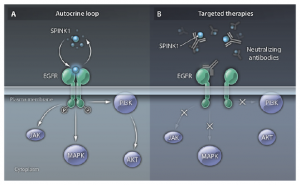
In the graphic below (courtesy of Goldstein et al., 2011), you can see that in part (a) SPINK1 secreted from prostate cancer cells can stimulate EGFR dimerization, phosphorylation, and downstream signaling through phosphoinositide 3-kinase (PI3K)/AKT, mitogen-activated protein kinase (MAPK), or janus kinase (JAK) pathways in an autocrine loop.

In part (b), in addition to small-molecule agents that block AR, PI3K/AKT, MAPK, or JAK signaling pathways, monoclonal antibodies against EGFR or SPINK1 could inhibit signal transduction by blocking the physical interaction between EGFR and the SPINK1 ligand:

SPINK1 in Prostate Cancer

In the research, an approved monoclonal antibody to EGFR, cetuximab, was used, together with an un-named SPINK1 antibody with better results than either alone. We should remember though, as Goldstein et al., note:

However, disappointing results in trials of EGFR-targeted therapies for prostate cancer with gefitinib, lapatinib, or cetuximab raise doubts about the importance of the EGFR signaling pathway for most prostate cancers.

What do these results mean?

Although animal research doesn’t always translate to positive results in humans in the clinic, it is entirely possible that better patient selection and the right combinations may be necessary to target a driving mutation, ligand and adaptive pathway in order to yield better results than previously seen with EGFR inhibitors.

Overall, I think this latest research does provide a solid rationale for the development of humanised anti-SPINK1 monoclonal antibodies for targeting a subset of patients with SPINK1 positive and ETS-negative prostate cancer in clinical trials. There are mouse antibodies available for research, but I couldn’t find a humanised one in development. It will be interesting to see any company takes up the challenge going forward.

References:

ResearchBlogging.orgGoldstein, A., Zong, Y., & Witte, O. (2011). A Two-Step Toward Personalized Therapies for Prostate Cancer Science Translational Medicine, 3 (72), 72-72 DOI: 10.1126/scitranslmed.3002169

Ateeq, B., Tomlins, S., Laxman, B., Asangani, I., Cao, Q., Cao, X., Li, Y., Wang, X., Feng, F., Pienta, K., Varambally, S., & Chinnaiyan, A. (2011). Therapeutic Targeting of SPINK1-Positive Prostate Cancer Science Translational Medicine, 3 (72), 72-72 DOI: 10.1126/scitranslmed.3001498

One of the hallmarks of cancer is that even within different tumour types, there is an enormous degree of heterogeneity. Ultimately, in simple terms this means that individual patients will respond to different therapies depending upon their underlying biology.   The challenge, therefore, is defining and categorising the subtypes and working out which are the passenger and driver oncogenes, since the latter will cause aberrant tumour growth and survival, while the former may result as a consequence of changing pathway activity.

This morning I was researching gliomas and came across this old paper (March 2006) that looks at molecular subtypes of gliomas i.e. glioblastomas and astrocytomas.  The article concluded:

“Recent evidence suggests that gliomas may arise from a cell type with neural stem cell-like properties. The current work demonstrates that prognostic subtypes of glioma resemble key stages in neurogenesis and implicates signaling pathways that play critical roles in regulation of forebrain neurogenesis in control of tumor aggressiveness. Longitudinal analysis of glioma cases reveals a frequent pattern of disease progression into the mesenchymal phenotype, a state associated with robust angiogenesis.

This work suggests that molecular classification of glioblastoma may predict response to targeted therapies and suggests that greater understanding of neurogenesis in the adult forebrain may yield novel therapeutic insights for glial malignancies.”

The reason I was curious about this particular paper was because following the AACR Special Conference on PI3K and mTOR that I attended last week, it made sense to look at the literature on mTOR, PI3K and AKT in more detail.

In the glioma research, it was interesting to see what predicted poor prognosis:

“A robust two-gene prognostic model utilizing PTEN and DLL3 expression suggests that Akt and Notch signaling are hallmarks of poor prognosis versus better prognosis gliomas, respectively.”

Now, while Akt and Notch signalling may be important, it doesn’t mean that they make idea targets for drug therapy.  PTEN loss of function is also a difficult target at present and it isn’t clear if it is a driver per se.  What was very clear at AACR last week was that for every action there is an equal and opposite reaction, meaning that targeting one part of a pathway may lead to switching of aberrant activity to another part of the pathway as it adapts to the changing environment.

Neal Rosen from MSKCC gave perhaps one of the best talks of the AACR meeting. He succinctly and simply put out a few constructs based on what we know so far. I will summarise some of the talks in a conference report (sign up on the top right column), but what was relevant to the paper on gliomas is that while at first sight it might make sense to target Akt, that strategy will have consequences.

According to Rosen, in general, inhibiting PI3K also stimulates HER3 expression and phosphorylation, as well as other receptor tyrosine kinases in many cell lines.  In other words, we may need a multi-targeting approach based on the original aberrant driver, the adaptive pathway and the ligand driving activity.

Double and triple combinations make sense from a scientific perspective, but they will also incur far higher costs and more complex clinical trial designs. Who knows whether other adaptive mechanisms will also evolve as a result of pursuing that strategy?  It brings vividly to mind Frank McCormick’s wac-a-mole approach that he described last year at AACR on the challenges of targeting the PI3K pathway in general, irrespective of upstream or downstream targets.

Progress is slowly being made, but we have a long way to go yet with the PI3K-mTOR pathway, although I’m hopeful of some positive progress soon. Certainly there will be some new data emerging on the biology at AACR in April and clinical data at ASCO in June.

References:

ResearchBlogging.orgPhillips, H., Kharbanda, S., Chen, R., Forrest, W., Soriano, R., Wu, T., Misra, A., Nigro, J., Colman, H., & Soroceanu, L. (2006). Molecular subclasses of high-grade glioma predict prognosis, delineate a pattern of disease progression, and resemble stages in neurogenesis Cancer Cell, 9 (3), 157-173 DOI: 10.1016/j.ccr.2006.02.019

Today, I’m heading off to San Francisco for the AACR Special Conference on Targeting PI3-Kinase and mTOR in cancer.  For those of you needing a brief primer on the pathway, you can find more about it in this 2010 post, which vies with one about ipilimumab in melanoma as the top two posts on Pharma Strategy since the end of October.

You can view the PI3K-mTOR program here.

I’m really excited to be attending this event – a lot of the ‘big guns’ in the PI3-kinase field are speaking at this event, including Lewis Cantley, Jeffrey Engelman, David Sabatini, Carlos Arteaga, Neal Rosen, Gordon Mills and many others.

There are also presentations from scientists at various Pharma and Biotech companies with PI3-kinase inhibitors in development, so it won’t just be about the basic translational research per se, but also about how the R&D is progressing to date with new therapeutics.

If anyone is at the meeting, please do stop and say hello – it’s always nice to meet readers in person – I bumped into a few at last weeks ASCO/ASTRO/SUO GU cancers symposium, for example.

I’ll be tweeting a few snippets from the conference, including tonight’s keynote by Jose Baselga (Mass General Hospital), but excluding unpublished data, under the hashtag #PI3K.  The aggregated tweets from that hashtag will be captured between now and Saturday in the widget below for easy following for those remote and interested in this sub-specialty:

1 Comment

Many of you will have been following the ongoing story of the discovery of activating V600E mutations in BRAF in greater than 50% of melanomas. As a result, BRAF inhibitors such as PLX4032 have emerged in melanoma but ultimately, we have also seen how resistance unfortunately sets in after 6 to 9 months of therapy despite some impressive initial results.  In addition, approximately 20% of patients don’t respond at all – the key question is why?

Previously, we have discussed several mechanism of resistance, namely AKT and MEK, which has lead to new clinical trial combinations of BRAF plus an AKT or MEK inhibitor (e.g. see this trial) to see if this approach can delay the development of resistance and thus improve the time to progression further.   A background on MEK inhibition can also be found here.

A new article published this month in Cancer Research from Paraiso et al., (2011) suggests another possible mechanism of resistance with BRAF inhibition may also be involved, namely loss of PTEN function (see references below).  They looked at what might happen with a new second generation BRAF inhibitor, PLX4720.

In this new research, some interesting findings emerged:

“We identify loss of PTEN expression, observed in >10% of melanoma specimens, as being responsible for increased PI3K/AKT signaling when BRAF is inhibited.

We further show that PTEN loss contributes to the intrinsic resistance of BRAF V600E-mutated melanoma cell lines to PLX4720 by suppressing the expression of the pro-apoptotic protein BIM.”

They essentially found that increased AKT signaling occurs with PTEN loss:

“Treatment of the PTEN+/- cell line panels with PLX4720 increased pPDK1 and pAKT signaling only in the melanoma cell lines lacking PTEN expression.”

They also observed that:

“Loss of PTEN contributes to intrinsic BRAF inhibitor resistance via the suppression of BIM-mediated apoptosis.”

Some of you may be wondering how these findings can be used to design new therapeutic strategies.  However, loss of PTEN function and heightened BIM expression isn’t something that can be changed directly, but rather, indirectly:

“Dual treatment of PTEN- cells with PLX4720 and a PI3K inhibitor enhanced BIM expression at both the mRNA and protein level and increased the level of apoptosis through a mechanism involving AKT3 and the activation of FOXO3a.”

There are some new trials open with either single agents or combination trials in this area, such as the following selection (by no means exhaustive):

  1. GSK2118436 (A BRAF and MEK/ERK inhibitor) – single agent trial interim data was previously presented at ASCO and ESMO last year.  The initial data in melanoma related brain mets presented at ESMO was stunning.
  2. BKM120 (PI3K) and GSK1120212 (MEK) – combination trial in advanced solid tumours with RAS/RAF mutations.
  3. GDC-0941 (PI3K) plus GDC-0973 (MEK) – combination trial in advanced solid tumours.
  4. GSK1120212 and GSK2141795 phase I safety and PK trial.

I think this is one area in oncology where the research into the underlying biology and mechanism of resistance is almost keeping pace with the clinical research, which is great news for patients!   More vibrant data may begin to emerge soon at ASCO in June and ESMO in September, so hopefully we won’t have long to wait for a new update on progress.

A big question that remains to be answered though, is figuring out which patients should get what combination and in what sequence?  Time will tell, but we have a while to go before we understand things better.

References:

ResearchBlogging.orgParaiso, K., Xiang, Y., Rebecca, V., Abel, E., Chen, A., Munko, A., Wood, E., Fedorenko, I., Sondak, V., Anderson, A., Ribas, A., Dalla Palma, M., Nathanson, K., Koomen, J., Messina, J., & Smalley, K. (2011). PTEN loss confers BRAF inhibitor resistance to melanoma cells through the suppression of BIM expression Cancer Research DOI: 10.1158/0008-5472.CAN-10-2954

1 Comment

Early this morning I saw a headline float by my Twitter stream from yesterday with a link to an article or paper suggesting that yes, we can indeed predict metastasis. I can’t remember who shared it, or what was the exact news article but a quick Google search for latest news found some noise around a potential biomarker, CPE-ΔN. The paper (open access) in the references link below, is from the Journal of Clinical Investigation.

Now, the idea that a biomarker might be able to predict metastasis is important because it signals the need for more aggressive treatment as the disease is advancing. Equally, if someone is doing well, you don’t want to intensify therapy needlessly but resection may be more appropriate.   Clearly, the earlier you detect the cancer, the better, but conversely, figuring out when to change treatment and prevent or slow metastasis is also important.

Reading the paper carefully, the authors stated:

“We report here that the carboxypeptidase E gene (CPE) is alternatively spliced in human tumors to yield an N-terminal truncated protein (CPE-ΔN) that drives metastasis.”

In the research, they used a liver cancer model (or hepatocellular cancer, HCC) to see what was happening with the protein.  Interestingly, CPE-ΔN tended to be present and have high levels in tumours that have metastasised.

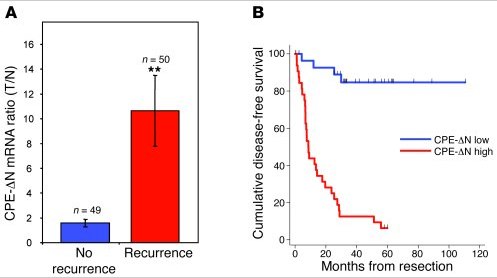
They followed a group of patients with HCC (n=99) and looked to determine whether high or low levels of CPE-ΔN was associated with prognosis, with interesting results:

Can cancer metastasis be predicted?

They also looked at patients with stage 2 disease that had only spread within the liver, as well as patients with a rare adrenal disease and colon cancer.  The patients with stage II HCC have a low chance of recurrence, but it can happen, so the question was could the biomarker be used to predict those most at risk?

The answer was yes.

Of the patients with early HCC (n=18):

  • Thirteen had low levels of CPE-ΔN and 10 of those were still cancer-free three years after surgery.   However, three with low CPE-delta N levels did have recurrence, giving an accuracy level of 77% in predicting metastasis.
  • Five had high levels of CPE-ΔN and in four of them recurrence occurred, giving an accuracy level of 90%.

All in all, it’s a good piece of solid research that may have important implications for future research.  Be warned, the paper is a little heavy to read though!

The next steps for the group are:

  1. Find a therapeutic method of blocking CPE-ΔN, preferably with a small molecule
  2. Determine the mechanism by which CPE-ΔN is activated, thereby figuring out how the switching on of metastasis works

All in all, although this research, while still at the very early stage, looks promising and worth following to see how the idea pans out.  I can’t help wondering how this research will impact the Norton and Massagué cancer seeding theory – it should add to it.  Now, if only we can find out what activates the CPE-ΔN protein, thereby triggering the metastasis, that could well be a key piece in the puzzle.

References:

ResearchBlogging.orgLee, T., Murthy, S., Cawley, N., Dhanvantari, S., Hewitt, S., Lou, H., Lau, T., Ma, S., Huynh, T., Wesley, R., Ng, I., Pacak, K., Poon, R., & Loh, Y. (2011). An N-terminal truncated carboxypeptidase E splice isoform induces tumor growth and is a biomarker for predicting future metastasis in human cancers Journal of Clinical Investigation DOI: 10.1172/JCI40433

Now that the dust has settled on the news from sanofi-aventis yesterday that iniparib did not achieve it’s primary survival endpoints in the phase III trial in newly diagnosed triple negative breast cancer (TNBC), it’s time to take stock of this class.

Yesterday was another major snow shovelling day in New Jersey so I missed the AstraZeneca year end conference call.  A Pharma Strategy Blog reader kindly filled me in with some relevant information – the company discontinued the development of their PARP inhibitor, olaparib, in BRCA breast cancer – scroll down to the discontinued section to see the note.

Our source also listened to the Q+A and in response to questions on olaparib from the analysts, Martin Mackay, the Head of R&D observed that:

“We decided to focus on serious ovarian cancer, and really focus our attention to that in the first instance and wait to see how those results play out in Phase III. Then we’ll revisit… breast cancer.”

This raises some interesting questions about PARP inhibitors in general.

Yesterday, we noted the fine line that needs to be trod between potency/efficacy and tolerability.  Last ASCO we saw how challenging it was to manage the toxicities with olaparib in combination with chemotherapy.  Iniparib doesn’t appear to add to the adverse event profile in combination, but missed its efficacy endpoints.

Meanwhile, Abbott’s PARP inhibitor, veliparib, is being tested in the I-SPY breast cancer trial, so while it will be a while before we see any data, it will be interesting to see how it pans out given that it is also more potent than iniparib.  Pfizer, BMS and Merck are also potential players in the PARP class, but their inhibitors are in earlier stage development. Based on the latest news with iniparib and olaparib it will be fascinating to see what they decide to do.

The latest developments in triple negative breast cancer also raise other critical issues:

  1. Was the olaparib decision based on toxicities, lack of efficacy or being behind iniparib, since they recently announced their phase II results?
  2. How will neliparib fare in the neoadjuvant setting and what toxicities might be expected?
  3. TNBC are mainly basal cell histology so many will also be BRCA1 or 2 positive – did these women do better in the olaparib trial?
  4. Will the Pfizer and Merck compounds have a better risk:benefit profile?
  5. What biomarkers will emerge to indicate subsets or predict response to therapy?
  6. If (5) does evolve, how will this develop from a diagnostics perspective?
  7. What will happen in ovarian, lung and prostate cancers, all of which have a very small proportion of people who have the BRCA1 or 2 mutation.

The current situation with iniparib and olaparib raises more questions than answers, so it will be interesting to see what learnings emerge from the data and whether the once promising class is salvageable or dead.

All in all, 2011 is turning out to be an interesting year and we have yet to get past January.

10 Comments

Since the human genome was sequenced in 2000, much progress has been made with cancer research.  In a review article published this week in the New England Journal of Medicine, McDermott et al., (2011) stated that:

“The identification of an essentially complete set of protein-coding genes, coupled with the discovery of novel transcribed elements such as microRNAs, has fostered an explosion of investigation using array-based approaches into patterns of gene expression in most cancer types.”

In most cancers, histology still drives diagnosis, which I always thought of as a rather crude method of differentiation.  The ones that have begun to advance beyond this?

  • Breast cancer: where expression profiling has led to the identification of different molecular subtypes of basallike, positive for human epidermal growth factor receptor 2 (HER2), normal breastlike, luminal A, and luminal B.
  • Acute and chronic myeloid leukemias, where molecular subtyping helps in diagnosis and also to determine outcomes and in some cases, when to change therapy as new mutations are acquired.

In CML, basic and clinical research may be far advanced in Academic practice on both sides of the pond, but sadly often community clinical practice in the US is lagging in basic routine monitoring of patients with CML in terms of regular cytogenetic and molecular testing to evaluate responses to treatment or acquired resistance developing.  In AML, many molecular subsets have been identified, but we still don’t know which are key drivers or mere passengers.  There is a long way to yet in practical day to day terms.

The impact of the research in breast cancer has demonstrated that different subtypes exhibit very different clinical and biologic features, including patient survival.  Essentially this means taking a very heterogeneous disease and identifying more homogenous subgroups that behave more consistently.  That said, the authors note:

“In routine clinical practice, however, classification is still based on conventional histologic analysis, coupled with immunohistochemical staining for estrogen receptor (ER), progesterone receptor (PR), and HER2, which when combined can reconstruct most of the subclasses defined by mRNA expression.”

Gradually, though, new treatments are evolving for each subtype as well and this will continue to develop as new, more targeted therapies emerge based on a deeper understanding of the biology and how it all fits together.  Systems biology is very much at the heart of breast cancer research.

The review highlighted several areas where advances may emerge:

  1. Prognostic indicators
  2. Optimising use of therapeutics
  3. Development of new therapeutics
  4. Acquired resistance to therapy
  5. Monitoring of disease burden and early recurrence
  6. Genomics in the design of early clinical trials
  7. Susceptibility to cancer

Of course, as the article notes,

“The technologies that are research tools today are primed to become the diagnostics of tomorrow.”

One of the cool things about this article was an interactive graphic looking at the assay of tumor DNA to detect recurrence and early after resection using non-small cell lung cancer (NSCLC) as an example.   Unfortunately, the article appears to be subscriber only, not open access, so if your institution takes this journal I highly recommend checking it out  {HT to Edward Winstead of the NCI Cancer Bulletin, this article is indeed open access for anyone to read}.

I’ll leave you with the final observation from the review to ponder and debate:

“The rapid development of next-generation sequencing technologies seems likely to be transformative. Within a few years, a complete cancer genome sequence will be obtainable for a few hundred dollars or less. As the number of informative genetic abnormalities to be searched for in an individual cancer continues to increase, it may ultimately be more parsimonious to sequence the whole genome rather than do a large battery of directed tests.

However, in order to exploit the full clinical potential of information within the cancer genome, it will first be necessary to incorporate analysis of the genome and transcriptome more widely into clinical trials, generating new and unexpected predictors of drug responsiveness and prognosis.”

References:

ResearchBlogging.orgFeero, W., Guttmacher, A., McDermott, U., Downing, J., & Stratton, M. (2011). Genomics and the Continuum of Cancer Care New England Journal of Medicine, 364 (4), 340-350 DOI: 10.1056/NEJMra0907178

2 Comments
error: Content is protected !!