Pharma Strategy Blog

Commentary on Pharma & Biotech Oncology / Hematology New Product Development

Posts from the ‘Technology’ category

Biosimilars are very much a hot topic of late.  They are approved new versions of innovator biopharmaceutical products, following patent expiry.  Essentially, this is like a generic version of the biologic product, hence their alternative name, follow-on biologics.

Recently, the FDA approved the Momenta/Sandoz’s follow-on versions of sanofi-aventis’s Lovenox, a low molecular weight heparin (LMWH), used to prevent and treat deep vein thrombosis or pulmonary embolism.   The patent expired in July 2010 and approval was given on July 23rd.  Reports in the press suggest that erosion of the brand was both fast and steep, with a 60% shift in market share to the cheaper versions almost overnight.

At present, the FDA doesn’t have a recognised approval system for follow-on biologics, so the process is somewhat fuzzy.  I’m not sure why the FDA approved Momenta’s versionof enoxaparin, but not Teva or Amphastar’s, although inevitably, there was a lot of noise surrounding the issue in the press over the last year.  I’m not going to go into the details of the shenanigans over this, but a quick Google search will offer more information than many will have time to read!

What was interesting to me was that Momenta scientists published an interesting paper in Nature Biotechnology (reference below) on Chinese hamster ovary (CHO) cells.   CHO cells are the most common cells used to synthesise recombinant proteins used in many drugs and are extremely well studied.  Previously, however, CHO cells were thought to lack the biosynthetic ability necessary to synthesize a particular glycoprotein, but the Momenta scientists found otherwise, underlining their expertise and research in this field.

These players – Momenta, Sandoz, Teva and Amphastar – probably have the lead in follow-on biologics for now, so they will be interesting companies to watch out for as the patent cliffs in biologics begins to hit big Pharma between now and 2015.

Now, while the FDA still doesn’t have any official regulations for follow-on biologics, the European Medicines Agency (EMA) has begun to tackle the issue head on, posting draft guidelines last week.  You can check them out online.  According to the EMA:

“The Agency has released the draft guideline on similar biological medicinal products containing monoclonal antibodies for a six-month consultation period.

The guideline lays down the requirements for medicines containing monoclonal antibodies that claim to be similar to another such medicine already marketed.

Comments on the draft guideline can be submitted to the Agency up to 31 May 2011.”

Unfortunately, I haven’t had time to digest the EMA proposals yet, but we will post a full synopsis in a future blog post soon.

If you have any thoughts, comments or questions, please feel to add them in the comments below.

References:

ResearchBlogging.org Bosques, C., Collins, B., Meador, J., Sarvaiya, H., Murphy, J., DelloRusso, G., Bulik, D., Hsu, I., Washburn, N., Sipsey, S., Myette, J., Raman, R., Shriver, Z., Sasisekharan, R., & Venkataraman, G. (2010). Chinese hamster ovary cells can produce galactose-α-1,3-galactose antigens on proteins Nature Biotechnology, 28 (11), 1153-1156 DOI: 10.1038/nbt1110-1153

11 Comments

Following this morning’s blog post, I’ve been deluged with emails wanting to know more about the basics of miRNA and it’s role in cancer.  It’s a very complex topic, as Walter Jessen, a cancer researcher pointed out on Twitter in a discussion with Angela Alexander, a Ph.D student at MD Anderson and myself about miRNA:

“Complicated stuff, esp when expression of mirs doesn’t jive with expression of genes that reg them or that they reg.”

Where reg is ‘regulate’ since Twitter only allows 140 chars or less for communicating ideas between people 🙂  Still, this was exactly the problem I was experiencing when researching the topic recently.

Walter kindly offered the link to a primer he wrote on his excellent blog, Highlight Health, which has some great cancer resources and information.  Do check it out.

For those of you already familiar with the technical research in this area, there is a nice blog site specialising in miRNA that is well worth checking out for resources and information.

Memorial Sloan Kettering Cancer Centre in Manhattan have a useful online search tool, which looks at “Predicted microRNA targets & target downregulation scores. Experimentally observed expression patterns.” Be warned, you can become distractible and lose yourself for a hour or two playing with this one 🙂

The University of Southampton in the UK also have a Junk RNA blog site collating some information as well.

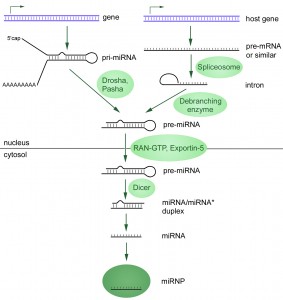
Wikipedia has some notes on the topic and some useful diagrams like this one:

Source: Wikipedia

Please feel free to add any other useful resources for others to browse in the comments section below.

The title of this post today is inspired by one of my bioinformatician science buddies on Friendfeed, Neil Saunders, who has a great blog that’s worth checking out.

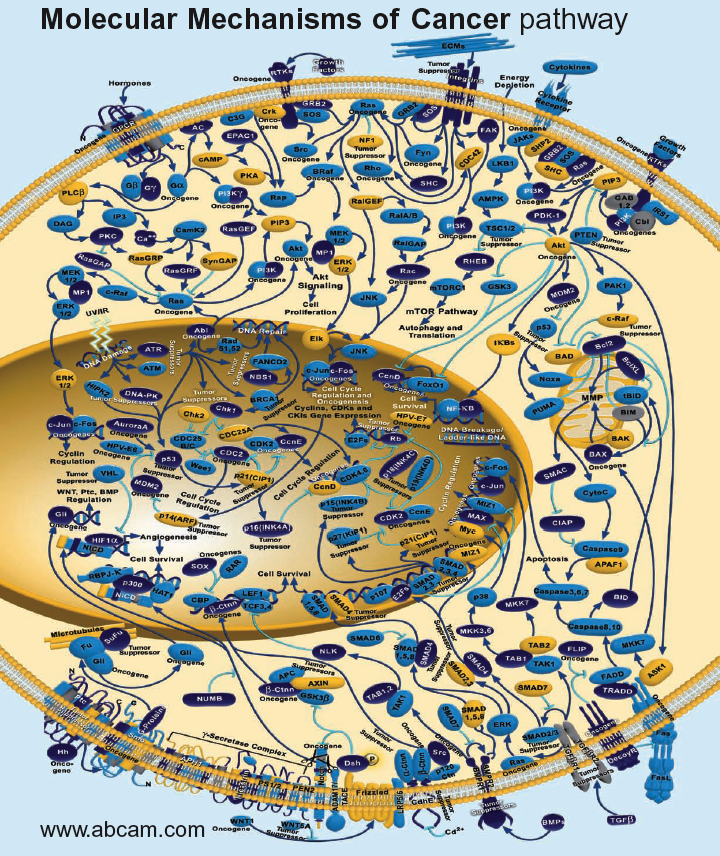
Here’s a wonderful simplified picture of many of the pathways thought to be involved with different types of cancer and was shown by Dr Wafik El Deiry of Penn at the recent AACR meeting on colorectal cancer in Philly:

Source: AbCam (pdf download)

Imagine all those pathways that are overexpressed in any given cancer, some may well be mutated, most will be passengers, a very few will be actual drivers.  Now imagine that all of them are lit up like a Christmas tree.

Not so easy to see the wood from the trees now, is it?

Think about drug development… how many people rush off and pick off one target and take a targeted therapy, either a monoclonal antibody or kinase inhibitor, combine it with standard chemotherapy and think it possibly might work, let’s suck it and see.

Ummm, no.

What are the chances of such a random unscientific approach actually working?  Pretty low.  Then we sit back and realise that the old models (animal, clinical etc) aren’t working any more and such an approach is no longer sustainable.  The drain on resources, whether time, money or people is too high.  The phase II/III attrition rate with that throw the mud at the wall approach is horrendous in oncology.

There is another way.

The smart researchers and companies are now using more modern, highly evolved animal models, doing more extensive preclinical research and thinking differently using a more holistic systems biology approach.  They’re trying to figure out what the logical drivers are, which might suggest some logical combinations (think two unapproved targeted agents with an approved one perhaps) based on the constitutively activated  or mutated targets, cross-talk, feedback loops and going into phase I research later with a more solid rationale.

The winners in this will be the companies with the most useful and broad pipeline who can mix and match more easily in this strategic pathway rather than tumour approach, with their own compounds than someone else’s.  Collaborations on the pharma side are still relatively few and far between.  They are often also a nightmare to manage, no matter what the original intentions were.

Change is already happening judging by the many enlightening conversations I’ve had this year with academic and pharma researchers, clinicians and commercial clients alike.  This is great news and it’s driven by a greater understanding of basic research, better animal models, a panopoly of potential druggable targets and a broad, deep pipeline across the oncology companies as a whole.  We just need to start putting the jigsaw together now and maybe we’ll see a difference in outcomes in the not too distant future.

The future may not be so far off as we think.  The future is now.

10 Comments

Here’s a nice paper that I’ve been reading, written by Tim Harris and Frank McCormick on cancer biology.  Lately, we’ve all seen how advances in DNA sequencing and genome-wide association studies (GWAS) are driving the discovery of the germline and somatic mutations that are present in different cancers.  This article sets out to review:

“The most important molecular changes in different cancers from the perspective of what should be analyzed on a routine basis in the clinic.”

Essentially, this is an overview of where we are in both hematologic and solid tumours and looks at the molecular subsets that are emerging, hopefully as targets for therapeutic intervention.  I’m not going to repeat their excellent article, but if you are really interested in this field, I highly recommend reading it.  A link is provided below after the post to the actual paper.

What struck me most though, was not the nice summary of what we know about the biology of cancer, but their vision of the future in cancer medicine:

“The year is 2020. I wake up and feel the lump under my arm that has been bothering me for several weeks. I decide to make an appointment with the doctor to find the cause, especially since my personal genetic analysis has highlighted alleles that are associated with an increased risk of cancer.

The doctor’s receptionist views my electronic health record online before I am buzzed in to see the doctor.  Once I have explained the problem, a biopsy from the offending lymph-node is taken, the tissue is flash-frozen using the nitrogen quick-freeze system, and then delivered to the laboratory downstairs for a rapid molecular work-up.

DNA from the tissue is sequenced to identify any mutations in the 500 most common genes known to be involved in cancer. Tissue sections are analyzed using high-resolution fluorescent optical images.  A blood sample is also taken to check my background genomic DNA sequence, concentrating on alleles known to predispose to lymphoma.  Sequences for the genes encoding drug-metabolizing enzymes and drug-distribution proteins are also obtained.

A proteomic work-up is undertaken to look at protein profiles and post translational modifications.  I also undergo new-generation imaging so the gross pathology of my organs can be viewed in three-dimensions.  Two hours later, I review the results on my handheld computer device. The results have been predigested and presented as a simple digital read-out so that a diagnosis, prognosis and appropriate treatment can be derived.

Fortunately, the overall molecular and cellular pathology of the lymph-node is considered normal.  Apart from my pre-existing heart disease, all other organs appear to be healthy and I am prescribed an anti-inflammatory drug.

I leave the doctor’s office with a sigh of relief that all appears to be well.”

Whoa, that may sound like something from Bones in Star Trek initially, but I suspect it may well not be as far fetched as we imagine.  Why?   Because over the last two years the progress made in systems biology and cancer genome studies have encouraged me greatly.  What was a fledging area of cancer research is now becoming very much to the forefront of new breakthroughs and increased understanding of what is happening at the molecular level and new prognostic and predictive biomarkers are emerging.

Of course, there is still a long way to go in the war on cancer, but I see plenty of signs that much progress is being made.  Where we may well fall down though, is not in the science per se, but rather in our efforts of communication and coordination:

“The stakeholders, which include the payers, health care organizations, pharmaceutical and biotechnology industry, and molecular diagnostics companies, need to be aligned to achieve the most effective partnership.”

We clearly have much to do in this direction.  We have many of the electronic tools available already and yet speed of testing, diagnosis, access to electronic patient records (EHR) and in particular communication, is often snail mail slow.  How many of us receive test results instantly on our PDAs or email? How many have physicians or other service providers who even communicate with their patients by email or other technologies? This needs to change, and for the better.

There are some nice examples of real empowerment emerging from the cancer community, as this post from my friend Jody, a breast cancer survivor, shows in her recent blog post.  It’s a great start and I hope to hear of many more examples like this.

What do you think?   What can be done to improve the delivery of healthcare for people with cancer and how can we foster greater collaborations?

ResearchBlogging.org
Harris, T., & McCormick, F. (2010). The molecular pathology of cancer Nature Reviews Clinical Oncology, 7 (5), 251-265 DOI: 10.1038/nrclinonc.2010.41

8 Comments

The Holy Grail of colorectal cancer prevention – a reliable screening test that users don’t dread and avoid – appears to be getting close.

A novel test that detects telltale DNA markers in stool samples correctly identified 85 percent of colon cancers, 64 percent of significant precancerous polyps, and 90 percent of healthy samples, researchers announced Thursday in Philadelphia at a conference held by the American Association for Cancer Research.

“There is no other noninvasive screening test for colon cancer that comes close” to that accuracy rate, said David Ahlquist, a Mayo Clinic researcher who invented part of the technology and who is working with the commercial developer, Exact Sciences of Madison, Wis.

The DNA test is still experimental, hasn’t been validated under real-life conditions, and will take at least another year of development, he said.

via Researchers at Philadelphia conference announce progress toward noninvasive colon cancer test | Philadelphia Inquirer | 10/29/2010.

This was a most interesting new test in development that was covered here at the AACR colorectal cancer biology to therapy meeting in the press briefing yesterday.

Current methods of colorectal cancer (CRC) screening for people over 50 involve either colonoscopy, which is invasive, or virtual colonoscopy, which is not covered extensively by insurers.  Both require a not inconsiderate amount of time to do, not to mention the inevitable nervousness that goes with such procedures.  Routine fecal tests currently available have unfortunately been shown to miss most advanced pre-cancers, so there is an real opportunity to develop a more sensitive and useful detection approach.

This new test takes a stool sample and looks for markers that indicate early presence of adenomas in the colon in a small validation study (n=59) by testing people who were being evaluated for CRC by colonoscopy, in other words, they had a high risk for CRC or were strongly suspected of having cancer. Such well characterised patients allows for quick segmentation into normal and cancerous groups, rather than waiting for long term epidemiology follow-up to see who develops cancer or not, which can take years.

According to the Mayo Clinic scientists, several combinations of methylation markers based on tissue DNA were found that discriminate colorectal neoplasia from normal mucosa.  These were evaluated as part of the test validation process.  The markers that were found to be useful included 3 methylated genes (TPFI2, BMP3, NDRG4), plus human DNA.

A huge advantage of this simpler approach is that I can see that potentially, primary care doctors could order it as part of routine screening at an annual physical, thereby finding colon adenomas early rather than waiting for a carcinoma to develop later in life.

The test from Exact Sciences looks at 4 genes known to be associated with the development of colorectal cancer and appears to be able to detect them with 85% sensitivity.  Another DNA test is also being developed in Germany by Epigenomics AG, but differs in that it uses blood samples and looks at changes in Septin 9, which is not used in the Exact Sciences test.  It is currently available to physicians in Germany.

The development of non-invasive easy to use tests like these is important because we all know that the earlier we detect abnormal growth, the easier it is to cure and improve overall outcomes for any cancer, as Bert Vogelstein emphasised in his talk the other evening and Tyler Jacks did in his keynote at the Xconomy meeting in Boston the other week.  Colon cancer, for example, has a 90% cure rate when detected and treated early with surgery.

The lead investigator, Dr David Ahlquist, told me that the Mayo clinical studies with the Exact Sciences test are due to run until the end of 2012, so if all goes well we may see an approved validated test for wide scale testing available by 2013.  Certainly the timeline is looking like the next couple of years rather than a much longer timeframe, which is very encouraging to all of us who have lost family members to the disease.  While a better screening test won’t bring them back, it does offer hope that we may be able to avoid losing other people to the disease because their cancer was detected too late to do anything about it.

The pace and new advances in the early detection of cancer is something we can all be cheered about.  Long may the trend continue!

5 Comments

Recently, the limitations of the current blogging platform have become apparent when we started to consider the idea of adding some new features to the blog such as podcasts, video interviews, newsletters etc. A number of readers have also requested more extensive downloadable reports for purchase, so this is something we will be able to do in the near future through a more secure site.

The time has now come to move to a new platform.

This weekend we plan on making the transfer after practising with two other blogs, so Pharma Strategy Blog will take it's turn and will be down temporarily while we make the hosting changes.

Hopefully, it will be business as usual on Monday morning using the same url with no technical glitches!

We apologise in advance for any downtime on Sat and Sun, but see y'all on the other (brighter) side after the weekend!

6 Comments

Yesterday, I attended an Xconomy meeting hosted by Millennium on the war on cancer.  It was an interesting meeting, well attended and with some spirited interaction between the presenters, panels and audience.

180497316For those unaware of the Boston scene, MIT sits by the Charles River and several biotech and pharma companies including Millennium, Ariad, sanofi-aventis, Genzyme and Novartis Institute for Biomedical Research (NIBR) sit behind it.  You can walk between them in minutes. Mass General and Tufts Hospitals are just 5-10 mins away in a taxi on the Boston side of the river, Harvard is a few minutes by cab from MIT in Cambridge.

It’s the very ease of relative access that makes interactions here much easier and also valuable. Last time I was here, I kept bumping into people I knew, including researchers in the streets, “Oh, can I ask you a quick question please?!”

It’s the classic Porter cluster effect and it seems to be working well here.  Still, you never see this in NJ Pharma-land, ever. Why? Because they all live on ivory tower campuses that you usually have to drive around and academia is miles away in Manhattan (and Boston). I hadn’t really thought of it this way before, but I can see that new emerging transformative technologies and therapies are more likely to come out of Boston and San Francisco than New Jersey, at least in the cancer field.

There were a number interesting observations that emerged from the meeting.

  1. No pharma peeps hiding behind a lectern here – people, including Millennium CEO Deborah Dunsire, stood out in front and engaged with the audience or became animated in panel discussion.  This is refreshing and I’d love to see more of this more laid back approach, without spin and carefully couched speeches.
  2. The panel session with Alexis Borisy (CEO Foundation Medicine), Tuan Na-Ngoc (CEO Aveo Pharma), Adelene Perkins (CEO Infinity), Nancy Simonian (CMO Millennium) was fun and adroitly moderated by Sylvia Westphal (Xconomy). Biomarkers, selecting patients carefully for treatment, targeted therapies, new combinations, new smarter scientific approaches, and greater collaborations in research with academia were very much the main topics discussed.
  3. While the authorities seem to be trying to build walls between industry and academia, the prevailing mood was very much that this is a bad thing and that closer collaborations should be both welcomed and encouraged.  We can’t continue with the old style models of development and expect them to work well in the new environment. Such an approach, with its high costs, low success rate and high phase III attrition, is not sustainable in the long run.
  4. As we learn more about the biology of cancer, so we should become smarter about which drugs we evaluate in which patient subsets, which combinations and sequences, in earlier rather than later disease.  Everyone wants to see bigger wins, not incremental improvements.
  5. Some interesting new emerging technologies were discussed were discussed on RNAi by Dave Okrongly from Quanterix and epigenetics by Mark Goldsmith of Constellation Pharma. The single molecule testing concept particularly caught my imagination. Quanterix’s PSA assay test appears to be 1000x more sensitive than current assays and this has major implications for the detection and monitoring of prostate cancer. Why? Because if we can pick up aggressive disease (where the PSA rate doubles) earlier, we may ultimately be able to do better with earlier and more appropriate intervention treatment for the patients before the disease metastases out of control.
  6. The mood in Boston seems much more cohesive, upbeat and focused than what I see in the NY/NJ region dominated by big Pharma and old school ways of thinking.
  7. It’s all about the science, baby!

One of the highlights for me, other than the excellent networking opportunities, was the final panel session with Mike Huckman (formerly Pharma’s Market on CNBC now on the dark side at MSL, a PR agency) and Tyler Jacks, a cancer researcher from MIT/Koch Institute.

Mike kicked off by asking Tyler about the Cancer Caucus event hosted by Harold Varmus of the NCI a couple of weeks ago, where a key group of scientists and clinicians were holed up discussing and identifying the most important areas in cancer that we don’t know about or need addressing.  Tyler identified his 3 key things as:

  1. Identifying phenotypes and drivers of cancer that link to molecular aberrations
  2. Making sense of the complexity of the human genome (we have a lot of data but what does it all mean?)
  3. Figuring out the characteristics of early lesions and how they progress (if we figure that out, can we stop them sooner?)

The NCI meeting created a mechanism for discussion and dialogue, but closer collaboration (between industry and academia) is clearly seen as the way forward.

Jacks also discussed a number of other pertinent areas, including advances in preclinical models and how new generation versions are much more accurate and sensitive for predicting what might happen. The old models were largely ‘short cuts’ and not very representative of what’s going on. The new models and approaches are teaching us more about resistance and how it arises, for example.

Related to this is better diagnostic tests, leading to better more targeted treatments. Interestingly, he was very upbeat about solving the cancer problem and how the next generation of researchers will likely see bigger strides as we start unravelling the puzzles.

Mike also asked Tyler about Boston as a location for fighting the war on cancer. Tyler replied that it is a wonderful environment for this given that acedemia, biologists, engineers and biotech research all exist in the same place, with MIT providing a natural hub or link. The culture of MIT was discussed as something they are working hard on, although younger scientists are inevitably more willing and flexible to change and adapt (this also applies anywhere).

For the next week or so, the Twitter stream will still be searchable, so for those interested, you can check my live tweets from the meeting using #xconomy and get a flavour for what the biotech chiefs and academia think about ‘Boston’s War on Cancer’ – remember to read from the bottom up as the newest tweets will be at the top.

Unfortunately, Twitter did it’s famous fail whale (no access) near the end (grrr) and thus the last two sessions are missing, including the chat with Tyler Jacks.

If you were at the Xconomy meeting, do feel free to add anything I’ve missed or if you have any other thoughts on the sessions. For me, it was a great afternoon and I’d to thank Luke Timmerman of Xconomy for inviting me to the excellent event, highly recommended, would definitely go again!

5 Comments

Peregrine Pharmaceuticals, Inc. (NASDAQ: PPHM), a clinical-stage biopharmaceutical company developing first-in-class monoclonal antibodies for the treatment of cancer and viral infections, today reported interim data from an ongoing Phase II clinical trial of its novel brain cancer therapy Cotara(R). Interim median overall survival was 86 weeks for a cohort of 14 patients with glioblastoma multiforme (GBM) treated at first relapse with a single infusion of Cotara. Cotara is a targeted monoclonal antibody linked to a radioisotope that is administered directly into the tumor, destroying the tumor from the inside out, with minimal exposure to healthy tissue.

via ir.peregrineinc.com

I thought this was an interesting announcement this morning from Peregrine. Glioblastoma multiforme (GBM) is a particularly nasty malignant cancer, with a tendency to aggressiveness and is generally difficult to treat.

Cotara is a novel experimental antibody based on tumour necrosis therapy (TNT). Although these are only early phase II results based on a portion of the full 40 patients expected in the trial, they look encouraging so far.

I suspect the reason for the press release is that the data is being presented at a neurosurgery meeting that's ongoing at the moment in San Francisco.

Definitely a development worth watching, but ultimately, a larger scale phase III trial will be needed before we can be sure whether or not it will be a valuable addition to the armamentarium.


Back from Milan and ESMO 2010, I thought it would be a good idea to quick a final quick overview of some of the early data from phase II trials that look interesting and might be worth watching as the research evolves (in no particular order).

1. Addition of cetuximab to cisplatin increased survival in triple negative breast cancer

Jose Baselga presented the results of a multi-centre randomised trial (from Spain, Belgium, Austria, Portugal, the UK and Israel) that compared the combination of cetuximab (Erbitux) with cisplatin versus cisplatin alone in 173 women with triple negative breast cancer (TNBC).

Although the overall response rate (ORR) trended in favour of the combination (20.0 vs 10.3%), the result did not meet the pre-specified assumptions. Interestingly though, the progression-free survival (PFS) showed a significant improvement with the addition of cetuximab (3.7 vs 1.5 months, P<0.03). Two months doesn't seem much, but in an advanced, highly aggressive disease, it may represent a disproportionally large improvement.

I'm not sure why cisplatin was chosen as a comparator, especially as TNBC is a particularly hard subset to treat, but the trial is ongoing to determine overall survival and a phase III study will likely evolve to determine if the results are repeatable in a larger population.

2. GSK2118436 in advanced melanoma with brain mets looks promising in a phase I/II study

By promising, I mean this was a very small cohort of patients who saw some early and unexpected evidence of tumour shrinkage in brain mets that had evolved from primary melanoma. The scans shown by the presenter, Georgina Long, from the Melanoma Institute Australia and Westmead Hospital in Sydney actually gave me goosebumps and it wasn't the chill in the room. You just don't expect to see such noticeable shrinkage with a single agent in this setting because this is a horrid, aggressive disease that has a nasty tendency to metastasize easily.

What was interesting about this study is that GSK2118436 is a BRAF inhibitor that also specifically targets V600E, similarly to Plexxikon/Roche's PLX4032. In both cases, they bind to the protein and shut down signaling activity. Although the trial is very early, since it looked at 3 different cohorts, the small subset with brain mets (n=10) were what caught everyone in the audience's attention, although good responses were also seen in the advanced melanoma group without brain mets.

To put the results in context, all 10 patients experienced some control of their brain mets, with 9 of the 10 patients having reductions in the overall size of their tumours. The overall reductions ranged from 20-100% of brain metastases that were 3mm or larger in diameter before treatment.

That just doesn't happen with advanced melanoma with brain mets… at least, I've never seen such dramatic responses before.

The big questions for me are how long will the responses be durable before resistance sets in and how soon is a larger scale trial going to get up and running? This is a very promising and most unexpected development that is worth following.

Dr Long summed it up very nicely:

“The ability to inhibit oncogenic BRAF is the most important development in the history of drug treatment of melanoma.”

3. ARQ-197 continues to show positive results in NSCLC

In this presentation, the final results of the phase II trial in non-small cell lung cancer (NSCLC) were discussed. We've covered this promising agent, ARQ-197 (ArQule/Daiichi Sankyo), a small molecule c-MET inhibitor, before on this blog.

A final analysis looked at the complete results in more depth. Patients treated with ARQ 197 plus erlotinib (Tarceva) developed new metastases in a median time of 7.3 months compared with 3.6 months for patients treated with erlotinib plus placebo.

What I found interesting in this study was that this effect was more pronounced among patients with non-squamous (NS) histology, since the median time to develop new metastases was 11.0 months in the ARQ 197 plus erlotinib arm compared to 3.6 months for those treated with the control arm (erlotinib plus placebo). I'm not sure why the NS over squamous histology should matter, but they clearly benefitted more.

The sponsors, ArQule and Daiichi Sankyo, have announced that they plan to pursue a phase III trial in this setting. It would, however, be nice to see an analysis of any lung biopsies collected to see if there are any relevant biomarkers that would explain the differences in histology and responders, otherwise many physicians may see this as an incremental improvement, if confirmed in a larger trial. Were thre any differences in people who were EGFR mutation or MET positive, for example?

There was certainly some energetic discussion in the Q&A, with tough questions asked of the speaker regarding why go ahead with a phase III study given a small benefit and why use OS when PFS is small and complicated by crossover, all very fair questions. Like many, I'd really like to see more granular analysis of who is responding to this agent and why before rushing into a phase III trial that may see a disappearing of any positive signal when investigator bias is eliminated in a larger randomised trial.

4. METMAB showed promising results in a subset of lung cancer patients

In the same session, David Spiegel presented the data from a phase II study with a different c-MET inhibitor. Here, patients with advanced NSCLC (n=128) were randomly assigned to receive either erlotinib plus METMAb (Roche/Genentech), a monoclonal antibody that binds specifically to the MET receptor on cancer cells or a control arm (erlotinib plus placebo).

The reason for the interest in c-MET inhibitors is that MET activation has been implicated in the resistance of lung cancers to EGFR inhibitors such as erlotinib. The big question is therefore whether a combination of the two would overcome resistance or not, thereby prolonging life.

In this study, participants were tested for mutations in the EGFR gene and also for expression of MET in tumour samples. 

The results were interesting – 51% of patients whose tumours expressed MET and those who received METMAb plus erlotinib had better OS and longer PFS than those who received erlotinib plus placebo.

Furthermore, in the subset of MET+ patients, adding METMAb to erlotinib nearly halved the risk of disease progression or death during the study compared to those treated with erlotinib plus placebo. In addition, patients whose tumours did not express MET protein appeared to do worse when treated with the METMAb/erlotinib combination, suggesting that the biomarker may be able to determine who is more likely to respond to therapy.

This is good news if it is repeatable in a phase III trial and show durable efficacy with good tolerability, because then potentially, oncologists would be able to screen and preselect patients for treatment with METMab rather than expose all patients to the systemic side effects without hope of it working.

Last but not least, there was some updated information on the novel trastuzumab-DM1 (T-DM1) combination therapy (Roche/Genentech).

4. T-DM1 continues to show solid results in metastatic breast cancer

Edith Perez presented the results of a phase II study looking at first line treatment with a new combination agent, trastuzumab-DM1 or T-DM1, in metastatic breast cancer.

As far as I know, T-DM1 is the first of a new type of cancer therapy known as an antibody-drug conjugate. Basically, it binds together two existing cancer drugs with the aim of delivering both drugs specifically to cancer cells, ie trastuzumab (Herceptin), an approved monoclonal antibody that targets the protein HER2 and DM1, a chemotherapy agent that targets microtubules. The goal of the new combination is too see if cardiotoxicity, a common problem associated with standard anthracycline therapy, is reduced and if efficacy is subsequently improved.

Women with breast cancer were randomised to treatment with either trastuzumab plus the chemotherapy drug docetaxel, or T-DM1. All 137 participants had HER2-positive metastatic cancer, with no prior chemotherapy for their metastatic disease.

The good news is that the early results demonstrated that T-DM1 has good anti-tumour activity as well as much lower toxicity when evaluated side by side to standard therapy.

After a median of approx 6 months of follow up, the overall response rate of in women who received T-DM1 was 48% compared with 41% in the control arm (trastuzumab plus docetaxel). The rates of clinically relevant adverse events were also significantly lower in the T-DM1 arm (37%) compared to the rate in women given traztuzumab plus docetaxel (75%).

Overall, I think the slight improvement in ORR was more than compensated by the dramatic improvement in side effects, which ultimately affect a patient's quality of life when undergoing cancer treatment. According to my chicken scratch notes from the session, cardiotoxicity and myelosuppression were both much improved in the T-DM1 arm over standard therapy.

Perez noted that the final analysis of the PFS data is expected in 2Q 2011, which I'm sure will be eagerly awaited based on the encouraging early data, although feeling better is one thing, but ultimately the sine qua non is will the women live longer?

All in all, I'm glad I trekked all the way to Milan for ESMO. There was more positive and promising early data than expected and aside from the repetitive blister walks, it was an enjoyable event. It was also nice to catch up with some friends in person and meet several readers of this blog who kindly came up and introduced themselves – I hope you all enjoyed the conference as much as I did!

3 Comments

At the AACR meeting on Molecular Diagnostics and Cancer Therapeutics meeting in Denver, there was quite a bit of interesting scientific data coming out on cancer biology and biomarkers, so here is a quick synopsis of what appealed to me:

1. IGF-1R is over expressed in a subset of triple negative breast cancers (TNBC)

This presentation, from Witkiewicz et al., was interesting because they showed that IGF-1R might be a useful prognostic biomarker in TNBC. Usually, TNBC, which occurs in 15-20% of all breast cancers and is associated with a poorer prognosis, so finding a subgroup that might actually do better could be useful. Gene amplification was seen in 23% of the cases investigated. Caution must be exercised here, however, just because something is over expressed or amplified, does not mean that it is mutated, and therefore a potential druggable target with a therapeutic as we saw with the negative phase III results with figitumumab, an IGF-1R inhibitor in lung cancer.

What I would like to know though, is how many women with TNBC also have the BRCA1 or 2 mutation and have amplified IGF-1R? We know that targeting a cancer with one drug at one or two mutations in solid tumours has modest effects. But what if we target several things with a combination therapy, for a specific subset, then that might possibly yield different results altogether.

2. Molecular biomarker analysis using circulating tumour cells (CTCs)

Siminder Atwal, a Genentech scientist, presented her work on CTCs, with the idea of determining whether they could be used as a predictive biomarker by correlating CTCs with HER2 status in archival tumour samples. CTC's in theory should match tumour biopsies since they are cells that have shed from the primary tumour.  The Genentech scientists found that they were indeed correlated, with a high concordance (95%) using the CellSearch system. Of course, EpCAM expression can vary in some tumour types, complicating analysis and interpretation, but it looks like they saw some early hints that molecular biomarker status in CTCs are indeed reflecive of the biomarker status in patient tumours.

Predictive biomarkers allow us test whether a patient is likely to benefit from a given treatment, so the obvious and leading question is whether this work could be extended to look at eg CTC's in colorectal, lung or breast cancers to determine whether a patient is more likely to respond to bevacizumab (Avastin) or not. It would probably be easier in breast (lots of biopsy samples) and colorectal (lots of surgery providing samples).

At the moment, there is no way of telling who is most likely to respond to Avastin, so a predictive biomarker test would be really useful for clinicians before deciding on treatment, rather than having to expose thousands of patients to the systemic side effects. Given that the FDA have to make a decision by the year end on the full approval of Avastin in breast cancer, it is a shame that they likely won't have this sort of data to help guide a decision.  

3. BRCA1 mutations in prostate cancer

Gerhardt Attard gave an enlightening talk entitled, "Circulating tumor cells: Potential uses, pitfalls and challenges in their use as pharmacodynamic markers" but what struck me was not so much the fascinating information about CTCs as his mention that a subset of prostate cancer patients have the BRCA1 mutation. They tested the impact of olaparib, a small molecule PARP inhibitor from AstraZeneca, and found that all three responded.

A study open for men with prostate cancer and either BRCA1 or 2 mutations is currently recruiting patients. Given the interest with PARP inhibitors in breast and ovarian cancers, I'll be following this development with great interest.

error: Content is protected !!