Pharma Strategy Blog

Commentary on Pharma & Biotech Oncology / Hematology New Product Development

Posts from the ‘Technology’ category

I was delighted to see, amongst all the big news this morning on President Obama and Osama Bin Laden, that there was a little gem for Biotech – Seattle Genetics announced that the FDA have accepted their BLA filings for antibody drug conjugate (ADC), brentuximab vedotin, and awarded Priority status.  The company stated that the Prescription Drug User Fee Act (PDUFA) date is now set for August 30th, based on the Feb 28th filing date.

Two BLA filings were submitted, one for relapsed Hodgkin Lymphoma (HL) and another for relapsed or refractory systemic anaplastic large cell lymphoma (ALCL).  These two hematologic cancers share a commonality, ie CD30, which is the defining marker of the disease and the target for the ADC therapy.

Based on the data we saw at the recent American Society of Hematology meeting in December, the recent NEJM publication, this is very good news indeed for patients.

New treatment options in rare or difficult to treat diseases are always most welcome. With the American Society of Clinical Oncology (ASCO) and European Hematology Association (EHA) meetings both coming up in June, I’m really looking forward to an update of the data and to see how this exciting new concept (antibody drug conjugates) are progressing.

This is an area where I think we will see many more developments in the very near future, with Genentech’s T-DM1 also likely to have data at ASCO in breast cancer.

One of the highlights of the recent American Association for Cancer Research annual meeting was a plenary session updating the results of the ongoing BATTLE trial at MD Anderson in non-small cell lung cancer (NSCLC).

The more scientific readers will want to check out the academic paper and commentaries published in Cancer Discovery, (see below) or listen to the complimentary AACR webcast of the plenary talk including Dr Hong’s Reverse Migration Strategy, but I realised that not everyone is familiar with, or understands the background, to this ground breaking study.

It therefore seems a great opportunity to use Storify to collate resources and snippets from social media sources to create a story around the events that have happened over the last year…


References:

ResearchBlogging.orgKim, E., Herbst, R., Wistuba, I., Lee, J., Blumenschein, G., Tsao, A., Stewart, D., Hicks, M., Erasmus, J., Gupta, S., Alden, C., Liu, S., Tang, X., Khuri, F., Tran, H., Johnson, B., Heymach, J., Mao, L., Fossella, F., Kies, M., Papadimitrakopoulou, V., Davis, S., Lippman, S., & Hong, W. (2011). The BATTLE Trial: Personalizing Therapy for Lung Cancer Cancer Discovery DOI: 10.1158/2159-8274.CD-10-0010

Sequist, L., Muzikansky, A., & Engelman, J. (2011). A New BATTLE in the Evolving War on Cancer Cancer Discovery DOI: 10.1158/2159-8274.CD-11-0044

Rubin, E., Anderson, K., & Gause, C. (2011). The BATTLE Trial: A Bold Step toward Improving the Efficiency of Biomarker-Based Drug Development Cancer Discovery DOI: 10.1158/2159-8274.CD-11-0036

1 Comment

This is turning out to be quite a week for posts on interesting and new things happening in melanoma.

Source: Wikipedia: metastatic melanoma that has invaded the pancreas

Yesterday, we discussed novel mechanisms of resistance to BRAF inhibitors such as PLX4032 and tomorrow we will review new findings associated with MEK resistance, but today I wanted to draw your attention to more basic research, that is, the identification of a new mutation in melanoma.

In a fascinating Letter to Nature Genetics, Wei et al., (2011) described how they used exome sequencing to systematically look at alterations in the DNA seen in the disease in 14 matched normal and metastatic tumours:

“Using stringent criteria, we identified 68 genes that appeared to be somatically mutated at elevated frequency, many of which are not known to be genetically altered in tumors.”

This is crucial, because when we consider therapeutic intervention down the road, we want to find targets that are aberrant in cancer, but preferrably, do not exist in people without cancer.  The reason for this is that many unwanted side effects are reduced by having a clear and obvious target.

What did the research show?

According to Wei et al., (2011), they found

“We discovered that TRRAP harbored a recurrent mutation that clustered in one position (p. Ser722Phe) in 6 out of 167 affected individuals (~4%), as well as a previously unidentified gene, GRIN2A, which was mutated in 33% of melanoma samples.”

The emphasis is mine, but what I found interesting was that TRRAP may be a new oncogene and GRIN2A may offer a druggable target in the same way that BRAF currently does for BRAF inhibitors.

Now, there are some limitations to this excellent piece of research:

  1. Small sample size
  2. Extrapolation to a wider population cannot be assumed
  3. Further research is essential to validate the targets

Implications:

The limitations aside, the findings are very important and do provide some useful clues for researchers to home in on and consider new studies to advance both the field, and our understanding of the biology of melanoma, further:

“Our study provides… the most comprehensive map of genetic alterations in melanoma to date and suggests that the glutamate signaling pathway is involved in this disease.”

This may a little bit of a surprise to the uninitiated.  Glutamate is an essential amino acid and a transmitter in the mature mammalian nervous system, but glutamate antagonists have been shown to limit tumour growth, as you can see in a PNAS article from Rzeski et al., (2001).

Overall, I think we will be hearing more about TRRAP and GRIN2A in metastatic melanoma going forwards.

References:

ResearchBlogging.orgWei, X., Walia, V., Lin, J., Teer, J., Prickett, T., Gartner, J., Davis, S., Stemke-Hale, K., Davies, M., Gershenwald, J., Robinson, W., Robinson, S., Rosenberg, S., & Samuels, Y. (2011). Exome sequencing identifies GRIN2A as frequently mutated in melanoma Nature Genetics DOI: 10.1038/ng.810

Rzeski, W. (2001). From the Cover: Glutamate antagonists limit tumor growth Proceedings of the National Academy of Sciences, 98 (11), 6372-6377 DOI: 10.1073/pnas.091113598

1 Comment

Breast cancer isn’t a topic I cover very often on this blog, mainly because there is so much written about it elsewhere, but I confess to being fascinated by the ongoing work on cancer cell seeding and metastases from Joan Massague and Larry Norton at Memorial Sloan Kettering.   The reason for this is that the origins of metastases might have wider applicability to other cancers, so the studies as a body of work are important in the field.   For those of you looking for some background on this important topic, check out this previous post on cancer cell seeding first.

Unfortunately, while at AACR the other week I lost track of time in the huge poster session one morning and missed Joan Massague’s plenary talk, but hopefully it will be available on the webcasts later this month, and I will post another update then.

Where are we now?

Science Translational Medicine

In the latest research, published last month in Science Translational Medicine, the researchers used Genome-Wide Analysis Studies (GWAS) to look at methylome signatures in breast cancers to see if there was any correlation between different patterns and survival.

We know that widespread changes in DNA methylation patterns occur during oncogenesis and tumour progression, so detailed research using GWAS may help us uncover patterns that ultimately help us unravel the heterogeneity of the disease.   The more homogenous the subgroups, the greater the chances of successful treatment and improved outcomes for patients down the road.

To this end, samples from breast cancer tumours (discovery set, n=39; validation set, n=132) were gathered from patients at MSKCC and analysed.

What did they find?

In the current study, Fang et al., (2011) noticed that one pattern in particular was associated with low metastatic risk and hence improved survival, ie the breast CpG island methylator phenotype (B-CIMP).  The paper is well worth checking out for the survival curves of B-CIMP+ vs. B-CIMP- alone.  Beautiful.

Interestingly, this trend was independent of other known breast cancer markers including estrogen receptor/progesterone receptor (ER/PR) and human epidermal growth factor receptor 2 (HER2) status.  They also found similar results i.e. presence of B-CIMP genes in other human tumour types, including glioma and colon cancer, which are widely available in the Cancer Genome Atlas.

What do these findings mean?

There are several important findings that emerge from this work.

  1. Discovery of a global B-CIMP gene that is associated with improved survival helps identify a group of patients who are likely to do better
  2. B-CIMP phenotype may play a mechanistic role in metastatic risk
  3. Presence of B-CIMP across multiple tumour types suggests that it targets the same genes across different cancers

The authors concluded that:

“Our findings may enable the development of new molecular diagnostics that more accurately reflect the epigenomic underpinnings of breast cancer prognosis.  These diagnostics may help further refine our ability to implement personalized medicine for breast cancer patients.”

If that scenario happens, it will be an amazing discovery in the development of breast cancer research and treatment and may spur further innovation through improved targeted agents, diagnostics and patient selection.

References:

ResearchBlogging.orgFang, F., Turcan, S., Rimner, A., Kaufman, A., Giri, D., Morris, L., Shen, R., Seshan, V., Mo, Q., Heguy, A., Baylin, S., Ahuja, N., Viale, A., Massague, J., Norton, L., Vahdat, L., Moynahan, M., & Chan, T. (2011). Breast Cancer Methylomes Establish an Epigenomic Foundation for Metastasis Science Translational Medicine, 3 (75), 75-75 DOI: 10.1126/scitranslmed.3001875

2 Comments

Yesterday heralded was the first of six four-hour poster sessions here at the American Association for Cancer Research (AACR) meeting.   Nearly 5,000 posters are being presented here in total, which makes for a lot of shoe leather running round the vast exhibit hall!

As my colleague pointed out on Biotech Strategy Blog, choosing one out of many interesting ones is a highly subjective matter.  He chose one on nanotechnology, an area that he has a keen interest in.

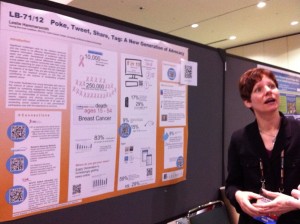
My selection for Poster of the Day is perhaps a little unusual.   In the patient advocacy session, Leslie Hammersmith’s stood out as a brilliant example of how to use social media really well at a scientific meeting.

What did I like about her approach?

1) She used Twitter to let people know she was presenting and drew attention to scientists like me to check out the poster (good marketing!).

2) The poster is simply and elegantly designed, making it easy to read for tired eyes, as mine were after a very long day.

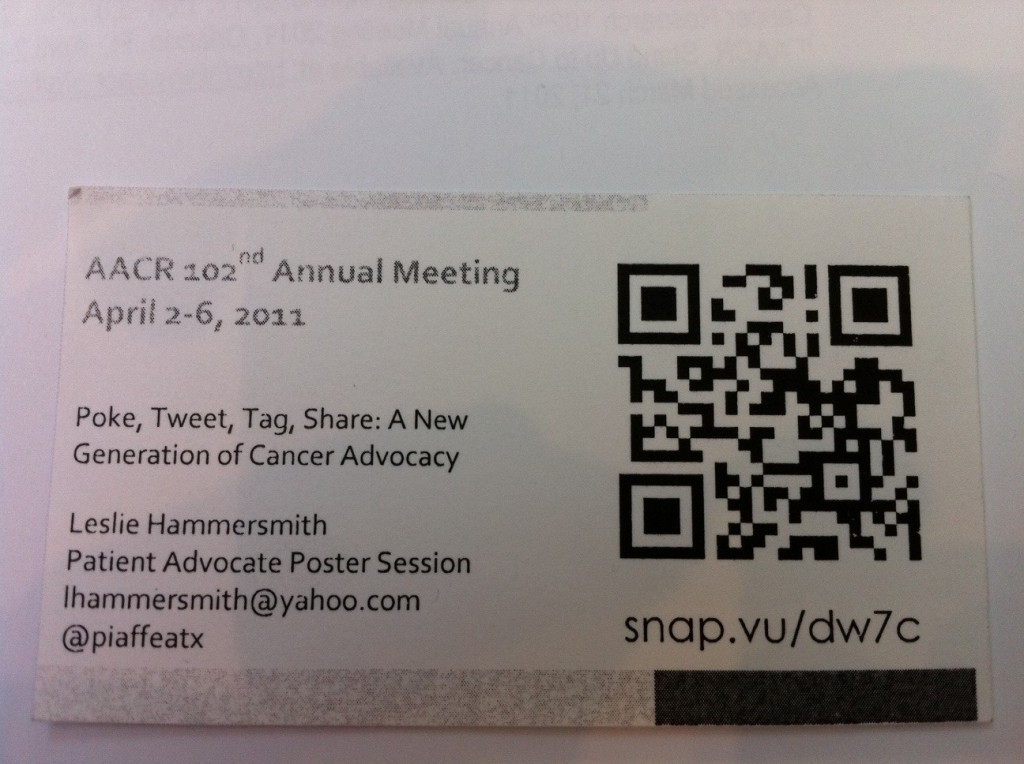
3) The use of QR codes for references and supporting materials as well as a card handed out to enable downloading of the poster via a QR code was novel and interesting.

4) Loved the title: “Poke, Tweet, Tag, Share: A new generation of Cancer Advocacy”

The clever use of QR codes made me want it on all the science posters too, both for easy downloads instead of handouts, and links to references.   In terms of innovation and creativity, this poster won hands down for me.  Nice job, Leslie!

For those of you hankering to see the poster yourselves, check out the card below using your QR reader and see for yourself:

1 Comment

At the recent American Association of Clinical Research special conference on the PI3K-mTOR pathway, it was very clear that this area of research is becoming a hot topic. At the annual meeting starting tomorrow, there are over 330 abstracts on PI3K alone – a huge increase over the last couple of years. This is one area where a systems biology approach to understanding the disease is bearing fruit.

We’ll be posting some highlights of each day during the meeting along with some video interviews with some experts on different topics.

In the meantime, we put together a short trailer for the AACR meeting – check it out:

http://www.youtube.com/watch?v=tubv0Mw4rgs

Way back in November 2009 at the American Association of Cancer Research (AACR) Molecular Targets meeting in Boston, there was a fascinating poster on the early promise for nanotechnology as a new form of efficient drug delivery for cancer therapeutics (see the blog post here).

Fast forward 18 months and my attention was drawn to a new article published in Cancer Research about how nanotechnology has been used preclinically to deliver therapy for breast cancer into the cancer cells rather than to the cells.  This is a subtle, but important, difference.

For those of your wondering what nanotechnology is, my colleague Pieter Droppert reviewed some basics earlier this month in a blog post:

“Nanotechnology is the application of science and engineering to materials that are between 1 and 100 nanometers (nm) in size.”

He went on to put this in layman terms:

“1nm is one-billionth of a meter.   To put this in context, 1nm is one seven-thousandth of the width of a red blood cell or one eighty-thousandth of the width of a human hair.  These are unimaginably small materials that are engineered to operate at the molecular and atomic level.”

The approach in the latest preclinical research (see references below) is to take trastuzumab (Herceptin) and combine it with biodegradable polymers to form nanoconjugates that are small enough to enter cancer cells because they are more water soluble rather than attack the outside of the cells, thereby potentially reducing toxicities associated with the therapy.

The same group also tried this technique with brain cancer (see references below), allowing the nanocells to cross the usually impenetratable blood-brain barrier, which:

“resulted in a marked inhibition of tumor angiogenesis and growth.”

In the breast cancer research, the group compared the results of their polymer-trastuzumab conjugate with trastuzumab alone in mice:

“Our experiments confirmed that a proper design of the lead nanobiopolymer was possible for efficient blocking of HER2/neu-positive breast tumor growth through dual inhibition of HER2/neu and Akt phosphorylation, and as a result, promoting enhanced tumor cell apoptosis.

The nanobiopolymer’s unique combination of features resulted in highly specific drug accumulation in the tumor tissue and inside tumor cells.”

It will be most interesting to see if this idea is developed clinically in human trials and whether the results will be reproducible or not.

Significance of the findings:

The nanoconjugate concept has promise, not just in allowing a novel drug delivery system to cross impenetrable barriers, but also in reducing the toxicities associated with systemic targeted therapy.  Randomised clinical trials in patients with cancer are required to determine if there is viability in humans.

References:

ResearchBlogging.orgInoue, S., Ding, H., Portilla-Arias, J., Hu, J., Konda, B., Fujita, M., Espinoza, A., Suhane, S., Riley, M., Gates, M., Patil, R., Penichet, M., Ljubimov, A., Black, K., Holler, E., & Ljubimova, J. (2011). Polymalic Acid-Based Nanobiopolymer Provides Efficient Systemic Breast Cancer Treatment by Inhibiting both HER2/neu Receptor Synthesis and Activity Cancer Research, 71 (4), 1454-1464 DOI: 10.1158/0008-5472.CAN-10-3093

Ljubimova, J., Fujita, M., Ljubimov, A., Torchilin, V., Black, K., & Holler, E. (2008). Poly(malic acid) nanoconjugates containing various antibodies and oligonucleotides for multitargeting drug delivery Nanomedicine, 3 (2), 247-265 DOI: 10.2217/17435889.3.2.247

Ding, H., Inoue, S., Ljubimov, A., Patil, R., Portilla-Arias, J., Hu, J., Konda, B., Wawrowsky, K., Fujita, M., Karabalin, N., Sasaki, T., Black, K., Holler, E., & Ljubimova, J. (2010). Inhibition of brain tumor growth by intravenous poly( -L-malic acid) nanobioconjugate with pH-dependent drug release Proceedings of the National Academy of Sciences, 107 (42), 18143-18148 DOI: 10.1073/pnas.1003919107

4 Comments

Many regular readers will remember the interview with Dr Sue Desmond-Hellmann, the Chancellor of UCSF, on the I-SPY2 trial, a large neoadjuvant study that seeks to accelerate the pace of identifying effective novel agents for early breast cancer by incorporating biomarkers from the beginning and an adaptive conjoint design. Biomarkers is definitely something that is very much to the fore these days.

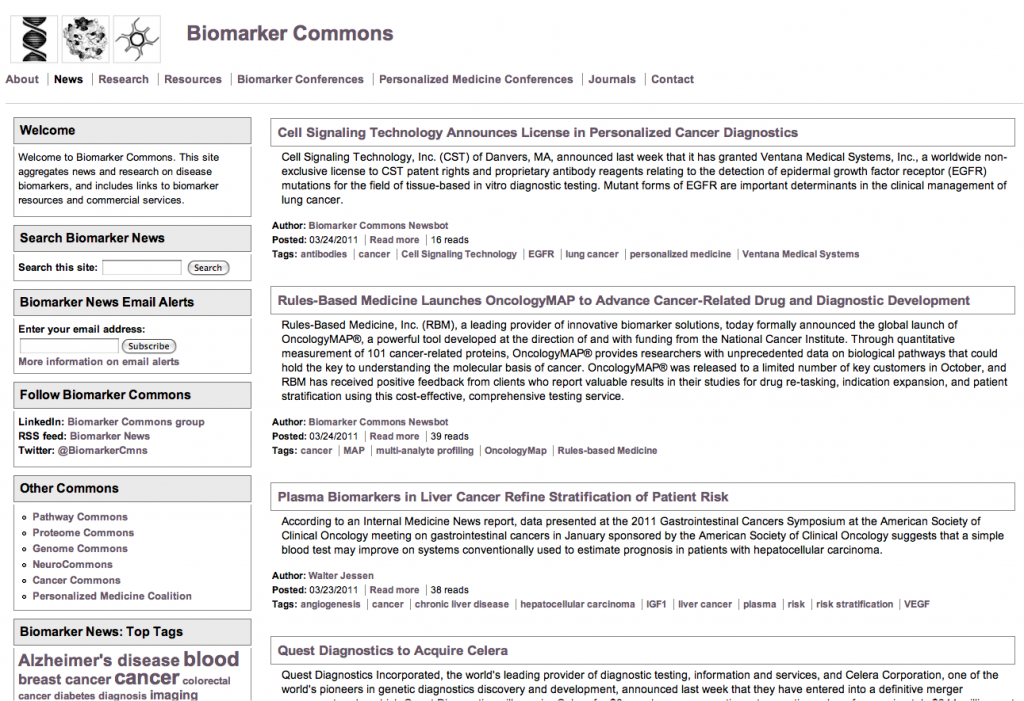
A great resource for scientists involved with research in the biomarker field is Biomarker Commons, curated by my friend Walter Jessen, who describes himself as,

“a computational biologist focused on biomarker discovery and prioritization”

Now that sounds like a fun job to me!

Walter has put a very nice site together in his spare time (he also runs Highlight Health a site dedicated to biomedical research as well as having a day job).  Biomarker Commons collates news, research and journal articles about biomarkers – it’s well worth checking out of you are interested in this field:

Biomarker Commons

I subscribe to the RSS feed for news items myself and find it very useful indeed, as well as loving the clean easy to use interface.

Another useful resource is the Biomarkers Consortium, which describes itself as:

“The Biomarkers Consortium is a major public-private biomedical research partnership managed by the Foundation for the National Institutes of Health with broad participation from stakeholders across the health field, including government, industry, academia and patient advocacy and other non-profit private sector organizations.

In addition to the Foundation for NIH, founding members include the National Institutes of Health, Food and Drug Administration and the Pharmaceutical Research and Manufacturers of America.”

The link above takes you to their active projects, which includes ISPY2, but if you are involved in cancer research, they welcome new project ideas and submissions too.

Related to biomarkers is companion diagnostics and this is something big Pharma and Biotech are both active in.  At least in high tech areas such as oncology.  As we identify and validate more biomarkers associated with disease, so the need for tests to measure them will increase.

In the long run, insurers in the US will also be happier because biomarkers will ultimately lead to fewer patients being treated with higher priced new therapeutics ie those most likely to benefit, rather than exposing thousands of patients to the systemic effects of a targeted therapy.

What was interesting though, was learning at European Association Urology meeting that in Germany, for example, bone mineral density measurements using DXA are not covered and patients must pay for them out of pocket.  These measurements are often required to determine the degree of bone loss.  For therapies that treat cancer-associated bone loss such as zoledronic acid (Zometa), which is currently approved and denosumab (Xgeva), which is pending approval in Europe, this may limit uptake of the drug.

This weekend I will be attending the annual American American of Cancer Research (AACR) meeting in Orlando and look forward to catching up on the various new developments not just in basic research, but also biomarkers and companion diagnostics. It promises to be an interesting meeting!


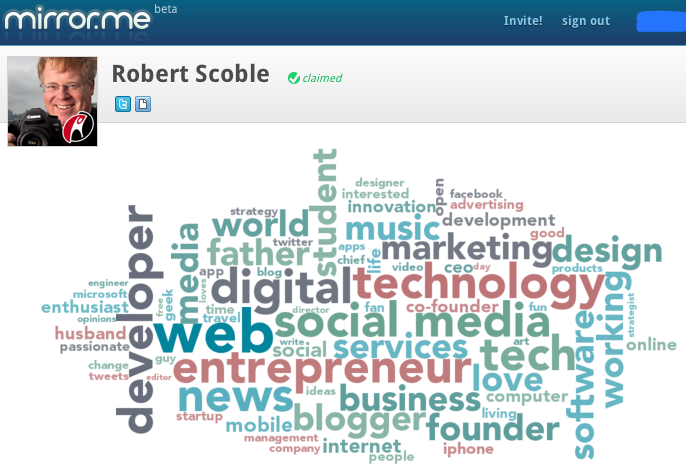
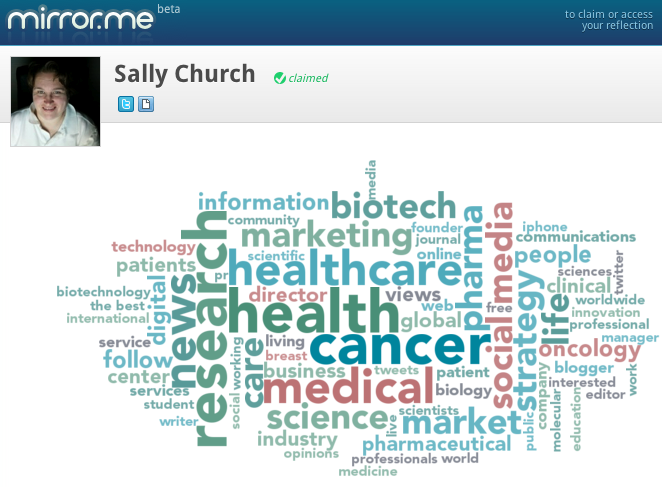
Some light hearted amusement for today is in order after the levity and gravity of the weekend.   One of my favourite Twitter buddies, Robert Scoble (@scobleizer) the tech geek, is always sharing cool stuff for people to try.  I noticed he posted a link to a new social media beta service, mirror.me, which creates a tag cloud of a user’s tweets.

Robert’s tag cloud looks like this, for example:

To create your tag cloud, simply go to mirror.me and authenticate the service using your Twitter username and password.  It then creates the graphic automatically, with the most commonly used words in a bigger font size.

Here’s my tag cloud as another example:

As other people join, it will also show your Twitter connections with their avatar (photo) and their tag clouds as they are created.  Very useful tool for seeing what people’s interests are and, presumably, something that will change organically if your tweets vary over time.

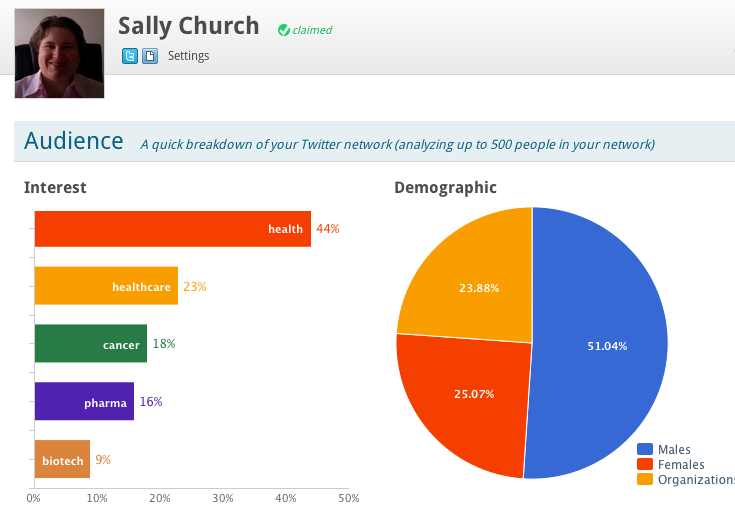
The tool will also show you some basic metrics, such as information about your followers and what their interests are based on their Twitter bio tags.  I was guessing that most of mine would come from the healthcare space:

Mirror.me metrics

Your results may vary depending upon your interests and followers.

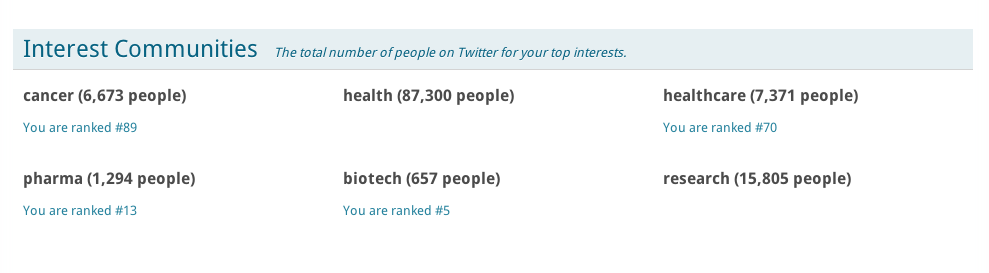
There are other metrics you can look at as well, such as rankings within your interests, but I’m not sure how this works yet:

mirror.me rankings

This feature is a little weird – some famous biotech companies are ranked lower than me and a bot tweeting people’s resumes is at the top of the biotech category, for example! That certainly gave me a smile for the morning 🙂

The good news is that mirror.me tweeted that they will be adding more features over time, so it should be a useful feature to follow and explore.


1 Comment

“How the mighty have fallen so quickly.  England were national heroes after winning the Ashes.  Now they are national chumps after this shocking and embarrassing defeat.”

Geoffrey Boycott, on England’s surprise defeat by Ireland in Cricket World Cup.

England v Ireland in the Cricket World Cup

England v Ireland in the Cricket World Cup

Some of you readers will be aware that I’m a big sports fan, of cricket and football in particular, so my cheerful mood earlier this morning was somewhat muted after learning that the motherland, England, somehow managed to lose to lowly Ireland.  In cricket!

Ugh, such is life – all good Englishmen will no doubt down another pint and shake their head in sorrow.

Still, that metaphor got me thinking.  In sports, there’s always another game, another tournament, another year – life goes on regardless.  While I was growing up, the mighty West Indies were at the height of their scintillating dynasty.  Now?  Not so much. Yesterday’s champs are tomorrow’s chumps and vice versa.  In clinical R&D though, if a major trial flops or is negative, it is rare that a company will go back and reconsider another series of trials with the agent in the same tumour type, even if the trial design was flawed, unless they have others already ongoing or in very late stages of planning.

You get one shot to get right.  Maybe two, if you are lucky.

Moving forwards, the incredibly high rate and cost of failures is unsustainable.  In the oncology arena, I think we will see the smart companies get smarter about drug development.  What does this mean in practice?

  1. More exploratory, smaller, phase II trials
  2. Focus on pathways and related activities as targets
  3. Increased use of translational research in 1) to determine mechanisms of resistance, adaptive pathways, biomarkers, logical combinations
  4. Greater use of the adaptive trial design to find the best winning combinations
  5. Increased use of diagnostics and biomarkers to select more clearly defined patient populations (ie smaller subgroups)

These trends are slowly happening now, you can see it more clearly in some pathways such as PI3K-mTOR, for example.  The days of taking a targeted therapy and adding it to standard of care chemotherapy in an unselected population, as happened with iniparib in triple negative breast cancer, are unlikely to be the future of cancer research.

What the more intense integration and iteration of basic research and phase II trials will give us is perhaps, a slightly slower development process, but with a much higher chance of success. In my book, that’s a much better approach – cancer patients deserve the best shot we can give them.

Photo Credit: ICC World Cup

Aside: For those wondering, my pre tournament tip was that India would be very strong contenders for this year’s World Cup, if only their bowling manages to get organised. Their batting strength is second to none, but Pakistan have a good chance if the Indian bowling shows any chinks and cracks.  Cricket is a team game, after all.  England regrouped and recovered to beat the strong Springboks from South Africa, so all is not lost yet!  Anybody but the Aussies, that’s all that matters 😉

1 Comment
error: Content is protected !!